A French Word to Live By
How to Conjugate Cacarder in French
/ka.kaʁ.de/
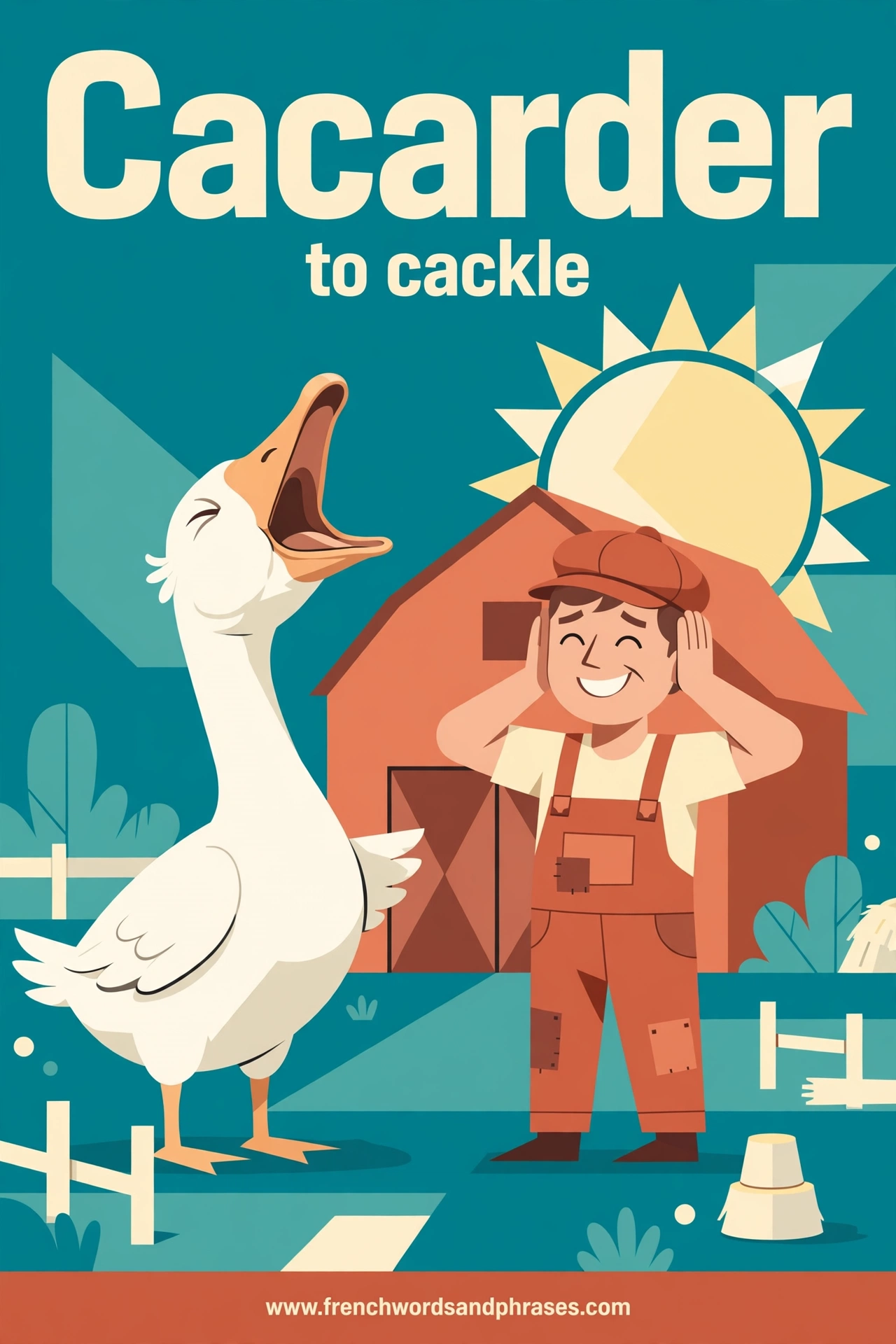
Cacarder means to cackle, to gabble — the goose’s harsh honking chatter, and, by a fond extension, the noisy gabbling of people who all talk at once.
A farmyard full of geese greeting a stranger, a café table where six friends all talk at the same time — cacarder is the verb of cheerful harsh noise: the goose’s cackle, borrowed for human gabble.
In this guide, you’ll learn how to conjugate cacarder in all the major French tenses and moods. Explore complete conjugation tables, French examples, English translations, and practice quizzes.
Understanding the French Verb Cacarder
Cacarder is a regular French verb belonging to the first group of verbs, those ending in-er.
It means to cackle, to gabble. Literally, it is the goose’s cry — loud, repeated and impossible to ignore, the original farmyard alarm. Figuratively, it describes noisy, confused group chatter where nobody is really listening: journalists write of assemblies and studios that cacardent, always with a smile and a comparison to the farmyard never far away.
Verb classification: First group (-er)
Auxiliary verb: Avoir
Past participle: cacardé
Present participle: cacardant
English equivalents: To cackle, to gabble (of geese, then of people); les oies cacardent — the geese are cackling; cacarder comme des oies — to gabble like geese; un groupe qui cacarde — a group chattering noisily; cessez de cacarder ! — stop gabbling!
One important detail: cacarder is another sound-word — ca-car-der imitates the goose’s repeated honk, and French, which loves its bird-verbs, extends it cheerfully to people: a market stall, a schoolyard or a family lunch can cacarder when every voice talks over the others. The verb is perfectly regular: les oies cacardent, nous cacardons, past participle cacardé. Do not confuse it with its near neighbour cacaber, the partridge’s quieter rattle.
Experience the Word
Cacarder is the verb of the joyful din — many harsh voices, all at once, none of them listening.
Imagine a farmyard in Normandy when the postman arrives. Thirty geese rise as one body, necks out, and the whole yard explodes — elles cacardent si fort que le facteur recule jusqu’à son vélo, laughing, while the farmer shouts over the noise that they do this to everyone.
No danger, no message — just noise for its own sake. The geese have cackled — cacardé — because cackling is what a farmyard does best.
How to Conjugate Cacarder: Complete French Conjugation Guide
Let’s explore every major conjugation of cacarder, beginning with the indicative mood.
How to Conjugate Cacarder in the Indicative Mood
The indicative mood is used to express facts, observations, actions, and events.
How to Conjugate Cacarder in the Present Tense (Présent)
Used for actions happening now, habitual actions, and general truths.
| Subject | Conjugation |
|---|---|
| je | cacarde |
| tu | cacardes |
| il / elle | cacarde |
| nous | cacardons |
| vous | cacardez |
| ils / elles | cacardent |
Example
Les oies cacardent dès qu’un étranger approche.
The geese cackle as soon as a stranger approaches.
Quick Quiz 1
Complete the sentence:
Nous ______ comme des oies quand nous retrouvons nos amis.
Reveal the answer
cacardons
Nous cacardons comme des oies quand nous retrouvons nos amis.
We gabble like geese when we meet our friends.
How to Conjugate Cacarder in the Passé Composé
Used for completed actions in the past. Cacarder takes the auxiliary verb avoir.
| Subject | Conjugation |
|---|---|
| j’ | ai cacardé |
| tu | as cacardé |
| il / elle | a cacardé |
| nous | avons cacardé |
| vous | avez cacardé |
| ils / elles | ont cacardé |
Example
Les oies ont cacardé toute la matinée.
The geese cackled all morning.
How to Conjugate Cacarder in the Imparfait (Imperfect Tense)
Used for habitual past actions, descriptions, and ongoing situations in the past.
| Subject | Conjugation |
|---|---|
| je | cacardais |
| tu | cacardais |
| il / elle | cacardait |
| nous | cacardions |
| vous | cacardiez |
| ils / elles | cacardaient |
Example
Dans cette ferme, les oies cacardaient à chaque visite.
On that farm, the geese used to cackle at every visit.
Quick Quiz 2
Choose the correct form:
The geese cackled all morning.
Les oies ______ toute la matinée. (ont cacardé / sont cacardées)
Reveal the answer
ont cacardé
Les oies ont cacardé toute la matinée.
Cacarder takes avoir.
How to Conjugate Cacarder in the Plus-que-parfait
Used to describe an action that had already been completed before another past event.
| Subject | Conjugation |
|---|---|
| j’ | avais cacardé |
| tu | avais cacardé |
| il / elle | avait cacardé |
| nous | avions cacardé |
| vous | aviez cacardé |
| ils / elles | avaient cacardé |
Example
Elles avaient cacardé bien avant l’arrivée du facteur.
They had cackled well before the postman arrived.
How to Conjugate Cacarder in the Passé Simple
Primarily used in formal writing, literature, and historical narratives. It is rarely used in everyday conversation.
| Subject | Conjugation |
|---|---|
| je | cacardai |
| tu | cacardas |
| il / elle | cacarda |
| nous | cacardâmes |
| vous | cacardâtes |
| ils / elles | cacardèrent |
Example
Les oies cacardèrent si fort que tout le village les entendit.
The geese cackled so loudly that the whole village heard them.
How to Conjugate Cacarder in the Passé Antérieur
A literary tense used to express an action completed immediately before another past action, generally in the passé simple.
| Subject | Conjugation |
|---|---|
| j’ | eus cacardé |
| tu | eus cacardé |
| il / elle | eut cacardé |
| nous | eûmes cacardé |
| vous | eûtes cacardé |
| ils / elles | eurent cacardé |
Example
Quand les oies eurent cacardé assez longtemps, elles se calmèrent enfin.
When the geese had cackled long enough, they finally calmed down.
How to Conjugate Cacarder in the Future Tense (Futur Simple)
Used to describe actions that will take place in the future.
| Subject | Conjugation |
|---|---|
| je | cacarderai |
| tu | cacarderas |
| il / elle | cacardera |
| nous | cacarderons |
| vous | cacarderez |
| ils / elles | cacarderont |
Example
Demain, les oies cacarderont encore à ton arrivée.
Tomorrow, the geese will cackle again when you arrive.
How to Conjugate Cacarder in the Futur Antérieur (Future Perfect)
Used for an action that will have been completed before a particular point in the future.
| Subject | Conjugation |
|---|---|
| j’ | aurai cacardé |
| tu | auras cacardé |
| il / elle | aura cacardé |
| nous | aurons cacardé |
| vous | aurez cacardé |
| ils / elles | auront cacardé |
Example
À midi, les oies auront cacardé pendant trois heures.
By midday, the geese will have cackled for three hours.
How to Conjugate Cacarder in the Near Future (Futur Proche)
Used to describe something that is going to happen soon. Formed with aller + infinitive.
| Subject | Conjugation |
|---|---|
| je | vais cacarder |
| tu | vas cacarder |
| il / elle | va cacarder |
| nous | allons cacarder |
| vous | allez cacarder |
| ils / elles | vont cacarder |
Example
Attention, les oies vont cacarder si tu approches.
Careful, the geese are going to cackle if you come closer.
How to Conjugate Cacarder in the Conditional Mood
The conditional mood expresses what would happen under certain circumstances. It is also frequently used to make polite requests or express wishes.
How to Conjugate Cacarder in the Present Conditional
| Subject | Conjugation |
|---|---|
| je | cacarderais |
| tu | cacarderais |
| il / elle | cacarderait |
| nous | cacarderions |
| vous | cacarderiez |
| ils / elles | cacarderaient |
Example
Si le facteur revenait, les oies cacarderaient encore plus fort.
If the postman came back, the geese would cackle even louder.
How to Conjugate Cacarder in the Past Conditional
| Subject | Conjugation |
|---|---|
| j’ | aurais cacardé |
| tu | aurais cacardé |
| il / elle | aurait cacardé |
| nous | aurions cacardé |
| vous | auriez cacardé |
| ils / elles | auraient cacardé |
Example
Les oies auraient cacardé davantage avec plus de visiteurs.
The geese would have cackled more with more visitors.
Cacarder in the Literary Past Conditional Form
This less common literary form uses the imperfect subjunctive of avoir.
| Subject | Conjugation |
|---|---|
| j’ | eusse cacardé |
| tu | eusses cacardé |
| il / elle | eût cacardé |
| nous | eussions cacardé |
| vous | eussiez cacardé |
| ils / elles | eussent cacardé |
Example
Les oies eussent cacardé jusqu’au soir.
The geese would have cackled until evening.
How to Conjugate Cacarder in the Subjunctive Mood
The subjunctive is used to express wishes, emotions, doubts, necessity, and uncertainty. It frequently follows expressions such as il faut que (it is necessary that) or bien que (although).
How to Conjugate Cacarder in the Present Subjunctive
| Subject | Conjugation |
|---|---|
| que je | cacarde |
| que tu | cacardes |
| qu’il / qu’elle | cacarde |
| que nous | cacardions |
| que vous | cacardiez |
| qu’ils / qu’elles | cacardent |
Example
Il est impossible que les oies cacardent sans raison.
It is impossible for the geese to cackle without a reason.
Quick Quiz 3
Complete the sentence using the subjunctive:
Il est impossible que les oies ______ sans raison.
Reveal the answer
cacardent
Il est impossible que les oies cacardent sans raison.
It is impossible for the geese to cackle without a reason.
How to Conjugate Cacarder in the Imperfect Subjunctive
A literary tense, rarely encountered in modern spoken French.
| Subject | Conjugation |
|---|---|
| que je | cacardasse |
| que tu | cacardasses |
| qu’il / qu’elle | cacardât |
| que nous | cacardassions |
| que vous | cacardassiez |
| qu’ils / qu’elles | cacardassent |
Example
On riait, bien que les oies cacardassent sans arrêt.
People laughed, although the geese cackled non-stop.
How to Conjugate Cacarder in the Pluperfect Subjunctive
A literary construction used to express an action completed before another past action.
| Subject | Conjugation |
|---|---|
| que j’ | eusse cacardé |
| que tu | eusses cacardé |
| qu’il / qu’elle | eût cacardé |
| que nous | eussions cacardé |
| que vous | eussiez cacardé |
| qu’ils / qu’elles | eussent cacardé |
Example
On racontait que les oies eussent cacardé toute la nuit.
People said the geese had cackled all night.
How to Conjugate Cacarder in the Past Subjunctive
| Subject | Conjugation |
|---|---|
| que j’ | aie cacardé |
| que tu | aies cacardé |
| qu’il / qu’elle | ait cacardé |
| que nous | ayons cacardé |
| que vous | ayez cacardé |
| qu’ils / qu’elles | aient cacardé |
Example
Je suis étonné que les oies aient cacardé si longtemps.
I am amazed the geese cackled for so long.
How to Conjugate Cacarder in the Imperative
The imperative is used to give commands, instructions, invitations, or suggestions. Subject pronouns are omitted.
How to Conjugate Cacarder in the Present Imperative
| Person | Conjugation |
|---|---|
| (tu) | cacarde |
| (nous) | cacardons |
| (vous) | cacardez |
Example
Ne cacardez pas tous en même temps, écoutez-vous !
Do not all gabble at the same time, listen to each other!
Quick Quiz 4
How would you say Do not all gabble at the same time (vous form)?
Reveal the answer
Ne cacardez pas tous en même temps !
French Participles of Cacarder
Participles are verb forms that can be used in compound tenses and other grammatical constructions.
Present Participle of Cacarder
cacardant
En cacardant, les oies ont réveillé tout le hameau.
By cackling, the geese woke the whole hamlet.
Past Participle of Cacarder
cacardé
Cacardé par trente oies à la fois, le bonjour du facteur s’est perdu dans le bruit.
Cackled at by thirty geese at once, the postman’s greeting was lost in the noise.
Cacarder in Everyday French: Real-Life Examples
Now that you know the conjugations, let’s see how cacarder appears in everyday French.
Example 1 — Present
Les oies cacardent à chaque visite.
The geese cackle at every visit.
Example 2 — Passé composé
Les oies ont cacardé toute la matinée.
The geese cackled all morning.
Example 3 — Imparfait
Les oies cacardaient sans arrêt autrefois.
The geese used to cackle non-stop in the old days.
Example 4 — Future
Les oies cacarderont à ton arrivée.
The geese will cackle when you arrive.
Example 5 — Conditional
Les oies cacarderaient encore plus fort.
The geese would cackle even louder.
Example 6 — Imperative
Ne cacardez pas tous ensemble !
Do not all gabble together!
Beyond Translation: The Meaning of Cacarder
English cackle belongs to hens and witches; French cacarder belongs to geese — louder, prouder, and funnier.
And French people cacardent too.
The figurative use is the verb’s second life: any group where everyone talks at once and nobody listens is cacardant — the farmyard’s revenge on the debating chamber.
How to Remember the French Verb Cacarder
Remember it this way: Cacarder is about thirty geese exploding into noise as the postman reaches the gate.
- The goose’s verb: les oies cacardent — loud, repeated, impossible to ignore.
- People cacardent too, when everyone gabbles at once and nobody listens.
- Regular -er: nous cacardons, ils cacardent, past participle cacardé.
The key idea is thirty geese exploding into noise as the postman reaches the gate.
Test Your Knowledge of Cacarder
Let’s see how much you’ve learned. Try answering these questions before revealing the answers.
Question 1
Which bird cackles with cacarder?
Reveal the answer
The goose — les oies cacardent, the farmyard’s loudest voice.
Question 2
How do you say The geese cackle as soon as a stranger approaches in French?
Reveal the answer
Les oies cacardent dès qu’un étranger approche.
Question 3
Translate: The geese cackled all morning.
Reveal the answer
Les oies ont cacardé toute la matinée.
Question 4
What is the past participle of cacarder?
Reveal the answer
Cacardé.
Question 5
Complete the sentence:
On riait, bien que les oies ______ sans arrêt.
Reveal the answer
cacardassent
On riait, bien que les oies cacardassent sans arrêt.
People laughed, although the geese cackled non-stop.
Your Final Challenge
Can You Use It?
How would you say this in French?
When the postman arrives, the geese cackle so loudly that the whole hamlet knows the time of the post.
Reveal the answer
Quand le facteur arrive, les oies cacardent si fort que tout le hameau connaît l’heure du courrier.
When the postman arrives, the geese cackle so loudly that the whole hamlet knows the time of the post.
A little French. A little curiosity. A richer everyday life.
LEARN FRENCH ONE WORD AT A TIME