A French Word to Live By
How to Conjugate Blémir in French
/ble.miʁ/
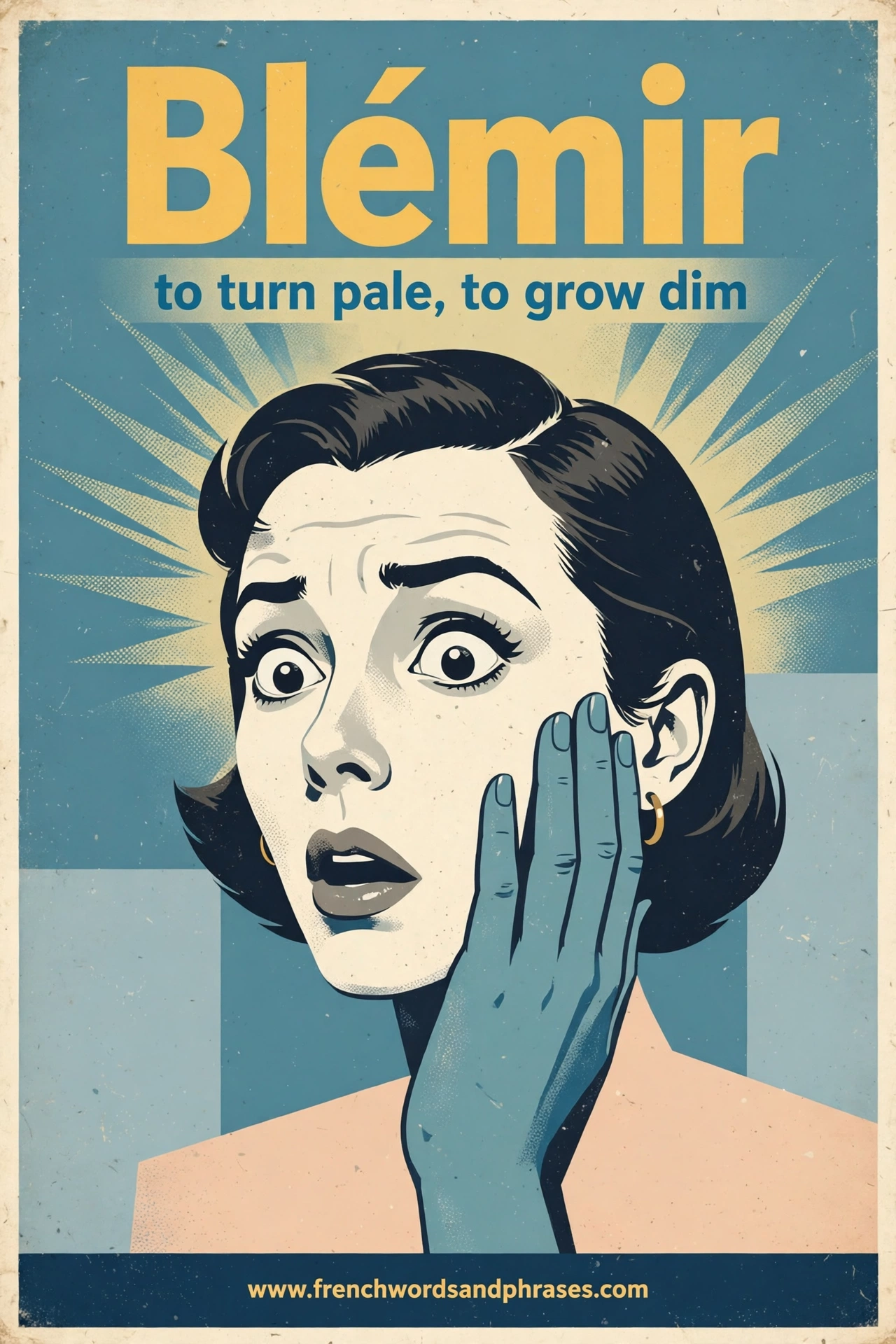
Blémir means to turn pale, to grow dim — for colour to drain slowly from a face, a light or a sky.
A face losing its colour at bad news, the last light of the day fading over the fields, a lamp dimming in the fog — blémir is the verb of colour leaving: slowly, visibly, and usually because something has gone wrong.
In this guide, you’ll learn how to conjugate blémir in all the major French tenses and moods. Explore complete conjugation tables, French examples, English translations, and practice quizzes.
Understanding the French Verb Blémir
Blémir is a regular French verb belonging to the second group of verbs, those ending in -ir.
It means to turn pale, to grow dim. It is used of people whose faces lose colour through fear, illness, shock or exhaustion, and of lights, skies and colours that grow dim and wan. In literature it is the classic verb of the heroine hearing terrible news: elle blémit, and the reader knows everything.
Verb classification: Second group (-ir)
Auxiliary verb: Avoir
Past participle: blémi
Present participle: blémissant
English equivalents: To turn pale, to grow pale, to blanch; blémir de peur — to turn pale with fear; blémir à une nouvelle — to go pale at a piece of news; la lumière blémit — the light grows dim; un teint qui blémit — a complexion that is paling.
One important detail: blémir is a regular second-group verb in -ir, built like finir: je blémis, tu blémis, il blémit, nous blémissons, vous blémissez, ils blémissent, with the tell-tale -iss- in the plural, the imperfect and the present participle blémissant. Do not confuse it with blêmir spelled with a circumflex in older texts — modern spelling keeps the acute accent, blémir. And note what blémir describes: a gradual draining of colour, not the sudden shock of pâlir in a single instant — though the two are close cousins and often interchangeable.
Experience the Word
Blémir is the verb of colour in retreat — watch a face, a lamp or a sky, and you can see it happening minute by minute.
Imagine a waiting room at the hospital. A woman sits with a letter she has not yet opened; the doctor calls her name, she stands, and before she has taken two steps her face blémit — the nurse sees it at once and comes to take her arm.
Nothing has been said yet. She has simply paled — blémi — and everyone in the room understands.
How to Conjugate Blémir: Complete French Conjugation Guide
Let’s explore every major conjugation of blémir, beginning with the indicative mood.
How to Conjugate Blémir in the Indicative Mood
The indicative mood is used to express facts, observations, actions, and events.
How to Conjugate Blémir in the Present Tense (Présent)
Used for actions happening now, habitual actions, and general truths.
| Subject | Conjugation |
|---|---|
| je | blémis |
| tu | blémis |
| il / elle | blémit |
| nous | blémissons |
| vous | blémissez |
| ils / elles | blémissent |
Example
Elle blémit chaque fois qu’on parle de l’accident.
She turns pale every time someone mentions the accident.
Quick Quiz 1
Complete the sentence:
Nous ______ à vue d’œil après ces semaines sans soleil.
Reveal the answer
blémissons
Nous blémissons à vue d’œil après ces semaines sans soleil.
We are turning visibly pale after these weeks without sun.
How to Conjugate Blémir in the Passé Composé
Used for completed actions in the past. Blémir takes the auxiliary verb avoir.
| Subject | Conjugation |
|---|---|
| j’ | ai blémi |
| tu | as blémi |
| il / elle | a blémi |
| nous | avons blémi |
| vous | avez blémi |
| ils / elles | ont blémi |
Example
Il a blémi en lisant la lettre du médecin.
He turned pale reading the doctor’s letter.
How to Conjugate Blémir in the Imparfait (Imperfect Tense)
Used for habitual past actions, descriptions, and ongoing situations in the past.
| Subject | Conjugation |
|---|---|
| je | blémissais |
| tu | blémissais |
| il / elle | blémissait |
| nous | blémissions |
| vous | blémissiez |
| ils / elles | blémissaient |
Example
Son visage blémissait à vue d’œil pendant la maladie.
His face was growing visibly paler during the illness.
Quick Quiz 2
Choose the correct form:
He turned pale reading the letter.
Il ______ en lisant la lettre. (a blémi / est blémi)
Reveal the answer
a blémi
Il a blémi en lisant la lettre.
Blémir takes avoir.
How to Conjugate Blémir in the Plus-que-parfait
Used to describe an action that had already been completed before another past event.
| Subject | Conjugation |
|---|---|
| j’ | avais blémi |
| tu | avais blémi |
| il / elle | avait blémi |
| nous | avions blémi |
| vous | aviez blémi |
| ils / elles | avaient blémi |
Example
Elle avait blémi bien avant d’entendre la nouvelle.
She had turned pale well before hearing the news.
How to Conjugate Blémir in the Passé Simple
Primarily used in formal writing, literature, and historical narratives. It is rarely used in everyday conversation.
| Subject | Conjugation |
|---|---|
| je | blémis |
| tu | blémis |
| il / elle | blémit |
| nous | blémîmes |
| vous | blémîtes |
| ils / elles | blémirent |
Example
Le ciel blémit peu à peu avant l’orage.
The sky grew dim little by little before the storm.
How to Conjugate Blémir in the Passé Antérieur
A literary tense used to express an action completed immediately before another past action, generally in the passé simple.
| Subject | Conjugation |
|---|---|
| j’ | eus blémi |
| tu | eus blémi |
| il / elle | eut blémi |
| nous | eûmes blémi |
| vous | eûtes blémi |
| ils / elles | eurent blémi |
Example
Quand elle eut blémi, on comprit la gravité de la nouvelle.
When she had turned pale, they understood how serious the news was.
How to Conjugate Blémir in the Future Tense (Futur Simple)
Used to describe actions that will take place in the future.
| Subject | Conjugation |
|---|---|
| je | blémirai |
| tu | blémiras |
| il / elle | blémira |
| nous | blémirons |
| vous | blémirez |
| ils / elles | blémiront |
Example
Tu blémiras quand tu verras la facture.
You will turn pale when you see the bill.
How to Conjugate Blémir in the Futur Antérieur (Future Perfect)
Used for an action that will have been completed before a particular point in the future.
| Subject | Conjugation |
|---|---|
| j’ | aurai blémi |
| tu | auras blémi |
| il / elle | aura blémi |
| nous | aurons blémi |
| vous | aurez blémi |
| ils / elles | auront blémi |
Example
À la fin de l’hiver, son teint aura blémi faute de soleil.
By the end of winter, her complexion will have grown pale for lack of sun.
How to Conjugate Blémir in the Near Future (Futur Proche)
Used to describe something that is going to happen soon. Formed with aller + infinitive.
| Subject | Conjugation |
|---|---|
| je | vais blémir |
| tu | vas blémir |
| il / elle | va blémir |
| nous | allons blémir |
| vous | allez blémir |
| ils / elles | vont blémir |
Example
Regarde-la, elle va blémir.
Look at her, she is going to turn pale.
How to Conjugate Blémir in the Conditional Mood
The conditional mood expresses what would happen under certain circumstances. It is also frequently used to make polite requests or express wishes.
How to Conjugate Blémir in the Present Conditional
| Subject | Conjugation |
|---|---|
| je | blémirais |
| tu | blémirais |
| il / elle | blémirait |
| nous | blémirions |
| vous | blémiriez |
| ils / elles | blémiraient |
Example
Sans maquillage, elle blémirait sur la photo.
Without make-up, she would look pale in the photo.
How to Conjugate Blémir in the Past Conditional
| Subject | Conjugation |
|---|---|
| j’ | aurais blémi |
| tu | aurais blémi |
| il / elle | aurait blémi |
| nous | aurions blémi |
| vous | auriez blémi |
| ils / elles | auraient blémi |
Example
Il aurait blémi s’il avait entendu ces mots.
He would have turned pale if he had heard those words.
Blémir in the Literary Past Conditional Form
This less common literary form uses the imperfect subjunctive of avoir.
| Subject | Conjugation |
|---|---|
| j’ | eusse blémi |
| tu | eusses blémi |
| il / elle | eût blémi |
| nous | eussions blémi |
| vous | eussiez blémi |
| ils / elles | eussent blémi |
Example
Elle eût blémi à cette annonce, si elle l’avait apprise ainsi.
She would have turned pale at that announcement, had she learned it that way.
How to Conjugate Blémir in the Subjunctive Mood
The subjunctive is used to express wishes, emotions, doubts, necessity, and uncertainty. It frequently follows expressions such as il faut que (it is necessary that) or bien que (although).
How to Conjugate Blémir in the Present Subjunctive
| Subject | Conjugation |
|---|---|
| que je | blémisse |
| que tu | blémisses |
| qu’il / qu’elle | blémisse |
| que nous | blémissions |
| que vous | blémissiez |
| qu’ils / qu’elles | blémissent |
Example
Il est étrange qu’elle blémisse si vite.
It is strange that she turns pale so quickly.
Quick Quiz 3
Complete the sentence using the subjunctive:
Il est étrange que vous ______ si vite.
Reveal the answer
blémissiez
Il est étrange que vous blémissiez si vite.
It is strange that you turn pale so quickly.
How to Conjugate Blémir in the Imperfect Subjunctive
A literary tense, rarely encountered in modern spoken French.
| Subject | Conjugation |
|---|---|
| que je | blémisse |
| que tu | blémisses |
| qu’il / qu’elle | blémît |
| que nous | blémissions |
| que vous | blémissiez |
| qu’ils / qu’elles | blémissent |
Example
Je craignais qu’il blémît devant tout le monde.
I was afraid he might turn pale in front of everyone.
How to Conjugate Blémir in the Pluperfect Subjunctive
A literary construction used to express an action completed before another past action.
| Subject | Conjugation |
|---|---|
| que j’ | eusse blémi |
| que tu | eusses blémi |
| qu’il / qu’elle | eût blémi |
| que nous | eussions blémi |
| que vous | eussiez blémi |
| qu’ils / qu’elles | eussent blémi |
Example
On disait qu’elle eût blémi en apprenant la nouvelle.
People said she had turned pale on hearing the news.
How to Conjugate Blémir in the Past Subjunctive
| Subject | Conjugation |
|---|---|
| que j’ | aie blémi |
| que tu | aies blémi |
| qu’il / qu’elle | ait blémi |
| que nous | ayons blémi |
| que vous | ayez blémi |
| qu’ils / qu’elles | aient blémi |
Example
Je ne crois pas qu’il ait blémi exprès.
I do not think he turned pale on purpose.
How to Conjugate Blémir in the Imperative
The imperative is used to give commands, instructions, invitations, or suggestions. Subject pronouns are omitted.
How to Conjugate Blémir in the Present Imperative
| Person | Conjugation |
|---|---|
| (tu) | blémis |
| (nous) | blémissons |
| (vous) | blémissez |
Example
Ne blémis pas pour si peu, ce n’est rien !
Do not turn pale over so little, it is nothing!
Quick Quiz 4
How would you say Do not turn pale (tu form)?
Reveal the answer
Ne blémis pas !
French Participles of Blémir
Participles are verb forms that can be used in compound tenses and other grammatical constructions.
Present Participle of Blémir
blémissant
En blémissant, elle serra la main de sa sœur.
Turning pale, she gripped her sister’s hand.
Past Participle of Blémir
blémi
Blémi par la peur, il restait sans voix.
Grown pale with fear, he remained speechless.
Blémir in Everyday French: Real-Life Examples
Now that you know the conjugations, let’s see how blémir appears in everyday French.
Example 1 — Present
Elle blémit à l’annonce de la nouvelle.
She turns pale at the announcement of the news.
Example 2 — Passé composé
Il a blémi en ouvrant l’enveloppe.
He turned pale as he opened the envelope.
Example 3 — Imparfait
La lumière blémissait dans la brume du soir.
The light was growing dim in the evening mist.
Example 4 — Future
Tu blémiras en voyant le résultat.
You will turn pale when you see the result.
Example 5 — Conditional
Elle blémirait si elle savait la vérité.
She would turn pale if she knew the truth.
Example 6 — Imperative
Ne blémis pas, tout va bien se passer !
Do not turn pale, everything will be fine!
Beyond Translation: The Meaning of Blémir
English says to turn pale with two words and a colour change; French blémir packs the whole slow disaster into one verb, from an old Germanic word for pale, wan and livid.
It is a verb of slow motion.
One does not blémir in a flash — colour ebbs, light thins, a complexion fades. That is why novelists love it: elle blémit gives the reader three long seconds in which to dread what comes next.
How to Remember the French Verb Blémir
Remember it this way: Blémir is about the colour draining slowly from a face at bad news.
- Second group, like finir: nous blémissons, with the -iss- that gives it away.
- Not just faces: la lumière blémit — lights, skies and colours grow dim too.
- Regular -ir: je blémis, nous blémissons, past participle blémi.
The key idea is the colour draining slowly from a face at bad news.
Test Your Knowledge of Blémir
Let’s see how much you’ve learned. Try answering these questions before revealing the answers.
Question 1
Which group does blémir belong to, and what is the giveaway in its plural forms?
Reveal the answer
The second group (-ir) — the -iss- in nous blémissons, ils blémissent, like finir.
Question 2
How do you say She turned pale at the news in French?
Reveal the answer
Elle a blémi à la nouvelle.
Question 3
Translate: The light grows dim in the mist.
Reveal the answer
La lumière blémit dans la brume.
Question 4
What is the past participle of blémir?
Reveal the answer
Blémi.
Question 5
Complete the sentence:
Je craignais qu’il ______ devant tout le monde.
Reveal the answer
blémît
Je craignais qu’il blémît devant tout le monde.
I was afraid he might turn pale in front of everyone.
Your Final Challenge
Can You Use It?
How would you say this in French?
When the door opened, she turned pale, then she smiled: it was only the wind.
Reveal the answer
Quand la porte s’est ouverte, elle a blémi, puis elle a souri : ce n’était que le vent.
When the door opened, she turned pale, then she smiled: it was only the wind.
A little French. A little curiosity. A richer everyday life.
LEARN FRENCH ONE WORD AT A TIME