A French Word to Live By
How to Conjugate Blatérer in French
/bla.te.ʁe/
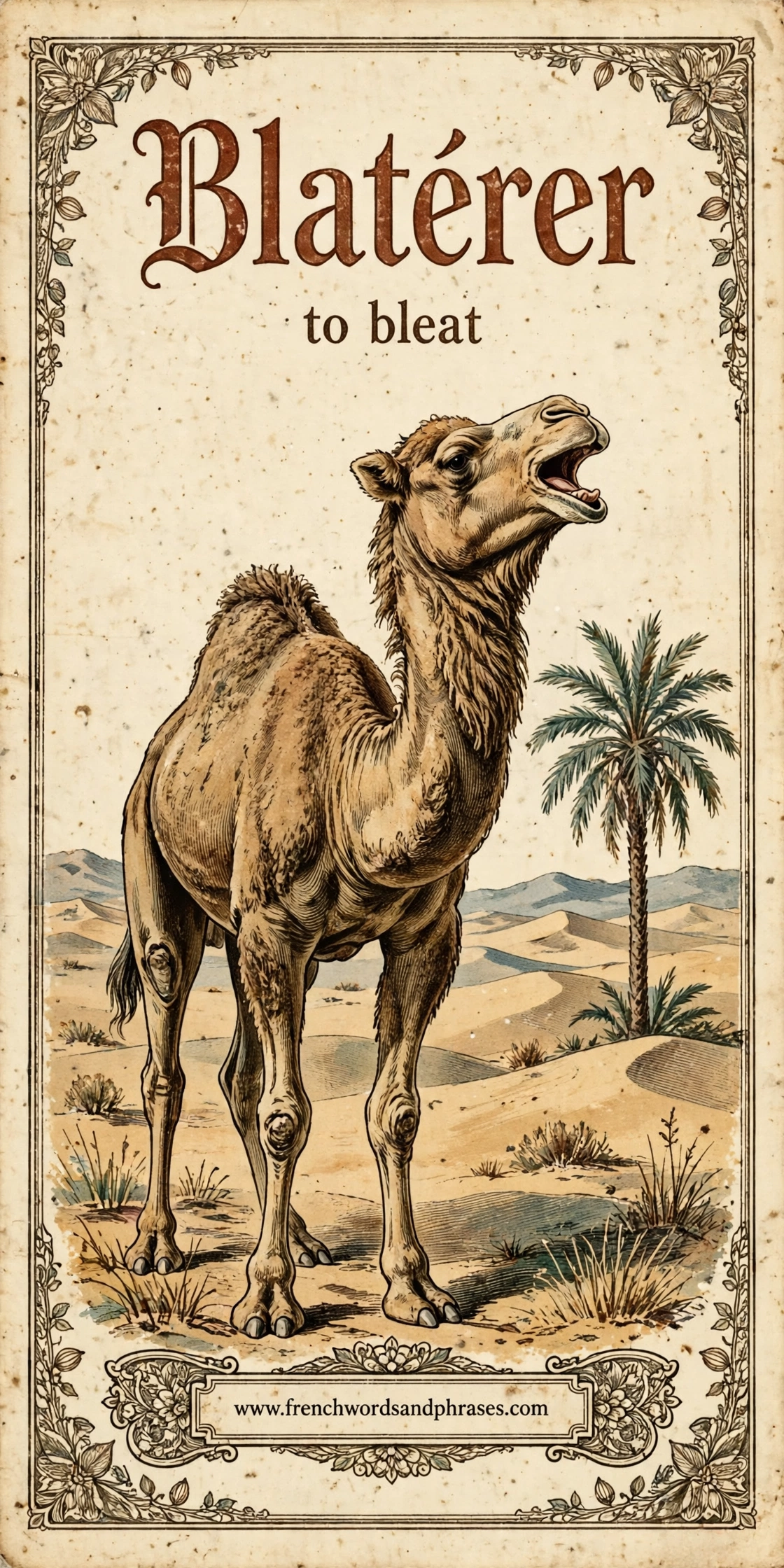
Blatérer means to bleat — to cry out the way a sheep, a goat or a camel does, in a trembling, complaining voice.
A ewe calling her lamb across the meadow, a goat protesting at the fence, a camel grumbling in the desert night — blatérer is the verb of the bleat: the wobbling, insistent cry of the flock animals, and the sound French reaches for when someone complains in the same reedy voice.
In this guide, you’ll learn how to conjugate blatérer in all the major French tenses and moods. Explore complete conjugation tables, French examples, English translations, and practice quizzes.
Understanding the French Verb Blatérer
Blatérer is a regular French verb belonging to the first group of verbs, those ending in -er.
It means to bleat. It belongs first to the farmyard and the desert: sheep, goats and camels blatèrent, each with its own cry. Applied to a person it is never kind — to say that someone blatère is to compare their complaints to the bleating of a sheep, all trembling protest and no argument.
Verb classification: First group (-er)
Auxiliary verb: Avoir
Past participle: blatéré
Present participle: blatérant
English equivalents: To bleat; le blatèrement du mouton — the bleating of the sheep; blatérer comme un mouton — to bleat like a sheep; le chameau blatère — the camel bleats (its rutting cry); blatérer de peur — to bleat with fear.
One important detail: blatérer is a céder-type verb — the é of the stem opens to è wherever the next syllable is mute: je blatère, tu blatères, il blatère, ils blatèrent, and all through the future and conditional: je blatèrerai, je blatèrerais. The é survives wherever the ending is sounded: nous blatérons, vous blatérez, je blatérais, en blatérant, and in the infinitive and the participle, blatérer, blatéré. The subjunctive splits along the same line: que je blatère, but que nous blatérions.
Experience the Word
Blatérer is the verb of the flock’s voice — a cry that wobbles, insists, and expects an answer.
Imagine a hillside farm at lambing time. A lamb has wandered behind the rocks and starts to cry; the ewe answers from the meadow, the rest of the flock joins in, and soon the whole hillside blatère — a chorus of trembling voices calling and replying across the grass.
No single cry is strong, but together they fill the valley. The flock has bleated — blatéré — until the shepherd comes.
How to Conjugate Blatérer: Complete French Conjugation Guide
Let’s explore every major conjugation of blatérer, beginning with the indicative mood.
How to Conjugate Blatérer in the Indicative Mood
The indicative mood is used to express facts, observations, actions, and events.
How to Conjugate Blatérer in the Present Tense (Présent)
Used for actions happening now, habitual actions, and general truths.
| Subject | Conjugation |
|---|---|
| je | blatère |
| tu | blatères |
| il / elle | blatère |
| nous | blatérons |
| vous | blatérez |
| ils / elles | blatèrent |
Example
Les moutons blatèrent dans la prairie dès l’aube.
The sheep bleat in the meadow from dawn.
Quick Quiz 1
Complete the sentence:
Nous écoutons les moutons qui ______ dans la prairie.
Reveal the answer
blatèrent
Nous écoutons les moutons qui blatèrent dans la prairie.
We are listening to the sheep bleating in the meadow.
How to Conjugate Blatérer in the Passé Composé
Used for completed actions in the past. Blatérer takes the auxiliary verb avoir.
| Subject | Conjugation |
|---|---|
| j’ | ai blatéré |
| tu | as blatéré |
| il / elle | a blatéré |
| nous | avons blatéré |
| vous | avez blatéré |
| ils / elles | ont blatéré |
Example
Le chameau a blatéré toute la nuit près de la tente.
The camel bleated all night near the tent.
How to Conjugate Blatérer in the Imparfait (Imperfect Tense)
Used for habitual past actions, descriptions, and ongoing situations in the past.
| Subject | Conjugation |
|---|---|
| je | blatérais |
| tu | blatérais |
| il / elle | blatérait |
| nous | blatérions |
| vous | blatériez |
| ils / elles | blatéraient |
Example
Les chèvres blatéraient quand le berger approchait.
The goats used to bleat when the shepherd approached.
Quick Quiz 2
Choose the correct form:
The camel bleated all night.
Le chameau ______ toute la nuit. (a blatéré / est blatéré)
Reveal the answer
a blatéré
Le chameau a blatéré toute la nuit.
Blatérer takes avoir.
How to Conjugate Blatérer in the Plus-que-parfait
Used to describe an action that had already been completed before another past event.
| Subject | Conjugation |
|---|---|
| j’ | avais blatéré |
| tu | avais blatéré |
| il / elle | avait blatéré |
| nous | avions blatéré |
| vous | aviez blatéré |
| ils / elles | avaient blatéré |
Example
L’agneau avait blatéré longtemps avant qu’on le retrouve.
The lamb had bleated for a long time before they found it.
How to Conjugate Blatérer in the Passé Simple
Primarily used in formal writing, literature, and historical narratives. It is rarely used in everyday conversation.
| Subject | Conjugation |
|---|---|
| je | blatérai |
| tu | blatéras |
| il / elle | blatéra |
| nous | blatérâmes |
| vous | blatérâtes |
| ils / elles | blatérèrent |
Example
Le troupeau blatéra en chœur à la vue du chien.
The flock bleated in chorus at the sight of the dog.
How to Conjugate Blatérer in the Passé Antérieur
A literary tense used to express an action completed immediately before another past action, generally in the passé simple.
| Subject | Conjugation |
|---|---|
| j’ | eus blatéré |
| tu | eus blatéré |
| il / elle | eut blatéré |
| nous | eûmes blatéré |
| vous | eûtes blatéré |
| ils / elles | eurent blatéré |
Example
Dès que le mouton eut blatéré, tout le troupeau répondit.
As soon as the sheep had bleated, the whole flock answered.
How to Conjugate Blatérer in the Future Tense (Futur Simple)
Used to describe actions that will take place in the future.
| Subject | Conjugation |
|---|---|
| je | blatèrerai |
| tu | blatèreras |
| il / elle | blatèrera |
| nous | blatèrerons |
| vous | blatèrerez |
| ils / elles | blatèreront |
Example
Demain, les brebis blatèreront en attendant la tonte.
Tomorrow, the ewes will bleat while waiting for shearing.
How to Conjugate Blatérer in the Futur Antérieur (Future Perfect)
Used for an action that will have been completed before a particular point in the future.
| Subject | Conjugation |
|---|---|
| j’ | aurai blatéré |
| tu | auras blatéré |
| il / elle | aura blatéré |
| nous | aurons blatéré |
| vous | aurez blatéré |
| ils / elles | auront blatéré |
Example
À l’aube, les chèvres auront blatéré pendant des heures.
By dawn, the goats will have been bleating for hours.
How to Conjugate Blatérer in the Near Future (Futur Proche)
Used to describe something that is going to happen soon. Formed with aller + infinitive.
| Subject | Conjugation |
|---|---|
| je | vais blatérer |
| tu | vas blatérer |
| il / elle | va blatérer |
| nous | allons blatérer |
| vous | allez blatérer |
| ils / elles | vont blatérer |
Example
Écoute, le mouton va blatérer encore.
Listen, the sheep is going to bleat again.
How to Conjugate Blatérer in the Conditional Mood
The conditional mood expresses what would happen under certain circumstances. It is also frequently used to make polite requests or express wishes.
How to Conjugate Blatérer in the Present Conditional
| Subject | Conjugation |
|---|---|
| je | blatèrerais |
| tu | blatèrerais |
| il / elle | blatèrerait |
| nous | blatèrerions |
| vous | blatèreriez |
| ils / elles | blatèreraient |
Example
Sans le chien, le troupeau blatèrerait moins.
Without the dog, the flock would bleat less.
How to Conjugate Blatérer in the Past Conditional
| Subject | Conjugation |
|---|---|
| j’ | aurais blatéré |
| tu | aurais blatéré |
| il / elle | aurait blatéré |
| nous | aurions blatéré |
| vous | auriez blatéré |
| ils / elles | auraient blatéré |
Example
L’agneau aurait blatéré toute la nuit si on l’avait laissé seul.
The lamb would have bleated all night if they had left it alone.
Blatérer in the Literary Past Conditional Form
This less common literary form uses the imperfect subjunctive of avoir.
| Subject | Conjugation |
|---|---|
| j’ | eusse blatéré |
| tu | eusses blatéré |
| il / elle | eût blatéré |
| nous | eussions blatéré |
| vous | eussiez blatéré |
| ils / elles | eussent blatéré |
Example
Le troupeau eût blatéré de peur sans le berger.
The flock would have bleated with fear without the shepherd.
How to Conjugate Blatérer in the Subjunctive Mood
The subjunctive is used to express wishes, emotions, doubts, necessity, and uncertainty. It frequently follows expressions such as il faut que (it is necessary that) or bien que (although).
How to Conjugate Blatérer in the Present Subjunctive
| Subject | Conjugation |
|---|---|
| que je | blatère |
| que tu | blatères |
| qu’il / qu’elle | blatère |
| que nous | blatérions |
| que vous | blatériez |
| qu’ils / qu’elles | blatèrent |
Example
Il est normal que les moutons blatèrent au printemps.
It is normal for sheep to bleat in spring.
Quick Quiz 3
Complete the sentence using the subjunctive:
Il est normal que le troupeau ______ au printemps.
Reveal the answer
blatère
Il est normal que le troupeau blatère au printemps.
It is normal for the flock to bleat in spring.
How to Conjugate Blatérer in the Imperfect Subjunctive
A literary tense, rarely encountered in modern spoken French.
| Subject | Conjugation |
|---|---|
| que je | blatérasse |
| que tu | blatérasses |
| qu’il / qu’elle | blatérât |
| que nous | blatérassions |
| que vous | blatérassiez |
| qu’ils / qu’elles | blatérassent |
Example
Le berger ne voulait pas que les chèvres blatérassent toute la nuit.
The shepherd did not want the goats to bleat all night.
How to Conjugate Blatérer in the Pluperfect Subjunctive
A literary construction used to express an action completed before another past action.
| Subject | Conjugation |
|---|---|
| que j’ | eusse blatéré |
| que tu | eusses blatéré |
| qu’il / qu’elle | eût blatéré |
| que nous | eussions blatéré |
| que vous | eussiez blatéré |
| qu’ils / qu’elles | eussent blatéré |
Example
On racontait que le chameau eût blatéré avant de s’endormir.
People said the camel had bleated before falling asleep.
How to Conjugate Blatérer in the Past Subjunctive
| Subject | Conjugation |
|---|---|
| que j’ | aie blatéré |
| que tu | aies blatéré |
| qu’il / qu’elle | ait blatéré |
| que nous | ayons blatéré |
| que vous | ayez blatéré |
| qu’ils / qu’elles | aient blatéré |
Example
Je crois que le mouton ait blatéré parce qu’il avait faim.
I think the sheep bleated because it was hungry.
How to Conjugate Blatérer in the Imperative
The imperative is used to give commands, instructions, invitations, or suggestions. Subject pronouns are omitted.
How to Conjugate Blatérer in the Present Imperative
| Person | Conjugation |
|---|---|
| (tu) | blatère |
| (nous) | blatérons |
| (vous) | blatérez |
Example
Blatère donc, petit agneau, appelle ta mère !
Bleat away then, little lamb, call your mother!
Quick Quiz 4
How would you say Bleat, little lamb (tu form)?
Reveal the answer
Blatère, petit agneau !
French Participles of Blatérer
Participles are verb forms that can be used in compound tenses and other grammatical constructions.
Present Participle of Blatérer
blatérant
En blatérant, les chèvres réclamaient leur foin.
By bleating, the goats were asking for their hay.
Past Participle of Blatérer
blatéré
Un long appel, blatéré par l’agneau perdu, a guidé le berger.
A long call, bleated by the lost lamb, guided the shepherd.
Blatérer in Everyday French: Real-Life Examples
Now that you know the conjugations, let’s see how blatérer appears in everyday French.
Example 1 — Present
Les moutons blatèrent dans la prairie.
The sheep bleat in the meadow.
Example 2 — Passé composé
Le chameau a blatéré toute la nuit.
The camel bleated all night.
Example 3 — Imparfait
Les chèvres blatéraient à la tombée du jour.
The goats used to bleat at dusk.
Example 4 — Future
Les brebis blatèreront avant la tonte.
The ewes will bleat before the shearing.
Example 5 — Conditional
Le troupeau blatèrerait moins sans le chien.
The flock would bleat less without the dog.
Example 6 — Imperative
Blatère, petit agneau, appelle ta mère !
Bleat, little lamb, call your mother!
Beyond Translation: The Meaning of Blatérer
English bleat is an honest word for an honest sound, but French blatérer comes dressed in Latin — balatrare, a learned cousin of the barnyard cry.
It is also the dictionary’s word for the camel.
Sheep and goats bleat in every language, but French gives even the camel a verb of its own register: le chameau blatère, the camel utters its deep, bubbling cry — proof that in French, every animal complains grammatically.
How to Remember the French Verb Blatérer
Remember it this way: Blatérer is about the whole flock answering the lost lamb across the meadow.
- Céder-type spelling: je blatère with è, but nous blatérons with é.
- Three animals blatèrent: le mouton, la chèvre — and, surprisingly, le chameau, the camel.
- Regular endings otherwise: je blatère, nous blatérons, past participle blatéré.
The key idea is the whole flock answering the lost lamb across the meadow.
Test Your Knowledge of Blatérer
Let’s see how much you’ve learned. Try answering these questions before revealing the answers.
Question 1
Why does je blatère have a grave accent but nous blatérons an acute one?
Reveal the answer
The céder-type rule — é becomes è before a mute syllable (je blatère), and stays é where the ending is sounded (nous blatérons).
Question 2
How do you say The sheep bleat in the meadow in French?
Reveal the answer
Les moutons blatèrent dans la prairie.
Question 3
Translate: The camel bleated all night.
Reveal the answer
Le chameau a blatéré toute la nuit.
Question 4
What is the past participle of blatérer?
Reveal the answer
Blatéré.
Question 5
Complete the sentence:
Il est normal que les chèvres ______ au printemps.
Reveal the answer
blatèrent
Il est normal que les chèvres blatèrent au printemps.
It is normal for goats to bleat in spring.
Your Final Challenge
Can You Use It?
How would you say this in French?
At dawn, the whole flock bleats, and the mountain answers in echo.
Reveal the answer
À l’aube, tout le troupeau blatère, et la montagne répond en écho.
At dawn, the whole flock bleats, and the mountain answers in echo.
A little French. A little curiosity. A richer everyday life.
LEARN FRENCH ONE WORD AT A TIME