A French Word to Live By
How to Conjugate Blasphémer in French
/blas.fe.me/
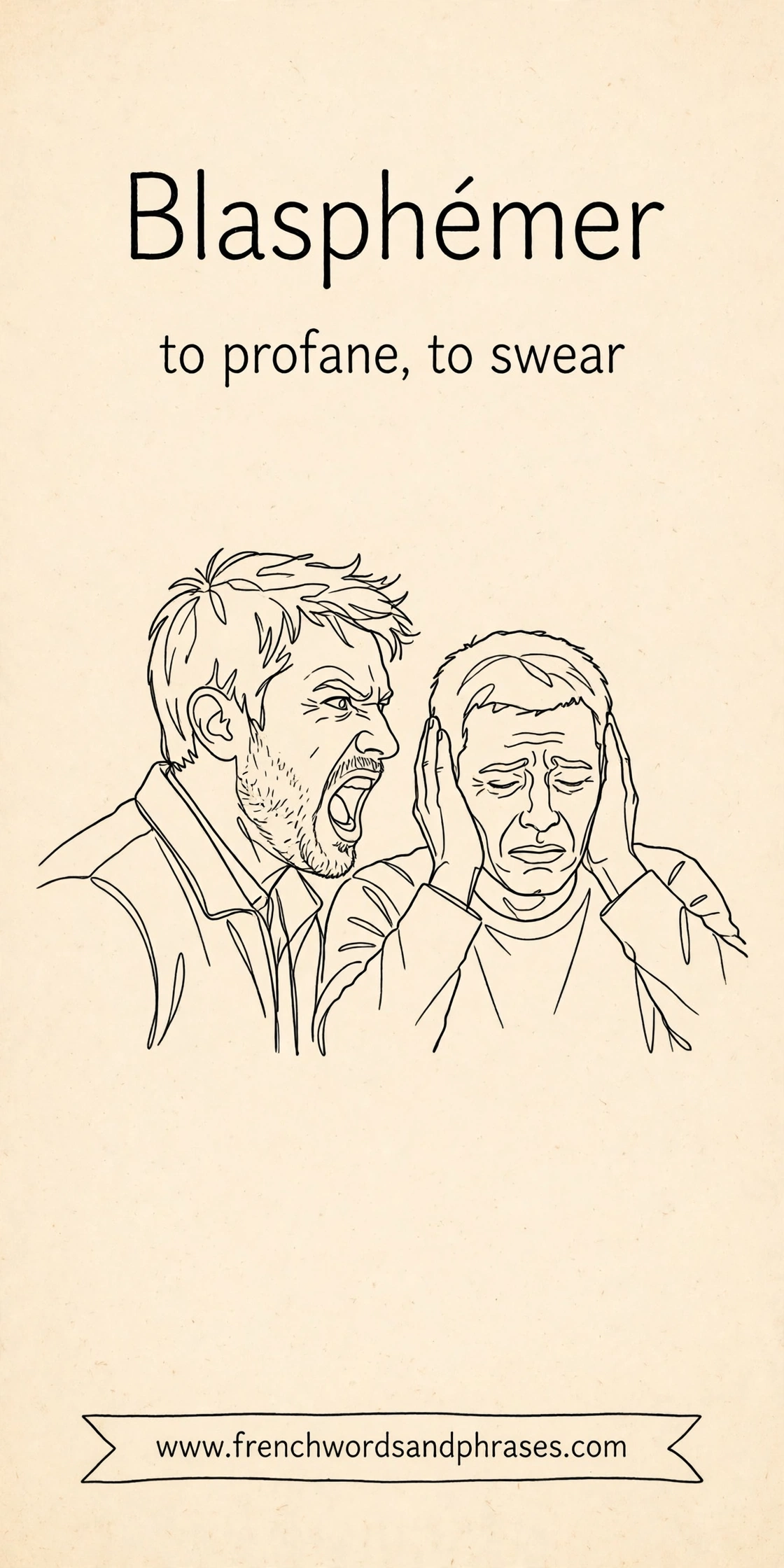
Blasphémer means to profane, to swear — to speak against God and sacred things, or simply to let fly with curses.
A soldier in a rage shakes his fist at the sky, a grandfather lets out the thunder-word he never uses in the house — blasphémer is the grave verb of forbidden speech: once a crime, now mostly the strongest swearing French has.
In this guide, you’ll learn how to conjugate blasphémer in all the major French tenses and moods. Explore complete conjugation tables, French examples, English translations, and practice quizzes.
Understanding the French Verb Blasphémer
Blasphémer is a regular French verb belonging to the first group of verbs, those ending in -er.
It means to profane, to swear. In its strict sense it is religious — speech against God, the saints or sacred things — and it was once punished by law. In everyday French it has widened to strong swearing in anger or pain, though it keeps a solemn weight that jurer or sacrer (in Quebec) do not: to say il blasphème is to say the words were shocking, not merely rude.
Verb classification: First group (-er)
Auxiliary verb: Avoir
Past participle: blasphémé
Present participle: blasphémant
English equivalents: To blaspheme, to profane, to curse and swear; blasphémer contre Dieu — to blaspheme against God; blasphémer le nom de Dieu — to take God’s name in vain; blasphémer comme un charretier — to swear like a trooper; un blasphème — a blasphemy, a profanity.
One important detail: blasphémer changes its accent like céder — the é of the stem opens to è wherever the next syllable is mute: je blasphème, tu blasphèmes, il blasphème, ils blasphèment, and through the whole future and conditional: je blasphémerai, je blasphémerais. The é survives where the ending is sounded: nous blasphémons, vous blasphémez, je blasphémais, en blasphémant, and in the infinitive and participle, blasphémer, blasphémé. The subjunctive splits the same way: que je blasphème, but que nous blasphémions. Historically this is the mother word of the family: blâmer (to blame) is its worn-down twin.
Experience the Word
Blasphémer is the verb of the word that should not be said — every culture keeps a few, and this verb is for the moment they escape.
Imagine a Breton fisherman of a hundred years ago, hauling a torn net in a rising storm. The catch is lost, the boat is labouring, and suddenly the sky gets the blame for everything: il blasphème, loudly, inventively, against heaven itself — and his young son, hearing words he has never heard at home, understands that some speech is reserved for the sea.
Back in the harbour, he will say nothing of the kind. He has blasphemed — il a blasphémé — and the storm has taken the words away.
How to Conjugate Blasphémer: Complete French Conjugation Guide
Let’s explore every major conjugation of blasphémer, beginning with the indicative mood.
How to Conjugate Blasphémer in the Indicative Mood
The indicative mood is used to express facts, observations, actions, and events.
How to Conjugate Blasphémer in the Present Tense (Présent)
Used for actions happening now, habitual actions, and general truths.
| Subject | Conjugation |
|---|---|
| je | blasphème |
| tu | blasphèmes |
| il / elle | blasphème |
| nous | blasphémons |
| vous | blasphémez |
| ils / elles | blasphèment |
Example
Il blasphème dès qu’il est en colère.
He swears as soon as he is angry.
Quick Quiz 1
Complete the sentence:
Nous ne ______ jamais en public.
Reveal the answer
blasphémons
Nous ne blasphémons jamais en public.
We never blaspheme in public.
How to Conjugate Blasphémer in the Passé Composé
Used for completed actions in the past. Blasphémer takes the auxiliary verb avoir.
| Subject | Conjugation |
|---|---|
| j’ | ai blasphémé |
| tu | as blasphémé |
| il / elle | a blasphémé |
| nous | avons blasphémé |
| vous | avez blasphémé |
| ils / elles | ont blasphémé |
Example
Le vieillard a blasphémé devant toute l’assemblée.
The old man blasphemed before the whole assembly.
How to Conjugate Blasphémer in the Imparfait (Imperfect Tense)
Used for habitual past actions, descriptions, and ongoing situations in the past.
| Subject | Conjugation |
|---|---|
| je | blasphémais |
| tu | blasphémais |
| il / elle | blasphémait |
| nous | blasphémions |
| vous | blasphémiez |
| ils / elles | blasphémaient |
Example
Autrefois, on blasphémait rarement en public.
In the old days, people rarely blasphemed in public.
Quick Quiz 2
Choose the correct form:
The old man blasphemed before everyone.
Le vieillard ______ devant tout le monde. (a blasphémé / est blasphémé)
Reveal the answer
a blasphémé
Le vieillard a blasphémé devant tout le monde.
Blasphémer takes avoir.
How to Conjugate Blasphémer in the Plus-que-parfait
Used to describe an action that had already been completed before another past event.
| Subject | Conjugation |
|---|---|
| j’ | avais blasphémé |
| tu | avais blasphémé |
| il / elle | avait blasphémé |
| nous | avions blasphémé |
| vous | aviez blasphémé |
| ils / elles | avaient blasphémé |
Example
Il avait blasphémé si souvent que personne n’écoutait plus.
He had sworn so often that nobody listened any more.
How to Conjugate Blasphémer in the Passé Simple
Primarily used in formal writing, literature, and historical narratives. It is rarely used in everyday conversation.
| Subject | Conjugation |
|---|---|
| je | blasphémai |
| tu | blasphémas |
| il / elle | blasphéma |
| nous | blasphémâmes |
| vous | blasphémâtes |
| ils / elles | blasphémèrent |
Example
Dans sa rage, le soldat blasphéma contre le ciel.
In his rage, the soldier blasphemed against heaven.
How to Conjugate Blasphémer in the Passé Antérieur
A literary tense used to express an action completed immediately before another past action, generally in the passé simple.
| Subject | Conjugation |
|---|---|
| j’ | eus blasphémé |
| tu | eus blasphémé |
| il / elle | eut blasphémé |
| nous | eûmes blasphémé |
| vous | eûtes blasphémé |
| ils / elles | eurent blasphémé |
Example
Dès qu’il eut blasphémé, un silence glacé tomba sur la salle.
As soon as he had blasphemed, an icy silence fell over the room.
How to Conjugate Blasphémer in the Future Tense (Futur Simple)
Used to describe actions that will take place in the future.
| Subject | Conjugation |
|---|---|
| je | blasphèmerai |
| tu | blasphèmeras |
| il / elle | blasphèmera |
| nous | blasphèmerons |
| vous | blasphèmerez |
| ils / elles | blasphèmeront |
Example
Si tu continues ainsi, tu blasphémeras devant les enfants.
If you go on like this, you will swear in front of the children.
How to Conjugate Blasphémer in the Futur Antérieur (Future Perfect)
Used for an action that will have been completed before a particular point in the future.
| Subject | Conjugation |
|---|---|
| j’ | aurai blasphémé |
| tu | auras blasphémé |
| il / elle | aura blasphémé |
| nous | aurons blasphémé |
| vous | aurez blasphémé |
| ils / elles | auront blasphémé |
Example
À la fin de la journée, il aura blasphémé cent fois.
By the end of the day, he will have sworn a hundred times.
How to Conjugate Blasphémer in the Near Future (Futur Proche)
Used to describe something that is going to happen soon. Formed with aller + infinitive.
| Subject | Conjugation |
|---|---|
| je | vais blasphémer |
| tu | vas blasphémer |
| il / elle | va blasphémer |
| nous | allons blasphémer |
| vous | allez blasphémer |
| ils / elles | vont blasphémer |
Example
Attention, il va blasphémer si le moteur ne démarre pas.
Careful, he is going to swear if the engine does not start.
How to Conjugate Blasphémer in the Conditional Mood
The conditional mood expresses what would happen under certain circumstances. It is also frequently used to make polite requests or express wishes.
How to Conjugate Blasphémer in the Present Conditional
| Subject | Conjugation |
|---|---|
| je | blasphèmerais |
| tu | blasphèmerais |
| il / elle | blasphèmerait |
| nous | blasphèmerions |
| vous | blasphèmeriez |
| ils / elles | blasphèmeraient |
Example
Un homme pieux ne blasphémerait jamais.
A pious man would never blaspheme.
How to Conjugate Blasphémer in the Past Conditional
| Subject | Conjugation |
|---|---|
| j’ | aurais blasphémé |
| tu | aurais blasphémé |
| il / elle | aurait blasphémé |
| nous | aurions blasphémé |
| vous | auriez blasphémé |
| ils / elles | auraient blasphémé |
Example
Elle n’aurait pas blasphémé sans cette provocation.
She would not have sworn without this provocation.
Blasphémer in the Literary Past Conditional Form
This less common literary form uses the imperfect subjunctive of avoir.
| Subject | Conjugation |
|---|---|
| j’ | eusse blasphémé |
| tu | eusses blasphémé |
| il / elle | eût blasphémé |
| nous | eussions blasphémé |
| vous | eussiez blasphémé |
| ils / elles | eussent blasphémé |
Example
Il eût blasphémé contre tous les dieux dans sa douleur.
He would have blasphemed against all the gods in his grief.
How to Conjugate Blasphémer in the Subjunctive Mood
The subjunctive is used to express wishes, emotions, doubts, necessity, and uncertainty. It frequently follows expressions such as il faut que (it is necessary that) or bien que (although).
How to Conjugate Blasphémer in the Present Subjunctive
| Subject | Conjugation |
|---|---|
| que je | blasphème |
| que tu | blasphèmes |
| qu’il / qu’elle | blasphème |
| que nous | blasphémions |
| que vous | blasphémiez |
| qu’ils / qu’elles | blasphèment |
Example
Il est inadmissible qu’il blasphème en classe.
It is unacceptable that he should swear in class.
Quick Quiz 3
Complete the sentence using the subjunctive:
Il est inadmissible que vous ______ en classe.
Reveal the answer
blasphémiez
Il est inadmissible que vous blasphémiez en classe.
It is unacceptable that you should swear in class.
How to Conjugate Blasphémer in the Imperfect Subjunctive
A literary tense, rarely encountered in modern spoken French.
| Subject | Conjugation |
|---|---|
| que je | blasphémasse |
| que tu | blasphémasses |
| qu’il / qu’elle | blasphémât |
| que nous | blasphémassions |
| que vous | blasphémassiez |
| qu’ils / qu’elles | blasphémassent |
Example
La mère craignait que son fils ne blasphémât un jour en public.
The mother feared her son might one day blaspheme in public.
How to Conjugate Blasphémer in the Pluperfect Subjunctive
A literary construction used to express an action completed before another past action.
| Subject | Conjugation |
|---|---|
| que j’ | eusse blasphémé |
| que tu | eusses blasphémé |
| qu’il / qu’elle | eût blasphémé |
| que nous | eussions blasphémé |
| que vous | eussiez blasphémé |
| qu’ils / qu’elles | eussent blasphémé |
Example
On racontait qu’il eût blasphémé jusque dans l’église.
People said he had blasphemed even inside the church.
How to Conjugate Blasphémer in the Past Subjunctive
| Subject | Conjugation |
|---|---|
| que j’ | aie blasphémé |
| que tu | aies blasphémé |
| qu’il / qu’elle | ait blasphémé |
| que nous | ayons blasphémé |
| que vous | ayez blasphémé |
| qu’ils / qu’elles | aient blasphémé |
Example
Je suis choqué qu’il ait blasphémé devant sa grand-mère.
I am shocked that he swore in front of his grandmother.
How to Conjugate Blasphémer in the Imperative
The imperative is used to give commands, instructions, invitations, or suggestions. Subject pronouns are omitted.
How to Conjugate Blasphémer in the Present Imperative
| Person | Conjugation |
|---|---|
| (tu) | blasphème |
| (nous) | blasphémons |
| (vous) | blasphémez |
Example
Ne blasphème pas devant les enfants !
Do not swear in front of the children!
Quick Quiz 4
How would you say Do not swear here (tu form)?
Reveal the answer
Ne blasphème pas ici !
French Participles of Blasphémer
Participles are verb forms that can be used in compound tenses and other grammatical constructions.
Present Participle of Blasphémer
blasphémant
En blasphémant ainsi, tu offenses tout le monde.
By swearing like that, you offend everyone.
Past Participle of Blasphémer
blasphémé
Après avoir blasphémé, il s’excusa aussitôt.
After swearing, he apologised at once.
Blasphémer in Everyday French: Real-Life Examples
Now that you know the conjugations, let’s see how blasphémer appears in everyday French.
Example 1 — Present
Il blasphème quand il est en colère.
He swears when he is angry.
Example 2 — Passé composé
Il a blasphémé devant tout le monde.
He blasphemed in front of everyone.
Example 3 — Imparfait
On blasphémait rarement en public.
People rarely blasphemed in public.
Example 4 — Future
Tu blasphémeras si tu ne fais pas attention.
You will swear if you are not careful.
Example 5 — Conditional
Un homme pieux ne blasphémerait jamais.
A pious man would never blaspheme.
Example 6 — Imperative
Ne blasphème pas ici !
Do not swear here!
Beyond Translation: The Meaning of Blasphémer
The word is Greek before it is French: blasphémia meant slanderous speech, and it split into two French heirs — blasphémer, which kept the sacred sense, and blâmer, to blame, which is the same word worn smooth by centuries of use.
Blasphemy was once a matter for courts, not just confessors.
In old France, blasphémer contre Dieu could be punished by fines, the pillory, worse — the famous chevalier de La Barre was executed in 1766 in a case soaked in accusations of blasphemy. The modern verb is tamer — a grandfather’s thunder-word — but it has kept the echo of the courtroom: il blasphème still sounds like a charge, not a description.
How to Remember the French Verb Blasphémer
Remember it this way: Blasphémer is about the fisherman shouting at the storm — words reserved for the sea.
- Céder-type accent: je blasphème with è, but nous blasphémons with é — and je blasphémerai in the future.
- Its worn-down twin is blâmer (to blame): same ancestor, two jobs — church and courtroom.
- Regular endings otherwise: je blasphème, nous blasphémons, past participle blasphémé, with avoir.
The key idea is the fisherman shouting at the storm — words reserved for the sea.
Test Your Knowledge of Blasphémer
Let’s see how much you’ve learned. Try answering these questions before revealing the answers.
Question 1
Why does je blasphème have a grave accent but nous blasphémons an acute one?
Reveal the answer
The céder-type rule — é becomes è before a mute syllable (je blasphème), and stays é where the ending is sounded (nous blasphémons).
Question 2
How do you say He swears when he is angry in French?
Reveal the answer
Il blasphème quand il est en colère.
Question 3
Translate: A pious man would never blaspheme.
Reveal the answer
Un homme pieux ne blasphémerait jamais.
Question 4
What is the past participle of blasphémer?
Reveal the answer
Blasphémé.
Question 5
Complete the sentence:
Il est inadmissible qu’il ______ en classe.
Reveal the answer
blasphème
Il est inadmissible qu’il blasphème en classe.
It is unacceptable that he should swear in class.
Your Final Challenge
Can You Use It?
How would you say this in French?
The old sailor blasphemed against the wind one last time, then brought his boat in as one brings in a flock.
Reveal the answer
Le vieux marin blasphéma contre le vent une dernière fois, puis il rentra son bateau comme on rentre un troupeau.
The old sailor blasphemed against the wind one last time, then brought his boat in as one brings in a flock.
A little French. A little curiosity. A richer everyday life.
LEARN FRENCH ONE WORD AT A TIME