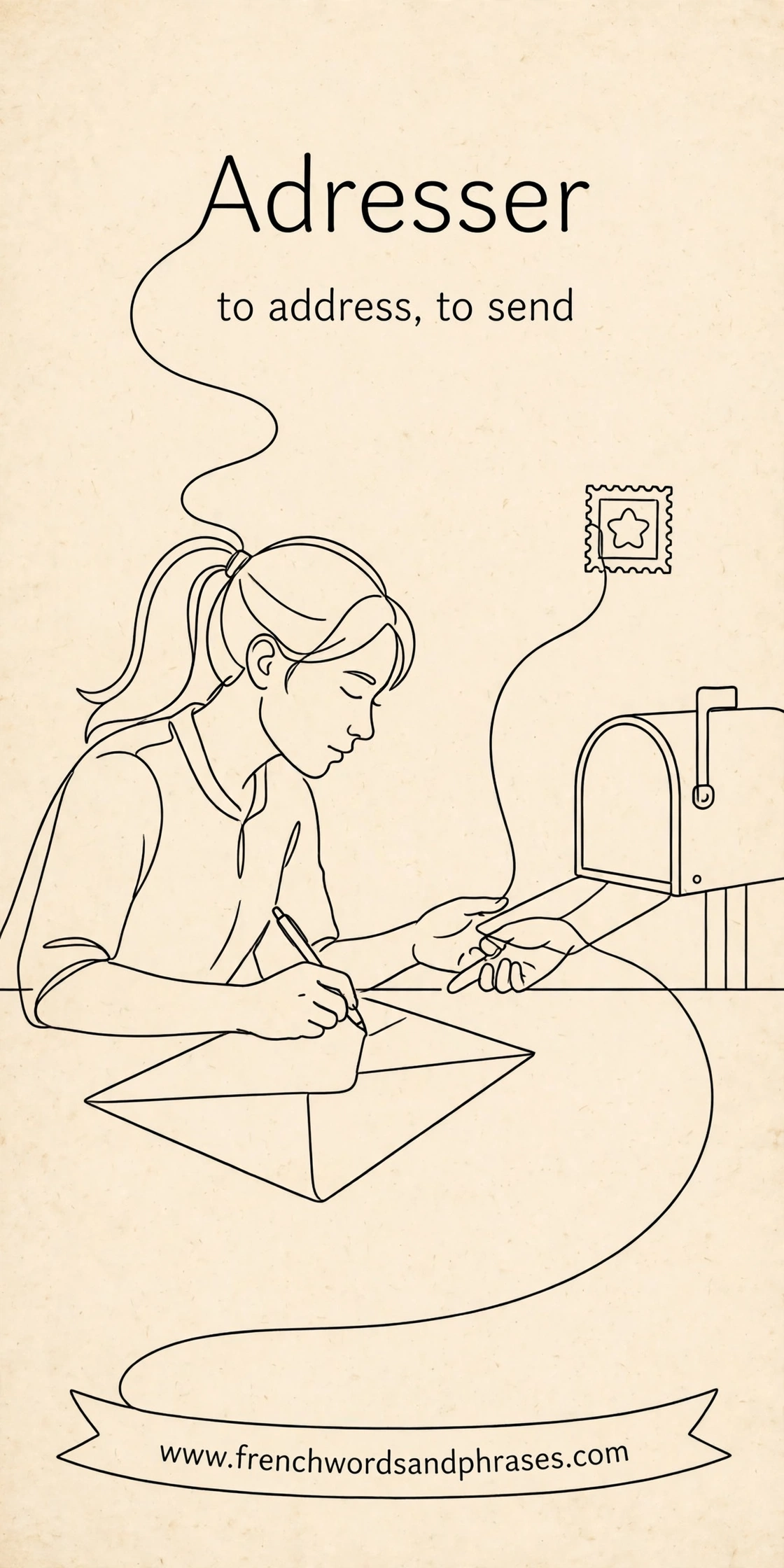
A French Word to Live By
How to Conjugate Adresser in French
/a.dʁe.se/
Adresser means to address, to send — to aim a letter, a parcel, a speech or a question at one particular person.
A name written carefully on an envelope, a mayor turning towards the crowd before his speech, a shy boy finally daring to speak to the baker — adresser is the verb of aiming words and parcels at the person they are meant for.
In this guide, you’ll learn how to conjugate adresser in all the major French tenses and moods. Explore complete conjugation tables, French examples, English translations, and practice quizzes.
Understanding the French Verb Adresser
Adresser is a regular French verb belonging to the first group of verbs, those ending in-er.
It means to address, to send. It covers the whole journey of anything aimed at a person: posting letters and parcels, delivering speeches, putting questions, and even launching reproaches or compliments — whatever is adressé has a named destination.
Verb classification: First group (-er)
Auxiliary verb: Avoir
Past participle: adressé
Present participle: adressant
English equivalents: To address, to send; adresser une lettre à quelqu’un — to send someone a letter; adresser la parole à quelqu’un — to speak to someone; adresser un reproche à quelqu’un — to reproach someone; adresser un discours — to deliver a speech.
One important detail: adresser is a perfectly regular -er verb with a double s in every form — j’adresse, nous adressons, adressé — and no stem change of any kind. Its trap is a family one: plain adresser sends or directs something to someone, always with à — adresser un colis à Marie — while the reflexive s’adresser à means to speak to someone or to apply to an office. Keep the two apart and the verb is trouble-free.
Experience the Word
Adresser is the verb of the aimed message — nothing is adressé into the air; everything lands on a chosen desk, doorstep or pair of ears.
Imagine an old-fashioned post office at Christmas. A grandmother writes her grandson’s name in her best handwriting, checks the address twice, and hands the parcel over: elle adresse le colis à Lyon, and her whole affection travels with it.
A letter is never just sent. It is addressed — adressée — to someone, and that someone is the point.
How to Conjugate Adresser: Complete French Conjugation Guide
Let’s explore every major conjugation of adresser, beginning with the indicative mood.
How to Conjugate Adresser in the Indicative Mood
The indicative mood is used to express facts, observations, actions, and events.
How to Conjugate Adresser in the Present Tense (Présent)
Used for actions happening now, habitual actions, and general truths.
| Subject | Conjugation |
|---|---|
| je | adresse |
| tu | adresses |
| il / elle | adresse |
| nous | adressons |
| vous | adressez |
| ils / elles | adressent |
Example
Elle adresse une lettre de remerciements à la mairie.
She is addressing a letter of thanks to the town hall.
Quick Quiz 1
Complete the sentence:
Nous ______ une pétition au ministère.
Reveal the answer
adressons
Nous adressons une pétition au ministère.
We are sending a petition to the ministry.
How to Conjugate Adresser in the Passé Composé
Used for completed actions in the past. Adresser takes the auxiliary verb avoir.
| Subject | Conjugation |
|---|---|
| j’ | ai adressé |
| tu | as adressé |
| il / elle | a adressé |
| nous | avons adressé |
| vous | avez adressé |
| ils / elles | ont adressé |
Example
J’ai adressé le colis à ton adresse de Lyon.
I sent the parcel to your address in Lyon.
How to Conjugate Adresser in the Imparfait (Imperfect Tense)
Used for habitual past actions, descriptions, and ongoing situations in the past.
| Subject | Conjugation |
|---|---|
| je | adressais |
| tu | adressais |
| il / elle | adressait |
| nous | adressions |
| vous | adressiez |
| ils / elles | adressaient |
Example
Il adressait rarement la parole à ses voisins.
He rarely spoke to his neighbours.
Quick Quiz 2
Choose the correct form:
She sent the parcel to Lyon.
Elle ______ le colis à Lyon. (a adressé / a adressée)
Reveal the answer
a adressé
Elle a adressé le colis à Lyon.
With avoir, the participle does not agree with the subject: adressé.
How to Conjugate Adresser in the Plus-que-parfait
Used to describe an action that had already been completed before another past event.
| Subject | Conjugation |
|---|---|
| j’ | avais adressé |
| tu | avais adressé |
| il / elle | avait adressé |
| nous | avions adressé |
| vous | aviez adressé |
| ils / elles | avaient adressé |
Example
Elle avait adressé sa démission au directeur la veille.
She had handed in her resignation to the director the day before.
How to Conjugate Adresser in the Passé Simple
Primarily used in formal writing, literature, and historical narratives. It is rarely used in everyday conversation.
| Subject | Conjugation |
|---|---|
| je | adressai |
| tu | adressas |
| il / elle | adressa |
| nous | adressâmes |
| vous | adressâtes |
| ils / elles | adressèrent |
Example
Le roi adressa un discours solennel à l’assemblée.
The king delivered a solemn speech to the assembly.
How to Conjugate Adresser in the Passé Antérieur
A literary tense used to express an action completed immediately before another past action, generally in the passé simple.
| Subject | Conjugation |
|---|---|
| j’ | eus adressé |
| tu | eus adressé |
| il / elle | eut adressé |
| nous | eûmes adressé |
| vous | eûtes adressé |
| ils / elles | eurent adressé |
Example
Quand il eut adressé ses adieux à la foule, il quitta la salle.
When he had said his farewells to the crowd, he left the hall.
How to Conjugate Adresser in the Future Tense (Futur Simple)
Used to describe actions that will take place in the future.
| Subject | Conjugation |
|---|---|
| je | adresserai |
| tu | adresseras |
| il / elle | adressera |
| nous | adresserons |
| vous | adresserez |
| ils / elles | adresseront |
Example
Demain, nous adresserons une pétition au ministère.
Tomorrow, we will send a petition to the ministry.
How to Conjugate Adresser in the Futur Antérieur (Future Perfect)
Used for an action that will have been completed before a particular point in the future.
| Subject | Conjugation |
|---|---|
| j’ | aurai adressé |
| tu | auras adressé |
| il / elle | aura adressé |
| nous | aurons adressé |
| vous | aurez adressé |
| ils / elles | auront adressé |
Example
À midi, elle aura adressé tous les courriers.
By noon, she will have sent all the letters.
How to Conjugate Adresser in the Near Future (Futur Proche)
Used to describe something that is going to happen soon. Formed with aller + infinitive.
| Subject | Conjugation |
|---|---|
| je | vais adresser |
| tu | vas adresser |
| il / elle | va adresser |
| nous | allons adresser |
| vous | allez adresser |
| ils / elles | vont adresser |
Example
Je vais adresser un mot au professeur.
I am going to send a note to the teacher.
How to Conjugate Adresser in the Conditional Mood
The conditional mood expresses what would happen under certain circumstances. It is also frequently used to make polite requests or express wishes.
How to Conjugate Adresser in the Present Conditional
| Subject | Conjugation |
|---|---|
| je | adresserais |
| tu | adresserais |
| il / elle | adresserait |
| nous | adresserions |
| vous | adresseriez |
| ils / elles | adresseraient |
Example
À ta place, j’adresserais une réclamation écrite.
In your place, I would send a written complaint.
How to Conjugate Adresser in the Past Conditional
| Subject | Conjugation |
|---|---|
| j’ | aurais adressé |
| tu | aurais adressé |
| il / elle | aurait adressé |
| nous | aurions adressé |
| vous | auriez adressé |
| ils / elles | auraient adressé |
Example
Elle aurait adressé le paquet plus tôt sans la grève.
She would have sent the package earlier without the strike.
Adresser in the Literary Past Conditional Form
This less common literary form uses the imperfect subjunctive of avoir.
| Subject | Conjugation |
|---|---|
| j’ | eusse adressé |
| tu | eusses adressé |
| il / elle | eût adressé |
| nous | eussions adressé |
| vous | eussiez adressé |
| ils / elles | eussent adressé |
Example
Il eût adressé sa demande au roi en personne.
He would have addressed his request to the king in person.
How to Conjugate Adresser in the Subjunctive Mood
The subjunctive is used to express wishes, emotions, doubts, necessity, and uncertainty. It frequently follows expressions such as il faut que (it is necessary that) or bien que (although).
How to Conjugate Adresser in the Present Subjunctive
| Subject | Conjugation |
|---|---|
| que je | adresse |
| que tu | adresses |
| qu’il / qu’elle | adresse |
| que nous | adressions |
| que vous | adressiez |
| qu’ils / qu’elles | adressent |
Example
Il faut que tu adresses ce dossier au bon service.
You must send this file to the right department.
Quick Quiz 3
Complete the sentence using the subjunctive:
Il faut que tu ______ ce dossier au bon service.
Reveal the answer
adresses
Il faut que tu adresses ce dossier au bon service.
You must send this file to the right department.
How to Conjugate Adresser in the Imperfect Subjunctive
A literary tense, rarely encountered in modern spoken French.
| Subject | Conjugation |
|---|---|
| que je | adressasse |
| que tu | adressasses |
| qu’il / qu’elle | adressât |
| que nous | adressassions |
| que vous | adressassiez |
| qu’ils / qu’elles | adressassent |
Example
Je doutais qu’il adressât un jour la parole à son frère.
I doubted he would ever speak to his brother.
How to Conjugate Adresser in the Pluperfect Subjunctive
A literary construction used to express an action completed before another past action.
| Subject | Conjugation |
|---|---|
| que j’ | eusse adressé |
| que tu | eusses adressé |
| qu’il / qu’elle | eût adressé |
| que nous | eussions adressé |
| que vous | eussiez adressé |
| qu’ils / qu’elles | eussent adressé |
Example
On racontait qu’elle eût adressé au ministre une lettre anonyme.
People said she had sent the minister an anonymous letter.
How to Conjugate Adresser in the Past Subjunctive
| Subject | Conjugation |
|---|---|
| que j’ | aie adressé |
| que tu | aies adressé |
| qu’il / qu’elle | ait adressé |
| que nous | ayons adressé |
| que vous | ayez adressé |
| qu’ils / qu’elles | aient adressé |
Example
Je suis content que tu aies adressé tes félicitations à Marie.
I am glad you sent your congratulations to Marie.
How to Conjugate Adresser in the Imperative
The imperative is used to give commands, instructions, invitations, or suggestions. Subject pronouns are omitted.
How to Conjugate Adresser in the Present Imperative
| Person | Conjugation |
|---|---|
| (tu) | adresse |
| (nous) | adressons |
| (vous) | adressez |
Example
Adresse ce colis à l’adresse indiquée !
Address this parcel to the address shown!
Quick Quiz 4
How would you say Address this parcel to Lyon (tu form)?
Reveal the answer
Adresse ce colis à Lyon !
French Participles of Adresser
Participles are verb forms that can be used in compound tenses and other grammatical constructions.
Present Participle of Adresser
adressant
En adressant son discours aux jeunes, le maire a touché juste.
By addressing his speech to the young, the mayor struck the right note.
Past Participle of Adresser
adressé
Adressée au mauvais service, la lettre s’est perdue.
Sent to the wrong department, the letter got lost.
Adresser in Everyday French: Real-Life Examples
Now that you know the conjugations, let’s see how adresser appears in everyday French.
Example 1 — Present
Elle adresse une lettre à la mairie.
She is sending a letter to the town hall.
Example 2 — Passé composé
J’ai adressé le colis à Lyon.
I sent the parcel to Lyon.
Example 3 — Imparfait
Il adressait rarement la parole à ses voisins.
He rarely spoke to his neighbours.
Example 4 — Future
Nous adresserons une pétition au ministère.
We will send a petition to the ministry.
Example 5 — Conditional
J’adresserais une réclamation écrite.
I would send a written complaint.
Example 6 — Imperative
Adresse ce colis à l’adresse indiquée !
Address this parcel to the address shown!
Beyond Translation: The Meaning of Adresser
French adresser and English address are the same word twice: both descend from a Latin verb meaning to direct something straight at its target.
That is why one French verb covers envelopes and speeches.
To address a crowd and to address an envelope are, in French as in older English, the same gesture — aiming words at a destination. The noun une adresse keeps the postal sense: the place where the aimed thing should land.
How to Remember the French Verb Adresser
Remember it this way: Adresser is about a name on an envelope, a speech aimed at a crowd.
- Double s everywhere, no stem change: j’adresse, nous adressons, adressé.
- What is adressé always has a destination: adresser quelque chose à quelqu’un.
- Adresser la parole à quelqu’un is the set phrase for speaking to someone.
The key idea is a name on an envelope, a speech aimed at a crowd.
Test Your Knowledge of Adresser
Let’s see how much you’ve learned. Try answering these questions before revealing the answers.
Question 1
Which preposition follows adresser when you name the recipient?
Reveal the answer
À — adresser une lettre à Marie, adresser la parole à un voisin.
Question 2
How do you say I sent the parcel to Lyon in French?
Reveal the answer
J’ai adressé le colis à Lyon.
Question 3
Translate: Tomorrow, we will send a petition to the ministry.
Reveal the answer
Demain, nous adresserons une pétition au ministère.
Question 4
What is the past participle of adresser?
Reveal the answer
Adressé — adressée, adressés, adressées.
Question 5
Complete the sentence:
Il faut que tu ______ ce dossier au bon service.
Reveal the answer
adresses
Il faut que tu adresses ce dossier au bon service.
You must send this file to the right department.
Your Final Challenge
Can You Use It?
How would you say this in French?
She addresses her letter to the end of the world, and hope fits inside an envelope.
Reveal the answer
Elle adresse sa lettre au bout du monde, et l’espoir tient dans une enveloppe.
She addresses her letter to the end of the world, and hope fits inside an envelope.
A little French. A little curiosity. A richer everyday life.
LEARN FRENCH ONE WORD AT A TIME