A French Word to Live By
How to Conjugate Aduler in French
/a.dy.le/
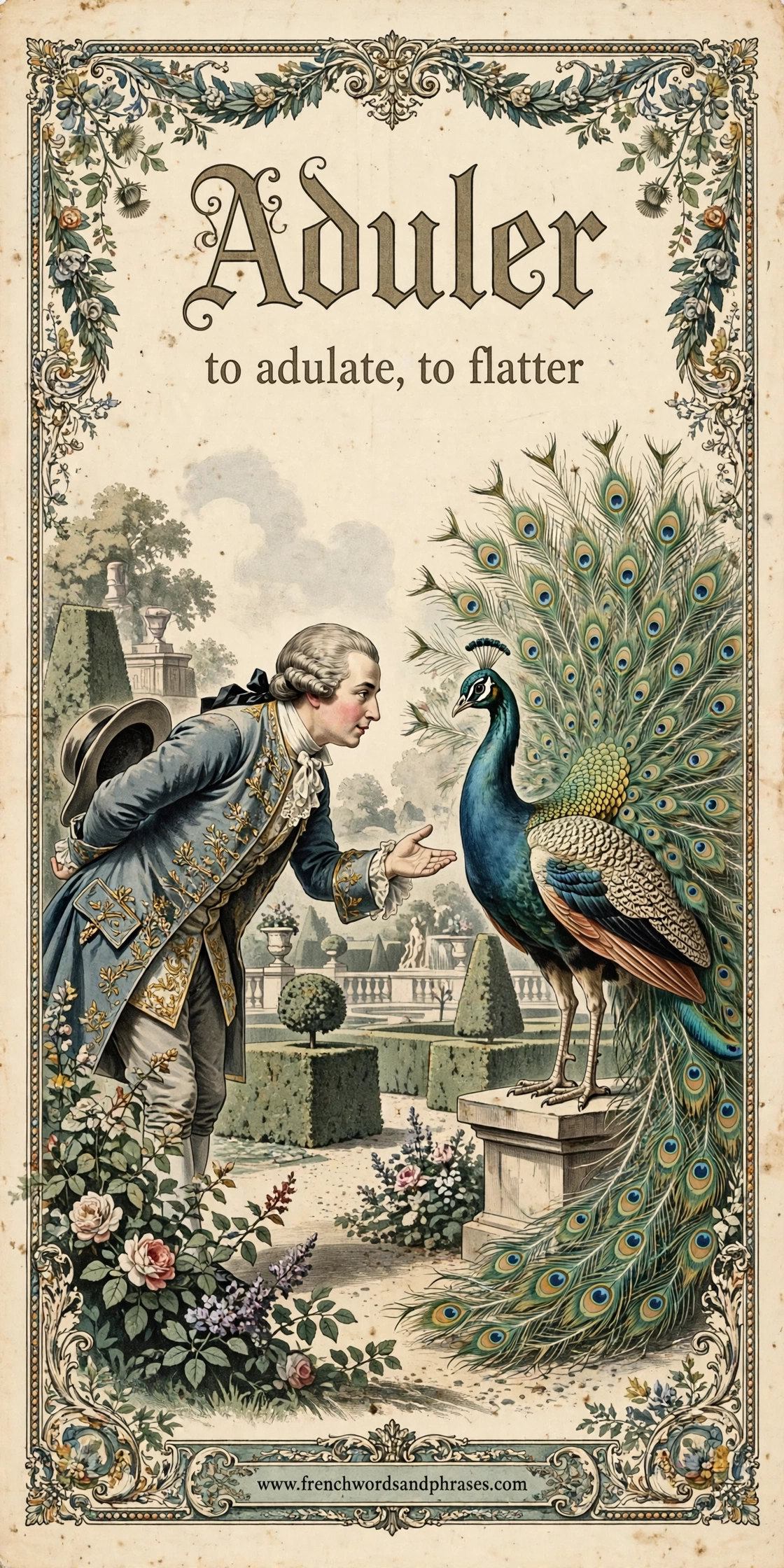
Aduler means to adulate, to flatter — to heap praise on someone far beyond what they deserve, in the hope of being noticed.
A courtier bowing a little too low, fans screaming a little too loud, an employee laughing a little too hard at the boss’s joke — aduler is flattery turned up to worship: praise with an agenda.
In this guide, you’ll learn how to conjugate aduler in all the major French tenses and moods. Explore complete conjugation tables, French examples, English translations, and practice quizzes.
Understanding the French Verb Aduler
Aduler is a regular French verb belonging to the first group of verbs, those ending in-er.
It means to adulate, to flatter. It lives at courts, in celebrity culture and in politics: stars are adulées by fans, leaders adulés by their entourage. The noun is l’adulation, and the tone is rarely neutral — to say someone est adulé is to say the praise around them has lost all measure.
Verb classification: First group (-er)
Auxiliary verb: Avoir
Past participle: adulé
Present participle: adulant
English equivalents: To adulate, to flatter excessively; aduler un prince — to fawn on a prince; aduler la foule — to flatter the crowd; être adulé — to be adored and fêted; un héros adulé — an idolised hero.
One important detail: aduler is a completely regular -er verb — j’adule, nous adulons, adulé — with no spelling trap at all. Its trap is one of degree: flatter is ordinary flattery, but aduler goes much further, into worship and fawning. French speakers reach for it when the praise is excessive, public and usually self-interested — the word itself carries a raised eyebrow.
Experience the Word
Aduler is praise with the volume turned too high — compliments so constant and so exaggerated that they stop sounding like admiration and start sounding like strategy.
Imagine a young singer after her first hit. Strangers weep at her concerts, journalists call her a genius, old friends suddenly telephone every day. Elle est adulée — and she no longer knows which voices are sincere.
Ordinary praise warms; this floods. She is adulated — adulée — and drowning in compliments.
How to Conjugate Aduler: Complete French Conjugation Guide
Let’s explore every major conjugation of aduler, beginning with the indicative mood.
How to Conjugate Aduler in the Indicative Mood
The indicative mood is used to express facts, observations, actions, and events.
How to Conjugate Aduler in the Present Tense (Présent)
Used for actions happening now, habitual actions, and general truths.
| Subject | Conjugation |
|---|---|
| je | adule |
| tu | adules |
| il / elle | adule |
| nous | adulons |
| vous | adulez |
| ils / elles | adulent |
Example
Les courtisans adulent le prince sans relâche.
The courtiers adulate the prince relentlessly.
Quick Quiz 1
Complete the sentence:
Les courtisans ______ le prince sans relâche.
Reveal the answer
adulent
Les courtisans adulent le prince sans relâche.
The courtiers adulate the prince relentlessly.
How to Conjugate Aduler in the Passé Composé
Used for completed actions in the past. Aduler takes the auxiliary verb avoir.
| Subject | Conjugation |
|---|---|
| j’ | ai adulé |
| tu | as adulé |
| il / elle | a adulé |
| nous | avons adulé |
| vous | avez adulé |
| ils / elles | ont adulé |
Example
La foule a adulé la chanteuse toute la soirée.
The crowd showered the singer with adulation all evening.
How to Conjugate Aduler in the Imparfait (Imperfect Tense)
Used for habitual past actions, descriptions, and ongoing situations in the past.
| Subject | Conjugation |
|---|---|
| je | adulais |
| tu | adulais |
| il / elle | adulait |
| nous | adulions |
| vous | aduliez |
| ils / elles | adulaient |
Example
Il adulait son maître dans l’espoir d’une faveur.
He used to flatter his master in the hope of a favour.
Quick Quiz 2
Choose the correct form:
The crowd adulated the singer.
La foule ______ la chanteuse. (a adulé / est adulé)
Reveal the answer
a adulé
La foule a adulé la chanteuse.
Aduler is a plain transitive verb with avoir: a adulé.
How to Conjugate Aduler in the Plus-que-parfait
Used to describe an action that had already been completed before another past event.
| Subject | Conjugation |
|---|---|
| j’ | avais adulé |
| tu | avais adulé |
| il / elle | avait adulé |
| nous | avions adulé |
| vous | aviez adulé |
| ils / elles | avaient adulé |
Example
Ils avaient adulé le champion avant de l’oublier.
They had idolised the champion before forgetting him.
How to Conjugate Aduler in the Passé Simple
Primarily used in formal writing, literature, and historical narratives. It is rarely used in everyday conversation.
| Subject | Conjugation |
|---|---|
| je | adulai |
| tu | adulas |
| il / elle | adula |
| nous | adulâmes |
| vous | adulâtes |
| ils / elles | adulèrent |
Example
Tout Paris adula l’actrice après la première.
All Paris adulated the actress after the premiere.
How to Conjugate Aduler in the Passé Antérieur
A literary tense used to express an action completed immediately before another past action, generally in the passé simple.
| Subject | Conjugation |
|---|---|
| j’ | eus adulé |
| tu | eus adulé |
| il / elle | eut adulé |
| nous | eûmes adulé |
| vous | eûtes adulé |
| ils / elles | eurent adulé |
Example
Quand la presse eut adulé le nouveau venu, elle se retourna contre lui.
When the press had finished adulating the newcomer, it turned against him.
How to Conjugate Aduler in the Future Tense (Futur Simple)
Used to describe actions that will take place in the future.
| Subject | Conjugation |
|---|---|
| je | adulerai |
| tu | aduleras |
| il / elle | adulera |
| nous | adulerons |
| vous | adulerez |
| ils / elles | aduleront |
Example
Les foules aduleront un autre héros demain.
The crowds will adulate another hero tomorrow.
How to Conjugate Aduler in the Futur Antérieur (Future Perfect)
Used for an action that will have been completed before a particular point in the future.
| Subject | Conjugation |
|---|---|
| j’ | aurai adulé |
| tu | auras adulé |
| il / elle | aura adulé |
| nous | aurons adulé |
| vous | aurez adulé |
| ils / elles | auront adulé |
Example
À la fin de la tournée, les fans l’auront adulée cent fois.
By the end of the tour, the fans will have adulated her a hundred times.
How to Conjugate Aduler in the Near Future (Futur Proche)
Used to describe something that is going to happen soon. Formed with aller + infinitive.
| Subject | Conjugation |
|---|---|
| je | vais aduler |
| tu | vas aduler |
| il / elle | va aduler |
| nous | allons aduler |
| vous | allez aduler |
| ils / elles | vont aduler |
Example
Ne va pas aduler ce chanteur médiocre.
Do not go and fawn over that mediocre singer.
How to Conjugate Aduler in the Conditional Mood
The conditional mood expresses what would happen under certain circumstances. It is also frequently used to make polite requests or express wishes.
How to Conjugate Aduler in the Present Conditional
| Subject | Conjugation |
|---|---|
| je | adulerais |
| tu | adulerais |
| il / elle | adulerait |
| nous | adulerions |
| vous | aduleriez |
| ils / elles | aduleraient |
Example
Il adulerait n’importe qui pour obtenir ce poste.
He would flatter anyone to get that job.
How to Conjugate Aduler in the Past Conditional
| Subject | Conjugation |
|---|---|
| j’ | aurais adulé |
| tu | aurais adulé |
| il / elle | aurait adulé |
| nous | aurions adulé |
| vous | auriez adulé |
| ils / elles | auraient adulé |
Example
Elle aurait adulé le directeur si elle avait voulu cette promotion.
She would have flattered the director if she had wanted that promotion.
Aduler in the Literary Past Conditional Form
This less common literary form uses the imperfect subjunctive of avoir.
| Subject | Conjugation |
|---|---|
| j’ | eusse adulé |
| tu | eusses adulé |
| il / elle | eût adulé |
| nous | eussions adulé |
| vous | eussiez adulé |
| ils / elles | eussent adulé |
Example
Il eût adulé le roi lui-même pour un sourire.
He would have adulated the king himself for a smile.
How to Conjugate Aduler in the Subjunctive Mood
The subjunctive is used to express wishes, emotions, doubts, necessity, and uncertainty. It frequently follows expressions such as il faut que (it is necessary that) or bien que (although).
How to Conjugate Aduler in the Present Subjunctive
| Subject | Conjugation |
|---|---|
| que je | adule |
| que tu | adules |
| qu’il / qu’elle | adule |
| que nous | adulions |
| que vous | aduliez |
| qu’ils / qu’elles | adulent |
Example
Je déteste qu’on adule les puissants.
I hate people fawning on the powerful.
Quick Quiz 3
Complete the sentence using the subjunctive:
Je déteste qu’on ______ les puissants.
Reveal the answer
adule
Je déteste qu’on adule les puissants.
I hate people fawning on the powerful.
How to Conjugate Aduler in the Imperfect Subjunctive
A literary tense, rarely encountered in modern spoken French.
| Subject | Conjugation |
|---|---|
| que je | adulasse |
| que tu | adulasses |
| qu’il / qu’elle | adulât |
| que nous | adulassions |
| que vous | adulassiez |
| qu’ils / qu’elles | adulassent |
Example
Il parlait comme s’il fallait qu’on l’adulât.
He spoke as if everyone had to adore him.
How to Conjugate Aduler in the Pluperfect Subjunctive
A literary construction used to express an action completed before another past action.
| Subject | Conjugation |
|---|---|
| que j’ | eusse adulé |
| que tu | eusses adulé |
| qu’il / qu’elle | eût adulé |
| que nous | eussions adulé |
| que vous | eussiez adulé |
| qu’ils / qu’elles | eussent adulé |
Example
On disait qu’ils eussent adulé le tyran par peur.
People said they had adulated the tyrant out of fear.
How to Conjugate Aduler in the Past Subjunctive
| Subject | Conjugation |
|---|---|
| que j’ | aie adulé |
| que tu | aies adulé |
| qu’il / qu’elle | ait adulé |
| que nous | ayons adulé |
| que vous | ayez adulé |
| qu’ils / qu’elles | aient adulé |
Example
Il est rare qu’un artiste ait été adulé si jeune.
It is rare for an artist to have been adulated so young.
How to Conjugate Aduler in the Imperative
The imperative is used to give commands, instructions, invitations, or suggestions. Subject pronouns are omitted.
How to Conjugate Aduler in the Present Imperative
| Person | Conjugation |
|---|---|
| (tu) | adule |
| (nous) | adulons |
| (vous) | adulez |
Example
N’adule jamais les puissants, respecte-les seulement.
Never fawn on the powerful, just respect them.
Quick Quiz 4
How would you say Never fawn on the powerful (tu form)?
Reveal the answer
N’adule jamais les puissants !
French Participles of Aduler
Participles are verb forms that can be used in compound tenses and other grammatical constructions.
Present Participle of Aduler
adulant
En adulant le prince, le courtisan espérait une pension.
By adulating the prince, the courtier hoped for a pension.
Past Participle of Aduler
adulé
Adulée par la foule, la chanteuse pleura de joie.
Adulated by the crowd, the singer wept with joy.
Aduler in Everyday French: Real-Life Examples
Now that you know the conjugations, let’s see how aduler appears in everyday French.
Example 1 — Present
Les courtisans adulent le prince.
The courtiers adulate the prince.
Example 2 — Passé composé
La foule a adulé la chanteuse.
The crowd showered the singer with adulation.
Example 3 — Imparfait
Il adulait son maître sans cesse.
He constantly flattered his master.
Example 4 — Future
Les foules aduleront un autre héros.
The crowds will adulate another hero.
Example 5 — Conditional
Il adulerait n’importe qui pour ce poste.
He would flatter anyone for that job.
Example 6 — Imperative
N’adule jamais les puissants !
Never fawn on the powerful!
Beyond Translation: The Meaning of Aduler
English adulate exists but is rare and bookish; French aduler is a living word of newspapers and conversation, from the Latin adulari — the verb used for a dog fawning and wagging at its master.
That animal image still clings to it.
To aduler someone is to praise them the way a hopeful dog greets its owner: completely, visibly, and with something to gain. French keeps the raised eyebrow built into the word.
How to Remember the French Verb Aduler
Remember it this way: Aduler is about courtiers bowing too low, fans screaming too loud.
- Regular -er, no traps: j’adule, nous adulons, adulé.
- Stronger than flatter: aduler is flattery up to worship, usually with an agenda.
- The noun is l’adulation — être adulé means to be idolised.
The key idea is courtiers bowing too low, fans screaming too loud.
Test Your Knowledge of Aduler
Let’s see how much you’ve learned. Try answering these questions before revealing the answers.
Question 1
How is aduler different from flatter?
Reveal the answer
Aduler goes much further — it is flattery raised to worship, usually excessive and self-interested.
Question 2
How do you say The courtiers adulate the prince in French?
Reveal the answer
Les courtisans adulent le prince.
Question 3
Translate: He would flatter anyone to get that job.
Reveal the answer
Il adulerait n’importe qui pour obtenir ce poste.
Question 4
What is the past participle of aduler?
Reveal the answer
Adulé — adulée, adulés, adulées.
Question 5
Complete the sentence:
Je déteste qu’on ______ les puissants.
Reveal the answer
adule
Je déteste qu’on adule les puissants.
I hate people fawning on the powerful.
Your Final Challenge
Can You Use It?
How would you say this in French?
The crowd adulates its heroes for a day, then forgets them without a glance.
Reveal the answer
La foule adule ses héros d’un jour, puis elle les oublie sans un regard.
The crowd adulates its heroes for a day, then forgets them without a glance.
A little French. A little curiosity. A richer everyday life.
LEARN FRENCH ONE WORD AT A TIME