A French Word to Live By
How to Conjugate Se adoucir in French
/sə a.du.siʁ/
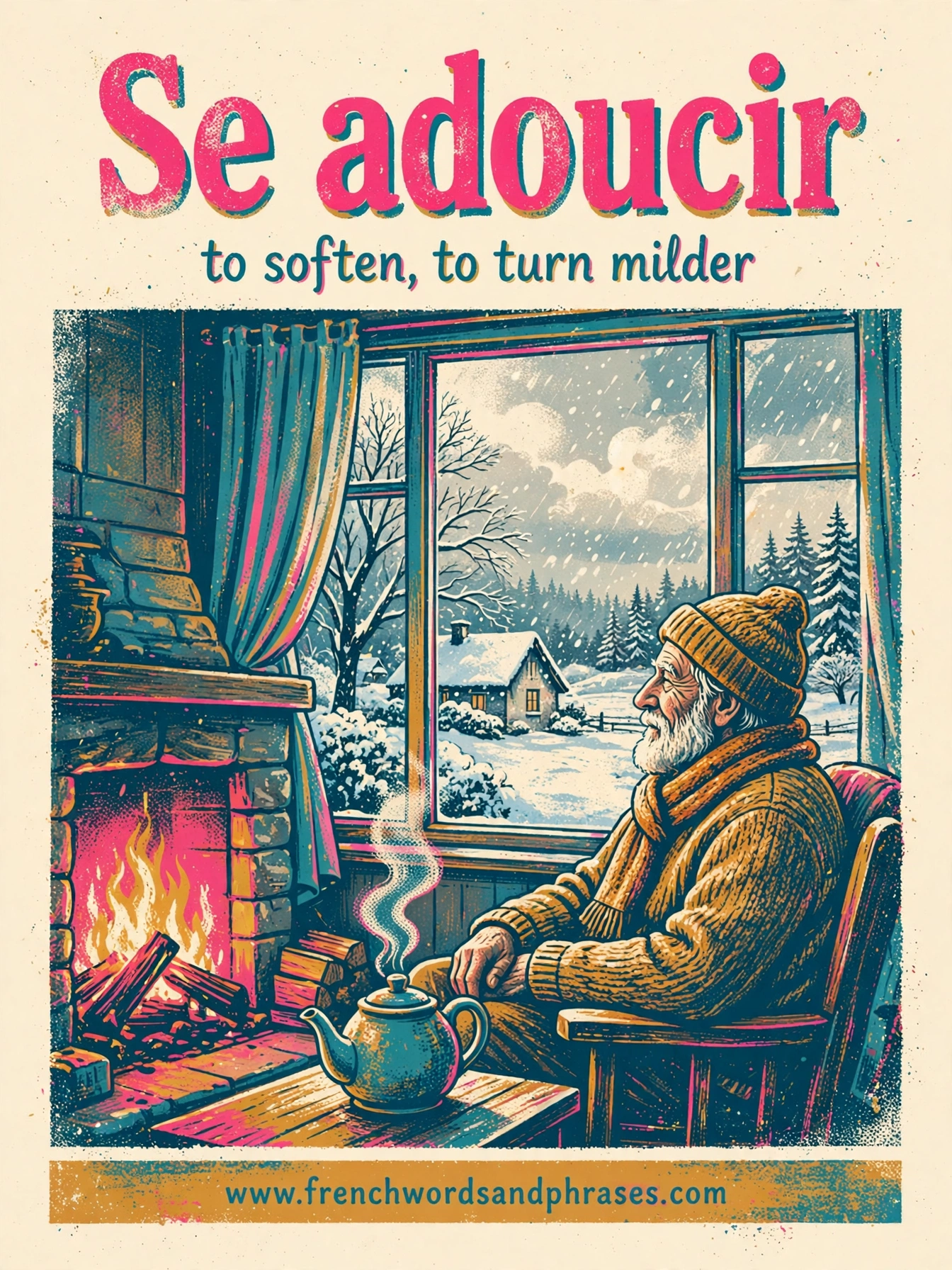
Se adoucir means to soften, to turn milder — what the weather does in March, what a hard heart does with the years, all by itself.
The first mild morning after a hard winter, a stern father’s voice gentling at his granddaughter’s birth, a wind dropping at sunset — se adoucir is the verb of softening that happens from within: nobody softens the thing; it softens itself.
In this guide, you’ll learn how to conjugate se adoucir in all the major French tenses and moods. Explore complete conjugation tables, French examples, English translations, and practice quizzes.
Understanding the French Verb Se adoucir
Se adoucir is a regular French verb belonging to the second group of verbs, those ending in -ir.
It means to soften, to turn milder. It is commonly used of the weather turning milder (le temps s’adoucit, les températures s’adoucissent), of characters and voices gentling with age or love, and even of markets and prices easing. Its classic subject is le temps in both senses — the weather and the years — because both, given long enough, soften.
Verb classification: Second group (-ir), reflexive
Auxiliary verb: Être
Past participle: adouci
Present participle: adoucissant
English equivalents: To soften, to turn milder, to grow gentler; le temps s’adoucit — the weather is turning milder; son caractère s’est adouci — his character has softened; la voix s’adoucit — the voice softens; les prix s’adoucissent — prices are easing.
One important detail: se adoucir is the reflexive face of adoucir — the difference is who does the softening. Le temps adoucit la peine (time softens grief, something acting on something else), but le temps s’adoucit (the weather itself turns mild). Being reflexive, it takes être in compound tenses and the participle agrees: elle s’est adoucie avec l’âge, les hivers se sont adoucis. Underneath, it is a regular second-group -ir: je m’adoucis, nous nous adoucissons, exactly like se finir would be, if finir could soften.
Experience the Word
Se adoucir is softening with no hand behind it — the thaw, the mellowing, the heart unclenching on its own.
Imagine the first week of March in a mountain village. The fountain, silent since December, ticks, then drips, then runs. An old man on the bench removes his scarf, then his hat: le temps s’adoucit. Across the square, his brother — the two have not spoken in ten years — crosses slowly, sits at the other end of the bench, and says only: « Il fait meilleur. » Something else, too, is beginning to thaw.
The weather has turned, and perhaps a heart with it. Both have softened — se sont adoucis — the way spring does everything: from within.
How to Conjugate Se adoucir: Complete French Conjugation Guide
Let’s explore every major conjugation of se adoucir, beginning with the indicative mood.
How to Conjugate Se adoucir in the Indicative Mood
The indicative mood is used to express facts, observations, actions, and events.
How to Conjugate Se adoucir in the Present Tense (Présent)
Used for actions happening now, habitual actions, and general truths.
| Subject | Conjugation |
|---|---|
| je | m’adoucis |
| tu | t’adoucis |
| il / elle | s’adoucit |
| nous | nous adoucissons |
| vous | vous adoucissez |
| ils / elles | s’adoucissent |
Example
Le temps s’adoucit après trois jours de gel.
The weather is turning milder after three days of frost.
Quick Quiz 1
Complete the sentence:
Nous sentons que l’air ______ depuis hier.
Reveal the answer
s’adoucit
Nous sentons que l’air s’adoucit depuis hier.
We can feel the air has been turning milder since yesterday.
How to Conjugate Se adoucir in the Passé Composé
Used for completed actions in the past. Se adoucir takes the auxiliary verb être.
| Subject | Conjugation |
|---|---|
| je | me suis adouci / me suis adoucie |
| tu | t’es adouci / t’es adoucie |
| il / elle | s’est adouci / s’est adoucie |
| nous | nous sommes adoucis / nous sommes adoucies |
| vous | vous êtes adoucis / vous êtes adoucies / vous êtes adouci / vous êtes adoucie |
| ils / elles | se sont adoucis / se sont adoucies |
Example
Son caractère s’est adouci avec l’âge.
His character has softened with age.
How to Conjugate Se adoucir in the Imparfait (Imperfect Tense)
Used for habitual past actions, descriptions, and ongoing situations in the past.
| Subject | Conjugation |
|---|---|
| je | m’adoucissais |
| tu | t’adoucissais |
| il / elle | s’adoucissait |
| nous | nous adoucissions |
| vous | vous adoucissiez |
| ils / elles | s’adoucissaient |
Example
Les hivers s’adoucissaient peu à peu dans la région.
The winters were gradually growing milder in the region.
Quick Quiz 2
Choose the correct form:
The weather turned milder.
Le temps ______. (s’est adouci / a adouci)
Reveal the answer
s’est adouci
Le temps s’est adouci.
Se adoucir is reflexive and takes être.
How to Conjugate Se adoucir in the Plus-que-parfait
Used to describe an action that had already been completed before another past event.
| Subject | Conjugation |
|---|---|
| je | m’étais adouci / m’étais adoucie |
| tu | t’étais adouci / t’étais adoucie |
| il / elle | s’était adouci / s’était adoucie |
| nous | nous étions adoucis / nous étions adoucies |
| vous | vous étiez adoucis / vous étiez adoucies / vous étiez adouci / vous étiez adoucie |
| ils / elles | s’étaient adoucis / s’étaient adoucies |
Example
Elle s’était adoucie depuis la naissance de sa fille.
She had grown gentler since her daughter’s birth.
How to Conjugate Se adoucir in the Passé Simple
Primarily used in formal writing, literature, and historical narratives. It is rarely used in everyday conversation.
| Subject | Conjugation |
|---|---|
| je | m’adoucis |
| tu | t’adoucis |
| il / elle | s’adoucit |
| nous | nous adoucîmes |
| vous | vous adoucîtes |
| ils / elles | s’adoucirent |
Example
Le vent s’adoucit au coucher du soleil.
The wind softened at sunset.
How to Conjugate Se adoucir in the Passé Antérieur
A literary tense used to express an action completed immediately before another past action, generally in the passé simple.
| Subject | Conjugation |
|---|---|
| je | me fus adouci / me fus adoucie |
| tu | te fus adouci / te fus adoucie |
| il / elle | se fut adouci / se fut adoucie |
| nous | nous fûmes adoucis / nous fûmes adoucies |
| vous | vous fûtes adoucis / vous fûtes adoucies / vous fûtes adouci / vous fûtes adoucie |
| ils / elles | se furent adoucis / se furent adoucies |
Example
Dès que le temps se fut adouci, les bourgeons parurent.
As soon as the weather had turned milder, the buds appeared.
How to Conjugate Se adoucir in the Future Tense (Futur Simple)
Used to describe actions that will take place in the future.
| Subject | Conjugation |
|---|---|
| je | m’adoucirai |
| tu | t’adouciras |
| il / elle | s’adoucira |
| nous | nous adoucirons |
| vous | vous adoucirez |
| ils / elles | s’adouciront |
Example
Le climat s’adoucira dès la semaine prochaine.
The weather will turn milder from next week.
How to Conjugate Se adoucir in the Futur Antérieur (Future Perfect)
Used for an action that will have been completed before a particular point in the future.
| Subject | Conjugation |
|---|---|
| je | me serai adouci / me serai adoucie |
| tu | te seras adouci / te seras adoucie |
| il / elle | se sera adouci / se sera adoucie |
| nous | nous serons adoucis / nous serons adoucies |
| vous | vous serez adoucis / vous serez adoucies / vous serez adouci / vous serez adoucie |
| ils / elles | se seront adoucis / se seront adoucies |
Example
Au printemps, l’air se sera bien adouci.
By spring, the air will have turned properly mild.
How to Conjugate Se adoucir in the Near Future (Futur Proche)
Used to describe something that is going to happen soon. Formed with aller + infinitive.
| Subject | Conjugation |
|---|---|
| je | vais m’adoucir |
| tu | vas t’adoucir |
| il / elle | va s’adoucir |
| nous | allons nous adoucir |
| vous | allez vous adoucir |
| ils / elles | vont s’adoucir |
Example
Regarde le ciel : le temps va s’adoucir.
Look at the sky: the weather is going to turn milder.
How to Conjugate Se adoucir in the Conditional Mood
The conditional mood expresses what would happen under certain circumstances. It is also frequently used to make polite requests or express wishes.
How to Conjugate Se adoucir in the Present Conditional
| Subject | Conjugation |
|---|---|
| je | m’adoucirais |
| tu | t’adoucirais |
| il / elle | s’adoucirait |
| nous | nous adoucirions |
| vous | vous adouciriez |
| ils / elles | s’adouciraient |
Example
Sans le mistral, l’hiver s’adoucirait plus vite.
Without the mistral, winter would grow milder faster.
How to Conjugate Se adoucir in the Past Conditional
| Subject | Conjugation |
|---|---|
| je | me serais adouci / me serais adoucie |
| tu | te serais adouci / te serais adoucie |
| il / elle | se serait adouci / se serait adoucie |
| nous | nous serions adoucis / nous serions adoucies |
| vous | vous seriez adoucis / vous seriez adoucies / vous seriez adouci / vous seriez adoucie |
| ils / elles | se seraient adoucis / se seraient adoucies |
Example
Il se serait adouci plus tôt avec des amis plus patients.
He would have softened sooner with more patient friends.
Se adoucir in the Literary Past Conditional Form
This less common literary form uses the imperfect subjunctive of être.
| Subject | Conjugation |
|---|---|
| je | me fusse adouci / me fusse adoucie |
| tu | te fusses adouci / te fusses adoucie |
| il / elle | se fût adouci / se fût adoucie |
| nous | nous fussions adoucis / nous fussions adoucies |
| vous | vous fussiez adoucis / vous fussiez adoucies / vous fussiez adouci / vous fussiez adoucie |
| ils / elles | se fussent adoucis / se fussent adoucies |
Example
Le temps se fût adouci sans cette dernière tempête.
The weather would have turned milder without that last storm.
How to Conjugate Se adoucir in the Subjunctive Mood
The subjunctive is used to express wishes, emotions, doubts, necessity, and uncertainty. It frequently follows expressions such as il faut que (it is necessary that) or bien que (although).
How to Conjugate Se adoucir in the Present Subjunctive
| Subject | Conjugation |
|---|---|
| que je | m’adoucisse |
| que tu | t’adoucisses |
| qu’il / qu’elle | s’adoucisse |
| que nous | nous adoucissions |
| que vous | vous adoucissiez |
| qu’ils / qu’elles | s’adoucissent |
Example
J’espère que le temps s’adoucisse avant dimanche.
I hope the weather turns milder before Sunday.
Quick Quiz 3
Complete the sentence using the subjunctive:
J’espère que vous ______ avec les années, monsieur.
Reveal the answer
vous adoucissiez
J’espère que vous vous adoucissiez avec les années, monsieur.
I hope you will grow gentler with the years, sir.
How to Conjugate Se adoucir in the Imperfect Subjunctive
A literary tense, rarely encountered in modern spoken French.
| Subject | Conjugation |
|---|---|
| que je | m’adoucisse |
| que tu | t’adoucisses |
| qu’il / qu’elle | s’adoucît |
| que nous | nous adoucissions |
| que vous | vous adoucissiez |
| qu’ils / qu’elles | s’adoucissent |
Example
On doutait que son cœur s’adoucît jamais.
People doubted his heart would ever soften.
How to Conjugate Se adoucir in the Pluperfect Subjunctive
A literary construction used to express an action completed before another past action.
| Subject | Conjugation |
|---|---|
| que je | me fusse adouci / me fusse adoucie |
| que tu | te fusses adouci / te fusses adoucie |
| qu’il / qu’elle | se fût adouci / se fût adoucie |
| que nous | nous fussions adoucis / nous fussions adoucies |
| que vous | vous fussiez adoucis / vous fussiez adoucies / vous fussiez adouci / vous fussiez adoucie |
| qu’ils / qu’elles | se fussent adoucis / se fussent adoucies |
Example
On racontait qu’elle se fût adoucie à la fin de sa vie.
People said she had grown gentler at the end of her life.
How to Conjugate Se adoucir in the Past Subjunctive
| Subject | Conjugation |
|---|---|
| que je | me sois adouci / me sois adoucie |
| que tu | te sois adouci / te sois adoucie |
| qu’il / qu’elle | se soit adouci / se soit adoucie |
| que nous | nous soyons adoucis / nous soyons adoucies |
| que vous | vous soyez adoucis / vous soyez adoucies / vous soyez adouci / vous soyez adoucie |
| qu’ils / qu’elles | se soient adoucis / se soient adoucies |
Example
Je suis content que ton père se soit adouci.
I am glad your father has softened.
How to Conjugate Se adoucir in the Imperative
The imperative is used to give commands, instructions, invitations, or suggestions. Subject pronouns are omitted.
How to Conjugate Se adoucir in the Present Imperative
| Person | Conjugation |
|---|---|
| (tu) | adoucis-toi |
| (nous) | adoucissons-nous |
| (vous) | adoucissez-vous |
Example
Adoucis-toi un peu, personne ne t’en veut !
Soften up a little, nobody is against you!
Quick Quiz 4
How would you say Soften up a little (tu form)?
Reveal the answer
Adoucis-toi un peu !
French Participles of Se adoucir
Participles are verb forms that can be used in compound tenses and other grammatical constructions.
Present Participle of Se adoucir
adoucissant
En s’adoucissant, le vent a laissé la mer se calmer.
By softening, the wind let the sea grow calm.
Past Participle of Se adoucir
adouci
Adouci par les années, le vieux chien ne grogne plus.
Softened by the years, the old dog no longer growls.
Se adoucir in Everyday French: Real-Life Examples
Now that you know the conjugations, let’s see how se adoucir appears in everyday French.
Example 1 — Present
Le temps s’adoucit après trois jours de gel.
The weather is turning milder after three days of frost.
Example 2 — Passé composé
Son caractère s’est adouci avec l’âge.
His character has softened with age.
Example 3 — Imparfait
Les hivers s’adoucissaient peu à peu.
The winters were gradually growing milder.
Example 4 — Future
Le climat s’adoucira dès la semaine prochaine.
The weather will turn milder from next week.
Example 5 — Conditional
Sans le mistral, l’hiver s’adoucirait plus vite.
Without the mistral, winter would grow milder faster.
Example 6 — Imperative
Adoucis-toi un peu, personne ne t’en veut !
Soften up a little, nobody is against you!
Beyond Translation: The Meaning of Se adoucir
French gives the thaw a reflexive verb because the thaw needs no agent: le temps s’adoucit — the weather softens itself, the way ice melts and hearts mellow.
One verb for the climate and the character.
English splits the work between ‘turn milder’ for the sky and ‘mellow’ for the man; French trusts a single word, as if to say that grandfathers and winters obey the same law: given enough seasons, everything hard grows doux.
How to Remember the French Verb Se adoucir
Remember it this way: Se adoucir is about the March thaw — the fountain dripping again, and a heart thawing with it.
- Adoucir softens something else; se adoucir softens by itself — le temps s’adoucit is the weather forecast’s favourite sentence.
- Être in compound tenses, participle agreeing: elle s’est adoucie, les hivers se sont adoucis.
- Second-group -ir underneath: je m’adoucis, nous nous adoucissons, past participle adouci.
The key idea is the March thaw — the fountain dripping again, and a heart thawing with it.
Test Your Knowledge of Se adoucir
Let’s see how much you’ve learned. Try answering these questions before revealing the answers.
Question 1
What is the difference between adoucir and se adoucir?
Reveal the answer
Adoucir softens something else; se adoucir softens by itself — le temps adoucit la peine, but le temps s’adoucit.
Question 2
How do you say His character has softened with age in French?
Reveal the answer
Son caractère s’est adouci avec l’âge.
Question 3
Translate: The weather is turning milder after three days of frost.
Reveal the answer
Le temps s’adoucit après trois jours de gel.
Question 4
What is the past participle of se adoucir, agreeing with a woman?
Reveal the answer
Adoucie — elle s’est adoucie avec l’âge.
Question 5
Complete the sentence:
J’espère que le temps ______ avant dimanche.
Reveal the answer
s’adoucisse
J’espère que le temps s’adoucisse avant dimanche.
I hope the weather turns milder before Sunday.
Your Final Challenge
Can You Use It?
How would you say this in French?
The weather turns milder, the buds open, and even old hearts end up following the spring.
Reveal the answer
Le temps s’adoucit, les bourgeons s’ouvrent, et même les vieux cœurs finissent par suivre le printemps.
The weather turns milder, the buds open, and even old hearts end up following the spring.
A little French. A little curiosity. A richer everyday life.
LEARN FRENCH ONE WORD AT A TIME