A French Word to Live By
Translate Accident vasculaire cérébral to English
/ak.si.dɑ̃ vas.ky.lɛʁ se.ʁe.bʁal/
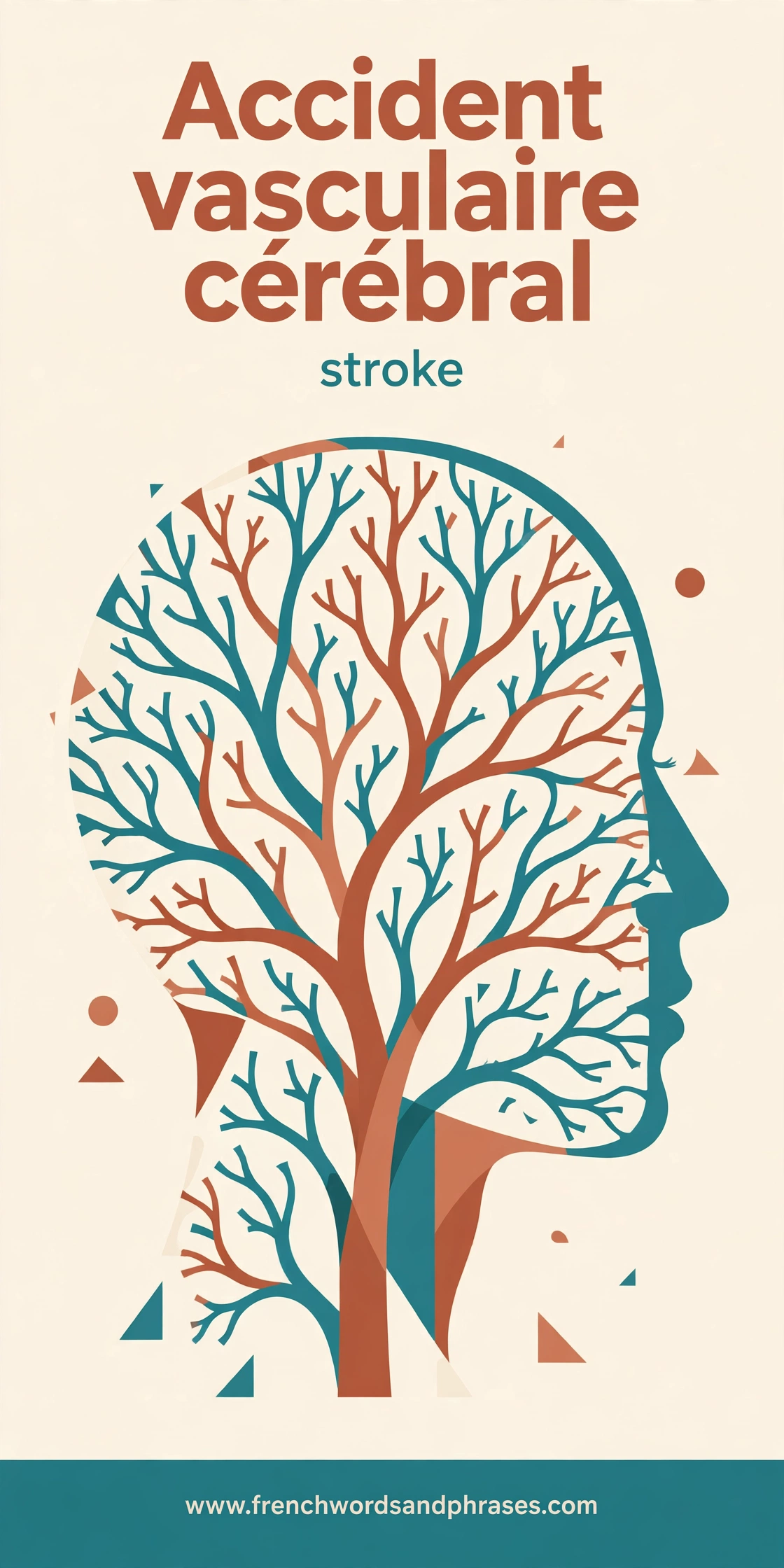
Accident vasculaire cérébral means stroke — the sudden brain event known everywhere in French as an AVC.
The ambulance doors open and the nurse is already speaking in initials: « AVC, côté gauche, il y a vingt minutes. » Three letters move the whole hospital — because accident vasculaire cérébral, a stroke, is the diagnosis where minutes are measured in brain cells.
Let’s explore how accident vasculaire cérébral works in French, beginning with the whole term on one card.
Understanding the French Phrase Accident vasculaire cérébral
Accident vasculaire cérébral is a French medical term built from accident (a sudden harmful event — a masculine noun that has its own page on this site), vasculaire (vascular — of the blood vessels) and cérébral (cerebral — of the brain). Word for word: a vascular accident of the brain. It is the formal, full name of a stroke — and in real French life it travels almost everywhere under its initials: un AVC.
It means a stroke — the loss of brain function that follows when the blood supply to the brain is suddenly interrupted, either by a blocked vessel (the ischaemic kind, the most common) or by a burst one (the haemorrhagic kind). Face drooping, arm weakness, speech trouble: the signs arrive in seconds and the treatment is a race. The source dictionaries sometimes call the term formal, even euphemistic — in practice it is simply the official name, the one on the chart, while AVC is the one in every mouth.
Type: Medical term — a diagnosis (accident + vasculaire + cérébral), shortened to AVC
Answers the need: Naming the emergency exactly — in the ambulance, the ward, the report, the family
Register: Formal and technical — the full form; AVC is universal at every level
Strength: Maximal — a leading cause of disability; every minute counts
One important usage detail: the adjectives stack in a fixed order after accident — vasculaire first, cérébral second — and both agree with accident (masculine singular). Cerebral palsy of vocabulary aside, the living word is the initials: faire un AVC, victime d’un AVC, après un AVC. Learn the full term to understand the chart; use AVC to be understood in the corridor.
Experience the Word
Accident vasculaire cérébral is a term that teaches its own urgency — three long words that French medicine itself found too slow, and replaced with three letters.
Imagine the rehabilitation ward, three months on: the former teacher relearning to write her name, letter by letter, the therapist patient as seasons. On her file, the three letters AVC. The full term belongs to the day it happened; the initials accompany the long road back.
English stroke is a single blunt blow of a word — the blow that fells. French describes the machinery instead: a vessel, a brain, an accident — the anatomy of the blow.
How to Use Accident vasculaire cérébral in French: Complete Guide
Let’s explore how accident vasculaire cérébral works in French, beginning with the whole term on one card.
Accident vasculaire cérébral at a Glance
The Whole Term on One Card
Real meaning, literal picture, English twin and register — accident vasculaire cérébral in five lines.
| Point | Accident vasculaire cérébral |
|---|---|
| What it really means | a stroke — brain function lost when its blood supply is suddenly interrupted |
| Word for word | a vascular accident of the brain — a vessel event in the brain |
| English equivalent | stroke (cerebrovascular accident) |
| Short form | un AVC — the initials, used by everyone, everywhere |
| Use it for | diagnoses, emergency calls, reports, prevention campaigns |
Example
Il a fait un accident vasculaire cérébral à l’âge de soixante ans.
He had a stroke at the age of sixty.
Word by Word: Building the Term
Three pieces — take them one by one and the diagnosis maps the disaster.
| Word | Literal meaning | Its job in the term |
|---|---|---|
| accident | sudden harmful event | the event itself — a masculine noun: un accident |
| vasculaire | vascular, of the vessels | the system at fault: the blood vessels |
| cérébral | cerebral, of the brain | the place: the brain, starved or flooded with blood |
Example
Vasculaire parle des vaisseaux, cérébral du cerveau.
Vasculaire speaks of the vessels, cérébral of the brain.
Quick Quiz 1
What do the initials AVC stand for?
Reveal the answer
Accident vasculaire cérébral — A for accident, V for vasculaire, C for cérébral.
On dit presque toujours « un AVC » dans la vie courante.
People almost always say “an AVC” in everyday life.
Where You Meet It: The Term in Its World
Accident vasculaire cérébral turns up in moments like these — sudden signs, fast ambulances, long recoveries.
| Situation | Example |
|---|---|
| The signs | le visage paralysé, le bras faible, la parole troublée — face paralysed, arm weak, speech troubled |
| The emergency | appeler le 15 — call the emergency number (15 in France) |
| The two kinds | un AVC ischémique ou hémorragique — an ischaemic or haemorrhagic stroke |
| The treatment | chaque minute compte — every minute counts |
| The aftermath | la rééducation après un AVC — rehabilitation after a stroke |
Example
Devant un AVC, chaque minute compte : on appelle le 15.
Faced with a stroke, every minute counts: call 15.
Make It Yours: The Term in Sentences
The full term is fixed — in living French, the initials do the daily work.
| Form | French | In English |
|---|---|---|
| The full term | un accident vasculaire cérébral | a stroke (full medical name) |
| The short form | un AVC | a stroke |
| Suffering one | faire un AVC | to have a stroke |
| Surviving one | survivre à un AVC | to survive a stroke |
| Recovering from one | se remettre d’un AVC | to recover from a stroke |
Example
Elle se remet lentement de son AVC, avec l’aide des kinés.
She is slowly recovering from her stroke, with the physios’ help.
Quick Quiz 2
Complete it: Un accident ______ cérébral, c’est un AVC. (vascular)
Reveal the answer
vasculaire — the vessel word stands between accident and cérébral, in that fixed order.
Un accident vasculaire cérébral, c’est un AVC.
A cerebrovascular accident is a stroke.
Everyday Expressions: The Emergency Frame
The term slots into these medical frames — each one ready to use as it stands.
| Frame | In English |
|---|---|
| faire un AVC | to have a stroke |
| les signes d’un AVC | the signs of a stroke |
| victime d’un AVC | a stroke victim, someone who has had a stroke |
| la rééducation | rehabilitation, re-education of movement and speech |
| les séquelles d’un AVC | the after-effects of a stroke |
Example
Connaître les signes d’un AVC peut sauver une vie.
Knowing the signs of a stroke can save a life.
Close Cousins: The Other Brain Events
The neurology shelf separates the cousins by what happens to the blood — and for how long.
| Expression | The difference |
|---|---|
| accident vasculaire cérébral | a stroke — the full event; damage that must be treated and repaired |
| accident ischémique transitoire (AIT) | a transient ischaemic attack — the same mechanism, but it passes without lasting damage |
| une hémorragie cérébrale | a cerebral haemorrhage — bleeding in the brain, one cause of an AVC |
| un anévrisme | an aneurysm — the weakened vessel that may burst |
Example
L’AIT est l’alerte ; l’AVC est l’événement.
The TIA is the warning; the stroke is the event.
Quick Quiz 3
Which cousin is the passing warning — l’AVC or l’AIT?
Reveal the answer
L’AIT — the accident ischémique transitoire passes without lasting damage, and warns that an AVC may follow.
Après un AIT, on surveille le risque d’AVC.
After a TIA, the risk of stroke is monitored.
Accident vasculaire cérébral and Its Neighbours
The neurology shelf around the term — vessels, brain and recovery.
| French | In English |
|---|---|
| un vaisseau sanguin | a blood vessel |
| le cerveau | the brain |
| un caillot | a (blood) clot |
| la tension | blood pressure |
| la rééducation | rehabilitation |
Example
Un caillot bouche un vaisseau du cerveau : c’est l’AVC ischémique.
A clot blocks a vessel in the brain: that is the ischaemic stroke.
Watch Out: The Traps Around Accident vasculaire cérébral
The traps: the word order, and a full name nobody says aloud.
| Trap | The truth |
|---|---|
| swapping the adjectives | the order is fixed: vasculaire, then cérébral — accident vasculaire cérébral |
| using the full term in conversation | possible but heavy: everyone, doctors included, says un AVC |
| confusing cérébral and cervelle | cérébral is the adjective of le cerveau; la cervelle is the brain as matter (and food) — the term uses cérébral |
| translating stroke as coup | un coup is a blow in other phrases (coup de soleil, sunstroke) — for the brain event, French says AVC |
Example
On écrit accident vasculaire cérébral, on dit AVC.
You write accident vasculaire cérébral, you say AVC.
Quick Quiz 4
True or false: in everyday French, doctors and families alike usually say the full term.
Reveal the answer
False — the full term belongs to charts and formal writing; the living word, at every level, is AVC.
Même les médecins disent « un AVC » entre eux.
Even doctors say “an AVC” among themselves.
Accident vasculaire cérébral in Everyday French: Real-Life Examples
Now that you know the word, let’s see how accident vasculaire cérébral appears in everyday French.
Example 1 — The news
Son père a fait un AVC la nuit dernière.
His father had a stroke last night.
Example 2 — The signs
Le visage paralysé d’un côté est un signe d’AVC.
A face paralysed on one side is a sign of a stroke.
Example 3 — The emergency
Devant ces signes, on appelle le 15 immédiatement.
Faced with these signs, call 15 immediately.
Example 4 — Recovery
Après son accident vasculaire cérébral, il réapprend à parler.
After his stroke, he is learning to speak again.
Example 5 — Prevention
La tension élevée augmente le risque d’AVC.
High blood pressure increases the risk of stroke.
Example 6 — The file
Le dossier indique : accident vasculaire cérébral, côté droit.
The file reads: stroke, right side.
Beyond Translation: The Meaning of Accident vasculaire cérébral
Languages choose their metaphors for catastrophe. English stroke remembers the blow — the stroke of fate, of a hand, of lightning. French chose the report instead: accident vasculaire cérébral, the vessel, the brain, the event, itemised like an engineer’s account of a failure.
And then life corrected the paperwork: three words became three letters, AVC, because an emergency cannot wait for its own name.
Learn both forms and you hold the whole register of French medicine — the full term for understanding, the initials for acting.
How to Remember the French Phrase Accident vasculaire cérébral
Remember it this way: Accident vasculaire cérébral means stroke — a vascular accident of the brain, shortened everywhere to AVC.
- You decode the initials — AVC: accident, vasculaire, cérébral, in that order.
- You map the term — vasculaire, the vessels; cérébral, the brain; accident, the sudden event.
- You know the warning cousin — l’AIT passes; l’AVC is the event itself.
The key idea is accident vasculaire cérébral = stroke, short form AVC — vessels + brain; its passing warning cousin is the AIT.
Test Your Knowledge of Accident vasculaire cérébral
Let’s see how much you’ve learned. Try answering these questions before revealing the answers.
Question 1
What does accident vasculaire cérébral mean?
Reveal the answer
A stroke — loss of brain function when the brain’s blood supply is suddenly interrupted.
Question 2
What is the short form everyone uses?
Reveal the answer
Un AVC — the initials of accident vasculaire cérébral.
Question 3
Translate: He had a stroke last night.
Reveal the answer
Il a fait un AVC la nuit dernière.
Question 4
What are the two kinds of stroke?
Reveal the answer
Ischaemic> (a blocked vessel — the most common) and haemorrhagic (a burst vessel).
Question 5
Complete the sentence:
Un accident ______ cérébral est une urgence. (vascular)
Reveal the answer
vasculaire
Un accident vasculaire cérébral est une urgence.
A stroke is an emergency.
Your Final Challenge
Can You Use It?
How would you say this in French?
“Faced with a stroke, every minute counts.”
Reveal the answer
Devant un AVC, chaque minute compte.
Faced with a stroke, every minute counts.
A little French. A little curiosity. A richer everyday life.
LEARN FRENCH ONE WORD AT A TIME