
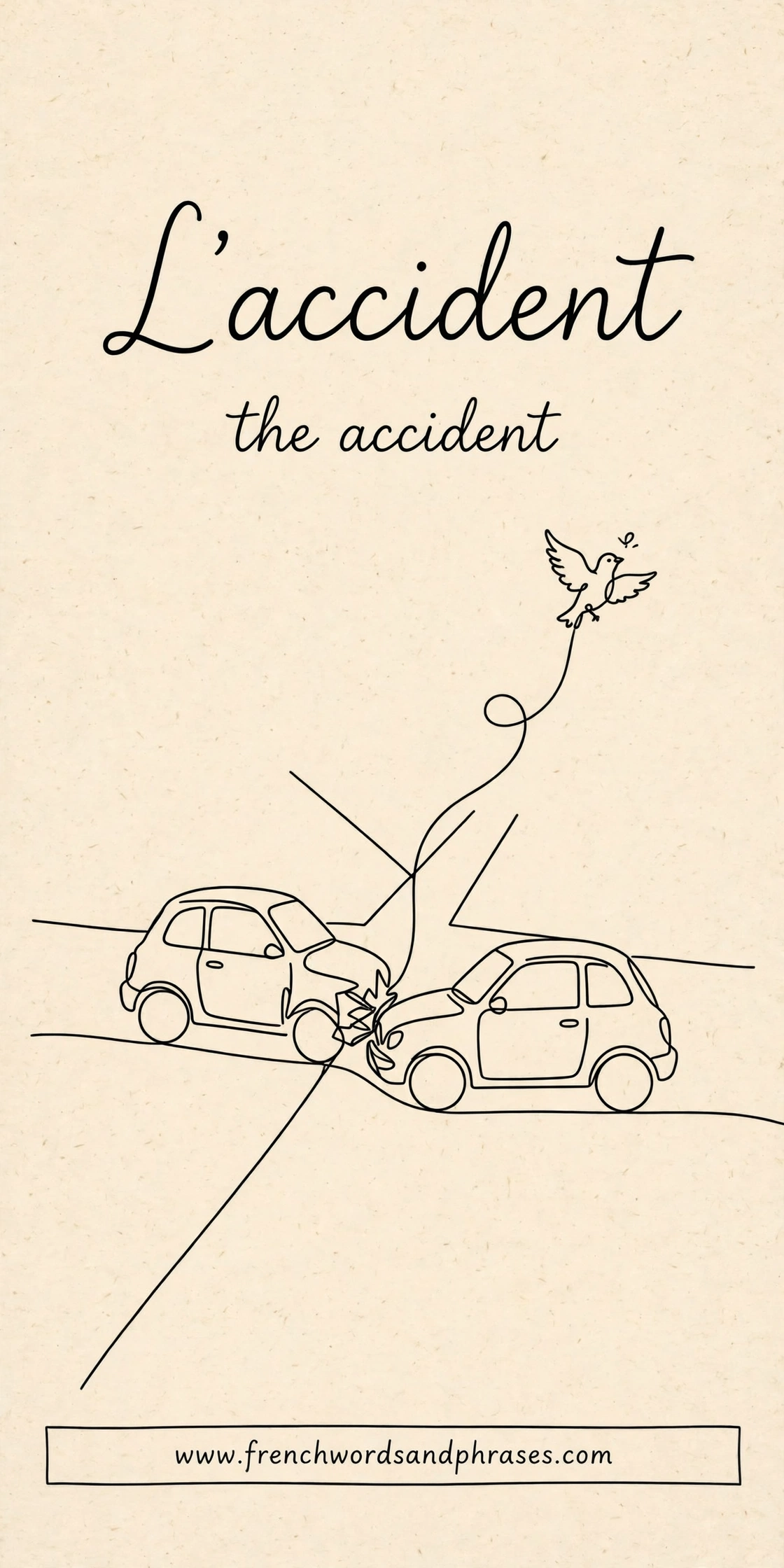
A French Word to Live By
Translate Accident to English
/aksidɑ̃/
L’accident means the accident.
Rain on the motorway, a line of brake lights, a crumpled bumper — an accident. But the same word hides in a happier scene: two old friends colliding in a foreign airport, laughing, « par accident », by pure chance. L’accident is French for everything that was never in the plan.
In this guide, you’ll learn what accident means in English, how to use it with its articles, how to form its plural, and how it appears in everyday French. Explore French examples, English translations, and practice quizzes.
Understanding the French Noun Accident
Accident is a masculine French noun, learned with its article: l’accident, un accident. It begins with a vowel, so the article melts into it: l’accident. It descends from the Latin accidens, what falls, what happens — from cadere, to fall, the root that also gives French chance its cousins.
It means an accident: an unfortunate event that happens by chance, above all a crash — un accident de voiture, a car accident, un accident de la route, a road accident, un accident du travail, a workplace accident. But the word is wider than disaster: par accident means by accident, by chance, unintentionally — you can delete a file or meet your future spouse par accident. In music, un accident is even the sharp or flat sign before a note.
Gender: Masculine — l’accident
Definite article: l’ — l’accident (the accident), melted before the vowel
Indefinite article: un — un accident (an accident)
Plural: les accidents
Spelling note: double c before e sounds /ks/; the final -ent is a nasal sound — the t is silent
Register: everyday — news, insurance, hospitals, conversation
English equivalents: The accident.
Two phrases carry the word through daily life. Avoir un accident, to have an accident, is what drivers and insurers say; and par accident turns any verb into a mistake or a coincidence: je l’ai effacé par accident, I deleted it by accident. After a crash, French drivers fill in un constat d’accident, the joint accident report form — a piece of paper every motorist in France knows.
Experience the Word
Accident is the word for the unplanned — the moment the day leaves its rails, for worse and occasionally for better.
Imagine the insurance form on the kitchen table, the sketch of two cars, the careful handwriting. Then imagine the same word at a wedding: « On s’est rencontrés par accident. » The crash and the coincidence share one small noun.
You have not just named a mishap. You have named chance itself when it hurts or surprises — l’accident, the thing nobody scheduled.
How to Use Accident in French: Complete Guide
Let’s explore how accident works in French, beginning with its articles — l’accident, un accident, par accident.
Accident with the Definite Article (L’, Les)
Used for a specific accident — the one in the news, the one on this road.
| Form | French |
|---|---|
| Masculine singular | l’accident |
| Plural | les accidents |
Example
L’accident a bloqué la route pendant deux heures.
The accident blocked the road for two hours.
Accident with the Indefinite Article (Un, Des)
Used for an accident in general — the kind everyone hopes to avoid.
| Form | French |
|---|---|
| Masculine singular | un accident |
| Plural | des accidents |
Example
Un accident est vite arrivé sur cette route.
An accident soon happens on this road.
Accident at Work (Par accident…)
Crashes and coincidences — the phrases that put accident to work.
| Use | French |
|---|---|
| by accident, by chance | par accident |
| a car accident | un accident de voiture |
| a road accident | un accident de la route |
| a workplace accident | un accident du travail |
| to have an accident | avoir un accident |
Example
Ils se sont rencontrés par accident à l’aéroport.
They met by chance at the airport.
Quick Quiz 1
Complete the sentence:
______ accident n’a fait aucun blessé. (the)
Reveal the answer
L’
L’accident n’a fait aucun blessé.
The accident injured no one — le melts into l’ before the vowel.
The Plural of Accident
Roads, winters and workshops supply the plural all too regularly.
| Number | French |
|---|---|
| Singular | l’accident |
| Plural | les accidents |
Example
Les accidents de ski remplissent les urgences en hiver.
Skiing accidents fill the emergency rooms in winter.
Accident with Possessive Adjectives (Mon, Ton, Son…)
Possessives agree with the noun: accident is masculine, so mon, ton, son in the singular.
| Owner | French |
|---|---|
| my | mon accident |
| your (tu) | ton accident |
| his / her | son accident |
| our | notre accident |
| your (vous) | votre accident |
| their | leur accident |
Example
Après son accident, il conduit plus prudemment.
After his accident, he drives more carefully.
Quick Quiz 2
Complete the sentence:
Elle raconte ______ accident à l’assureur. (her)
Reveal the answer
son
Elle raconte son accident à l’assureur.
She tells the insurer about her accident — accident is masculine, so son.
Accident with Demonstrative Adjectives (Cet, Ces)
Used to point: cet accident, this accident — the one everyone is discussing.
| Form | French |
|---|---|
| Masculine singular | cet accident |
| Plural | ces accidents |
Example
Cet accident aurait pu être évité.
This accident could have been avoided.
Accident with Adjectives
Adjectives agree with accident — masculine singular: un accident grave, un petit accident.
| Adjective | With Accident |
|---|---|
| grave (serious) | un accident grave |
| mortel (fatal) | un accident mortel |
| petit (small) | un petit accident |
| de voiture (car) | un accident de voiture |
| bête (silly, stupid) | un accident bête |
Example
Un accident grave a fermé l’autoroute.
A serious accident has closed the motorway.
Quick Quiz 3
Complete the sentence:
Un accident ______ peut coûter la vie. (fatal)
Reveal the answer
mortel
Un accident mortel peut coûter la vie.
A fatal accident can cost lives.
Everyday Expressions with Accident
Insurance forms and happy chances — the accident phrases of daily life.
| Expression | In English |
|---|---|
| par accident | by accident, by chance |
| avoir un accident | to have an accident |
| un accident de la route | a road accident |
| déclarer un accident | to report an accident (to insurance) |
| un constat d’accident | an accident report form |
Example
J’ai effacé le fichier par accident.
I deleted the file by accident.
Words from the Same Family as Accident
Chance, falls and collisions — the words that travel with accident.
| French | In English |
|---|---|
| la chance | the luck, the chance |
| le hasard | the chance, randomness |
| la chute | the fall |
| la collision | the collision |
| l’assurance | the insurance |
Example
Après l’accident, l’assurance paie les réparations.
After the accident, the insurance pays for the repairs.
Quick Quiz 4
What does « par accident » mean?
Reveal the answer
By accident, by chance — unintentionally, without planning it.
Je l’ai appris par accident.
I learned it by chance.
Accident in Everyday French: Real-Life Examples
Now that you know the word, let’s see how accident appears in everyday French.
Example 1 — News
Un accident sur l’autoroute ralentit la circulation.
An accident on the motorway is slowing traffic.
Example 2 — By chance
Je suis tombé sur ce livre par accident.
I came across this book by chance.
Example 3 — At work
Il a eu un accident du travail à l’usine.
He had a workplace accident at the factory.
Example 4 — Small mishap
Ce n’est qu’un petit accident, rien de cassé.
It’s only a small accident, nothing broken.
Example 5 — Insurance
Elle déclare l’accident à son assurance.
She reports the accident to her insurance.
Example 6 — Luck
Par un heureux accident, le train était en retard aussi.
By a happy accident, the train was late too.
Beyond Translation: The Meaning of Accident
Accident began as philosophy: the Latin accidens, what falls toward you, named everything about a thing that could be otherwise — its colour, its place, its luck — against its essence, what it must be. French daily life kept both ends of the word. It is the crash on the wet road and the meeting that changes a life; the form you fill in and the story you tell at weddings. Few words admit so honestly how much of a life is unplanned.
To say accident is to give chance a name and a form to fill in.
It evokes flashing lights on a night road — and, just as often, a smile: par accident, thank goodness.
How to Remember the French Noun Accident
Remember it this way: Accident is the accident — the crash and the coincidence in one word: l’accident, and par accident, by chance.
- Always masculine — l’accident, un accident, cet accident.
- The double life — a mishap (un accident de voiture) and pure chance (par accident).
- The saying — un accident est vite arrivé, an accident soon happens: be careful.
The key idea is l’accident — the accident, masculine; par accident = by chance.
Test Your Knowledge of Accident
Let’s see how much you’ve learned. Try answering these questions before revealing the answers.
Question 1
Is accident masculine or feminine?
Reveal the answer
Masculine — l’accident, un accident.
Question 2
How do you say by chance, by accident?
Reveal the answer
Par accident.
Question 3
Translate: He had a car accident.
Reveal the answer
Il a eu un accident de voiture.
Question 4
What form do drivers fill in after a crash?
Reveal the answer
Un constat d’accident — the joint accident report form.
Question 5
Complete the sentence:
______ accident a eu lieu hier soir. (the)
Reveal the answer
L’
L’accident a eu lieu hier soir.
The accident took place last night.
Your Final Challenge
Can You Use It?
How would you say this in French?
“They met by chance at the station.”
Reveal the answer
Ils se sont rencontrés par accident à la gare.
They met by chance at the station.
A little French. A little curiosity. A richer everyday life.
LEARN FRENCH ONE WORD AT A TIME




