A French Word to Live By
Translate Abstème to English
/ap.stɛm/
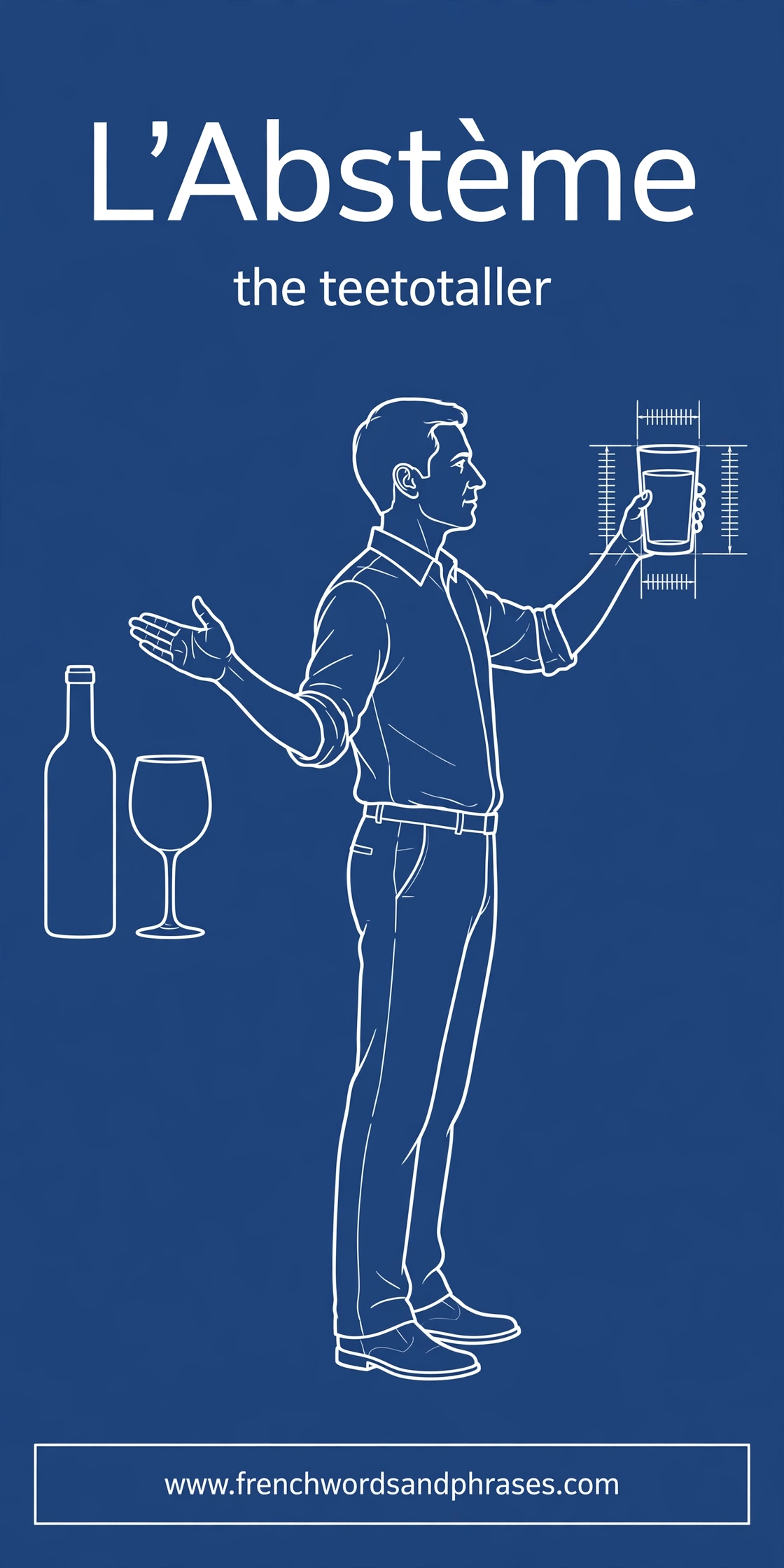
L’Abstème means the teetotaller.
The wedding feast is in full swing, the champagne is going round, and one guest lifts his glass with all the others — a glass of sparkling water, with a smile and not a drop of embarrassment. He has not touched alcohol in forty years, by choice: l’abstème.
In this guide, you’ll learn what abstème means in English, how to use it with its articles, how to form its plural, and how it appears in everyday French. Explore French examples, English translations, and practice quizzes.
Understanding the French Noun Abstème
Abstème is a masculine French noun, learned with its article: l’abstème, un abstème — it begins with a vowel, so le shrinks to l’. The same form serves for a woman: une abstème. It is also an adjective: un homme abstème, a man who never drinks.
It means the teetotaller — a person who abstains completely from alcohol, not for an evening but as a settled choice of life. The abstème does not drink wine, beer or spirits at all; at the table you will find water, juice or coffee in his glass, and often a very clear head the next morning.
Gender: Masculine
Feminine: abstème — same spelling, une abstème (the teetotaller, a woman)
Definite article: l’ — l’abstème (the teetotaller)
Indefinite article: un — un abstème (a teetotaller); une — une abstème (a teetotaller, a woman)
Plural: les abstèmes
English equivalents: The teetotaller.
One important usage detail: abstème is a rather formal, dictionary-flavoured word. In everyday conversation, French people usually explain instead — il ne boit jamais d’alcool, he never drinks alcohol. Abstème is the precise label; the explanation is what you will actually hear.
Experience the Word
Abstème is more than a drinking habit. It is a quiet discipline kept at the loudest tables — weddings, birthdays, New Year’s Eve — where saying no, gracefully, a hundred times a year takes a steady character.
Imagine the toast at midnight: twenty glasses of champagne rise, and one glass of water rises with them, exactly as high, with exactly the same joy.
You have not just refused a drink. You have kept a promise to yourself — une promesse tenue.
How to Use Abstème in French: Complete Guide
Let’s explore how abstème works in French, beginning with its articles — a vowel-start word with one form for men and women alike.
Abstème with the Definite Article (L’, Les)
Abstème begins with a vowel, so le and la both shrink to l’ — l’abstème, the person everyone knows never drinks.
| Form | French |
|---|---|
| Singular | l’abstème |
| Plural | les abstèmes |
Example
L’abstème commande un jus d’orange pendant que les autres choisissent un vin.
The teetotaller orders an orange juice while the others choose a wine.
Abstème with the Indefinite Article (Un, Une, Des)
Used for a teetotaller in general — un or une tells you whether it is a man or a woman.
| Form | French |
|---|---|
| Masculine singular | un abstème |
| Feminine singular | une abstème |
| Plural | des abstèmes |
Example
C’est une abstème depuis l’âge de vingt ans.
She has been a teetotaller since the age of twenty.
At the Table: Drinks and Choices
Toasts, glasses and polite refusals — the vocabulary that surrounds the abstème.
| French | In English |
|---|---|
| l’alcool | alcohol |
| un verre d’eau | a glass of water |
| un jus de fruits | a fruit juice |
| trinquer | to clink glasses, to toast |
| refuser poliment | to refuse politely |
| ne jamais boire | to never drink |
Example
L’abstème trinque avec un verre d’eau, comme tout le monde.
The teetotaller clinks glasses with a glass of water, like everyone else.
Quick Quiz 1
Complete the sentence:
Mon grand-père est ______, il ne boit que de l’eau.
Reveal the answer
abstème
Mon grand-père est abstème, il ne boit que de l’eau.
My grandfather is a teetotaller; he drinks only water.
The Plural of Abstème
Abstème adds an -s in the plural — les abstèmes, the teetotallers at the table.
| Number | French |
|---|---|
| Singular | l’abstème |
| Plural | les abstèmes |
Example
Les abstèmes de la famille trinquent au jus de pomme.
The teetotallers in the family toast with apple juice.
Abstème with Possessive Adjectives (Mon, Ton, Son…)
Abstème begins with a vowel, so even for a woman the possessives are mon, ton, son — never « ma abstème ».
| Owner | French |
|---|---|
| my | mon abstème |
| your (tu) | ton abstème |
| his / her | son abstème |
| our | notre abstème |
| your (vous) | votre abstème |
| their | leur abstème |
Example
Notre abstème de tante prépare toujours un punch sans alcool.
Our teetotaller of an aunt always makes an alcohol-free punch.
Quick Quiz 2
Complete the sentence:
______ abstème préféré ne manque jamais une fête. (Our)
Reveal the answer
Notre
Notre abstème préféré ne manque jamais une fête.
Our favourite teetotaller never misses a party.
Abstème with Demonstrative Adjectives (Cet, Ces)
Used to point: cet abstème, with cet because the word begins with a vowel.
| Form | French |
|---|---|
| Singular | cet abstème |
| Plural | ces abstèmes |
Example
Cet abstème n’a pas touché un verre de vin depuis 1980.
This teetotaller has not touched a glass of wine since 1980.
Abstème with Adjectives
Adjectives agree with the person: convaincu becomes convaincue for a woman.
| Adjective | With Abstème |
|---|---|
| convaincu (convinced) | un abstème convaincu / une abstème convaincue |
| strict (strict) | un abstème strict / une abstème stricte |
| joyeux (cheerful) | un abstème joyeux / une abstème joyeuse |
| ancien (long-standing) | un ancien abstème / une ancienne abstème |
| fier (proud) | un abstème fier / une abstème fière |
Example
C’est un abstème joyeux qui danse jusqu’au bout de la fête.
He is a cheerful teetotaller who dances until the end of the party.
Quick Quiz 3
Complete the sentence:
Elle est une abstème très ______. (proud)
Reveal the answer
fière
Elle est une abstème très fière.
She is a very proud teetotaller — the adjective takes the feminine form even though abstème keeps its shape.
Everyday Expressions with Abstème
Toasts and refusals — the abstème phrases of daily life.
| Expression | In English |
|---|---|
| être abstème | to be a teetotaller |
| rester abstème | to remain a teetotaller |
| un abstème convaincu | a convinced teetotaller |
| ne jamais toucher à l’alcool | to never touch alcohol |
| trinquer sans alcool | to toast without alcohol |
| un punch sans alcool | an alcohol-free punch |
Example
Il est abstème, mais il trinque volontiers avec un jus de fruits.
He is a teetotaller, but he gladly toasts with a fruit juice.
Words from the Same Family as Abstème
Abstaining, sobriety and alcohol — the words that travel with abstème.
| French | In English |
|---|---|
| l’abstinence | abstinence |
| s’abstenir | to abstain |
| sobre | sober, temperate |
| la sobriété | sobriety |
| l’alcool | alcohol |
| boire | to drink |
Example
L’abstème pratique l’abstinence avec le sourire.
The teetotaller practises abstinence with a smile.
Quick Quiz 4
How do French people usually express this idea in everyday speech?
Reveal the answer
With an explanation, not the label — il ne boit jamais d’alcool, he never drinks alcohol. Abstème is the dictionary’s precise word.
Elle est abstème : elle ne boit jamais d’alcool.
She is a teetotaller: she never drinks alcohol.
Abstème in Everyday French: Real-Life Examples
Now that you know the word, let’s see how abstème appears in everyday French.
Example 1 — At a wedding
L’abstème lève son verre d’eau pendant le toast.
The teetotaller raises his glass of water during the toast.
Example 2 — Explaining a choice
Je suis abstème, je ne bois jamais d’alcool.
I am a teetotaller, I never drink alcohol.
Example 3 — At the restaurant
Pour l’abstème de la table, un jus de fruits, s’il vous plaît.
For the teetotaller at the table, a fruit juice, please.
Example 4 — Family history
Mon grand-père, abstème toute sa vie, a vécu jusqu’à cent ans.
My grandfather, a teetotaller all his life, lived to a hundred.
Example 5 — A kind host
Elle prépare un punch sans alcool pour son amie abstème.
She is making an alcohol-free punch for her teetotaller friend.
Example 6 — New Year
Même le 31 décembre, cet abstème trinque à l’eau pétillante.
Even on New Year’s Eve, this teetotaller toasts with sparkling water.
Beyond Translation: The Meaning of Abstème
The abstème is a figure of quiet consistency in a country that loves its wine. France puts a bottle at the centre of almost every celebration, so the person who never drinks becomes a small social puzzle — until everyone realises the glass in his hand matters far less than the person holding it.
To say abstème is to name a choice kept calmly, in public, for a lifetime.
It evokes the raised glass of water at midnight, the host who remembers and prepares something special, and a very French lesson: taking part is about presence, not about what is poured.
How to Remember the French Noun Abstème
Remember it this way: Abstème is the teetotaller — a vowel-start word with one form for everyone: un abstème, une abstème.
- You see the table — l’abstème trinque à l’eau, sans gêne.
- You remember the vowel — mon abstème, pas ma abstème.
- You hear everyday French — il ne boit jamais d’alcool, voilà l’idée.
The key idea is l’abstème — the one whose glass holds water.
Test Your Knowledge of Abstème
Let’s see how much you’ve learned. Try answering these questions before revealing the answers.
Question 1
What is an abstème?
Reveal the answer
A teetotaller — a person who abstains completely from alcohol.
Question 2
Is abstème masculine or feminine?
Reveal the answer
Masculine — l’abstème, un abstème — and the same form serves for a woman: une abstème.
Question 3
Translate: My grandfather is a teetotaller; he drinks only water.
Reveal the answer
Mon grand-père est abstème ; il ne boit que de l’eau.
Question 4
What does trinquer mean?
Reveal the answer
To clink glasses, to toast — something the abstème does with water or juice, like everyone else.
Question 5
Complete the sentence:
______ abstème commande un café après le repas. (This)
Reveal the answer
Cet
Cet abstème commande un café après le repas.
This teetotaller orders a coffee after the meal — cet, because the word begins with a vowel.
Your Final Challenge
Can You Use It?
How would you say this in French?
“My grandfather is a teetotaller; he drinks only water.”
Reveal the answer
Mon grand-père est abstème ; il ne boit que de l’eau.
My grandfather is a teetotaller; he drinks only water.
A little French. A little curiosity. A richer everyday life.
LEARN FRENCH ONE WORD AT A TIME