A French Word to Live By
How to Conjugate Absoudre in French
/ap.sudʁ/
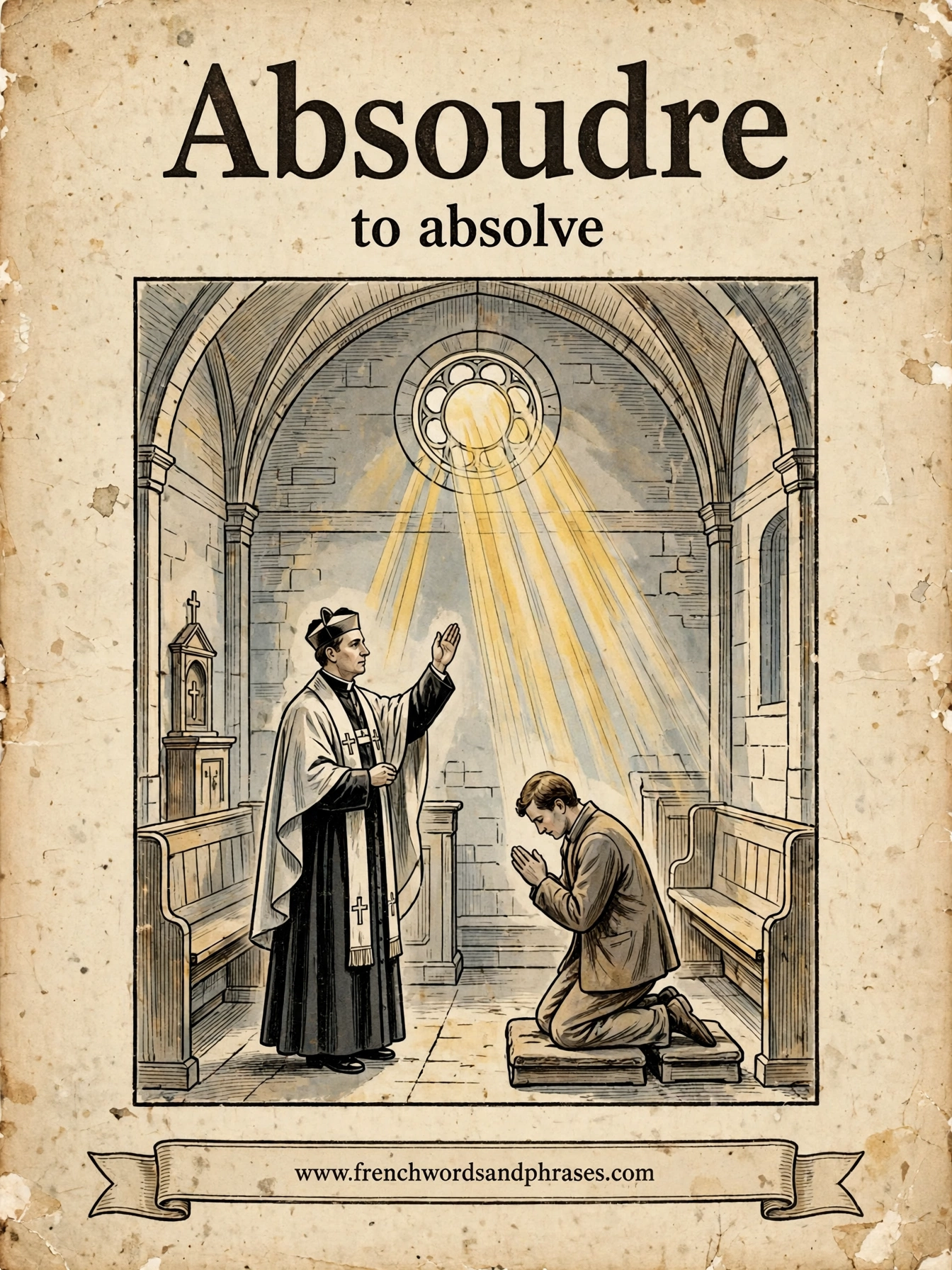
Absoudre means to absolve — to free someone from guilt, in the confessional or in the courtroom.
A penitent kneeling in a quiet church, a jury rising to pronounce an acquittal, a king pardoning a rebel — absoudre is the verb of guilt lifted: the moment an authority, sacred or legal, declares that a fault no longer counts.
In this guide, you’ll learn how to conjugate absoudre in all the major French tenses and moods. Explore complete conjugation tables, French examples, English translations, and practice quizzes.
Understanding the French Verb Absoudre
Absoudre is an irregular French verb ending in -re, with two stems — absolv- and absou- — and a past participle ending in -s.
It means to absolve. It belongs to two solemn worlds: the Church, where the priest absout the penitent in confession — je vous absous — and the law, where a court absout an accused, acquitting him of the charge. Between them it covers pardons by kings and, figuratively, any judgement that clears a name.
Verb classification: Irregular (-re)
Auxiliary verb: Avoir
Past participle: absous
Present participle: absolvant
English equivalents: To absolve, to acquit, to pardon; absoudre un pécheur — to absolve a sinner; absoudre un accusé — to acquit an accused; l’absolution — absolution; être absous — to be acquitted, absolved.
One important detail: absoudre runs on two stems. Where the ending is sounded, you hear absolv-: nous absolvons, vous absolvez, je absolvais, en absolvant, and the subjunctive que j’absolve. In the singular present and the future, the stem is absou-: je absous, tu absous, il absout, j’absoudrai. The past participle is short and strange: absous for a man, absoute for a woman — elle a été absoute. Its cousin dissoudre (to dissolve) conjugates in exactly the same way.
Experience the Word
Absoudre is the verb of the lifted weight — guilt, real or accused, taken off a pair of shoulders by a voice with the right to lift it.
Imagine an old man entering a village church at dusk, carrying a fault for fifty years. He kneels, he whispers, and the priest’s hand rises: je vous absous. He walks out into the evening lighter than the sparrows — absous, not because the past has changed, but because it no longer accuses him.
The fault is still in the past. It has been absolved — absoute — and the past has lost its power to condemn.
How to Conjugate Absoudre: Complete French Conjugation Guide
Let’s explore every major conjugation of absoudre, beginning with the indicative mood.
How to Conjugate Absoudre in the Indicative Mood
The indicative mood is used to express facts, observations, actions, and events.
How to Conjugate Absoudre in the Present Tense (Présent)
Used for actions happening now, habitual actions, and general truths.
| Subject | Conjugation |
|---|---|
| je | absous |
| tu | absous |
| il / elle | absout |
| nous | absolvons |
| vous | absolvez |
| ils / elles | absolvent |
Example
Le prêtre absout les pécheurs qui se repentent.
The priest absolves the sinners who repent.
Quick Quiz 1
Complete the sentence:
Nous ______ les pénitents après la confession.
Reveal the answer
absolvons
Nous absolvons les pénitents après la confession.
We absolve the penitents after confession.
How to Conjugate Absoudre in the Passé Composé
Used for completed actions in the past. Absoudre takes the auxiliary verb avoir.
| Subject | Conjugation |
|---|---|
| j’ | ai absous |
| tu | as absous |
| il / elle | a absous |
| nous | avons absous |
| vous | avez absous |
| ils / elles | ont absous |
Example
Le jury a absous l’accusé faute de preuves.
The jury acquitted the accused for lack of evidence.
How to Conjugate Absoudre in the Imparfait (Imperfect Tense)
Used for habitual past actions, descriptions, and ongoing situations in the past.
| Subject | Conjugation |
|---|---|
| je | absolvais |
| tu | absolvais |
| il / elle | absolvait |
| nous | absolvions |
| vous | absolviez |
| ils / elles | absolvaient |
Example
Autrefois, le roi absolvait les condamnés le jour de sa fête.
In the old days, the king used to pardon the condemned on his feast day.
Quick Quiz 2
Choose the correct form:
The jury acquitted the accused.
Le jury ______ l’accusé. (a absous / est absous)
Reveal the answer
a absous
Le jury a absous l’accusé.
Absoudre takes avoir.
How to Conjugate Absoudre in the Plus-que-parfait
Used to describe an action that had already been completed before another past event.
| Subject | Conjugation |
|---|---|
| j’ | avais absous |
| tu | avais absous |
| il / elle | avait absous |
| nous | avions absous |
| vous | aviez absous |
| ils / elles | avaient absous |
Example
Le prêtre l’avait absous avant son départ.
The priest had absolved him before his departure.
How to Conjugate Absoudre in the Passé Simple
Primarily used in formal writing, literature, and historical narratives. It is rarely used in everyday conversation.
| Subject | Conjugation |
|---|---|
| je | absolus |
| tu | absolus |
| il / elle | absolut |
| nous | absolûmes |
| vous | absolûtes |
| ils / elles | absolurent |
Example
Le juge absolut l’accusé après un court délibéré.
The judge acquitted the accused after a short deliberation.
How to Conjugate Absoudre in the Passé Antérieur
A literary tense used to express an action completed immediately before another past action, generally in the passé simple.
| Subject | Conjugation |
|---|---|
| j’ | eus absous |
| tu | eus absous |
| il / elle | eut absous |
| nous | eûmes absous |
| vous | eûtes absous |
| ils / elles | eurent absous |
Example
Quand le prêtre eut absous le pénitent, la cloche sonna.
When the priest had absolved the penitent, the bell rang.
How to Conjugate Absoudre in the Future Tense (Futur Simple)
Used to describe actions that will take place in the future.
| Subject | Conjugation |
|---|---|
| je | absoudrai |
| tu | absoudras |
| il / elle | absoudra |
| nous | absoudrons |
| vous | absoudrez |
| ils / elles | absoudront |
Example
Le tribunal absoudra les innocents, j’en suis sûr.
The court will acquit the innocent, I am sure of it.
How to Conjugate Absoudre in the Futur Antérieur (Future Perfect)
Used for an action that will have been completed before a particular point in the future.
| Subject | Conjugation |
|---|---|
| j’ | aurai absous |
| tu | auras absous |
| il / elle | aura absous |
| nous | aurons absous |
| vous | aurez absous |
| ils / elles | auront absous |
Example
À la fin du procès, le jury aura absous les deux frères.
By the end of the trial, the jury will have acquitted the two brothers.
How to Conjugate Absoudre in the Near Future (Futur Proche)
Used to describe something that is going to happen soon. Formed with aller + infinitive.
| Subject | Conjugation |
|---|---|
| je | vais absoudre |
| tu | vas absoudre |
| il / elle | va absoudre |
| nous | allons absoudre |
| vous | allez absoudre |
| ils / elles | vont absoudre |
Example
Le prêtre va absoudre les fidèles après la confession.
The priest is going to absolve the faithful after confession.
How to Conjugate Absoudre in the Conditional Mood
The conditional mood expresses what would happen under certain circumstances. It is also frequently used to make polite requests or express wishes.
How to Conjugate Absoudre in the Present Conditional
| Subject | Conjugation |
|---|---|
| je | absoudrais |
| tu | absoudrais |
| il / elle | absoudrait |
| nous | absoudrions |
| vous | absoudriez |
| ils / elles | absoudraient |
Example
Sans preuves, le jury absoudrait l’accusé.
Without evidence, the jury would acquit the accused.
How to Conjugate Absoudre in the Past Conditional
| Subject | Conjugation |
|---|---|
| j’ | aurais absous |
| tu | aurais absous |
| il / elle | aurait absous |
| nous | aurions absous |
| vous | auriez absous |
| ils / elles | auraient absous |
Example
Elle aurait absous son fils même coupable.
She would have absolved her son even if guilty.
Absoudre in the Literary Past Conditional Form
This less common literary form uses the imperfect subjunctive of avoir.
| Subject | Conjugation |
|---|---|
| j’ | eusse absous |
| tu | eusses absous |
| il / elle | eût absous |
| nous | eussions absous |
| vous | eussiez absous |
| ils / elles | eussent absous |
Example
Le roi eût absous le prisonnier sans l’avis de ses conseillers.
The king would have pardoned the prisoner without his advisers’ counsel.
How to Conjugate Absoudre in the Subjunctive Mood
The subjunctive is used to express wishes, emotions, doubts, necessity, and uncertainty. It frequently follows expressions such as il faut que (it is necessary that) or bien que (although).
How to Conjugate Absoudre in the Present Subjunctive
| Subject | Conjugation |
|---|---|
| que je | absolve |
| que tu | absolves |
| qu’il / qu’elle | absolve |
| que nous | absolvions |
| que vous | absolviez |
| qu’ils / qu’elles | absolvent |
Example
Il faut que le prêtre l’absolve avant la messe.
The priest must absolve him before mass.
Quick Quiz 3
Complete the sentence using the subjunctive:
Il faut que vous ______ l’accusé si les preuves manquent.
Reveal the answer
absolviez
Il faut que vous absolviez l’accusé si les preuves manquent.
You must acquit the accused if the evidence is lacking.
How to Conjugate Absoudre in the Imperfect Subjunctive
A literary tense, rarely encountered in modern spoken French.
| Subject | Conjugation |
|---|---|
| que je | absolusse |
| que tu | absolusses |
| qu’il / qu’elle | absolût |
| que nous | absolussions |
| que vous | absolussiez |
| qu’ils / qu’elles | absolussent |
Example
On doutait que le jury absolût l’accusé si vite.
People doubted the jury would acquit the accused so quickly.
How to Conjugate Absoudre in the Pluperfect Subjunctive
A literary construction used to express an action completed before another past action.
| Subject | Conjugation |
|---|---|
| que j’ | eusse absous |
| que tu | eusses absous |
| qu’il / qu’elle | eût absous |
| que nous | eussions absous |
| que vous | eussiez absous |
| qu’ils / qu’elles | eussent absous |
Example
On racontait que le roi eût absous le rebelle.
People said the king had pardoned the rebel.
How to Conjugate Absoudre in the Past Subjunctive
| Subject | Conjugation |
|---|---|
| que j’ | aie absous |
| que tu | aies absous |
| qu’il / qu’elle | ait absous |
| que nous | ayons absous |
| que vous | ayez absous |
| qu’ils / qu’elles | aient absous |
Example
Je suis heureux que le prêtre l’ait absous.
I am glad the priest absolved him.
How to Conjugate Absoudre in the Imperative
The imperative is used to give commands, instructions, invitations, or suggestions. Subject pronouns are omitted.
How to Conjugate Absoudre in the Present Imperative
| Person | Conjugation |
|---|---|
| (tu) | absous |
| (nous) | absolvons |
| (vous) | absolvez |
Example
Absolvez-le, il a assez souffert !
Absolve him, he has suffered enough!
Quick Quiz 4
How would you say Absolve him (tu form)?
Reveal the answer
Absous-le !
French Participles of Absoudre
Participles are verb forms that can be used in compound tenses and other grammatical constructions.
Present Participle of Absoudre
absolvant
En absolvant les pécheurs, le prêtre suit un rite ancien.
In absolving sinners, the priest follows an ancient rite.
Past Participle of Absoudre
absous
Absoute par le prêtre, elle quitta l’église en paix.
Absolved by the priest, she left the church in peace.
Absoudre in Everyday French: Real-Life Examples
Now that you know the conjugations, let’s see how absoudre appears in everyday French.
Example 1 — Present
Le prêtre absout les pécheurs repentants.
The priest absolves the repentant sinners.
Example 2 — Passé composé
Le jury a absous l’accusé.
The jury acquitted the accused.
Example 3 — Imparfait
Le roi absolvait les condamnés.
The king used to pardon the condemned.
Example 4 — Future
Le tribunal absoudra les innocents.
The court will acquit the innocent.
Example 5 — Conditional
Le jury absoudrait l’accusé sans preuves.
The jury would acquit the accused without evidence.
Example 6 — Imperative
Absolvez-le, il a assez souffert !
Absolve him, he has suffered enough!
Beyond Translation: The Meaning of Absoudre
English absolve is the same Latin word — absolvere, to loosen, to set free — and French absoudre keeps both its courtrooms: the confessional and the assizes.
To absolve is to untie.
The fault is not denied and the past is not rewritten; the knot is simply loosened by someone with the authority to loosen it — je vous absous — and the penitent walks out untied.
How to Remember the French Verb Absoudre
Remember it this way: Absoudre is about the knot untied — guilt lifted in church and in court.
- Two stems: absolv- where the ending sounds (nous absolvons, en absolvant), absou- in the singular and future (je absous, j’absoudrai).
- Past participle absous — and absoute for a woman: elle a été absoute.
- Two courtrooms, one verb: the priest absout the sinner, the jury absout the accused.
The key idea is the knot untied — guilt lifted in church and in court.
Test Your Knowledge of Absoudre
Let’s see how much you’ve learned. Try answering these questions before revealing the answers.
Question 1
What are the two stems of absoudre?
Reveal the answer
Absolv- (nous absolvons, en absolvant) and absou- (je absous, j’absoudrai).
Question 2
How do you say The priest absolves the sinners in French?
Reveal the answer
Le prêtre absout les pécheurs.
Question 3
Translate: The jury acquitted the accused for lack of evidence.
Reveal the answer
Le jury a absous l’accusé faute de preuves.
Question 4
What is the past participle of absoudre, for a man and for a woman?
Reveal the answer
Absous for a man, absoute for a woman.
Question 5
Complete the sentence:
Il faut que le prêtre l’______ avant la messe.
Reveal the answer
absolve
Il faut que le prêtre l’absolve avant la messe.
The priest must absolve him before mass.
Your Final Challenge
Can You Use It?
How would you say this in French?
The priest absolves the penitent in a low voice, and the man leaves the church lighter than he entered it.
Reveal the answer
Le prêtre absout le pénitent à voix basse, et l’homme ressort de l’église plus léger qu’il n’y était entré.
The priest absolves the penitent in a low voice, and the man leaves the church lighter than he entered it.
A little French. A little curiosity. A richer everyday life.
LEARN FRENCH ONE WORD AT A TIME