A French Word to Live By
How to Conjugate Abstenir in French
/ap.stə.niʁ/
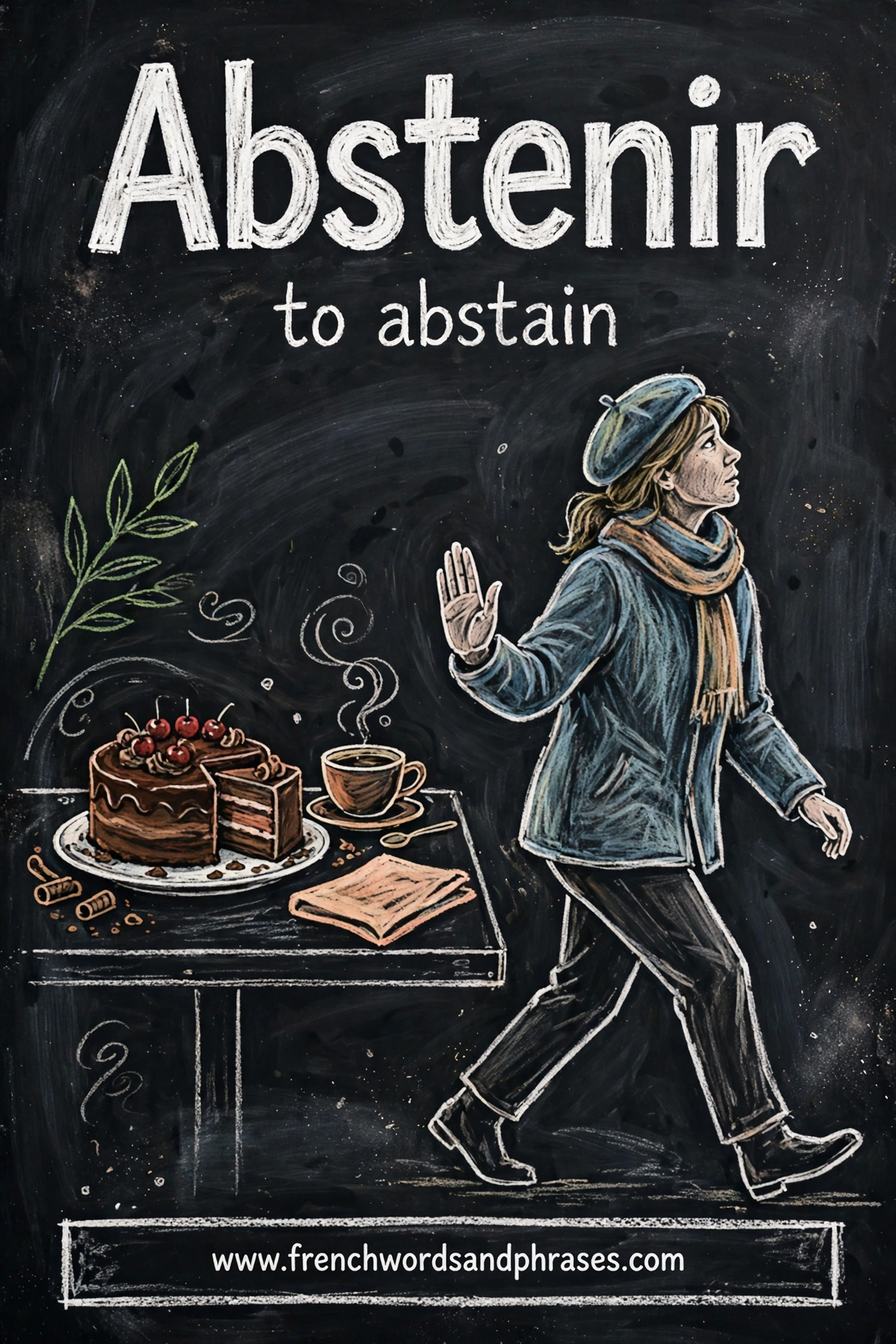
Abstenir — in real life always s’abstenir — means to abstain: to hold yourself back from voting, from drinking, from answering.
A polling station where a third of the names are never called, a diplomat raising neither hand at the United Nations, a guest waving away the wine — abstenir, as s’abstenir, is the verb of the deliberate non-act: the vote not cast, the glass not taken, the reply not sent.
In this guide, you’ll learn how to conjugate abstenir in all the major French tenses and moods. Explore complete conjugation tables, French examples, English translations, and practice quizzes.
Understanding the French Verb Abstenir
Abstenir is an irregular French verb ending in -tenir, conjugated exactly like tenir and used reflexively — s’abstenir — with être in compound tenses.
It means to abstain. It is the official verb of elections — les abstentionnistes are counted as carefully as the voters — and the polite verb of self-denial everywhere else: s’abstenir de fumer, de boire, de répondre. Its noun l’abstention measures the health of a democracy; its cousin l’abstinence belongs to Lent, to medicine and to monks.
Verb classification: Irregular (-tenir), reflexive
Auxiliary verb: Être
Past participle: abstenu
Present participle: abstenant
English equivalents: To abstain, to refrain; s’abstenir de voter — to abstain from voting; s’abstenir de fumer — to refrain from smoking; l’abstention — abstention (at elections); l’abstinence — abstinence; un abstentionniste — an abstainer.
One important detail: s’abstenir is tenir holding itself back, and it keeps every irregularity of its parent: je m’abstiens, tu t’abstiens, il s’abstient with the -ien- stem, nous nous abstenons, vous vous abstenez, ils s’abstiennent; the future runs on abstiendr-: je m’abstiendrai; the passé simple is je m’abstins and the past participle abstenu. Being reflexive, it takes être and the participle agrees: elle s’est abstenue. And it is almost always followed by de: s’abstenir de voter, de boire, de commenter.
Experience the Word
S’abstenir is the verb of the hand that stays down — an act performed by not acting, and counted all the same.
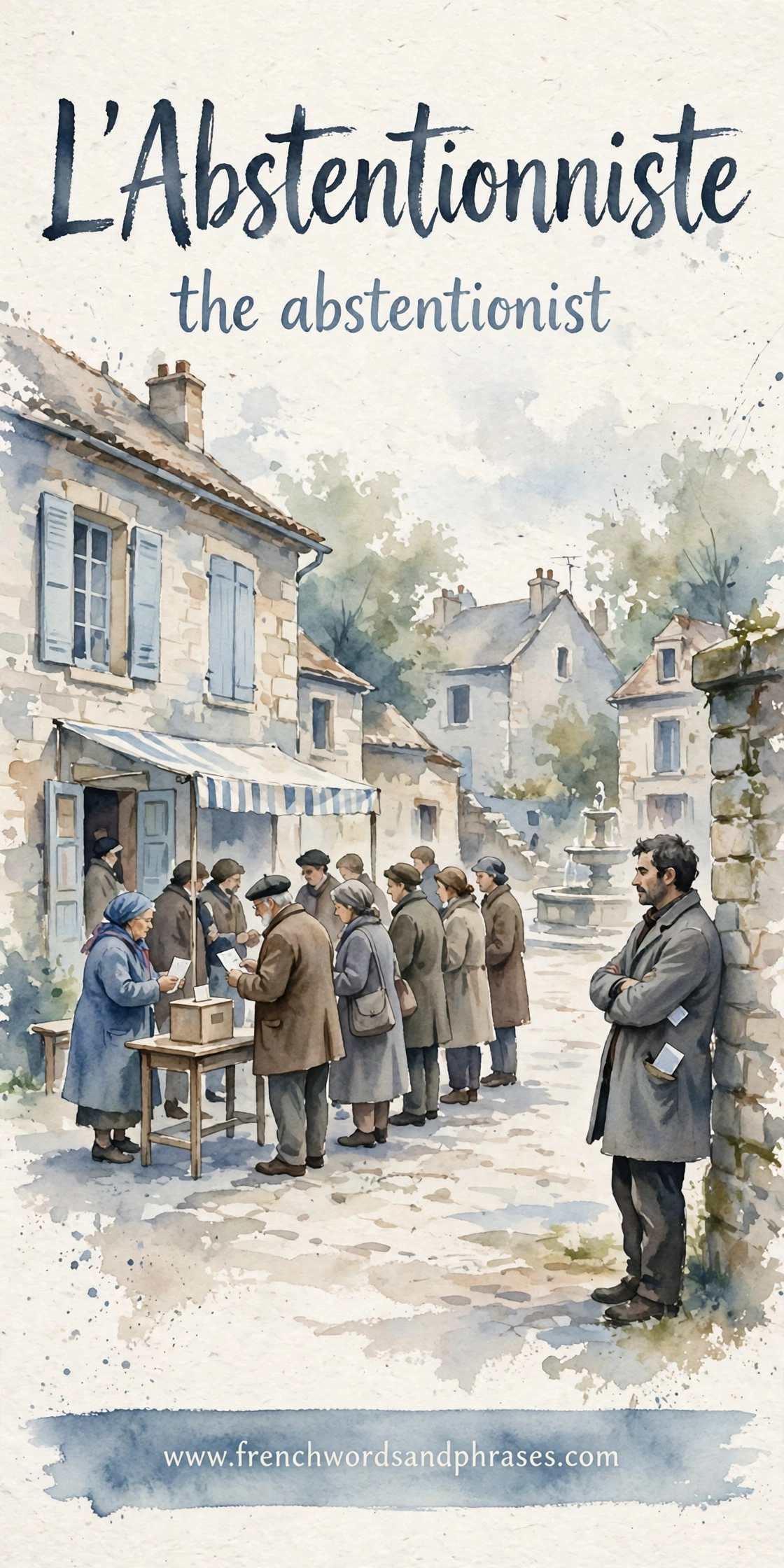
Imagine a village meeting called to decide the new school site. The mayor reads the two proposals; hands rise for the first, hands rise for the second — and old Monsieur Rey, whose garden borders both fields, folds his arms and s’abstient, deliberately, publicly. His silence weighs as much as any vote in the room, and everybody knows it.
He has said nothing and chosen nothing. He has abstained — il s’est abstenu — and his abstention is itself a position.
How to Conjugate Abstenir: Complete French Conjugation Guide
Let’s explore every major conjugation of abstenir, beginning with the indicative mood.
How to Conjugate Abstenir in the Indicative Mood
The indicative mood is used to express facts, observations, actions, and events.
How to Conjugate Abstenir in the Present Tense (Présent)
Used for actions happening now, habitual actions, and general truths.
| Subject | Conjugation |
|---|---|
| je | m’abstiens |
| tu | t’abstiens |
| il / elle | s’abstient |
| nous | nous abstenons |
| vous | vous abstenez |
| ils / elles | s’abstiennent |
Example
De plus en plus d’électeurs s’abstiennent aux élections.
More and more voters are abstaining in elections.
Quick Quiz 1
Complete the sentence:
Nous nous ______ de voter cette fois.
Reveal the answer
abstenons
Nous nous abstenons de voter cette fois.
We are abstaining from voting this time.
How to Conjugate Abstenir in the Passé Composé
Used for completed actions in the past. Abstenir takes the auxiliary verb être.
| Subject | Conjugation |
|---|---|
| je | me suis abstenu / me suis abstenue |
| tu | t’es abstenu / t’es abstenue |
| il / elle | s’est abstenu / s’est abstenue |
| nous | nous sommes abstenus / nous sommes abstenues |
| vous | vous êtes abstenus / vous êtes abstenues / vous êtes abstenu / vous êtes abstenue |
| ils / elles | se sont abstenus / se sont abstenues |
Example
Elle s’est abstenue de tout commentaire.
She refrained from any comment.
How to Conjugate Abstenir in the Imparfait (Imperfect Tense)
Used for habitual past actions, descriptions, and ongoing situations in the past.
| Subject | Conjugation |
|---|---|
| je | m’abstenais |
| tu | t’abstenais |
| il / elle | s’abstenait |
| nous | nous abstenions |
| vous | vous absteniez |
| ils / elles | s’abstenaient |
Example
Il s’abstenait de fumer devant les enfants.
He used to refrain from smoking in front of the children.
Quick Quiz 2
Choose the correct form:
She refrained from commenting.
Elle ______ de commenter. (s’est abstenue / a abstenu)
Reveal the answer
s’est abstenue
Elle s’est abstenue de commenter.
S’abstenir is reflexive and takes être.
How to Conjugate Abstenir in the Plus-que-parfait
Used to describe an action that had already been completed before another past event.
| Subject | Conjugation |
|---|---|
| je | m’étais abstenu / m’étais abstenue |
| tu | t’étais abstenu / t’étais abstenue |
| il / elle | s’était abstenu / s’était abstenue |
| nous | nous étions abstenus / nous étions abstenues |
| vous | vous étiez abstenus / vous étiez abstenues / vous étiez abstenu / vous étiez abstenue |
| ils / elles | s’étaient abstenus / s’étaient abstenues |
Example
Ils s’étaient abstenus lors du premier vote.
They had abstained in the first vote.
How to Conjugate Abstenir in the Passé Simple
Primarily used in formal writing, literature, and historical narratives. It is rarely used in everyday conversation.
| Subject | Conjugation |
|---|---|
| je | m’abstins |
| tu | t’abstins |
| il / elle | s’abstint |
| nous | nous abstînmes |
| vous | vous abstîntes |
| ils / elles | s’abstinrent |
Example
Le député s’abstint de voter la loi.
The deputy abstained from voting on the law.
How to Conjugate Abstenir in the Passé Antérieur
A literary tense used to express an action completed immediately before another past action, generally in the passé simple.
| Subject | Conjugation |
|---|---|
| je | me fus abstenu / me fus abstenue |
| tu | te fus abstenu / te fus abstenue |
| il / elle | se fut abstenu / se fut abstenue |
| nous | nous fûmes abstenus / nous fûmes abstenues |
| vous | vous fûtes abstenus / vous fûtes abstenues / vous fûtes abstenu / vous fûtes abstenue |
| ils / elles | se furent abstenus / se furent abstenues |
Example
Dès qu’elle se fut abstenue, la motion fut adoptée.
As soon as she had abstained, the motion was carried.
How to Conjugate Abstenir in the Future Tense (Futur Simple)
Used to describe actions that will take place in the future.
| Subject | Conjugation |
|---|---|
| je | m’abstiendrai |
| tu | t’abstiendras |
| il / elle | s’abstiendra |
| nous | nous abstiendrons |
| vous | vous abstiendrez |
| ils / elles | s’abstiendront |
Example
Je m’abstiendrai de toute remarque.
I will refrain from any remark.
How to Conjugate Abstenir in the Futur Antérieur (Future Perfect)
Used for an action that will have been completed before a particular point in the future.
| Subject | Conjugation |
|---|---|
| je | me serai abstenu / me serai abstenue |
| tu | te seras abstenu / te seras abstenue |
| il / elle | se sera abstenu / se sera abstenue |
| nous | nous serons abstenus / nous serons abstenues |
| vous | vous serez abstenus / vous serez abstenues / vous serez abstenu / vous serez abstenue |
| ils / elles | se seront abstenus / se seront abstenues |
Example
À la fin du scrutin, la moitié des électeurs se seront abstenus.
By the end of the ballot, half the voters will have abstained.
How to Conjugate Abstenir in the Near Future (Futur Proche)
Used to describe something that is going to happen soon. Formed with aller + infinitive.
| Subject | Conjugation |
|---|---|
| je | vais m’abstenir |
| tu | vas t’abstenir |
| il / elle | va s’abstenir |
| nous | allons nous abstenir |
| vous | allez vous abstenir |
| ils / elles | vont s’abstenir |
Example
Tu vas t’abstenir cette fois encore ?
Are you going to abstain this time too?
How to Conjugate Abstenir in the Conditional Mood
The conditional mood expresses what would happen under certain circumstances. It is also frequently used to make polite requests or express wishes.
How to Conjugate Abstenir in the Present Conditional
| Subject | Conjugation |
|---|---|
| je | m’abstiendrais |
| tu | t’abstiendrais |
| il / elle | s’abstiendrait |
| nous | nous abstiendrions |
| vous | vous abstiendriez |
| ils / elles | s’abstiendraient |
Example
Sans conviction, il s’abstiendrait probablement.
Without conviction, he would probably abstain.
How to Conjugate Abstenir in the Past Conditional
| Subject | Conjugation |
|---|---|
| je | me serais abstenu / me serais abstenue |
| tu | te serais abstenu / te serais abstenue |
| il / elle | se serait abstenu / se serait abstenue |
| nous | nous serions abstenus / nous serions abstenues |
| vous | vous seriez abstenus / vous seriez abstenues / vous seriez abstenu / vous seriez abstenue |
| ils / elles | se seraient abstenus / se seraient abstenues |
Example
Elle se serait abstenue si le texte l’avait choquée.
She would have abstained if the text had shocked her.
Abstenir in the Literary Past Conditional Form
This less common literary form uses the imperfect subjunctive of être.
| Subject | Conjugation |
|---|---|
| je | me fusse abstenu / me fusse abstenue |
| tu | te fusses abstenu / te fusses abstenue |
| il / elle | se fût abstenu / se fût abstenue |
| nous | nous fussions abstenus / nous fussions abstenues |
| vous | vous fussiez abstenus / vous fussiez abstenues / vous fussiez abstenu / vous fussiez abstenue |
| ils / elles | se fussent abstenus / se fussent abstenues |
Example
Le sage se fût abstenu de répondre à l’injure.
The wise man would have refrained from answering the insult.
How to Conjugate Abstenir in the Subjunctive Mood
The subjunctive is used to express wishes, emotions, doubts, necessity, and uncertainty. It frequently follows expressions such as il faut que (it is necessary that) or bien que (although).
How to Conjugate Abstenir in the Present Subjunctive
| Subject | Conjugation |
|---|---|
| que je | m’abstienne |
| que tu | t’abstiennes |
| qu’il / qu’elle | s’abstienne |
| que nous | nous abstenions |
| que vous | vous absteniez |
| qu’ils / qu’elles | s’abstiennent |
Example
Il vaut mieux que tu t’abstiennes de commenter.
It is better that you refrain from commenting.
Quick Quiz 3
Complete the sentence using the subjunctive:
Il faut que vous vous ______ de répondre.
Reveal the answer
absteniez
Il faut que vous vous absteniez de répondre.
You must refrain from answering.
How to Conjugate Abstenir in the Imperfect Subjunctive
A literary tense, rarely encountered in modern spoken French.
| Subject | Conjugation |
|---|---|
| que je | m’abstinsse |
| que tu | t’abstinsses |
| qu’il / qu’elle | s’abstînt |
| que nous | nous abstinssions |
| que vous | vous abstinssiez |
| qu’ils / qu’elles | s’abstinssent |
Example
On ne pensait pas qu’il s’abstînt de voter.
Nobody thought he would abstain from voting.
How to Conjugate Abstenir in the Pluperfect Subjunctive
A literary construction used to express an action completed before another past action.
| Subject | Conjugation |
|---|---|
| que je | me fusse abstenu / me fusse abstenue |
| que tu | te fusses abstenu / te fusses abstenue |
| qu’il / qu’elle | se fût abstenu / se fût abstenue |
| que nous | nous fussions abstenus / nous fussions abstenues |
| que vous | vous fussiez abstenus / vous fussiez abstenues / vous fussiez abstenu / vous fussiez abstenue |
| qu’ils / qu’elles | se fussent abstenus / se fussent abstenues |
Example
On regrettait qu’ils se fussent abstenus en si grand nombre.
People regretted that they had abstained in such great numbers.
How to Conjugate Abstenir in the Past Subjunctive
| Subject | Conjugation |
|---|---|
| que je | me sois abstenu / me sois abstenue |
| que tu | te sois abstenu / te sois abstenue |
| qu’il / qu’elle | se soit abstenu / se soit abstenue |
| que nous | nous soyons abstenus / nous soyons abstenues |
| que vous | vous soyez abstenus / vous soyez abstenues / vous soyez abstenu / vous soyez abstenue |
| qu’ils / qu’elles | se soient abstenus / se soient abstenues |
Example
Je suis surpris qu’elle se soit abstenue.
I am surprised she abstained.
How to Conjugate Abstenir in the Imperative
The imperative is used to give commands, instructions, invitations, or suggestions. Subject pronouns are omitted.
How to Conjugate Abstenir in the Present Imperative
| Person | Conjugation |
|---|---|
| (tu) | abstiens-toi |
| (nous) | abstenons-nous |
| (vous) | abstenez-vous |
Example
Abstiens-toi de tout commentaire !
Refrain from any comment!
Quick Quiz 4
How would you say Refrain from smoking (tu form)?
Reveal the answer
Abstiens-toi de fumer !
French Participles of Abstenir
Participles are verb forms that can be used in compound tenses and other grammatical constructions.
Present Participle of Abstenir
abstenant
En s’abstenant de voter, ils ont laissé les autres décider.
By abstaining from voting, they let the others decide.
Past Participle of Abstenir
abstenu
Abstenue au premier tour, elle a voté au second.
Having abstained in the first round, she voted in the second.
Abstenir in Everyday French: Real-Life Examples
Now that you know the conjugations, let’s see how abstenir appears in everyday French.
Example 1 — Present
Les électeurs s’abstiennent en masse.
Voters are abstaining in droves.
Example 2 — Passé composé
Elle s’est abstenue de commenter.
She refrained from commenting.
Example 3 — Imparfait
Il s’abstenait de fumer.
He used to refrain from smoking.
Example 4 — Future
Je m’abstiendrai de toute remarque.
I will refrain from any remark.
Example 5 — Conditional
Il s’abstiendrait sans conviction.
He would abstain, lacking conviction.
Example 6 — Imperative
Abstiens-toi de répondre !
Refrain from answering!
Beyond Translation: The Meaning of Abstenir
English abstain is its twin — both from the Latin abstinere, to hold away — but French makes the holding reflexive: you hold yourself back, s’abstenir, and the grammar insists on it.
An abstention is a vote that weighs by its absence.
French election nights report le taux d’abstention before almost anything else — the number of citizens who s’abstiennent has become the country’s most watched figure.
How to Remember the French Verb Abstenir
Remember it this way: Abstenir is about the hand that stays down — tenir, holding yourself back.
- Tenir in disguise: je m’abstiens, nous nous abstenons, ils s’abstiennent — and je m’abstiendrai in the future.
- Always reflexive in real life, always with être: elle s’est abstenue, participle agreeing.
- Followed by de: s’abstenir de voter, de fumer, de répondre.
The key idea is the hand that stays down — tenir, holding yourself back.
Test Your Knowledge of Abstenir
Let’s see how much you’ve learned. Try answering these questions before revealing the answers.
Question 1
Which auxiliary does s’abstenir use, and why?
Reveal the answer
Être — it is a reflexive verb: elle s’est abstenue, with the participle agreeing.
Question 2
How do you say More and more voters are abstaining in French?
Reveal the answer
De plus en plus d’électeurs s’abstiennent.
Question 3
Translate: She refrained from any comment.
Reveal the answer
Elle s’est abstenue de tout commentaire.
Question 4
What is the past participle of s’abstenir?
Reveal the answer
Abstenu — agreeing: abstenue, abstenus, abstenues.
Question 5
Complete the sentence:
Il vaut mieux que tu t’______ de commenter.
Reveal the answer
abstiennes
Il vaut mieux que tu t’abstiennes de commenter.
It is better that you refrain from commenting.
Your Final Challenge
Can You Use It?
How would you say this in French?
In elections, those who abstain sometimes decide as much as those who vote.
Reveal the answer
Aux élections, ceux qui s’abstiennent décident parfois autant que ceux qui votent.
In elections, those who abstain sometimes decide as much as those who vote.
A little French. A little curiosity. A richer everyday life.
LEARN FRENCH ONE WORD AT A TIME