A French Word to Live By
Translate Français to English
/fʁɑ̃.sɛ/
Français means French.
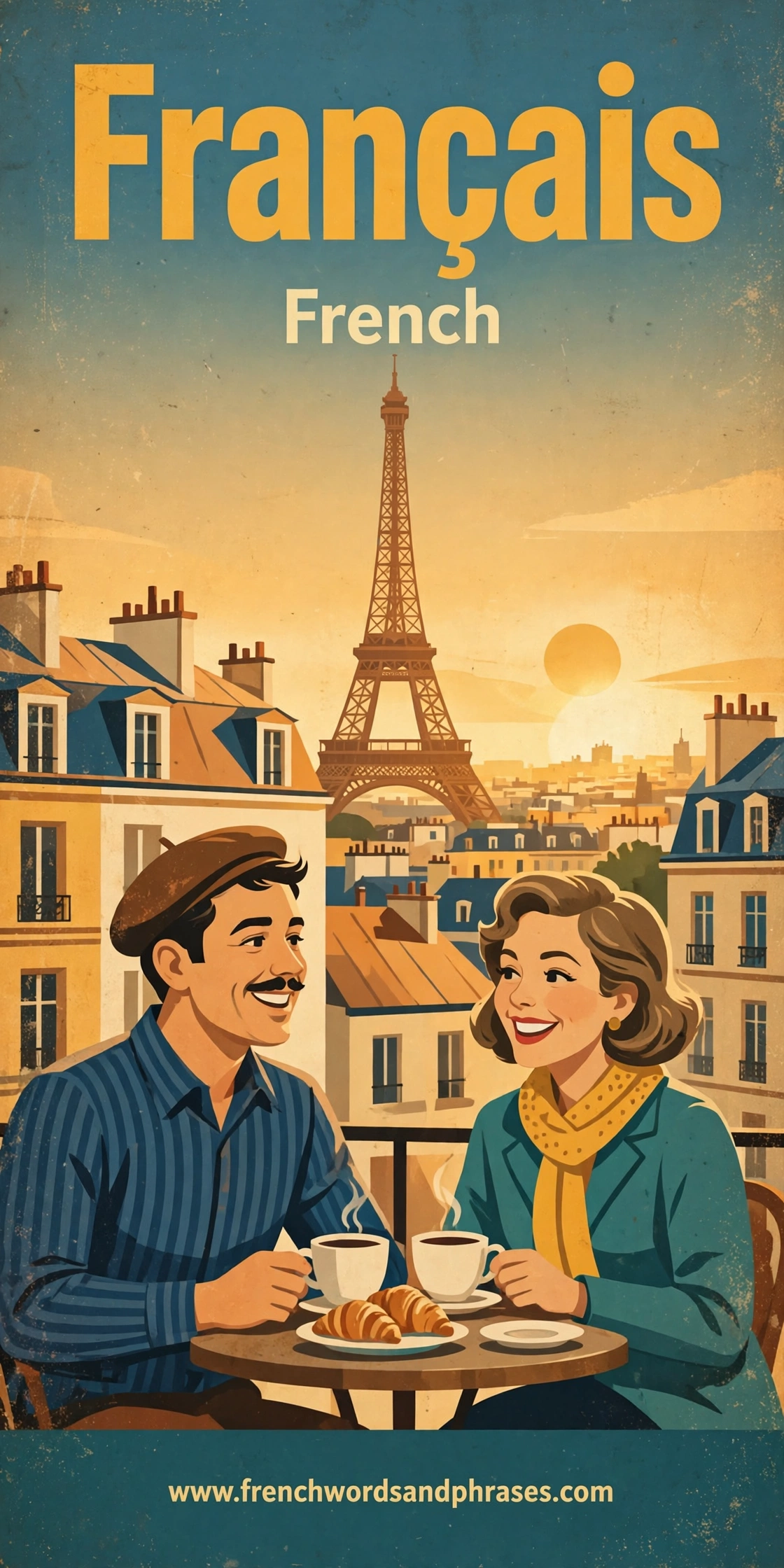
A café terrace in Lyon at eight in the morning: croissants, a small black coffee, and the waiter who greets every regular by name. Everything about the scene — the bread, the pace, the conversation — is summed up by one word on the menu board: français.
In this guide, you’ll learn what français means in English, how its feminine française is formed, where it stands in the sentence, and when French gives the word a capital letter. Explore French examples, English translations, and practice quizzes.
Understanding the French Adjective Français
Français is a French nationality adjective — masculine français, feminine française. The feminine wakes up the silent final letter: français ends in a quiet s, française ends in a spoken -se. In the plural, the masculine does not change (français) while the feminine adds an s (françaises).
It means French — of France, its people, its language and its culture. It describes people (un acteur français, a French actor), things (un vin français, a French wine) and ideas (la cuisine française, French cooking). With a capital letter it becomes a person — un Français — and in lower case with le, le français, it is the French language itself.
Type: Nationality adjective
Masculine: français
Feminine: française
English equivalents: French.
One important usage detail: the capital letter. A French person takes one — un Français, une Française — but the adjective and the language never do: un film français, elle parle français. Like most adjectives, français also stands after the noun it describes.
Experience the Word
Français is the adjective of the boulangerie at dawn — the smell of warm bread, a queue of neighbours, and a word that covers a country, a people and a language all at once.
Imagine a small cinema in Paris showing a film français with no subtitles, and the whole room laughing at the same line at the same moment. To be français, in that room, is simply to belong to the joke.
You have not just named a nationality. You have pointed at a whole way of living — and at the language you are learning.
How to Use Français in French: Complete Guide
Let’s explore how français works in French, beginning with the whole word on one card.
Français at a Glance
Before the details, here is the whole word on one card.
The Whole Word on One Card
Meaning, type, position and forms — français in four lines.
| Point | Français |
|---|---|
| Meaning | French |
| Type | nationality adjective |
| Usual position | after the noun — un film français |
| Forms | français / française / français / françaises |
Example
C’est un film français.
It’s a French film.
The Four Forms of Français
Nationality adjectives agree like other adjectives: here are the four forms of français, with the feminine waking up the final letter.
| Form | Français | Example |
|---|---|---|
| Masculine singular | français | un acteur français — a French actor |
| Feminine singular | française | une actrice française — a French actress |
| Masculine plural | français | des acteurs français — French actors |
| Feminine plural | françaises | des actrices françaises — French actresses |
Example
Un acteur français et une actrice française jouent dans ce film.
A French actor and a French actress are in this film.
Quick Quiz 1
What is the feminine of français?
Reveal the answer
française
Une femme française, des traditions françaises.
A French woman, French traditions.
The Feminine of Français: -ais Becomes -aise
Français belongs to the -ais family: the feminine replaces the silent ending with -aise, and suddenly the final letter is heard.
| Situation | Example |
|---|---|
| Masculine | français — the final s is silent |
| Feminine | française — the ending is pronounced, like a z |
| Masculine plural | français — no change at all |
| Feminine plural | françaises — add s |
Example
Elle est française et fière de l’être.
She is French and proud of it.
Where Français Goes: After the Noun
Français follows the noun it describes, like most French adjectives, and it sits comfortably after être. Adverbs slide in front of it without moving it.
| Pattern | Example |
|---|---|
| After the noun | un vin français — a French wine |
| After être | elle est française — she is French |
| With an adverb | très français — very French |
| Before the noun | un français film — not in everyday French |
Example
Ce fromage est très français.
This cheese is very French.
Quick Quiz 2
How do you say ‘a French film’ — un français film or un film français?
Reveal the answer
un film français
Français stands after the noun.
A French film.
More French: Comparing with Français
Français compares the regular way, with plus, moins and aussi — French loves to argue about what is plus français, more French, than something else.
| Degree | Example |
|---|---|
| As French as | aussi français que — as French as |
| More French | plus français — more French |
| Less French | moins français — less French |
| The most French (masc.) | le plus français — le plus français des villages |
| The most French (fem.) | la plus française — la plus française des villes |
Example
Ce quartier est plus français que l’autre.
This neighbourhood is more French than the other one.
Everyday Expressions with Français
Français does triple duty in French: adjective, person and language. The capital letter tells you which job it is doing.
| Expression | In English |
|---|---|
| un Français / une Française | a Frenchman / a Frenchwoman — capital letter for the person |
| le français | the French language |
| parler français | to speak French |
| à la française | in the French way, French-style |
| la cuisine française | French cooking |
| un passeport français | a French passport |
Example
Elle parle français avec un Français de Lyon.
She speaks French with a Frenchman from Lyon.
Quick Quiz 3
What does le français mean, written in lower case with le?
Reveal the answer
The French language
Je parle français et j’apprends l’anglais.
I speak French and I’m learning English.
Français and Its Neighbours
Français lives among the other nationalities of the French-speaking world and its closest European neighbours.
| French | In English |
|---|---|
| belge | Belgian — un Belge, une Belge |
| suisse | Swiss — un Suisse, une Suisse |
| québécois | Quebecer — un Québécois, une Québécoise |
| canadien | Canadian — un Canadien, une Canadienne |
| italien | Italian — un Italien, une Italienne |
| espagnol | Spanish — un Espagnol, une Espagnole |
Example
Un Belge et un Français parlent français ensemble.
A Belgian and a Frenchman speak French together.
Watch Out: The Traps Around Français
The traps here are the capital letter, the invented feminine, and the plural that looks like the singular.
| Trap | The truth |
|---|---|
| The capital letter | people take one — un Français; the adjective and the language never do |
| The feminine | française — never ‘françaine’ |
| The masculine plural | français — the plural looks exactly like the singular |
| France or français? | la France is the country; français is the adjective, the person and the language |
Example
Un Français parle français.
A Frenchman speaks French.
Quick Quiz 4
Which is correct for a French woman — une Français or une Française?
Reveal the answer
une Française
A capital letter for the person, and the feminine form française.
A Frenchwoman.
Français in Everyday French: Real-Life Examples
Now that you know the word, let’s see how français appears in everyday French.
Example 1 — A neighbour
Mon voisin est français, il vient de Bordeaux.
My neighbour is French, he comes from Bordeaux.
Example 2 — At school
Elle apprend le français à l’école.
She is learning French at school.
Example 3 — A film
Nous avons regardé un film français hier soir.
We watched a French film last night.
Example 4 — Food
La cuisine française est célèbre dans le monde entier.
French cooking is famous all over the world.
Example 5 — Travel
Une touriste française visite le musée.
A French tourist is visiting the museum.
Example 6 — Wine
Ces vins français sont excellents.
These French wines are excellent.
Beyond Translation: The Meaning of Français
English needs three different words where French uses one: French the adjective, a Frenchman the person, French the language are all français — only the capital letter and the article change.
No other word on this site is quite so close to home.
Every page here exists because of this one: le français is the language, les Français are its speakers, and français is the word that describes them both.
How to Remember the French Adjective Français
Remember it this way: Français changes its ending for women, keeps its s in the masculine plural, and only wears a capital letter when it names a person.
- You see two singular forms — un homme français, une femme française.
- You keep the masculine plural unchanged — des hommes français, des femmes françaises.
- You give the person a capital letter — un Français — but never the language: le français.
The key idea is français / française — and a capital letter only for the person.
Test Your Knowledge of Français
Let’s see how much you’ve learned. Try answering these questions before revealing the answers.
Question 1
What does français mean?
Reveal the answer
French — of France, its people and its language.
Question 2
What is the feminine of français?
Reveal the answer
française — the -ais ending becomes -aise.
Question 3
Translate: a French film.
Reveal the answer
Un film français.
Question 4
Complete the sentence:
Elle est ______ . (French)
Reveal the answer
française
Elle est française.
She is French.
Question 5
How do you say ‘a Frenchman’?
Reveal the answer
Un Français — with a capital letter, because it names a person.
Your Final Challenge
Can You Use It?
How would you say this in French?
“She is French, and she teaches French in a French school.”
Reveal the answer
Elle est française, et elle enseigne le français dans une école française.
She is French, and she teaches French in a French school.
A little French. A little curiosity. A richer everyday life.
LEARN FRENCH ONE WORD AT A TIME