A French Word to Live By
How to Conjugate Cavaler in French
/ka.va.le/
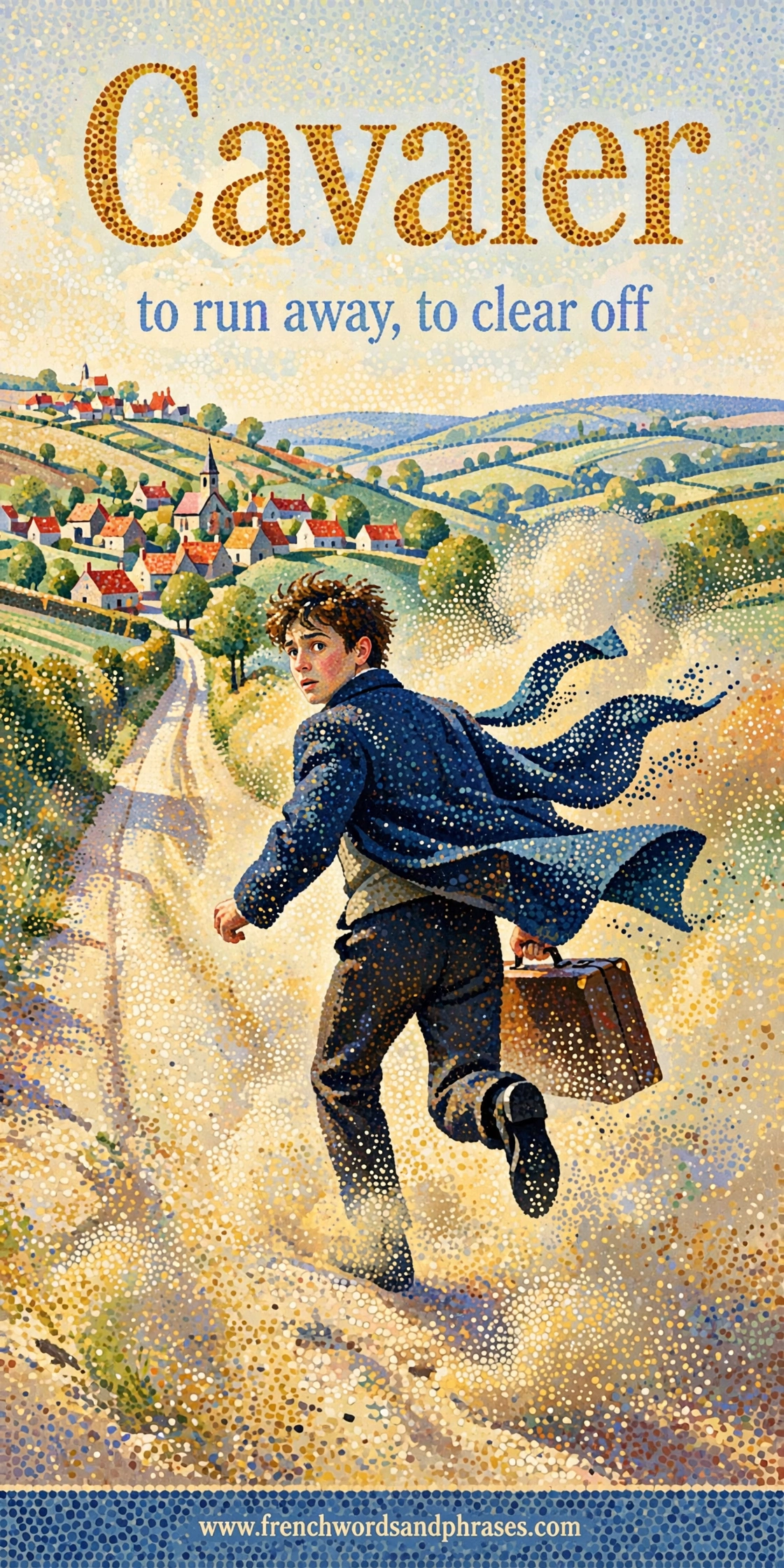
Cavaler means to run away, to clear off — to dash off at full speed, because staying would be worse, or simply because there is somewhere else to be, fast.
A schoolboy bolting at the last bell, a thief vanishing down an alley at the first siren, a dog streaking after the postman — cavaler is the verb of the dash: legs going like hooves, whether in flight, in pursuit or in sheer high spirits.
In this guide, you’ll learn how to conjugate cavaler in all the major French tenses and moods. Explore complete conjugation tables, French examples, English translations, and practice quizzes.
Understanding the French Verb Cavaler
Cavaler is a regular French verb belonging to the first group of verbs, those ending in-er.
It means to run away, to clear off. It ranges from genuine flight (a thief, a fugitive en cavale) to the harmless rush of daily life — cavaler toute la journée is to rush around all day, and children who cavalent dans la maison are charging about the house, not escaping from it.
Verb classification: First group (-er)
Auxiliary verb: Avoir
Past participle: cavalé
Present participle: cavalant
English equivalents: To run away, to clear off, to dash about; cavaler après quelqu’un — to chase after someone; cavaler partout — to rush about everywhere; cavaler jusqu’à la gare — to dash to the station; être en cavale — to be on the run (of a fugitive); faire cavaler quelqu’un — to send someone running all over the place.
One important detail: cavaler is familiar in tone — it is cavalry slang that escaped the barracks: originally to gallop off on horseback, now to leg it anywhere. It is perfectly regular: je cavale, nous cavalons, ils cavalent. With après it means to chase: le chien cavale après le facteur. The fugitive who has cavalé is en cavale — on the run — a phrase every French crime headline uses.
Experience the Word
Cavaler is the verb of speed with a grin — part gallop, part getaway, always in a hurry.
Imagine the last day of school. The bell has barely sounded when thirty children cavalent through the gate, satchels bouncing, into the summer. Nobody is chasing them and nothing is wrong — it is simply impossible, at that moment, to walk.
School is behind them and the holidays ahead. They have cleared off — cavalé — at the speed of freedom.
How to Conjugate Cavaler: Complete French Conjugation Guide
Let’s explore every major conjugation of cavaler, beginning with the indicative mood.
How to Conjugate Cavaler in the Indicative Mood
The indicative mood is used to express facts, observations, actions, and events.
How to Conjugate Cavaler in the Present Tense (Présent)
Used for actions happening now, habitual actions, and general truths.
| Subject | Conjugation |
|---|---|
| je | cavale |
| tu | cavales |
| il / elle | cavale |
| nous | cavalons |
| vous | cavalez |
| ils / elles | cavalent |
Example
Dès que la cloche sonne, les élèves cavalent vers la sortie.
As soon as the bell rings, the pupils dash towards the exit.
Quick Quiz 1
Complete the sentence:
Nous ______ jusqu’à la gare pour attraper le train.
Reveal the answer
cavalons
Nous cavalons jusqu’à la gare pour attraper le train.
We are dashing to the station to catch the train.
How to Conjugate Cavaler in the Passé Composé
Used for completed actions in the past. Cavaler takes the auxiliary verb avoir.
| Subject | Conjugation |
|---|---|
| j’ | ai cavalé |
| tu | as cavalé |
| il / elle | a cavalé |
| nous | avons cavalé |
| vous | avez cavalé |
| ils / elles | ont cavalé |
Example
Le voleur a cavalé dès qu’il a entendu la sirène.
The thief ran off as soon as he heard the siren.
How to Conjugate Cavaler in the Imparfait (Imperfect Tense)
Used for habitual past actions, descriptions, and ongoing situations in the past.
| Subject | Conjugation |
|---|---|
| je | cavalais |
| tu | cavalais |
| il / elle | cavalait |
| nous | cavalions |
| vous | cavaliez |
| ils / elles | cavalaient |
Example
Enfant, il cavalait dans les champs dès l’école finie.
As a child, he would run off into the fields as soon as school ended.
Quick Quiz 2
Choose the correct form:
The thief ran off at the first sound.
Le voleur ______ au premier bruit. (a cavalé / est cavalé)
Reveal the answer
a cavalé
Le voleur a cavalé au premier bruit.
Cavaler takes avoir.
How to Conjugate Cavaler in the Plus-que-parfait
Used to describe an action that had already been completed before another past event.
| Subject | Conjugation |
|---|---|
| j’ | avais cavalé |
| tu | avais cavalé |
| il / elle | avait cavalé |
| nous | avions cavalé |
| vous | aviez cavalé |
| ils / elles | avaient cavalé |
Example
Ils avaient cavalé jusqu’à la gare, mais le train était déjà parti.
They had rushed to the station, but the train had already left.
How to Conjugate Cavaler in the Passé Simple
Primarily used in formal writing, literature, and historical narratives. It is rarely used in everyday conversation.
| Subject | Conjugation |
|---|---|
| je | cavalai |
| tu | cavalas |
| il / elle | cavala |
| nous | cavalâmes |
| vous | cavalâtes |
| ils / elles | cavalèrent |
Example
À l’arrivée des gendarmes, la bande cavala dans les ruelles.
When the gendarmes arrived, the gang ran off into the alleys.
How to Conjugate Cavaler in the Passé Antérieur
A literary tense used to express an action completed immediately before another past action, generally in the passé simple.
| Subject | Conjugation |
|---|---|
| j’ | eus cavalé |
| tu | eus cavalé |
| il / elle | eut cavalé |
| nous | eûmes cavalé |
| vous | eûtes cavalé |
| ils / elles | eurent cavalé |
Example
Quand le chien eut cavalé après le facteur, tout le quartier rit.
When the dog had chased after the postman, the whole neighbourhood laughed.
How to Conjugate Cavaler in the Future Tense (Futur Simple)
Used to describe actions that will take place in the future.
| Subject | Conjugation |
|---|---|
| je | cavalerai |
| tu | cavaleras |
| il / elle | cavalera |
| nous | cavalerons |
| vous | cavalerez |
| ils / elles | cavaleront |
Example
Si tu cries, le chat cavalera sous le lit.
If you shout, the cat will dash under the bed.
How to Conjugate Cavaler in the Futur Antérieur (Future Perfect)
Used for an action that will have been completed before a particular point in the future.
| Subject | Conjugation |
|---|---|
| j’ | aurai cavalé |
| tu | auras cavalé |
| il / elle | aura cavalé |
| nous | aurons cavalé |
| vous | aurez cavalé |
| ils / elles | auront cavalé |
Example
À la tombée de la nuit, les enfants auront cavalé dans tout le jardin.
By nightfall, the children will have rushed all over the garden.
How to Conjugate Cavaler in the Near Future (Futur Proche)
Used to describe something that is going to happen soon. Formed with aller + infinitive.
| Subject | Conjugation |
|---|---|
| je | vais cavaler |
| tu | vas cavaler |
| il / elle | va cavaler |
| nous | allons cavaler |
| vous | allez cavaler |
| ils / elles | vont cavaler |
Example
Attention, le chien va cavaler après le vélo !
Watch out, the dog is going to chase after the bike!
How to Conjugate Cavaler in the Conditional Mood
The conditional mood expresses what would happen under certain circumstances. It is also frequently used to make polite requests or express wishes.
How to Conjugate Cavaler in the Present Conditional
| Subject | Conjugation |
|---|---|
| je | cavalerais |
| tu | cavalerais |
| il / elle | cavalerait |
| nous | cavalerions |
| vous | cavaleriez |
| ils / elles | cavaleraient |
Example
Sans ses bottes de pluie, elle cavalerait moins dans les flaques.
Without her wellington boots, she would dash through the puddles less.
How to Conjugate Cavaler in the Past Conditional
| Subject | Conjugation |
|---|---|
| j’ | aurais cavalé |
| tu | aurais cavalé |
| il / elle | aurait cavalé |
| nous | aurions cavalé |
| vous | auriez cavalé |
| ils / elles | auraient cavalé |
Example
Il aurait cavalé jusqu’à la gare s’il avait su l’heure.
He would have rushed to the station if he had known the time.
Cavaler in the Literary Past Conditional Form
This less common literary form uses the imperfect subjunctive of avoir.
| Subject | Conjugation |
|---|---|
| j’ | eusse cavalé |
| tu | eusses cavalé |
| il / elle | eût cavalé |
| nous | eussions cavalé |
| vous | eussiez cavalé |
| ils / elles | eussent cavalé |
Example
Le voleur eût cavalé plus loin sans la rivière en crue.
The thief would have run farther but for the flooded river.
How to Conjugate Cavaler in the Subjunctive Mood
The subjunctive is used to express wishes, emotions, doubts, necessity, and uncertainty. It frequently follows expressions such as il faut que (it is necessary that) or bien que (although).
How to Conjugate Cavaler in the Present Subjunctive
| Subject | Conjugation |
|---|---|
| que je | cavale |
| que tu | cavales |
| qu’il / qu’elle | cavale |
| que nous | cavalions |
| que vous | cavaliez |
| qu’ils / qu’elles | cavalent |
Example
Je ne veux pas que les enfants cavalent dans la maison.
I do not want the children charging around the house.
Quick Quiz 3
Complete the sentence using the subjunctive:
Elle craint que le chien ne ______ après les poules.
Reveal the answer
cavale
Elle craint que le chien ne cavale après les poules.
She fears the dog may chase after the hens.
How to Conjugate Cavaler in the Imperfect Subjunctive
A literary tense, rarely encountered in modern spoken French.
| Subject | Conjugation |
|---|---|
| que je | cavalasse |
| que tu | cavalasses |
| qu’il / qu’elle | cavalât |
| que nous | cavalassions |
| que vous | cavalassiez |
| qu’ils / qu’elles | cavalassent |
Example
Elle craignait que le chien ne cavalât après les poules.
She feared the dog might chase after the hens.
How to Conjugate Cavaler in the Pluperfect Subjunctive
A literary construction used to express an action completed before another past action.
| Subject | Conjugation |
|---|---|
| que j’ | eusse cavalé |
| que tu | eusses cavalé |
| qu’il / qu’elle | eût cavalé |
| que nous | eussions cavalé |
| que vous | eussiez cavalé |
| qu’ils / qu’elles | eussent cavalé |
Example
On racontait qu’ils eussent cavalé toute la nuit pour échapper aux gendarmes.
People said they had run all night to escape the gendarmes.
How to Conjugate Cavaler in the Past Subjunctive
| Subject | Conjugation |
|---|---|
| que j’ | aie cavalé |
| que tu | aies cavalé |
| qu’il / qu’elle | ait cavalé |
| que nous | ayons cavalé |
| que vous | ayez cavalé |
| qu’ils / qu’elles | aient cavalé |
Example
Je suis surpris qu’il ait cavalé si loin à pied.
I am surprised he ran so far on foot.
How to Conjugate Cavaler in the Imperative
The imperative is used to give commands, instructions, invitations, or suggestions. Subject pronouns are omitted.
How to Conjugate Cavaler in the Present Imperative
| Person | Conjugation |
|---|---|
| (tu) | cavale |
| (nous) | cavalons |
| (vous) | cavalez |
Example
Cavalez, les enfants, le goûter est prêt !
Run along, children, tea is ready!
Quick Quiz 4
How would you say Run along, tea is ready (tu form)?
Reveal the answer
Cavale, le goûter est prêt !
French Participles of Cavaler
Participles are verb forms that can be used in compound tenses and other grammatical constructions.
Present Participle of Cavaler
cavalant
En cavalant après son chapeau, il a traversé tout le marché.
Chasing after his hat, he crossed the whole market.
Past Participle of Cavaler
cavalé
Le chat, cavalé par le chien du voisin, a grimpé à l’arbre.
The cat, chased by the neighbour’s dog, climbed the tree.
Cavaler in Everyday French: Real-Life Examples
Now that you know the conjugations, let’s see how cavaler appears in everyday French.
Example 1 — Present
Les élèves cavalent vers la sortie.
The pupils dash towards the exit.
Example 2 — Passé composé
Le voleur a cavalé au premier bruit.
The thief ran off at the first sound.
Example 3 — Imparfait
Il cavalait dans les champs après l’école.
He would run off into the fields after school.
Example 4 — Future
Le chat cavalera sous le lit si tu cries.
The cat will dash under the bed if you shout.
Example 5 — Conditional
Il cavalerait jusqu’à la gare pour te voir.
He would dash to the station to see you.
Example 6 — Imperative
Cavalez, les enfants, le goûter est prêt !
Run along, children, tea is ready!
Beyond Translation: The Meaning of Cavaler
English cavalry and cavalier are cousins — all from the horse, caballus.
Cavaler is the gallop, democratised.
The cavalryman galloped off on orders; the schoolboy, the thief and the dog cavalent on their own authority. French police reporting keeps the military echo alive: a fugitive is en cavale, on the run, and the manhunt is a hunt for a rider long since down to his own two feet.
How to Remember the French Verb Cavaler
Remember it this way: Cavaler is about the schoolboy bolting through the gate at the last bell.
- Familiar register: cavaler is to leg it, to clear off — livelier than courir, less formal than s’enfuir.
- With après it chases: cavaler après le facteur, après le bus, après son chapeau.
- Regular -er: je cavale, nous cavalons, past participle cavalé; the fugitive is en cavale.
The key idea is the schoolboy bolting through the gate at the last bell.
Test Your Knowledge of Cavaler
Let’s see how much you’ve learned. Try answering these questions before revealing the answers.
Question 1
What does être en cavale mean?
Reveal the answer
To be on the run — said of a fugitive who has cleared off and is being hunted.
Question 2
How do you say The thief ran off as soon as he heard the siren in French?
Reveal the answer
Le voleur a cavalé dès qu’il a entendu la sirène.
Question 3
Translate: The dog is going to chase after the bike.
Reveal the answer
Le chien va cavaler après le vélo.
Question 4
What is the past participle of cavaler?
Reveal the answer
Cavalé.
Question 5
Complete the sentence:
Je ne veux pas que les enfants ______ dans la maison.
Reveal the answer
cavalent
Je ne veux pas que les enfants cavalent dans la maison.
I do not want the children charging around the house.
Your Final Challenge
Can You Use It?
How would you say this in French?
At the first siren, he runs off down the alley, and the town will not see him again.
Reveal the answer
Dès la première sirène, il cavale par la ruelle, et la ville ne le reverra pas.
At the first siren, he runs off down the alley, and the town will not see him again.
A little French. A little curiosity. A richer everyday life.
LEARN FRENCH ONE WORD AT A TIME