A French Word to Live By
How to Conjugate Caver in French
/ka.ve/
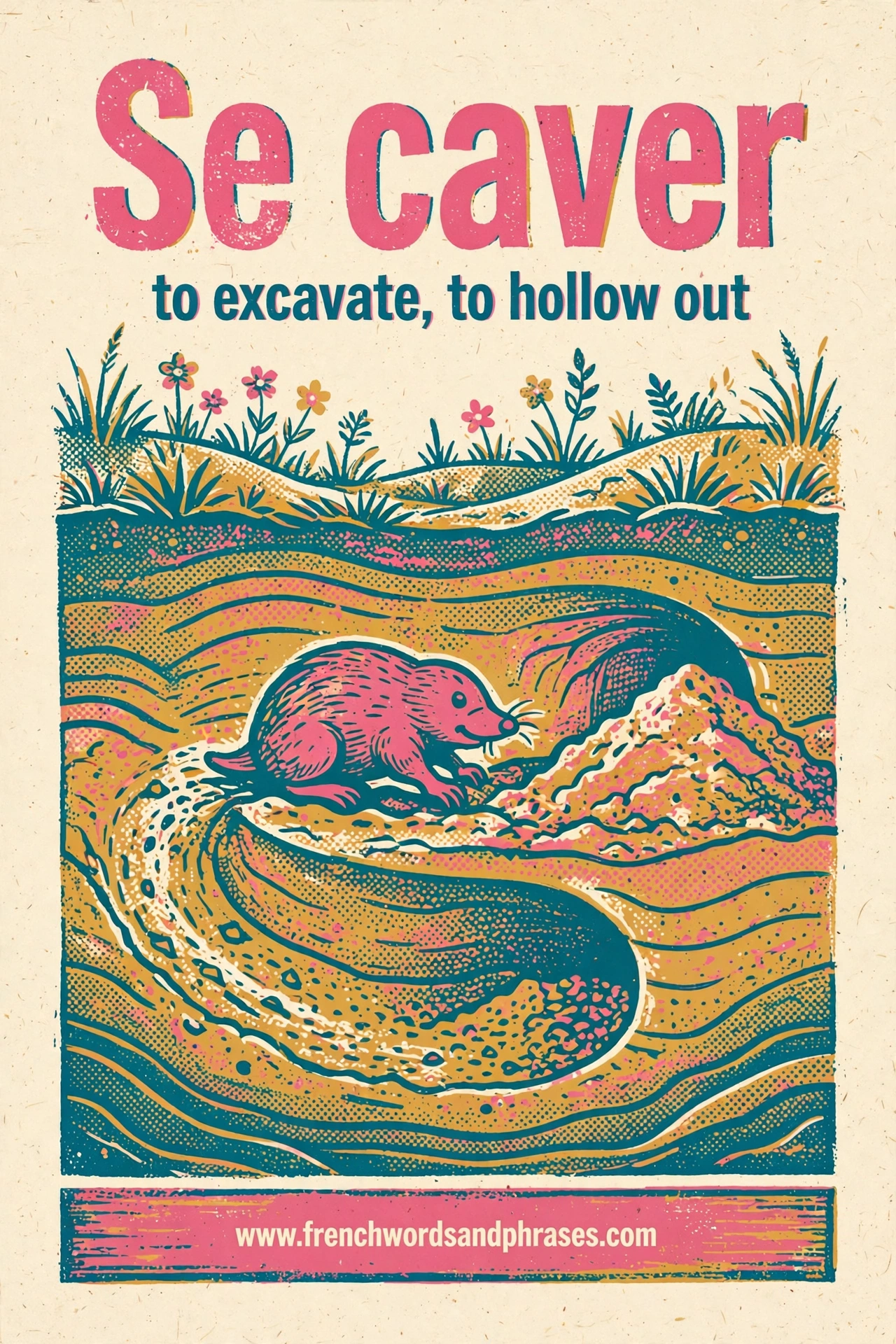
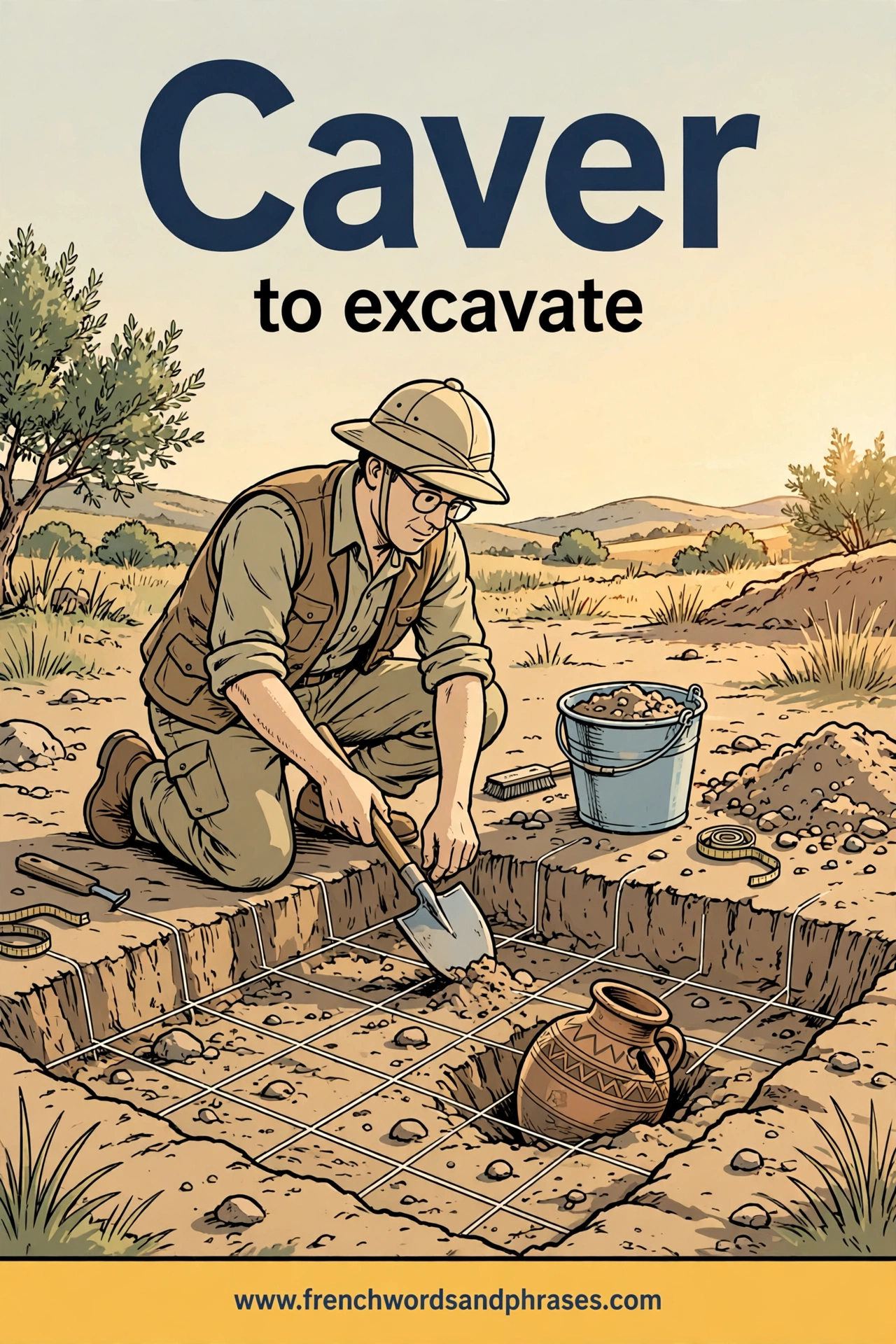
Caver means to excavate — to hollow out earth or rock, digging a cavity where there was solid ground.
Miners opening a gallery in black rock, a river quietly eating the foot of a cliff for a thousand years — caver is the slow, strong verb of hollowing: making an empty space inside something solid, by pick, by machine or by water.
In this guide, you’ll learn how to conjugate caver in all the major French tenses and moods. Explore complete conjugation tables, French examples, English translations, and practice quizzes.
Understanding the French Verb Caver
Caver is a regular French verb belonging to the first group of verbs, those ending in-er.
It means to excavate. It is a somewhat technical, written verb — miners, engineers and geologists cave galleries, tunnels and foundations, and in literature water caves cliffs and riverbanks; everyday French more often reaches for creuser, but caver is the precise word for hollowing from within.
Verb classification: First group (-er)
Auxiliary verb: Avoir
Past participle: cavé
Present participle: cavant
English equivalents: To excavate, to hollow out; caver une galerie — to dig out a gallery; caver un tunnel — to bore a tunnel; l’eau cave la falaise — the water hollows out the cliff; (at cards and gaming) caver — to stake, to put up a stake; une cave — a cellar, and also a player’s stake.
One important detail: caver is the verb of une cave, a hollow place — to cave is to make a cave. It is regular: je cave, nous cavons, ils cavent. Its great subject is water: la mer cave la falaise, le torrent cave son lit. Gamblers know a second life of the word: at the card table, caver is to stake money, and une cave is the stake itself — the hollow you fill with your fortune, perhaps.
Experience the Word
Caver is the verb of the hollow made patiently — solid matter persuaded, grain by grain, to become a space.
Imagine the cliff path above the sea. Every winter storm throws the waves at the same soft seam of rock; every year the seam is a finger’s breadth deeper. Nobody dug this cave and nobody planned it — l’eau cave la falaise, and one day there will be an arch, and one day the arch will fall.
No pick, no machine, only time. The cliff has been excavated — cavée — by the most patient worker of all.
How to Conjugate Caver: Complete French Conjugation Guide
Let’s explore every major conjugation of caver, beginning with the indicative mood.
How to Conjugate Caver in the Indicative Mood
The indicative mood is used to express facts, observations, actions, and events.
How to Conjugate Caver in the Present Tense (Présent)
Used for actions happening now, habitual actions, and general truths.
| Subject | Conjugation |
|---|---|
| je | cave |
| tu | caves |
| il / elle | cave |
| nous | cavons |
| vous | cavez |
| ils / elles | cavent |
Example
Les mineurs cavent une nouvelle galerie dans la roche.
The miners are excavating a new gallery in the rock.
Quick Quiz 1
Complete the sentence:
Nous ______ une galerie dans la roche.
Reveal the answer
cavons
Nous cavons une galerie dans la roche.
We are excavating a gallery in the rock.
How to Conjugate Caver in the Passé Composé
Used for completed actions in the past. Caver takes the auxiliary verb avoir.
| Subject | Conjugation |
|---|---|
| j’ | ai cavé |
| tu | as cavé |
| il / elle | a cavé |
| nous | avons cavé |
| vous | avez cavé |
| ils / elles | ont cavé |
Example
La rivière a cavé la falaise pendant des siècles.
The river has hollowed out the cliff over centuries.
How to Conjugate Caver in the Imparfait (Imperfect Tense)
Used for habitual past actions, descriptions, and ongoing situations in the past.
| Subject | Conjugation |
|---|---|
| je | cavais |
| tu | cavais |
| il / elle | cavait |
| nous | cavions |
| vous | caviez |
| ils / elles | cavaient |
Example
Les ouvriers cavaient le tunnel à la pioche.
The workmen used to dig the tunnel with pickaxes.
Quick Quiz 2
Choose the correct form:
The water had hollowed out a passage.
L’eau ______ un passage. (avait cavé / était cavée)
Reveal the answer
avait cavé
L’eau avait cavé un passage.
Caver takes avoir.
How to Conjugate Caver in the Plus-que-parfait
Used to describe an action that had already been completed before another past event.
| Subject | Conjugation |
|---|---|
| j’ | avais cavé |
| tu | avais cavé |
| il / elle | avait cavé |
| nous | avions cavé |
| vous | aviez cavé |
| ils / elles | avaient cavé |
Example
L’eau avait cavé un passage sous la route.
The water had hollowed out a passage under the road.
How to Conjugate Caver in the Passé Simple
Primarily used in formal writing, literature, and historical narratives. It is rarely used in everyday conversation.
| Subject | Conjugation |
|---|---|
| je | cavai |
| tu | cavas |
| il / elle | cava |
| nous | cavâmes |
| vous | cavâtes |
| ils / elles | cavèrent |
Example
En trois hivers, le torrent cava un ravin profond.
In three winters, the torrent carved out a deep ravine.
How to Conjugate Caver in the Passé Antérieur
A literary tense used to express an action completed immediately before another past action, generally in the passé simple.
| Subject | Conjugation |
|---|---|
| j’ | eus cavé |
| tu | eus cavé |
| il / elle | eut cavé |
| nous | eûmes cavé |
| vous | eûtes cavé |
| ils / elles | eurent cavé |
Example
Quand les mineurs eurent cavé la galerie, on posa les étais.
When the miners had excavated the gallery, the props were put in.
How to Conjugate Caver in the Future Tense (Futur Simple)
Used to describe actions that will take place in the future.
| Subject | Conjugation |
|---|---|
| je | caverai |
| tu | caveras |
| il / elle | cavera |
| nous | caverons |
| vous | caverez |
| ils / elles | caveront |
Example
L’entreprise cavera un tunnel sous la rivière.
The company will bore a tunnel under the river.
How to Conjugate Caver in the Futur Antérieur (Future Perfect)
Used for an action that will have been completed before a particular point in the future.
| Subject | Conjugation |
|---|---|
| j’ | aurai cavé |
| tu | auras cavé |
| il / elle | aura cavé |
| nous | aurons cavé |
| vous | aurez cavé |
| ils / elles | auront cavé |
Example
À la fin du chantier, ils auront cavé deux kilomètres de galerie.
By the end of the works, they will have excavated two kilometres of gallery.
How to Conjugate Caver in the Near Future (Futur Proche)
Used to describe something that is going to happen soon. Formed with aller + infinitive.
| Subject | Conjugation |
|---|---|
| je | vais caver |
| tu | vas caver |
| il / elle | va caver |
| nous | allons caver |
| vous | allez caver |
| ils / elles | vont caver |
Example
La machine va caver la roche jour et nuit.
The machine is going to bore through the rock day and night.
How to Conjugate Caver in the Conditional Mood
The conditional mood expresses what would happen under certain circumstances. It is also frequently used to make polite requests or express wishes.
How to Conjugate Caver in the Present Conditional
| Subject | Conjugation |
|---|---|
| je | caverais |
| tu | caverais |
| il / elle | caverait |
| nous | caverions |
| vous | caveriez |
| ils / elles | caveraient |
Example
Avec une meilleure machine, on caverait deux fois plus vite.
With a better machine, we would dig twice as fast.
How to Conjugate Caver in the Past Conditional
| Subject | Conjugation |
|---|---|
| j’ | aurais cavé |
| tu | aurais cavé |
| il / elle | aurait cavé |
| nous | aurions cavé |
| vous | auriez cavé |
| ils / elles | auraient cavé |
Example
Ils auraient cavé le tunnel à la main sans la foreuse.
They would have dug the tunnel by hand without the drill.
Caver in the Literary Past Conditional Form
This less common literary form uses the imperfect subjunctive of avoir.
| Subject | Conjugation |
|---|---|
| j’ | eusse cavé |
| tu | eusses cavé |
| il / elle | eût cavé |
| nous | eussions cavé |
| vous | eussiez cavé |
| ils / elles | eussent cavé |
Example
Le torrent eût cavé la falaise entière sans le barrage.
The torrent would have hollowed out the whole cliff but for the dam.
How to Conjugate Caver in the Subjunctive Mood
The subjunctive is used to express wishes, emotions, doubts, necessity, and uncertainty. It frequently follows expressions such as il faut que (it is necessary that) or bien que (although).
How to Conjugate Caver in the Present Subjunctive
| Subject | Conjugation |
|---|---|
| que je | cave |
| que tu | caves |
| qu’il / qu’elle | cave |
| que nous | cavions |
| que vous | caviez |
| qu’ils / qu’elles | cavent |
Example
Il faut que l’eau cave lentement pour former ces grottes.
The water must hollow slowly to form these caves.
Quick Quiz 3
Complete the sentence using the subjunctive:
Je suis étonné que la mer ______ ces falaises.
Reveal the answer
ait cavé
Je suis étonné que la mer ait cavé ces falaises.
I am amazed the sea hollowed out these cliffs.
How to Conjugate Caver in the Imperfect Subjunctive
A literary tense, rarely encountered in modern spoken French.
| Subject | Conjugation |
|---|---|
| que je | cavasse |
| que tu | cavasses |
| qu’il / qu’elle | cavât |
| que nous | cavassions |
| que vous | cavassiez |
| qu’ils / qu’elles | cavassent |
Example
On craignait que la rivière ne cavât sous les fondations.
People feared the river might hollow out under the foundations.
How to Conjugate Caver in the Pluperfect Subjunctive
A literary construction used to express an action completed before another past action.
| Subject | Conjugation |
|---|---|
| que j’ | eusse cavé |
| que tu | eusses cavé |
| qu’il / qu’elle | eût cavé |
| que nous | eussions cavé |
| que vous | eussiez cavé |
| qu’ils / qu’elles | eussent cavé |
Example
Les géologues pensaient que la mer eût cavé ces falaises en mille ans.
The geologists thought the sea had hollowed out these cliffs in a thousand years.
How to Conjugate Caver in the Past Subjunctive
| Subject | Conjugation |
|---|---|
| que j’ | aie cavé |
| que tu | aies cavé |
| qu’il / qu’elle | ait cavé |
| que nous | ayons cavé |
| que vous | ayez cavé |
| qu’ils / qu’elles | aient cavé |
Example
Je suis étonné que l’eau ait cavé une grotte si profonde.
I am amazed the water hollowed out such a deep cave.
How to Conjugate Caver in the Imperative
The imperative is used to give commands, instructions, invitations, or suggestions. Subject pronouns are omitted.
How to Conjugate Caver in the Present Imperative
| Person | Conjugation |
|---|---|
| (tu) | cave |
| (nous) | cavons |
| (vous) | cavez |
Example
Cavez ici, la roche est plus tendre !
Dig here, the rock is softer!
Quick Quiz 4
How would you say Dig here, the rock is softer (tu form)?
Reveal the answer
Cave ici, la roche est plus tendre !
French Participles of Caver
Participles are verb forms that can be used in compound tenses and other grammatical constructions.
Present Participle of Caver
cavant
En cavant la falaise, l’eau crée des abris pour les oiseaux.
By hollowing out the cliff, the water creates shelters for the birds.
Past Participle of Caver
cavé
Cavée par les vagues, la falaise menace de s’effondrer.
Hollowed out by the waves, the cliff threatens to collapse.
Caver in Everyday French: Real-Life Examples
Now that you know the conjugations, let’s see how caver appears in everyday French.
Example 1 — Present
Les mineurs cavent une galerie.
The miners are excavating a gallery.
Example 2 — Passé composé
La rivière a cavé la falaise.
The river has hollowed out the cliff.
Example 3 — Imparfait
Les ouvriers cavaient le tunnel à la pioche.
The workmen used to dig the tunnel with pickaxes.
Example 4 — Future
L’entreprise cavera un tunnel sous la rivière.
The company will bore a tunnel under the river.
Example 5 — Conditional
On caverait plus vite avec une meilleure machine.
We would dig faster with a better machine.
Example 6 — Imperative
Cavez ici, la roche est plus tendre !
Dig here, the rock is softer!
Beyond Translation: The Meaning of Caver
English cave, cavity and concave are all cousins — from Latin cavus, hollow.
Caver is the making of the hollow.
French uses it where English separates dig, bore, hollow and undermine into different verbs: the miner, the tunnel-boring machine and the winter sea all do the same slow work, and French gives them a single word for it.
How to Remember the French Verb Caver
Remember it this way: Caver is about the sea patiently hollowing out the foot of the cliff.
- Une cave is a hollow place (a cellar); caver is to make one — in rock, earth or a cliff.
- Its favourite subject is water: l’eau cave la falaise, le torrent cave son lit.
- Regular -er: je cave, nous cavons, past participle cavé; at the card table, caver is to stake.
The key idea is the sea patiently hollowing out the foot of the cliff.
Test Your Knowledge of Caver
Let’s see how much you’ve learned. Try answering these questions before revealing the answers.
Question 1
What is the link between caver and une cave?
Reveal the answer
Caver is to make a cave — to hollow out a cavity in earth or rock.
Question 2
How do you say The river has hollowed out the cliff in French?
Reveal the answer
La rivière a cavé la falaise.
Question 3
Translate: The miners are excavating a new gallery.
Reveal the answer
Les mineurs cavent une nouvelle galerie.
Question 4
What is the past participle of caver?
Reveal the answer
Cavé — feminine cavée: la falaise cavée par les vagues.
Question 5
Complete the sentence:
Il faut que l’eau ______ lentement pour former ces grottes.
Reveal the answer
cave
Il faut que l’eau cave lentement pour former ces grottes.
The water must hollow slowly to form these caves.
Your Final Challenge
Can You Use It?
How would you say this in French?
The water has been hollowing the cliff for a thousand years, patiently, never hurrying.
Reveal the answer
L’eau cave la falaise depuis mille ans, patiente, sans jamais se presser.
The water has been hollowing the cliff for a thousand years, patiently, never hurrying.
A little French. A little curiosity. A richer everyday life.
LEARN FRENCH ONE WORD AT A TIME