A French Word to Live By
Translate Pâle to English
/pɑl/
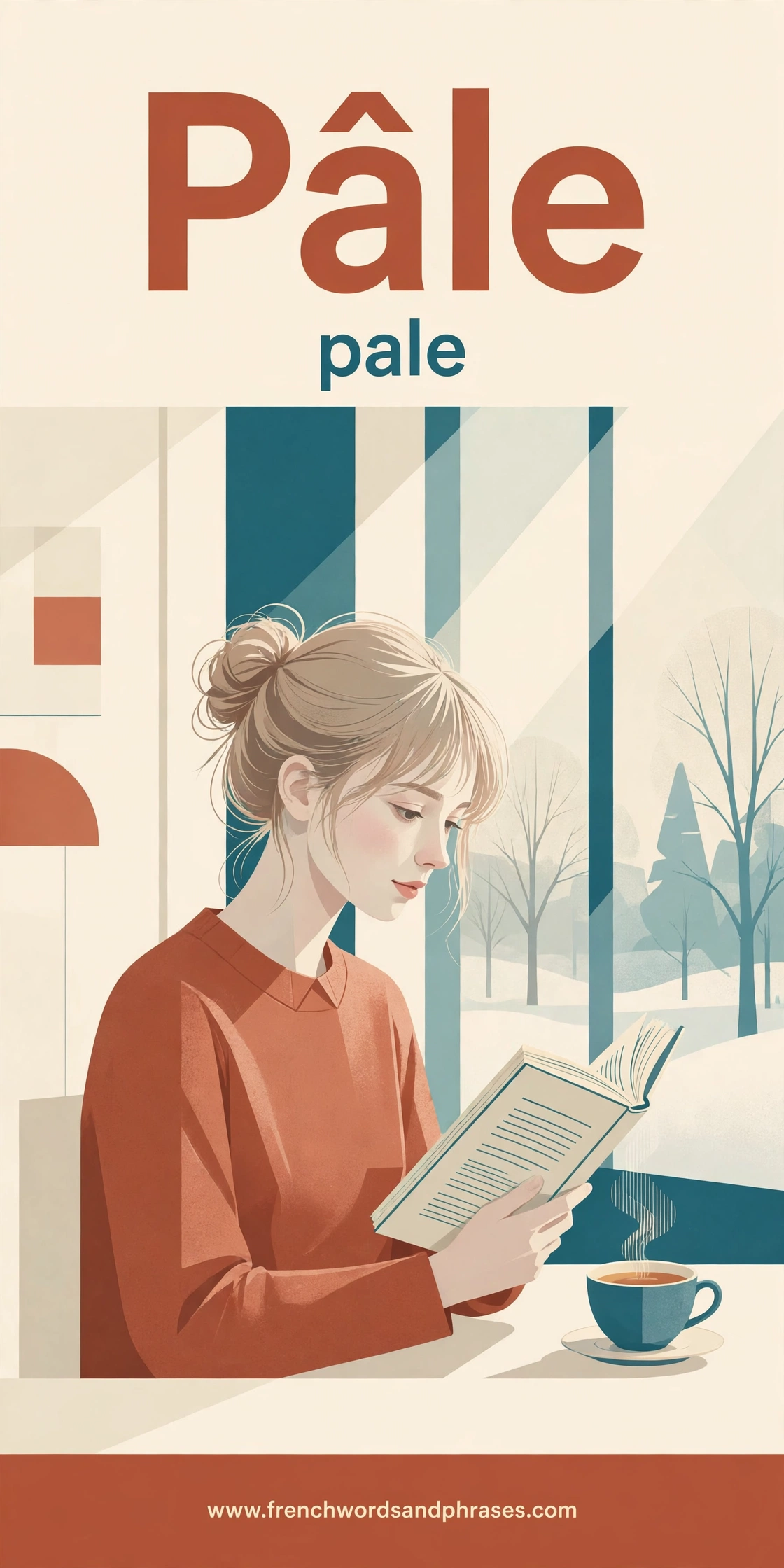
Pâle means pale.
The classroom goes quiet as the teacher announces the results. At the back, a boy who has not slept hears his name, stands up too fast, and the colour drains from his face in front of everyone — white as the page in his notebook. His friend whispers: « Ça va ? Tu es tout pâle. »
In this guide, you’ll learn what pâle means in English, why it never changes between masculine and feminine, how it names the lightest shades of colours, and the one figurative place where it steps in front of the noun. Explore French examples, English translations, and practice quizzes.
Understanding the French Adjective Pâle
Pâle is a French adjective of quality — the adjective of faint colour. It already ends in -e, so masculine and feminine are identical: only the plural adds an s. Un visage pâle, une lumière pâle, des couleurs pâles — one form does nearly all the work.
It means pale — of a face drained of colour by fear, illness or tiredness (un teint pâle), of light that is weak and watery (une pâle lumière), and of colours in their lightest shade: un bleu pâle, a pale blue; un rose pâle, a pale pink. One word for everything the colour has half left.
Type: Adjective of quality — faint colour
Answers the question: What is it like? — pale
Changes form: Only in the plural — pâle / pâles, the same for masculine and feminine
English equivalents: Pale; light (of colours); faint.
One important usage detail: pâle stands AFTER the noun — un visage pâle. But in one figurative family it steps in front: une pâle copie, a pale imitation — a feeble copy of the real thing. After a colour, the whole phrase stays invariable: des robes bleu pâle.
Experience the Word
Pâle is the adjective of the winter morning and the held breath — the face at the window, the first light that has not yet decided to be day.
Imagine a painter mixing his colours, adding white drop by drop until the fierce blue of noon becomes the blue of early sky. He is not weakening the colour. He is finding the exact moment where it starts to speak quietly.
You have not just described a lack of colour. You have described colour at its most delicate.
How to Use Pâle in French: Complete Guide
Let’s explore how pâle works in French, beginning with the whole word on one card.
Pâle at a Glance
Before the details, here is the whole word on one card.
The Whole Word on One Card
Meaning, type, position and forms — pâle in four lines.
| Point | Pâle |
|---|---|
| Meaning | pale |
| Type | adjective of quality — faint colour |
| Usual position | after the noun — un visage pâle |
| Form | pâle for everyone — pâles in the plural |
Example
Il a le visage pâle.
His face is pale.
The Four Forms of Pâle
Here is an easy agreement: pâle already ends in -e, so the feminine changes nothing. Only the plural adds an s.
| Form | Pâle | Example |
|---|---|---|
| Masculine singular | pâle | un teint pâle — a pale complexion |
| Feminine singular | pâle | une lumière pâle — a pale light |
| Masculine plural | pâles | des visages pâles — pale faces |
| Feminine plural | pâles | des couleurs pâles — pale colours |
Example
Les enfants ont des visages pâles après l’hiver.
The children have pale faces after the winter.
Quick Quiz 1
Does pâle change for a feminine noun?
Reveal the answer
No
Un visage pâle, une lumière pâle — the form is identical.
A pale face, a pale light.
The Feminine of Pâle: Nothing Changes
Most adjectives build their feminine by adding an e. Pâle was born with one — and with a circumflex accent on the a — so the feminine has nothing to add.
| Situation | Example |
|---|---|
| Masculine | un garçon pâle — a pale boy |
| Feminine | une fille pâle — identical |
| Why | pâle already ends in -e, so the feminine adds nothing |
| The plural | add s — des lunes pâles, pale moons |
Example
Elle est pâle, elle n’a presque pas dormi.
She is pale, she has hardly slept.
Where Pâle Goes: After the Noun — and One Figurative Exception
Pâle follows the noun, like most adjectives of quality. Its one special address is in front of the noun in a figurative sense, where it means feeble rather than light-coloured.
| Pattern | Example |
|---|---|
| After the noun | un visage pâle — a pale face |
| After a colour | un bleu pâle — a pale blue |
| Before the noun (figurative) | une pâle copie — a pale imitation, a feeble copy |
| After être | elle est pâle — she is pale |
Example
Ce tableau n’est qu’une pâle copie de l’original.
This painting is only a pale copy of the original.
Quick Quiz 2
In une pâle copie, does pâle describe a colour?
Reveal the answer
No
Before the noun, pâle is figurative: a feeble imitation.
Une pâle copie — a pale copy.
Paler Still: Comparing with Pâle
Pâle compares the regular way, with plus, moins and aussi — and the superlative agrees as usual: le plus pâle, la plus pâle.
| Degree | Example |
|---|---|
| As pale as | aussi pâle que — as pale as |
| Paler | plus pâle — paler |
| Less pale | moins pâle — less pale |
| The palest (masc.) | le plus pâle — le plus pâle des élèves |
| The palest (fem.) | la plus pâle — la plus pâle des robes |
Example
Il est plus pâle qu’hier, il doit se reposer.
He is paler than yesterday, he needs to rest.
Everyday Expressions with Pâle
Pâle is the word of the sickroom visit and the painter’s palette — and it owns one of the great French similes for a fright.
| Expression | In English |
|---|---|
| pâle comme un linge | as white as a sheet |
| un bleu pâle | a pale, light blue |
| un teint pâle | a pale complexion |
| devenir pâle | to turn pale, to go pale |
| une pâle copie | a pale imitation |
| pâlir | to go pale (the verb) |
Example
En entendant la nouvelle, il est devenu pâle comme un linge.
On hearing the news, he went as white as a sheet.
Quick Quiz 3
What does pâle comme un linge mean?
Reveal the answer
As white as a sheet
Elle était pâle comme un linge avant l’examen.
She was as white as a sheet before the exam.
Pâle and Its Neighbours
Pâle is the faint end of the colour family — bronzé and coloré glow at the other end, and blanc says plainly what pâle only suggests.
| French | In English |
|---|---|
| blanc | white — full white, no suggestion about it |
| blême | wan, deathly pale — stronger and more literary |
| livide | ashen, livid — pale with shock or cold |
| bronzé | tanned — the opposite souvenir of the sun |
| coloré | coloured, colourful — colour fully present |
Example
Après les vacances, personne n’est plus pâle au bureau.
After the holidays, nobody at the office is pale any more.
Watch Out: The Traps Around Pâle
The traps here are the circumflex that must not be dropped, the colour phrases that refuse to agree, and a verb that does the turning for you.
| Trap | The truth |
|---|---|
| Spelling | pâle keeps its circumflex — pâle, never ‘pale’ in French text |
| Colour phrases | bleu pâle does not agree: des robes bleu pâle, not ‘bleues pâles’ |
| Agreement | do not add a second e — une fille pâle, never ‘pâlée’ |
| The verb | to turn pale is pâlir or devenir pâle — elle pâlit |
Example
Elle porte une robe bleu pâle avec un ruban blanc.
She is wearing a pale blue dress with a white ribbon.
Quick Quiz 4
How do you write ‘pale blue dresses’ — des robes bleues pâles or des robes bleu pâle?
Reveal the answer
des robes bleu pâle
A colour shade is invariable: it never agrees.
Pale blue dresses.
Pâle in Everyday French: Real-Life Examples
Now that you know the word, let’s see how pâle appears in everyday French.
Example 1 — At school
Tu es tout pâle, tu devrais t’asseoir un moment.
You are quite pale, you should sit down for a moment.
Example 2 — Choosing paint
Je préfère le bleu pâle pour la chambre des enfants.
I prefer the pale blue for the children’s bedroom.
Example 3 — Winter faces
Après l’hiver, tous les visages sont pâles au village.
After the winter, all the faces in the village are pale.
Example 4 — The moon
Une pâle lune monte derrière les toits.
A pale moon rises behind the rooftops.
Example 5 — A fright
Il est devenu pâle en voyant la facture.
He turned pale when he saw the bill.
Example 6 — A judgment
Ce film n’est qu’une pâle copie du roman.
This film is only a pale copy of the novel.
Beyond Translation: The Meaning of Pâle
English says pale for the meaning of pâle — the same word, wearing a circumflex in French like a small roof over the a. But French stretches the word further than English bothers to: a shade of paint, a weak light, a feeble imitation are all pâle.
To call something pâle is to say the colour, or the courage, has half gone out of it.
And at the top of its scale stands the great simile of the laundry room: pâle comme un linge — pale as a sheet, the face of someone who has just heard the news.
How to Remember the French Adjective Pâle
Remember it this way: Pâle is the faint-colour adjective — one form for him and her, an s for the plural, and its place behind the noun.
- You see one form for everyone — un visage pâle, une lumière pâle.
- You add only an s in the plural — des visages pâles, des couleurs pâles.
- You keep the little roof — pâle always wears its circumflex.
The key idea is pâle never changes except in the plural, and after a colour the whole shade stays invariable.
Test Your Knowledge of Pâle
Let’s see how much you’ve learned. Try answering these questions before revealing the answers.
Question 1
What does pâle mean?
Reveal the answer
Pale — of faces, light and the lightest shades of colours.
Question 2
What is the feminine of pâle?
Reveal the answer
pâle — identical. The word already ends in -e.
Question 3
Translate: a pale face.
Reveal the answer
Un visage pâle.
Question 4
Complete the sentence:
Elle est devenue ______ en entendant la nouvelle.
Reveal the answer
pâle
Elle est devenue pâle en entendant la nouvelle.
She turned pale on hearing the news.
Question 5
What does une pâle copie mean?
Reveal the answer
A pale imitation — a feeble copy of the real thing.
Your Final Challenge
Can You Use It?
How would you say this in French?
“His face is pale, he is tired.”
Reveal the answer
Son visage est pâle, il est fatigué.
His face is pale, he is tired.
A little French. A little curiosity. A richer everyday life.
LEARN FRENCH ONE WORD AT A TIME