A French Word to Live By
How to Conjugate Collectionner in French
/kɔ.lɛk.sjɔ.ne/
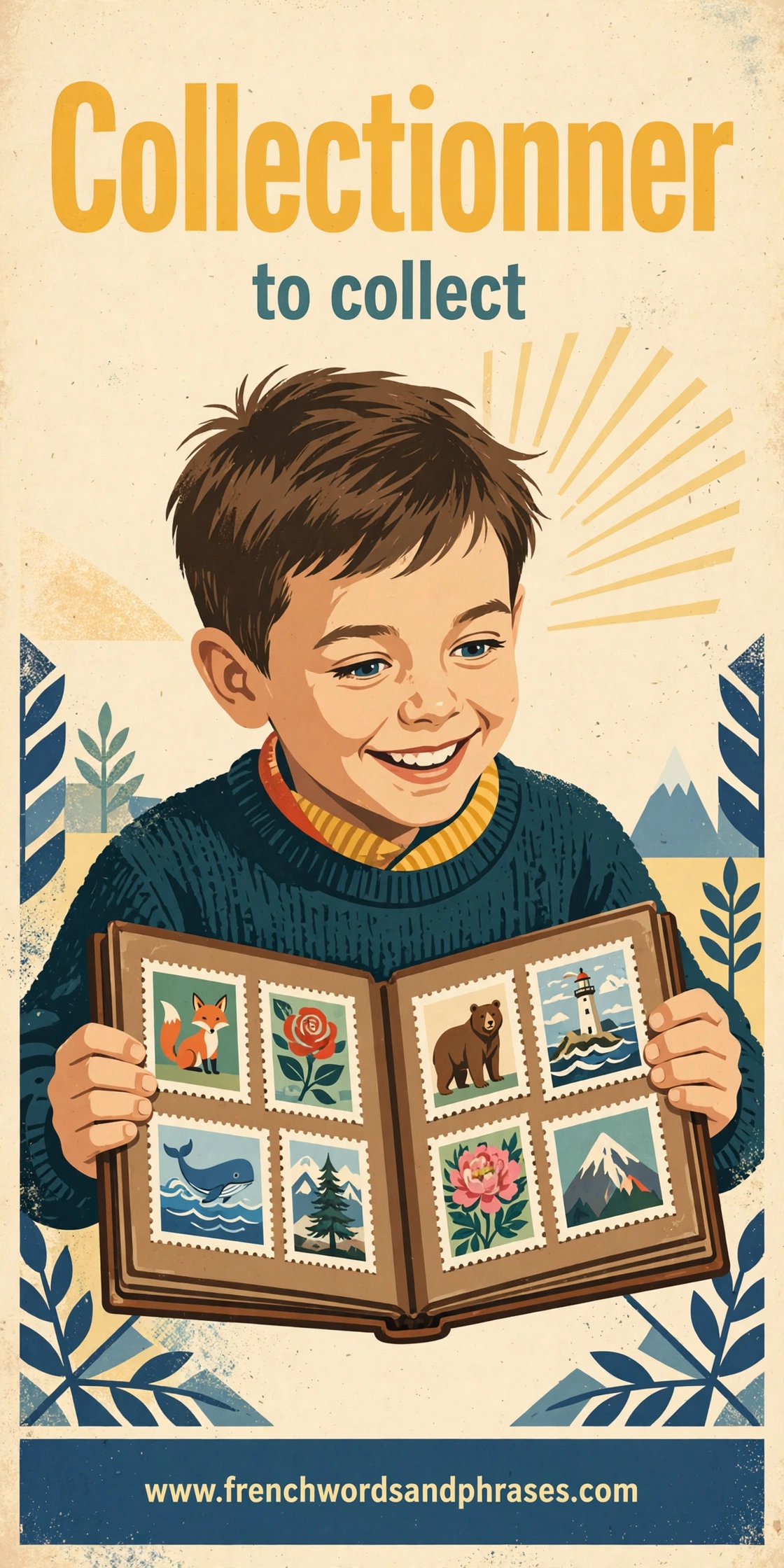
Collectionner means to collect — to gather stamps, coins, cards or anything else, piece by patient piece, into a collection.
An album of stamps with one page still half empty, a shelf of coins in little paper envelopes, a child trading cards in the schoolyard — collectionner is the verb of the patient hunt: finding, keeping and completing, one small treasure at a time.
In this guide, you’ll learn how to conjugate collectionner in all the major French tenses and moods. Explore complete conjugation tables, French examples, English translations, and practice quizzes.
Understanding the French Verb Collectionner
Collectionner is a regular French verb belonging to the first group of verbs, those ending in-er.
It means to collect. It is the standard verb for every collecting hobby, from stamps and coins to postcards, dolls and vintage cars, and it always implies a set being built deliberately — quite different from ramasser (to pick up) or accumuler (to pile up), because a collection has order, gaps and a missing piece.
Verb classification: First group (-er)
Auxiliary verb: Avoir
Past participle: collectionné
Present participle: collectionnant
English equivalents: To collect, to make a collection of; collectionner les timbres — to collect stamps; collectionner les pièces — to collect coins; un collectionneur, une collectionneuse — a collector; une collection — a collection.
One important detail: collectionner is a long but perfectly regular -er verb — je collectionne, nous collectionnons, ils collectionnent — with its double n safely in place from the noun une collection. Watch the person behind it: un collectionneur is a collector, and French has specialist names for the famous hobbies — un philatéliste collects stamps, un numismate collects coins. Figuratively, one can also collectionner les conquêtes or collectionner les échecs — to notch up conquests or failures.
Experience the Word
Collectionner is the verb of the joyful hunt — every collection is a story with one page still missing.
Imagine a grandfather at a Sunday flea market, magnifying glass in his pocket. He is not buying stamps, exactly; he is hunting the one blue stamp from 1932 that has escaped him for thirty years — il collectionne, and the hunt is the pleasure.
He may never complete the album. He has been collecting — collectionnant — all his life, and that was always the point.
How to Conjugate Collectionner: Complete French Conjugation Guide
Let’s explore every major conjugation of collectionner, beginning with the indicative mood.
How to Conjugate Collectionner in the Indicative Mood
The indicative mood is used to express facts, observations, actions, and events.
How to Conjugate Collectionner in the Present Tense (Présent)
Used for actions happening now, habitual actions, and general truths.
| Subject | Conjugation |
|---|---|
| je | collectionne |
| tu | collectionnes |
| il / elle | collectionne |
| nous | collectionnons |
| vous | collectionnez |
| ils / elles | collectionnent |
Example
Mon grand-père collectionne les timbres depuis cinquante ans.
My grandfather has been collecting stamps for fifty years.
Quick Quiz 1
Complete the sentence:
Nous ______ les pièces anciennes.
Reveal the answer
collectionnons
Nous collectionnons les pièces anciennes.
We collect old coins.
How to Conjugate Collectionner in the Passé Composé
Used for completed actions in the past. Collectionner takes the auxiliary verb avoir.
| Subject | Conjugation |
|---|---|
| j’ | ai collectionné |
| tu | as collectionné |
| il / elle | a collectionné |
| nous | avons collectionné |
| vous | avez collectionné |
| ils / elles | ont collectionné |
Example
Elle a collectionné plus de trois cents cartes postales.
She has collected more than three hundred postcards.
How to Conjugate Collectionner in the Imparfait (Imperfect Tense)
Used for habitual past actions, descriptions, and ongoing situations in the past.
| Subject | Conjugation |
|---|---|
| je | collectionnais |
| tu | collectionnais |
| il / elle | collectionnait |
| nous | collectionnions |
| vous | collectionniez |
| ils / elles | collectionnaient |
Example
Enfant, je collectionnais les coquillages sur la plage.
As a child, I used to collect shells on the beach.
Quick Quiz 2
Choose the correct form:
He collected stamps for years.
Il ______ les timbres pendant des années. (a collectionné / est collectionné)
Reveal the answer
a collectionné
Il a collectionné les timbres pendant des années.
Collectionner takes avoir.
How to Conjugate Collectionner in the Plus-que-parfait
Used to describe an action that had already been completed before another past event.
| Subject | Conjugation |
|---|---|
| j’ | avais collectionné |
| tu | avais collectionné |
| il / elle | avait collectionné |
| nous | avions collectionné |
| vous | aviez collectionné |
| ils / elles | avaient collectionné |
Example
Il avait collectionné les pièces rares avant de tout vendre.
He had collected the rare coins before selling everything.
How to Conjugate Collectionner in the Passé Simple
Primarily used in formal writing, literature, and historical narratives. It is rarely used in everyday conversation.
| Subject | Conjugation |
|---|---|
| je | collectionnai |
| tu | collectionnas |
| il / elle | collectionna |
| nous | collectionnâmes |
| vous | collectionnâtes |
| ils / elles | collectionnèrent |
Example
Le musée collectionna pendant un siècle les œuvres de la région.
The museum collected the region’s works for a century.
How to Conjugate Collectionner in the Passé Antérieur
A literary tense used to express an action completed immediately before another past action, generally in the passé simple.
| Subject | Conjugation |
|---|---|
| j’ | eus collectionné |
| tu | eus collectionné |
| il / elle | eut collectionné |
| nous | eûmes collectionné |
| vous | eûtes collectionné |
| ils / elles | eurent collectionné |
Example
Quand il eut collectionné mille timbres, il les exposa.
When he had collected a thousand stamps, he exhibited them.
How to Conjugate Collectionner in the Future Tense (Futur Simple)
Used to describe actions that will take place in the future.
| Subject | Conjugation |
|---|---|
| je | collectionnerai |
| tu | collectionneras |
| il / elle | collectionnera |
| nous | collectionnerons |
| vous | collectionnerez |
| ils / elles | collectionneront |
Example
Un jour, tu collectionneras les voitures anciennes.
One day, you will collect vintage cars.
How to Conjugate Collectionner in the Futur Antérieur (Future Perfect)
Used for an action that will have been completed before a particular point in the future.
| Subject | Conjugation |
|---|---|
| j’ | aurai collectionné |
| tu | auras collectionné |
| il / elle | aura collectionné |
| nous | aurons collectionné |
| vous | aurez collectionné |
| ils / elles | auront collectionné |
Example
À la fin de l’année, elle aura collectionné cinquante nouvelles pièces.
By the end of the year, she will have collected fifty new coins.
How to Conjugate Collectionner in the Near Future (Futur Proche)
Used to describe something that is going to happen soon. Formed with aller + infinitive.
| Subject | Conjugation |
|---|---|
| je | vais collectionner |
| tu | vas collectionner |
| il / elle | va collectionner |
| nous | allons collectionner |
| vous | allez collectionner |
| ils / elles | vont collectionner |
Example
Regarde cette vitrine, je vais collectionner les montres !
Look at that window — I am going to collect watches!
How to Conjugate Collectionner in the Conditional Mood
The conditional mood expresses what would happen under certain circumstances. It is also frequently used to make polite requests or express wishes.
How to Conjugate Collectionner in the Present Conditional
| Subject | Conjugation |
|---|---|
| je | collectionnerais |
| tu | collectionnerais |
| il / elle | collectionnerait |
| nous | collectionnerions |
| vous | collectionneriez |
| ils / elles | collectionneraient |
Example
Sans les prix actuels, je collectionnerais les tableaux.
Without today’s prices, I would collect paintings.
How to Conjugate Collectionner in the Past Conditional
| Subject | Conjugation |
|---|---|
| j’ | aurais collectionné |
| tu | aurais collectionné |
| il / elle | aurait collectionné |
| nous | aurions collectionné |
| vous | auriez collectionné |
| ils / elles | auraient collectionné |
Example
Il aurait collectionné les timbres s’il avait eu la patience.
He would have collected stamps if he had had the patience.
Collectionner in the Literary Past Conditional Form
This less common literary form uses the imperfect subjunctive of avoir.
| Subject | Conjugation |
|---|---|
| j’ | eusse collectionné |
| tu | eusses collectionné |
| il / elle | eût collectionné |
| nous | eussions collectionné |
| vous | eussiez collectionné |
| ils / elles | eussent collectionné |
Example
Elle eût collectionné les papillons sans ses allergies.
She would have collected butterflies without her allergies.
How to Conjugate Collectionner in the Subjunctive Mood
The subjunctive is used to express wishes, emotions, doubts, necessity, and uncertainty. It frequently follows expressions such as il faut que (it is necessary that) or bien que (although).
How to Conjugate Collectionner in the Present Subjunctive
| Subject | Conjugation |
|---|---|
| que je | collectionne |
| que tu | collectionnes |
| qu’il / qu’elle | collectionne |
| que nous | collectionnions |
| que vous | collectionniez |
| qu’ils / qu’elles | collectionnent |
Example
Il faut que tu collectionnes quelque chose de moins encombrant.
You need to collect something less bulky.
Quick Quiz 3
Complete the sentence using the subjunctive:
Il faut que vous ______ des objets rares.
Reveal the answer
collectionniez
Il faut que vous collectionniez des objets rares.
You must collect rare objects.
How to Conjugate Collectionner in the Imperfect Subjunctive
A literary tense, rarely encountered in modern spoken French.
| Subject | Conjugation |
|---|---|
| que je | collectionnasse |
| que tu | collectionnasses |
| qu’il / qu’elle | collectionnât |
| que nous | collectionnassions |
| que vous | collectionnassiez |
| qu’ils / qu’elles | collectionnassent |
Example
Je ne savais pas qu’il collectionnât les armes anciennes.
I did not know he collected antique weapons.
How to Conjugate Collectionner in the Pluperfect Subjunctive
A literary construction used to express an action completed before another past action.
| Subject | Conjugation |
|---|---|
| que j’ | eusse collectionné |
| que tu | eusses collectionné |
| qu’il / qu’elle | eût collectionné |
| que nous | eussions collectionné |
| que vous | eussiez collectionné |
| qu’ils / qu’elles | eussent collectionné |
Example
On disait qu’il eût collectionné des milliers de livres.
People said he had collected thousands of books.
How to Conjugate Collectionner in the Past Subjunctive
| Subject | Conjugation |
|---|---|
| que j’ | aie collectionné |
| que tu | aies collectionné |
| qu’il / qu’elle | ait collectionné |
| que nous | ayons collectionné |
| que vous | ayez collectionné |
| qu’ils / qu’elles | aient collectionné |
Example
Je suis étonné qu’elle ait collectionné autant de poupées.
I am amazed she collected so many dolls.
How to Conjugate Collectionner in the Imperative
The imperative is used to give commands, instructions, invitations, or suggestions. Subject pronouns are omitted.
How to Conjugate Collectionner in the Present Imperative
| Person | Conjugation |
|---|---|
| (tu) | collectionne |
| (nous) | collectionnons |
| (vous) | collectionnez |
Example
Collectionne ce que tu aimes, pas ce qui vaut cher !
Collect what you love, not what is expensive!
Quick Quiz 4
How would you say Collect what you love (tu form)?
Reveal the answer
Collectionne ce que tu aimes !
French Participles of Collectionner
Participles are verb forms that can be used in compound tenses and other grammatical constructions.
Present Participle of Collectionner
collectionnant
En collectionnant les cartes, il a appris toute la géographie.
By collecting the cards, he learned all the geography.
Past Participle of Collectionner
collectionné
Collectionnées avec patience, ces pièces valent aujourd’hui une fortune.
Collected with patience, these coins are worth a fortune today.
Collectionner in Everyday French: Real-Life Examples
Now that you know the conjugations, let’s see how collectionner appears in everyday French.
Example 1 — Present
Mon grand-père collectionne les timbres.
My grandfather collects stamps.
Example 2 — Passé composé
Elle a collectionné trois cents cartes postales.
She has collected three hundred postcards.
Example 3 — Imparfait
Je collectionnais les coquillages.
I used to collect shells.
Example 4 — Future
Tu collectionneras les voitures anciennes.
You will collect vintage cars.
Example 5 — Conditional
Je collectionnerais les tableaux avec plus d’argent.
I would collect paintings with more money.
Example 6 — Imperative
Collectionnez ce qui vous plaît !
Collect what you like!
Beyond Translation: The Meaning of Collectionner
English collect and French collectionner are plain cousins, both from Latin colligere, to gather together — the same root that gives French the scholarly colliger.
A collection is a hunt with a memory.
That is why collectionner feels different from simply buying: every stamp, coin or card in the album remembers the day it was found, and the empty spaces remember the ones still out there.
How to Remember the French Verb Collectionner
Remember it this way: Collectionner is about the grandfather hunting the one missing stamp at the flea market.
- The double n comes free from the noun: une collection, un collectionneur, collectionner.
- Name the treasures: collectionner les timbres, les pièces, les cartes postales.
- Regular -er: je collectionne, nous collectionnons, past participle collectionné.
The key idea is the grandfather hunting the one missing stamp at the flea market.
Test Your Knowledge of Collectionner
Let’s see how much you’ve learned. Try answering these questions before revealing the answers.
Question 1
What is the French name for a stamp collector, and for a collector in general?
Reveal the answer
Un philatéliste collects stamps; a collector in general is un collectionneur (une collectionneuse).
Question 2
How do you say My grandfather collects stamps in French?
Reveal the answer
Mon grand-père collectionne les timbres.
Question 3
Translate: She has collected three hundred postcards.
Reveal the answer
Elle a collectionné trois cents cartes postales.
Question 4
What is the past participle of collectionner?
Reveal the answer
Collectionné.
Question 5
Complete the sentence:
Il faut que tu ______ quelque chose de plus petit.
Reveal the answer
collectionnes
Il faut que tu collectionnes quelque chose de plus petit.
You need to collect something smaller.
Your Final Challenge
Can You Use It?
How would you say this in French?
She collects old postcards, and every card tells her of a journey she has never taken.
Reveal the answer
Elle collectionne les cartes postales anciennes, et chaque carte lui raconte un voyage qu’elle n’a jamais fait.
She collects old postcards, and every card tells her of a journey she has never taken.
A little French. A little curiosity. A richer everyday life.
LEARN FRENCH ONE WORD AT A TIME