A French Word to Live By
How to Conjugate Boumer in French
/bu.me/
Boumer means to go like a bomb — the familiar, slightly dated way to say that a place or a party is buzzing: ça boume !
A little harbour bar on a Saturday night, glasses clinking, an accordion in the corner and not a free chair in the house — in the French of the good old days, there is only one way to describe it: ça boume. Boumer is the verb of a place that is going like a bomb.
In this guide, you’ll learn how to conjugate boumer in all the major French tenses and moods. Explore complete conjugation tables, French examples, English translations, and practice quizzes.
Understanding the French Verb Boumer
Boumer is a regular French verb belonging to the first group of verbs, those ending in-er.
It means to go like a bomb. It belongs to parties, bars, dance halls and village fêtes: the subject is the event or the place, never really a person. Its noun twin, une boum, was the word for a teenagers’ party; both words now sound charmingly retro, which is exactly why grandparents still say ça boume with delight.
Verb classification: First group (-er)
Auxiliary verb: Avoir
Past participle: boumé
Present participle: boumant
English equivalents: To buzz, to be going great, to be in full swing (familiar, dated); ça boume ! — things are buzzing!; ça a boumé toute la nuit — the place buzzed all night; une boum — a party (dated slang); le boum — the boom, the rush.
One important detail: boumer is a familiar and now rather dated verb, and in real life it lives almost entirely in one form — the third person with ça: ça boume, ça a boumé, ça boumait. Nobody conjugates it through all six persons at the dinner table; the full paradigm exists, but ça is its natural subject, the way English says it’s buzzing. The conjugation itself is perfectly regular -er: ça boume, ça boumera, que ça boume, past participle boumé. Say it with a smile — it carries the flavour of the fifties and sixties.
Experience the Word
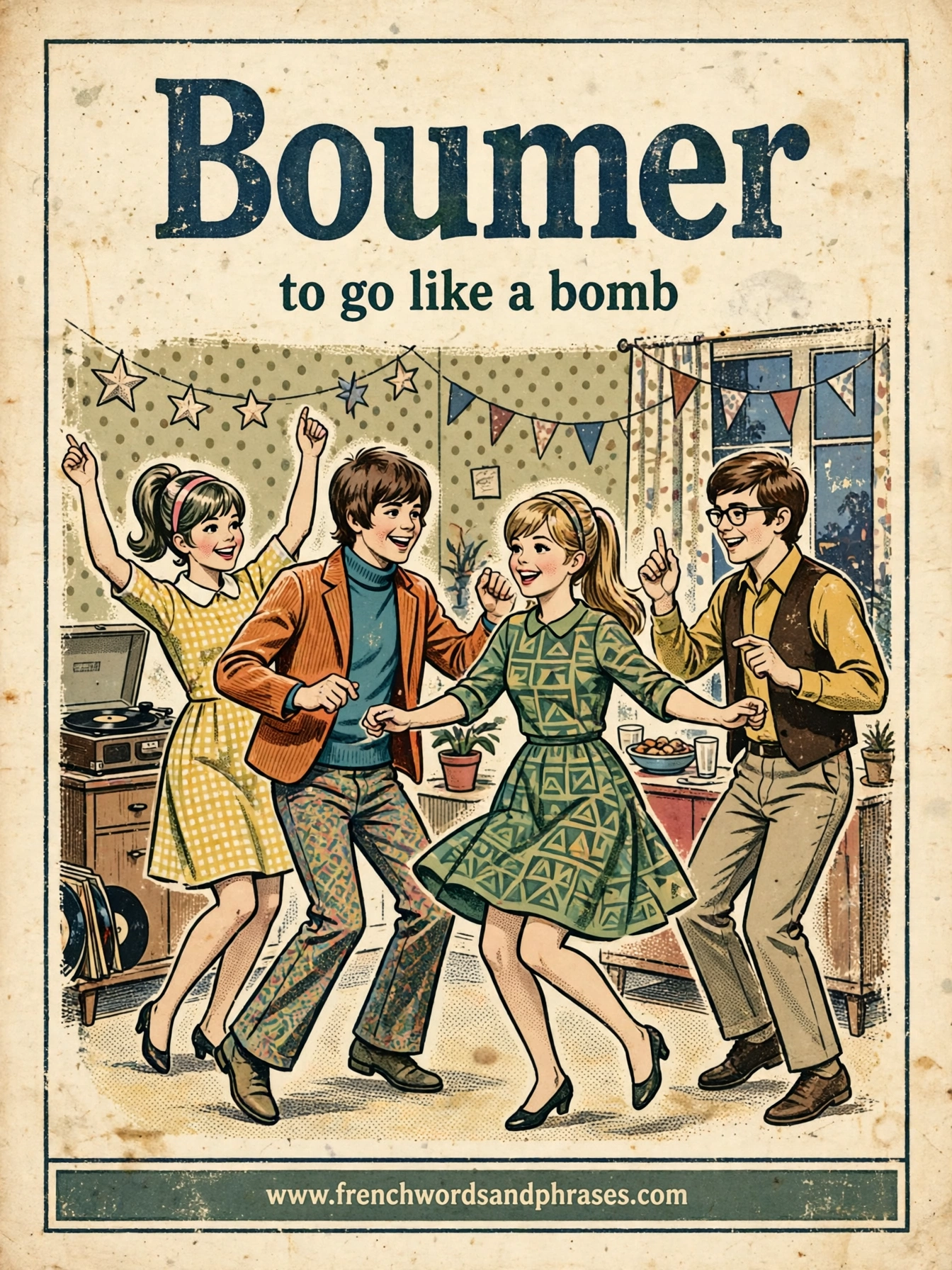
Boumer is the verb of the full house — music up, glasses up, and the whole place going like a bomb.
Imagine a village fête in 1962. The brass band has taken a break, the dance floor is full, the lemonade stall has run out twice, and the mayor, loosening his tie, says what everyone is thinking: ce soir, ça boume !
Nothing is exploding except the evening itself. It is buzzing — ça boume — and nobody wants to go home.
How to Conjugate Boumer: Complete French Conjugation Guide
Let’s explore every major conjugation of boumer, beginning with the indicative mood.
How to Conjugate Boumer in the Indicative Mood
The indicative mood is used to express facts, observations, actions, and events.
How to Conjugate Boumer in the Present Tense (Présent)
Used for actions happening now, habitual actions, and general truths.
| Subject | Conjugation |
|---|---|
| je | boume |
| tu | boumes |
| il / elle | boume |
| nous | boumons |
| vous | boumez |
| ils / elles | boument |
Example
Ce soir, ça boume dans le petit bar du port !
Tonight, the little harbour bar is buzzing!
Quick Quiz 1
Complete the sentence:
Ce soir, ça ______ dans tout le quartier.
Reveal the answer
boume
Ce soir, ça boume dans tout le quartier.
Tonight, the whole neighbourhood is buzzing.
How to Conjugate Boumer in the Passé Composé
Used for completed actions in the past. Boumer takes the auxiliary verb avoir.
| Subject | Conjugation |
|---|---|
| j’ | ai boumé |
| tu | as boumé |
| il / elle | a boumé |
| nous | avons boumé |
| vous | avez boumé |
| ils / elles | ont boumé |
Example
Samedi soir, ça a boumé toute la nuit chez les voisins.
On Saturday night, the neighbours’ place was buzzing all night.
How to Conjugate Boumer in the Imparfait (Imperfect Tense)
Used for habitual past actions, descriptions, and ongoing situations in the past.
| Subject | Conjugation |
|---|---|
| je | boumais |
| tu | boumais |
| il / elle | boumait |
| nous | boumions |
| vous | boumiez |
| ils / elles | boumaient |
Example
Dans les années soixante, ça boumait dans les caves de Saint-Germain.
In the sixties, the Saint-Germain cellars were buzzing.
Quick Quiz 2
Choose the correct form:
The party buzzed all night.
La soirée ______ toute la nuit. (a boumé / est boumée)
Reveal the answer
a boumé
La soirée a boumé toute la nuit.
Boumer takes avoir.
How to Conjugate Boumer in the Plus-que-parfait
Used to describe an action that had already been completed before another past event.
| Subject | Conjugation |
|---|---|
| j’ | avais boumé |
| tu | avais boumé |
| il / elle | avait boumé |
| nous | avions boumé |
| vous | aviez boumé |
| ils / elles | avaient boumé |
Example
Quand nous sommes arrivés, ça avait boumé depuis des heures chez eux.
When we arrived, things had been buzzing at their place for hours.
How to Conjugate Boumer in the Passé Simple
Primarily used in formal writing, literature, and historical narratives. It is rarely used in everyday conversation.
| Subject | Conjugation |
|---|---|
| je | boumai |
| tu | boumas |
| il / elle | bouma |
| nous | boumâmes |
| vous | boumâtes |
| ils / elles | boumèrent |
Example
Ce soir-là, ça bouma jusqu’au bout de la nuit.
That night, things buzzed until the very end of the night.
How to Conjugate Boumer in the Passé Antérieur
A literary tense used to express an action completed immediately before another past action, generally in the passé simple.
| Subject | Conjugation |
|---|---|
| j’ | eus boumé |
| tu | eus boumé |
| il / elle | eut boumé |
| nous | eûmes boumé |
| vous | eûtes boumé |
| ils / elles | eurent boumé |
Example
Quand ça eut boumé toute la soirée, le quartier s’endormit enfin.
When things had buzzed all evening, the neighbourhood finally fell asleep.
How to Conjugate Boumer in the Future Tense (Futur Simple)
Used to describe actions that will take place in the future.
| Subject | Conjugation |
|---|---|
| je | boumerai |
| tu | boumeras |
| il / elle | boumera |
| nous | boumerons |
| vous | boumerez |
| ils / elles | boumeront |
Example
Demain, ça boumera à la fête du village !
Tomorrow, the village fête will be buzzing!
How to Conjugate Boumer in the Futur Antérieur (Future Perfect)
Used for an action that will have been completed before a particular point in the future.
| Subject | Conjugation |
|---|---|
| j’ | aurai boumé |
| tu | auras boumé |
| il / elle | aura boumé |
| nous | aurons boumé |
| vous | aurez boumé |
| ils / elles | auront boumé |
Example
À minuit, ça aura boumé depuis six heures à la salle des fêtes.
By midnight, things will have been buzzing for six hours in the village hall.
How to Conjugate Boumer in the Near Future (Futur Proche)
Used to describe something that is going to happen soon. Formed with aller + infinitive.
| Subject | Conjugation |
|---|---|
| je | vais boumer |
| tu | vas boumer |
| il / elle | va boumer |
| nous | allons boumer |
| vous | allez boumer |
| ils / elles | vont boumer |
Example
Préparez les verres, ça va boumer ce soir !
Get the glasses ready, tonight is going to buzz!
How to Conjugate Boumer in the Conditional Mood
The conditional mood expresses what would happen under certain circumstances. It is also frequently used to make polite requests or express wishes.
How to Conjugate Boumer in the Present Conditional
| Subject | Conjugation |
|---|---|
| je | boumerais |
| tu | boumerais |
| il / elle | boumerait |
| nous | boumerions |
| vous | boumeriez |
| ils / elles | boumeraient |
Example
Avec un orchestre, ça boumerait encore plus fort.
With a band, it would buzz even louder.
How to Conjugate Boumer in the Past Conditional
| Subject | Conjugation |
|---|---|
| j’ | aurais boumé |
| tu | aurais boumé |
| il / elle | aurait boumé |
| nous | aurions boumé |
| vous | auriez boumé |
| ils / elles | auraient boumé |
Example
Sans la pluie, ça aurait boumé à la fête.
Without the rain, the party would have buzzed.
Boumer in the Literary Past Conditional Form
This less common literary form uses the imperfect subjunctive of avoir.
| Subject | Conjugation |
|---|---|
| j’ | eusse boumé |
| tu | eusses boumé |
| il / elle | eût boumé |
| nous | eussions boumé |
| vous | eussiez boumé |
| ils / elles | eussent boumé |
Example
La place eût boumé toute la nuit sans le couvre-feu.
The square would have buzzed all night without the curfew.
How to Conjugate Boumer in the Subjunctive Mood
The subjunctive is used to express wishes, emotions, doubts, necessity, and uncertainty. It frequently follows expressions such as il faut que (it is necessary that) or bien que (although).
How to Conjugate Boumer in the Present Subjunctive
| Subject | Conjugation |
|---|---|
| que je | boume |
| que tu | boumes |
| qu’il / qu’elle | boume |
| que nous | boumions |
| que vous | boumiez |
| qu’ils / qu’elles | boument |
Example
Il faut que ça boume à ton anniversaire !
Your birthday party has to buzz!
Quick Quiz 3
Complete the sentence using the subjunctive:
Il faut que ça ______ ce soir !
Reveal the answer
boume
Il faut que ça boume ce soir !
It has to buzz tonight!
How to Conjugate Boumer in the Imperfect Subjunctive
A literary tense, rarely encountered in modern spoken French.
| Subject | Conjugation |
|---|---|
| que je | boumasse |
| que tu | boumasses |
| qu’il / qu’elle | boumât |
| que nous | boumassions |
| que vous | boumassiez |
| qu’ils / qu’elles | boumassent |
Example
On aurait voulu que ça boumât un peu plus tard dans la soirée.
We would have liked it to buzz a bit later in the evening.
How to Conjugate Boumer in the Pluperfect Subjunctive
A literary construction used to express an action completed before another past action.
| Subject | Conjugation |
|---|---|
| que j’ | eusse boumé |
| que tu | eusses boumé |
| qu’il / qu’elle | eût boumé |
| que nous | eussions boumé |
| que vous | eussiez boumé |
| qu’ils / qu’elles | eussent boumé |
Example
Il semblait que ça eût boumé toute la nuit dans la rue.
It seemed things had buzzed all night in the street.
How to Conjugate Boumer in the Past Subjunctive
| Subject | Conjugation |
|---|---|
| que j’ | aie boumé |
| que tu | aies boumé |
| qu’il / qu’elle | ait boumé |
| que nous | ayons boumé |
| que vous | ayez boumé |
| qu’ils / qu’elles | aient boumé |
Example
Je suis content que ça ait boumé à la soirée.
I am glad the party buzzed.
How to Conjugate Boumer in the Imperative
The imperative is used to give commands, instructions, invitations, or suggestions. Subject pronouns are omitted.
How to Conjugate Boumer in the Present Imperative
| Person | Conjugation |
|---|---|
| (tu) | boume |
| (nous) | boumons |
| (vous) | boumez |
Example
Que ça boume ce soir !
Let it buzz tonight!
Quick Quiz 4
How would you say Let it buzz tonight?
Reveal the answer
Que ça boume ce soir !
French Participles of Boumer
Participles are verb forms that can be used in compound tenses and other grammatical constructions.
Present Participle of Boumer
boumant
En boumant dès neuf heures, la soirée n’a jamais faibli.
Buzzing from nine o’clock onwards, the party never flagged.
Past Participle of Boumer
boumé
Tout le monde parlait encore de cette soirée qui avait tant boumé.
Everyone was still talking about that party, which had buzzed so much.
Boumer in Everyday French: Real-Life Examples
Now that you know the conjugations, let’s see how boumer appears in everyday French.
Example 1 — Present
Ce soir, ça boume au bar du port.
Tonight, the harbour bar is buzzing.
Example 2 — Passé composé
Samedi, ça a boumé chez les voisins.
On Saturday, the neighbours’ place was buzzing.
Example 3 — Imparfait
Autrefois, ça boumait dans les caves parisiennes.
In the old days, the Paris cellars were buzzing.
Example 4 — Future
Demain, ça boumera à la fête du village.
Tomorrow, the village fête will be buzzing.
Example 5 — Conditional
Avec un orchestre, ça boumerait encore mieux.
With a band, it would buzz even better.
Example 6 — Imperative
Que ça boume ce soir !
Let it buzz tonight!
Beyond Translation: The Meaning of Boumer
The word sounds like what it means: boum is the thump of the bass drum and the bang of the party going off, a cousin of English boom.
Une boum was the party itself.
For a generation of French teenagers, la boum was the Saturday-night dance at a friend’s house — and a place where ça boumait was a place where life was happening at full volume. The verb has aged, but like a good song, it has aged well.
How to Remember the French Verb Boumer
Remember it this way: Boumer is about the village fête in 1962 — ça boume !.
- One living form does almost all the work: ça boume — things are buzzing, the place is going great.
- Familiar and dated: it smells of dance halls and the sixties — say it with a grin, like a grandparent at a wedding.
- Regular -er underneath: ça boume, ça a boumé, ça boumera, past participle boumé.
The key idea is the village fête in 1962 — ça boume !.
Test Your Knowledge of Boumer
Let’s see how much you’ve learned. Try answering these questions before revealing the answers.
Question 1
What does ça boume mean, and what is special about this verb in real life?
Reveal the answer
Things are buzzing / going great — and boumer lives almost entirely in the third person with ça.
Question 2
How do you say Tonight the bar is buzzing in French?
Reveal the answer
Ce soir, ça boume au bar.
Question 3
Translate: On Saturday, the party buzzed all night.
Reveal the answer
Samedi, ça a boumé toute la nuit.
Question 4
What is the past participle of boumer?
Reveal the answer
Boumé.
Question 5
Complete the sentence:
Il faut que ça ______ à ton anniversaire !
Reveal the answer
boume
Il faut que ça boume à ton anniversaire !
Your birthday party has to buzz!
Your Final Challenge
Can You Use It?
How would you say this in French?
In this little neighbourhood café, things buzz every Friday night just like in the good old days.
Reveal the answer
Dans ce petit café de quartier, ça boume tous les vendredis soir comme au bon vieux temps.
In this little neighbourhood café, things buzz every Friday night just like in the good old days.
A little French. A little curiosity. A richer everyday life.
LEARN FRENCH ONE WORD AT A TIME