A French Word to Live By
How to Conjugate Boucler in French
/bu.kle/
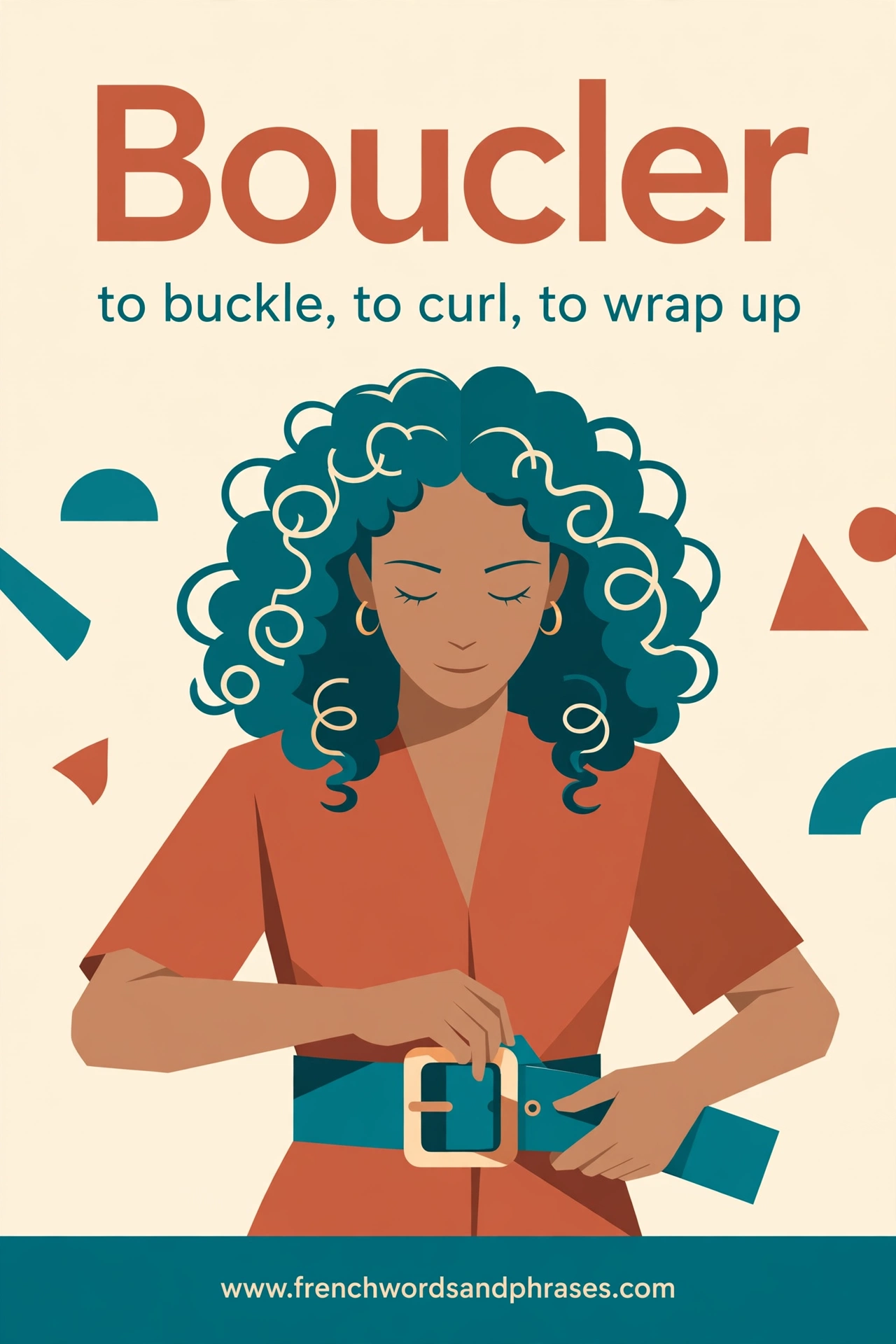
Boucler means to buckle and to close the loop — to fasten a belt, curl a head of hair, finish a file or seal off a street, always ending where the circle closes.
A belt pulled through its buckle on a plane, a hairdresser’s curling iron at work, a journalist finishing a report at midnight, police sealing a street — boucler is the verb of the loop closing: straps, curls, files and districts, all fastened round.
In this guide, you’ll learn how to conjugate boucler in all the major French tenses and moods. Explore complete conjugation tables, French examples, English translations, and practice quizzes.
Understanding the French Verb Boucler
Boucler is a regular French verb belonging to the first group of verbs, those ending in-er.
It means to buckle, to curl, to wrap up. It moves easily between the wardrobe (belts, suitcases, hair), the office (finishing reports, budgets and editions — boucler un journal is to put the paper to bed) and the street (police cordons), and it always carries the satisfaction of a thing properly closed.
Verb classification: First group (-er)
Auxiliary verb: Avoir
Past participle: bouclé
Present participle: bouclant
English equivalents: To buckle, to fasten, to curl, to complete; boucler sa ceinture — to fasten one’s seatbelt; boucler ses cheveux — to curl one’s hair; boucler un dossier, un rapport — to finish off a file, a report; boucler le quartier — to seal off the district; boucler la boucle — to come full circle.
One important detail: boucler is the verb of une boucle, a loop or buckle, and every sense closes one: the belt’s buckle, the curl that loops back on itself, the file that is finished and closed, the street the police loop shut. Watch the everyday trio: boucler sa ceinture (fasten your seatbelt — the announcement on every flight), boucler un dossier (wrap up a file), and the idiom boucler la boucle, to come full circle. The verb is a regular -er: je boucle, nous bouclons, ils bouclent.
Experience the Word
Boucler is the verb of the closing loop — the click of the buckle, the last page of the file, the end of the circle.
Imagine a features editor at eleven at night. Photographs chosen, captions written, one headline still missing. She types it, checks the page once more, and boucle le journal — the loop closes, the presses can roll, and the newsroom finally exhales.
One headline, one click of the loop. The paper is bouclé — wrapped up — and the night belongs to the printers.
How to Conjugate Boucler: Complete French Conjugation Guide
Let’s explore every major conjugation of boucler, beginning with the indicative mood.
How to Conjugate Boucler in the Indicative Mood
The indicative mood is used to express facts, observations, actions, and events.
How to Conjugate Boucler in the Present Tense (Présent)
Used for actions happening now, habitual actions, and general truths.
| Subject | Conjugation |
|---|---|
| je | boucle |
| tu | boucles |
| il / elle | boucle |
| nous | bouclons |
| vous | bouclez |
| ils / elles | bouclent |
Example
Le coiffeur boucle les cheveux de la mariée.
The hairdresser is curling the bride’s hair.
Quick Quiz 1
Complete the sentence:
Nous ______ le budget chaque vendredi soir.
Reveal the answer
bouclons
Nous bouclons le budget chaque vendredi soir.
We finalise the budget every Friday evening.
How to Conjugate Boucler in the Passé Composé
Used for completed actions in the past. Boucler takes the auxiliary verb avoir.
| Subject | Conjugation |
|---|---|
| j’ | ai bouclé |
| tu | as bouclé |
| il / elle | a bouclé |
| nous | avons bouclé |
| vous | avez bouclé |
| ils / elles | ont bouclé |
Example
Elle a bouclé son rapport avant minuit.
She finished off her report before midnight.
How to Conjugate Boucler in the Imparfait (Imperfect Tense)
Used for habitual past actions, descriptions, and ongoing situations in the past.
| Subject | Conjugation |
|---|---|
| je | bouclais |
| tu | bouclais |
| il / elle | bouclait |
| nous | bouclions |
| vous | boucliez |
| ils / elles | bouclaient |
Example
Autrefois, on bouclait les valises avec des sangles.
In the old days, people used to fasten suitcases with straps.
Quick Quiz 2
Choose the correct form:
She finished off her report.
Elle ______ son rapport. (a bouclé / est bouclé)
Reveal the answer
a bouclé
Elle a bouclé son rapport.
Boucler takes avoir.
How to Conjugate Boucler in the Plus-que-parfait
Used to describe an action that had already been completed before another past event.
| Subject | Conjugation |
|---|---|
| j’ | avais bouclé |
| tu | avais bouclé |
| il / elle | avait bouclé |
| nous | avions bouclé |
| vous | aviez bouclé |
| ils / elles | avaient bouclé |
Example
La police avait bouclé le quartier avant l’aube.
The police had sealed off the district before dawn.
How to Conjugate Boucler in the Passé Simple
Primarily used in formal writing, literature, and historical narratives. It is rarely used in everyday conversation.
| Subject | Conjugation |
|---|---|
| je | bouclai |
| tu | bouclas |
| il / elle | boucla |
| nous | bouclâmes |
| vous | bouclâtes |
| ils / elles | bouclèrent |
Example
Il boucla sa ceinture et démarra sans un mot.
He fastened his seatbelt and drove off without a word.
How to Conjugate Boucler in the Passé Antérieur
A literary tense used to express an action completed immediately before another past action, generally in the passé simple.
| Subject | Conjugation |
|---|---|
| j’ | eus bouclé |
| tu | eus bouclé |
| il / elle | eut bouclé |
| nous | eûmes bouclé |
| vous | eûtes bouclé |
| ils / elles | eurent bouclé |
Example
Quand elle eut bouclé le dernier dossier, elle éteignit son ordinateur.
When she had finished the last file, she switched off her computer.
How to Conjugate Boucler in the Future Tense (Futur Simple)
Used to describe actions that will take place in the future.
| Subject | Conjugation |
|---|---|
| je | bouclerai |
| tu | boucleras |
| il / elle | bouclera |
| nous | bouclerons |
| vous | bouclerez |
| ils / elles | boucleront |
Example
Nous bouclerons le budget vendredi soir.
We will finalise the budget on Friday evening.
How to Conjugate Boucler in the Futur Antérieur (Future Perfect)
Used for an action that will have been completed before a particular point in the future.
| Subject | Conjugation |
|---|---|
| j’ | aurai bouclé |
| tu | auras bouclé |
| il / elle | aura bouclé |
| nous | aurons bouclé |
| vous | aurez bouclé |
| ils / elles | auront bouclé |
Example
À minuit, l’équipe aura bouclé le journal.
By midnight, the team will have put the newspaper to bed.
How to Conjugate Boucler in the Near Future (Futur Proche)
Used to describe something that is going to happen soon. Formed with aller + infinitive.
| Subject | Conjugation |
|---|---|
| je | vais boucler |
| tu | vas boucler |
| il / elle | va boucler |
| nous | allons boucler |
| vous | allez boucler |
| ils / elles | vont boucler |
Example
Attache-toi, on va boucler nos ceintures et décoller.
Sit down, we are going to fasten our seatbelts and take off.
How to Conjugate Boucler in the Conditional Mood
The conditional mood expresses what would happen under certain circumstances. It is also frequently used to make polite requests or express wishes.
How to Conjugate Boucler in the Present Conditional
| Subject | Conjugation |
|---|---|
| je | bouclerais |
| tu | bouclerais |
| il / elle | bouclerait |
| nous | bouclerions |
| vous | boucleriez |
| ils / elles | boucleraient |
Example
Avec un jour de plus, elle bouclerait son roman.
With one more day, she would finish her novel.
How to Conjugate Boucler in the Past Conditional
| Subject | Conjugation |
|---|---|
| j’ | aurais bouclé |
| tu | aurais bouclé |
| il / elle | aurait bouclé |
| nous | aurions bouclé |
| vous | auriez bouclé |
| ils / elles | auraient bouclé |
Example
Ils auraient bouclé le quartier plus tôt sans la foule.
They would have sealed off the district earlier without the crowd.
Boucler in the Literary Past Conditional Form
This less common literary form uses the imperfect subjunctive of avoir.
| Subject | Conjugation |
|---|---|
| j’ | eusse bouclé |
| tu | eusses bouclé |
| il / elle | eût bouclé |
| nous | eussions bouclé |
| vous | eussiez bouclé |
| ils / elles | eussent bouclé |
Example
Le rédacteur eût bouclé le journal avant minuit.
The editor would have put the paper to bed before midnight.
How to Conjugate Boucler in the Subjunctive Mood
The subjunctive is used to express wishes, emotions, doubts, necessity, and uncertainty. It frequently follows expressions such as il faut que (it is necessary that) or bien que (although).
How to Conjugate Boucler in the Present Subjunctive
| Subject | Conjugation |
|---|---|
| que je | boucle |
| que tu | boucles |
| qu’il / qu’elle | boucle |
| que nous | bouclions |
| que vous | boucliez |
| qu’ils / qu’elles | bouclent |
Example
Il faut que tu boucles ta ceinture avant le décollage.
You must fasten your seatbelt before take-off.
Quick Quiz 3
Complete the sentence using the subjunctive:
Il faut que vous ______ le dossier avant vendredi.
Reveal the answer
boucliez
Il faut que vous boucliez le dossier avant vendredi.
You must wrap up the file before Friday.
How to Conjugate Boucler in the Imperfect Subjunctive
A literary tense, rarely encountered in modern spoken French.
| Subject | Conjugation |
|---|---|
| que je | bouclasse |
| que tu | bouclasses |
| qu’il / qu’elle | bouclât |
| que nous | bouclassions |
| que vous | bouclassiez |
| qu’ils / qu’elles | bouclassent |
Example
On attendait que la police bouclât le périmètre.
People were waiting for the police to seal off the perimeter.
How to Conjugate Boucler in the Pluperfect Subjunctive
A literary construction used to express an action completed before another past action.
| Subject | Conjugation |
|---|---|
| que j’ | eusse bouclé |
| que tu | eusses bouclé |
| qu’il / qu’elle | eût bouclé |
| que nous | eussions bouclé |
| que vous | eussiez bouclé |
| qu’ils / qu’elles | eussent bouclé |
Example
On racontait qu’elle eût bouclé son rapport en une nuit.
People said she had finished off her report in one night.
How to Conjugate Boucler in the Past Subjunctive
| Subject | Conjugation |
|---|---|
| que j’ | aie bouclé |
| que tu | aies bouclé |
| qu’il / qu’elle | ait bouclé |
| que nous | ayons bouclé |
| que vous | ayez bouclé |
| qu’ils / qu’elles | aient bouclé |
Example
Je suis content que vous ayez bouclé le dossier à temps.
I am glad you wrapped up the file in time.
How to Conjugate Boucler in the Imperative
The imperative is used to give commands, instructions, invitations, or suggestions. Subject pronouns are omitted.
How to Conjugate Boucler in the Present Imperative
| Person | Conjugation |
|---|---|
| (tu) | boucle |
| (nous) | bouclons |
| (vous) | bouclez |
Example
Boucle ta ceinture, on décolle !
Fasten your seatbelt, we are taking off!
Quick Quiz 4
How would you say Fasten your seatbelt (tu form)?
Reveal the answer
Boucle ta ceinture !
French Participles of Boucler
Participles are verb forms that can be used in compound tenses and other grammatical constructions.
Present Participle of Boucler
bouclant
En bouclant ses cheveux, elle chantonnait devant le miroir.
Curling her hair, she hummed in front of the mirror.
Past Participle of Boucler
bouclé
Bouclé en deux jours, le rapport a impressionné la direction.
Wrapped up in two days, the report impressed the management.
Boucler in Everyday French: Real-Life Examples
Now that you know the conjugations, let’s see how boucler appears in everyday French.
Example 1 — Present
Le coiffeur boucle les cheveux de la mariée.
The hairdresser is curling the bride’s hair.
Example 2 — Passé composé
Elle a bouclé son rapport avant minuit.
She finished off her report before midnight.
Example 3 — Imparfait
On bouclait les valises avec des sangles.
People used to fasten suitcases with straps.
Example 4 — Future
Nous bouclerons le budget vendredi soir.
We will finalise the budget on Friday evening.
Example 5 — Conditional
Avec un jour de plus, elle bouclerait son roman.
With one more day, she would finish her novel.
Example 6 — Imperative
Boucle ta ceinture, on décolle !
Fasten your seatbelt, we are taking off!
Beyond Translation: The Meaning of Boucler
English buckle is a blood relative — both come from the Latin buccula, a little cheek-strap — but French boucler travelled further, from the strap to everything that closes in a loop.
To finish is to close the circle.
That is why a French journalist boucling a newspaper and a traveller boucling a suitcase use the same word: in French, an ending is not a stop, it is a loop clicked shut — boucler la boucle, to come full circle.
How to Remember the French Verb Boucler
Remember it this way: Boucler is about belts, curls and files all fastened shut.
- Une boucle is a loop or buckle: boucler closes the loop — belt, curl, file or street.
- Three everyday uses: boucler sa ceinture, boucler un dossier, boucler la boucle.
- Regular -er: je boucle, nous bouclons, past participle bouclé.
The key idea is belts, curls and files all fastened shut.
Test Your Knowledge of Boucler
Let’s see how much you’ve learned. Try answering these questions before revealing the answers.
Question 1
What single image links all the senses of boucler?
Reveal the answer
Une boucle, a loop — the belt buckles, the hair curls into loops, the file and the street are closed in a loop.
Question 2
How do you say She finished off her report before midnight in French?
Reveal the answer
Elle a bouclé son rapport avant minuit.
Question 3
Translate: Fasten your seatbelt, we are taking off.
Reveal the answer
Boucle ta ceinture, on décolle !
Question 4
What is the past participle of boucler?
Reveal the answer
Bouclé.
Question 5
Complete the sentence:
Il faut que tu ______ ta ceinture avant le décollage.
Reveal the answer
boucles
Il faut que tu boucles ta ceinture avant le décollage.
You must fasten your seatbelt before take-off.
Your Final Challenge
Can You Use It?
How would you say this in French?
She fastens her seatbelt, finishes her novel, and so brings the best year of her life full circle.
Reveal the answer
Elle boucle sa ceinture, boucle son roman, et boucle ainsi la plus belle année de sa vie.
She fastens her seatbelt, finishes her novel, and so brings the best year of her life full circle.
A little French. A little curiosity. A richer everyday life.
LEARN FRENCH ONE WORD AT A TIME