A French Word to Live By
How to Conjugate Se bouchonner in French
/sə bu.ʃɔ.ne/
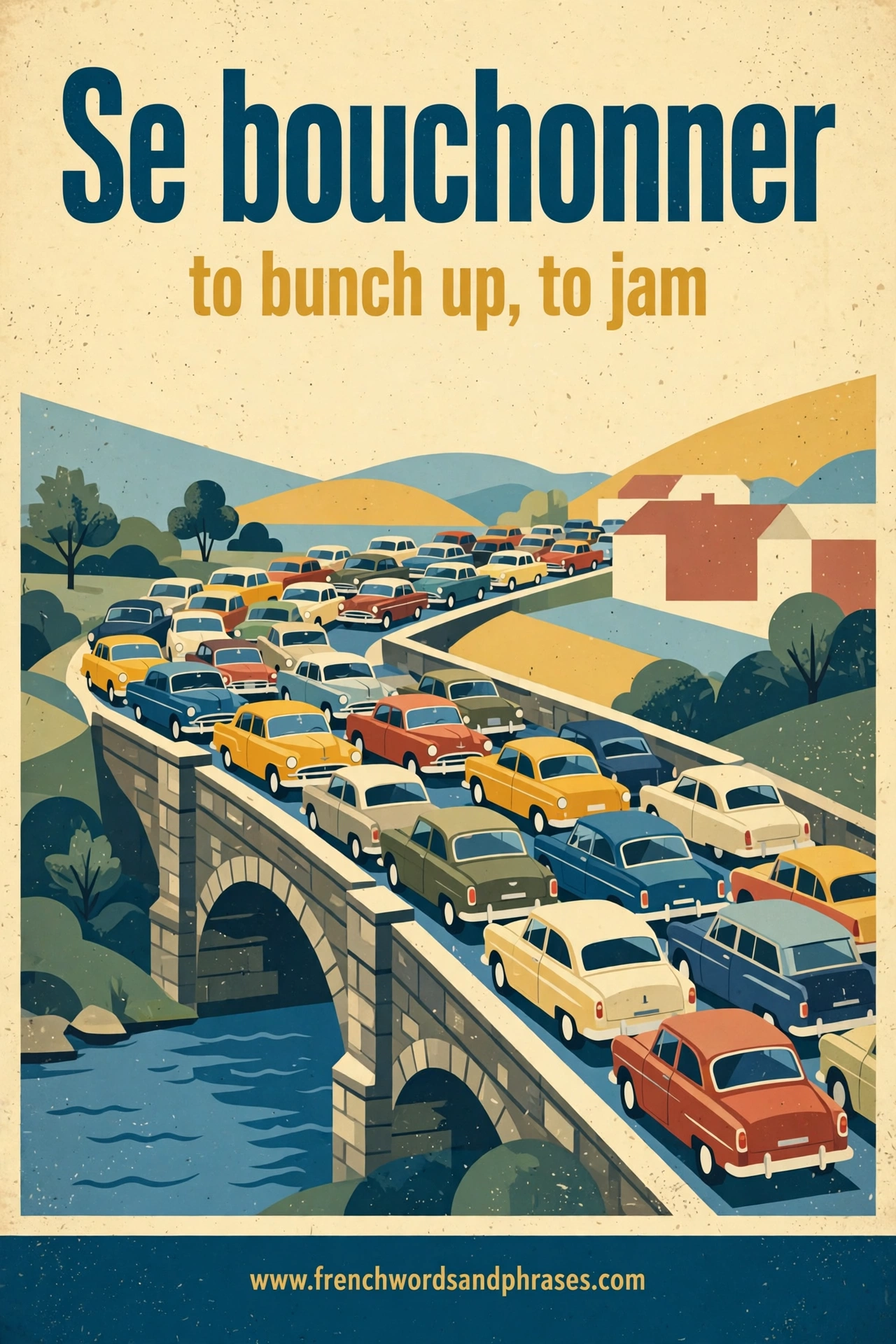
Se bouchonner means to bunch up — fabric riding into folds, crowds squeezing into a jam, things pressing themselves into a wad.
A shirt that creeps into creases inside the washing machine, a crowd thickening at a stadium gate until nobody can move — se bouchonner is what cloth and crowds do when they press themselves into a cork: bunched, wrinkled, stuck.
In this guide, you’ll learn how to conjugate se bouchonner in all the major French tenses and moods. Explore complete conjugation tables, French examples, English translations, and practice quizzes.
Understanding the French Verb Se bouchonner
Se bouchonner is a regular French verb belonging to the first group of verbs, those ending in-er.
It means to bunch up, to jam. It describes the slow self-crumpling of cloth in wardrobes and washing machines, and the thickening of any crowd or queue into a jam — the moment free movement turns into a press of bodies or folds.
Verb classification: First group (-er), reflexive
Auxiliary verb: Être
Past participle: bouchonné
Present participle: bouchonnant
English equivalents: To bunch up, to ride up, to get crumpled; le linge se bouchonne — the laundry bunches up; la chemise se bouchonne — the shirt rides up into creases; la foule se bouchonne — the crowd jams together; tout se bouchonne à la sortie — everything jams at the exit.
One important detail: se bouchonner is the reflexive twin of bouchonner — nobody does the bunching, the thing bunches itself, so the participle agrees with the subject: la chemise s’est bouchonnée, les rideaux se sont bouchonnés. Its favourite subjects are fabrics (le linge, une chemise, un rideau) and crowds (la foule, les voyageurs). Being reflexive, it always takes être: je me bouchonne, nous nous bouchonnons.
Experience the Word
Se bouchonner is the verb of the bunch — folds gathering in cloth, bodies gathering at a gate, everything pressed a little too close.
Imagine the last train home on a strike day. The platform fills, the doors open, and a hundred travellers press forward at once: la foule se bouchonne against the carriage doors, shoulders to shoulders, until the guard’s whistle cuts through and the mass slowly unsticks itself.
Nobody pushed, nobody planned it. The crowd has simply bouchonnée — bunched — itself into a cork at the door.
How to Conjugate Se bouchonner: Complete French Conjugation Guide
Let’s explore every major conjugation of se bouchonner, beginning with the indicative mood.
How to Conjugate Se bouchonner in the Indicative Mood
The indicative mood is used to express facts, observations, actions, and events.
How to Conjugate Se bouchonner in the Present Tense (Présent)
Used for actions happening now, habitual actions, and general truths.
| Subject | Conjugation |
|---|---|
| je | me bouchonne |
| tu | te bouchonnes |
| il / elle | se bouchonne |
| nous | nous bouchonnons |
| vous | vous bouchonnez |
| ils / elles | se bouchonnent |
Example
Le linge se bouchonne toujours dans cette machine.
The laundry always bunches up in this machine.
Quick Quiz 1
Complete the sentence:
Nous nous ______ toujours aux portillons du métro.
Reveal the answer
bouchonnons
Nous nous bouchonnons toujours aux portillons du métro.
We always bunch up at the metro gates.
How to Conjugate Se bouchonner in the Passé Composé
Used for completed actions in the past. Se bouchonner takes the auxiliary verb être.
| Subject | Conjugation |
|---|---|
| je | me suis bouchonné / me suis bouchonnée |
| tu | t’es bouchonné / t’es bouchonnée |
| il / elle | s’est bouchonné / s’est bouchonnée |
| nous | nous sommes bouchonnés / nous sommes bouchonnées |
| vous | vous êtes bouchonnés / vous êtes bouchonnées / vous êtes bouchonné / vous êtes bouchonnée |
| ils / elles | se sont bouchonnés / se sont bouchonnées |
Example
La foule s’est bouchonnée à l’entrée du stade.
The crowd jammed together at the stadium entrance.
How to Conjugate Se bouchonner in the Imparfait (Imperfect Tense)
Used for habitual past actions, descriptions, and ongoing situations in the past.
| Subject | Conjugation |
|---|---|
| je | me bouchonnais |
| tu | te bouchonnais |
| il / elle | se bouchonnait |
| nous | nous bouchonnions |
| vous | vous bouchonniez |
| ils / elles | se bouchonnaient |
Example
Ses chemises se bouchonnaient au fond de la valise.
His shirts used to get crumpled at the bottom of the suitcase.
Quick Quiz 2
Choose the correct form:
The crowd jammed together at the entrance.
La foule ______ à l’entrée. (s’est bouchonnée / a bouchonné)
Reveal the answer
s’est bouchonnée
La foule s’est bouchonnée à l’entrée.
Se bouchonner is reflexive, takes être, and the participle agrees: bouchonnée.
How to Conjugate Se bouchonner in the Plus-que-parfait
Used to describe an action that had already been completed before another past event.
| Subject | Conjugation |
|---|---|
| je | m’étais bouchonné / m’étais bouchonnée |
| tu | t’étais bouchonné / t’étais bouchonnée |
| il / elle | s’était bouchonné / s’était bouchonnée |
| nous | nous étions bouchonnés / nous étions bouchonnées |
| vous | vous étiez bouchonnés / vous étiez bouchonnées / vous étiez bouchonné / vous étiez bouchonnée |
| ils / elles | s’étaient bouchonnés / s’étaient bouchonnées |
Example
Le rideau s’était bouchonné derrière la porte.
The curtain had bunched up behind the door.
How to Conjugate Se bouchonner in the Passé Simple
Primarily used in formal writing, literature, and historical narratives. It is rarely used in everyday conversation.
| Subject | Conjugation |
|---|---|
| je | me bouchonnai |
| tu | te bouchonnas |
| il / elle | se bouchonna |
| nous | nous bouchonnâmes |
| vous | vous bouchonnâtes |
| ils / elles | se bouchonnèrent |
Example
Les voyageurs se bouchonnèrent sur le quai en quelques secondes.
The travellers jammed together on the platform within seconds.
How to Conjugate Se bouchonner in the Passé Antérieur
A literary tense used to express an action completed immediately before another past action, generally in the passé simple.
| Subject | Conjugation |
|---|---|
| je | me fus bouchonné / me fus bouchonnée |
| tu | te fus bouchonné / te fus bouchonnée |
| il / elle | se fut bouchonné / se fut bouchonnée |
| nous | nous fûmes bouchonnés / nous fûmes bouchonnées |
| vous | vous fûtes bouchonnés / vous fûtes bouchonnées / vous fûtes bouchonné / vous fûtes bouchonnée |
| ils / elles | se furent bouchonnés / se furent bouchonnées |
Example
Dès que la foule se fut bouchonnée au portillon, les agents fermèrent l’accès.
As soon as the crowd had jammed at the gate, the staff closed the entrance.
How to Conjugate Se bouchonner in the Future Tense (Futur Simple)
Used to describe actions that will take place in the future.
| Subject | Conjugation |
|---|---|
| je | me bouchonnerai |
| tu | te bouchonneras |
| il / elle | se bouchonnera |
| nous | nous bouchonnerons |
| vous | vous bouchonnerez |
| ils / elles | se bouchonneront |
Example
Si tu bourres la machine, tout se bouchonnera.
If you cram the machine full, everything will bunch up.
How to Conjugate Se bouchonner in the Futur Antérieur (Future Perfect)
Used for an action that will have been completed before a particular point in the future.
| Subject | Conjugation |
|---|---|
| je | me serai bouchonné / me serai bouchonnée |
| tu | te seras bouchonné / te seras bouchonnée |
| il / elle | se sera bouchonné / se sera bouchonnée |
| nous | nous serons bouchonnés / nous serons bouchonnées |
| vous | vous serez bouchonnés / vous serez bouchonnées / vous serez bouchonné / vous serez bouchonnée |
| ils / elles | se seront bouchonnés / se seront bouchonnées |
Example
À la sortie du match, la foule se sera bouchonnée trois fois aux portillons.
By the end of the match, the crowd will have jammed at the gates three times.
How to Conjugate Se bouchonner in the Near Future (Futur Proche)
Used to describe something that is going to happen soon. Formed with aller + infinitive.
| Subject | Conjugation |
|---|---|
| je | vais me bouchonner |
| tu | vas te bouchonner |
| il / elle | va se bouchonner |
| nous | allons nous bouchonner |
| vous | allez vous bouchonner |
| ils / elles | vont se bouchonner |
Example
Regarde la sortie, tout va se bouchonner.
Look at the exit, everything is going to jam up.
How to Conjugate Se bouchonner in the Conditional Mood
The conditional mood expresses what would happen under certain circumstances. It is also frequently used to make polite requests or express wishes.
How to Conjugate Se bouchonner in the Present Conditional
| Subject | Conjugation |
|---|---|
| je | me bouchonnerais |
| tu | te bouchonnerais |
| il / elle | se bouchonnerait |
| nous | nous bouchonnerions |
| vous | vous bouchonneriez |
| ils / elles | se bouchonneraient |
Example
Avec plus de place, la foule se bouchonnerait moins.
With more room, the crowd would bunch up less.
How to Conjugate Se bouchonner in the Past Conditional
| Subject | Conjugation |
|---|---|
| je | me serais bouchonné / me serais bouchonnée |
| tu | te serais bouchonné / te serais bouchonnée |
| il / elle | se serait bouchonné / se serait bouchonnée |
| nous | nous serions bouchonnés / nous serions bouchonnées |
| vous | vous seriez bouchonnés / vous seriez bouchonnées / vous seriez bouchonné / vous seriez bouchonnée |
| ils / elles | se seraient bouchonnés / se seraient bouchonnées |
Example
Le linge se serait bouchonné si tu l’avais laissé en boule.
The laundry would have got crumpled if you had left it in a ball.
Se bouchonner in the Literary Past Conditional Form
This less common literary form uses the imperfect subjunctive of être.
| Subject | Conjugation |
|---|---|
| je | me fusse bouchonné / me fusse bouchonnée |
| tu | te fusses bouchonné / te fusses bouchonnée |
| il / elle | se fût bouchonné / se fût bouchonnée |
| nous | nous fussions bouchonnés / nous fussions bouchonnées |
| vous | vous fussiez bouchonnés / vous fussiez bouchonnées / vous fussiez bouchonné / vous fussiez bouchonnée |
| ils / elles | se fussent bouchonnés / se fussent bouchonnées |
Example
La foule se fût bouchonnée sans les barrières de sécurité.
The crowd would have jammed together without the safety barriers.
How to Conjugate Se bouchonner in the Subjunctive Mood
The subjunctive is used to express wishes, emotions, doubts, necessity, and uncertainty. It frequently follows expressions such as il faut que (it is necessary that) or bien que (although).
How to Conjugate Se bouchonner in the Present Subjunctive
| Subject | Conjugation |
|---|---|
| que je | me bouchonne |
| que tu | te bouchonnes |
| qu’il / qu’elle | se bouchonne |
| que nous | nous bouchonnions |
| que vous | vous bouchonniez |
| qu’ils / qu’elles | se bouchonnent |
Example
Je ne veux pas que ta chemise se bouchonne dans la valise.
I do not want your shirt to get crumpled in the suitcase.
Quick Quiz 3
Complete the sentence using the subjunctive:
Je ne veux pas que vous vous ______ à la sortie.
Reveal the answer
bouchonniez
Je ne veux pas que vous vous bouchonniez à la sortie.
I do not want you to bunch up at the exit.
How to Conjugate Se bouchonner in the Imperfect Subjunctive
A literary tense, rarely encountered in modern spoken French.
| Subject | Conjugation |
|---|---|
| que je | me bouchonnasse |
| que tu | te bouchonnasses |
| qu’il / qu’elle | se bouchonnât |
| que nous | nous bouchonnassions |
| que vous | vous bouchonnassiez |
| qu’ils / qu’elles | se bouchonnassent |
Example
Il fallait que rien ne se bouchonnât aux sorties de secours.
Nothing was allowed to jam the emergency exits.
How to Conjugate Se bouchonner in the Pluperfect Subjunctive
A literary construction used to express an action completed before another past action.
| Subject | Conjugation |
|---|---|
| que je | me fusse bouchonné / me fusse bouchonnée |
| que tu | te fusses bouchonné / te fusses bouchonnée |
| qu’il / qu’elle | se fût bouchonné / se fût bouchonnée |
| que nous | nous fussions bouchonnés / nous fussions bouchonnées |
| que vous | vous fussiez bouchonnés / vous fussiez bouchonnées / vous fussiez bouchonné / vous fussiez bouchonnée |
| qu’ils / qu’elles | se fussent bouchonnés / se fussent bouchonnées |
Example
On racontait que les voyageurs se fussent bouchonnés sur le quai pendant la grève.
People said the travellers had jammed together on the platform during the strike.
How to Conjugate Se bouchonner in the Past Subjunctive
| Subject | Conjugation |
|---|---|
| que je | me sois bouchonné / me sois bouchonnée |
| que tu | te sois bouchonné / te sois bouchonnée |
| qu’il / qu’elle | se soit bouchonné / se soit bouchonnée |
| que nous | nous soyons bouchonnés / nous soyons bouchonnées |
| que vous | vous soyez bouchonnés / vous soyez bouchonnées / vous soyez bouchonné / vous soyez bouchonnée |
| qu’ils / qu’elles | se soient bouchonnés / se soient bouchonnées |
Example
Je suis agacé que le rideau se soit bouchonné encore une fois.
I am annoyed the curtain has bunched up yet again.
How to Conjugate Se bouchonner in the Imperative
The imperative is used to give commands, instructions, invitations, or suggestions. Subject pronouns are omitted.
How to Conjugate Se bouchonner in the Present Imperative
| Person | Conjugation |
|---|---|
| (tu) | bouchonne-toi |
| (nous) | bouchonnons-nous |
| (vous) | bouchonnez-vous |
Example
Ne vous bouchonnez pas tous à la sortie !
Do not all bunch up at the exit!
Quick Quiz 4
How would you say Do not bunch up at the exit (vous form)?
Reveal the answer
Ne vous bouchonnez pas à la sortie !
French Participles of Se bouchonner
Participles are verb forms that can be used in compound tenses and other grammatical constructions.
Present Participle of Se bouchonner
bouchonnant
En se bouchonnant dans la machine, le linge se froisse.
By bunching up in the machine, the laundry gets creased.
Past Participle of Se bouchonner
bouchonné
Bouchonnée dans un coin du placard, la robe était méconnaissable.
Crumpled in a corner of the wardrobe, the dress was unrecognisable.
Se bouchonner in Everyday French: Real-Life Examples
Now that you know the conjugations, let’s see how se bouchonner appears in everyday French.
Example 1 — Present
Le linge se bouchonne toujours dans cette machine.
The laundry always bunches up in this machine.
Example 2 — Passé composé
La foule s’est bouchonnée à l’entrée du stade.
The crowd jammed together at the stadium entrance.
Example 3 — Imparfait
Ses chemises se bouchonnaient au fond de la valise.
His shirts used to get crumpled at the bottom of the suitcase.
Example 4 — Future
Si tu bourres la machine, tout se bouchonnera.
If you cram the machine full, everything will bunch up.
Example 5 — Conditional
Avec plus de place, la foule se bouchonnerait moins.
With more room, the crowd would bunch up less.
Example 6 — Imperative
Ne vous bouchonnez pas tous à la sortie !
Do not all bunch up at the exit!
Beyond Translation: The Meaning of Se bouchonner
Where bouchonner needs a hand or a radio announcer, se bouchonner happens all by itself — the reflexive is French’s way of saying the wad formed on its own.
Cloth and crowds, same physics.
A shirt in a suitcase and a crowd at a gate obey the same law: press soft things into a narrow space and they se bouchonnent — they cork themselves shut.
How to Remember the French Verb Se bouchonner
Remember it this way: Se bouchonner is about the shirt bunching up in the wash, the crowd at the gate.
- Always reflexive, always être: le linge s’est bouchonné dans la machine.
- Its subjects are fabrics and crowds: la chemise se bouchonne, la foule se bouchonne.
- The participle agrees with the subject: bouchonnée, bouchonnés, bouchonnées.
The key idea is the shirt bunching up in the wash, the crowd at the gate.
Test Your Knowledge of Se bouchonner
Let’s see how much you’ve learned. Try answering these questions before revealing the answers.
Question 1
Which auxiliary does se bouchonner use, and why?
Reveal the answer
Être — it is a reflexive verb: la foule s’est bouchonnée à l’entrée.
Question 2
How do you say The laundry always bunches up in this machine in French?
Reveal the answer
Le linge se bouchonne toujours dans cette machine.
Question 3
Translate: The crowd jammed together at the stadium entrance.
Reveal the answer
La foule s’est bouchonnée à l’entrée du stade.
Question 4
What is the past participle of se bouchonner?
Reveal the answer
Bouchonné — agreeing: bouchonnée, bouchonnés, bouchonnées.
Question 5
Complete the sentence:
Je ne veux pas que ta chemise se ______ dans la valise.
Reveal the answer
bouchonne
Je ne veux pas que ta chemise se bouchonne dans la valise.
I do not want your shirt to get crumpled in the suitcase.
Your Final Challenge
Can You Use It?
How would you say this in French?
At the stadium exit, the crowd jams together for a moment, then flows away like a river set free.
Reveal the answer
À la sortie du stade, la foule se bouchonne un instant, puis s’écoule comme un fleuve délivré.
At the stadium exit, the crowd jams together for a moment, then flows away like a river set free.
A little French. A little curiosity. A richer everyday life.
LEARN FRENCH ONE WORD AT A TIME