A French Word to Live By
How to Conjugate Bouder in French
/bu.de/
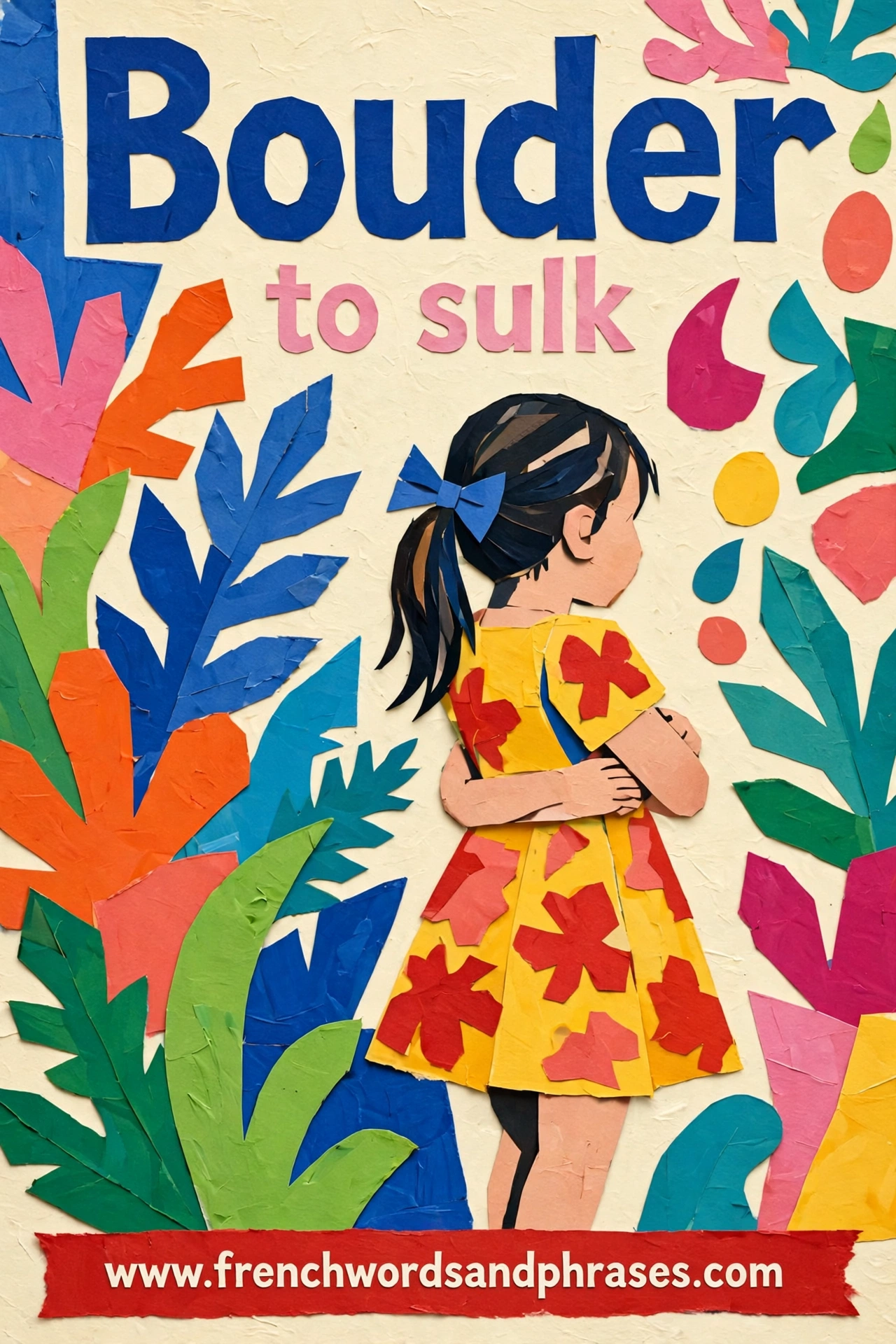
Bouder means to sulk — to turn away with a pout, refusing people, pleasures and apologies until the storm passes.
A small boy in the corner with crossed arms, a friend who answers in monosyllables all evening, a cat facing the wall — bouder is the verb of the sulk: the turned back, the pushed-out lip, the silence that wants to be noticed.
In this guide, you’ll learn how to conjugate bouder in all the major French tenses and moods. Explore complete conjugation tables, French examples, English translations, and practice quizzes.
Understanding the French Verb Bouder
Bouder is a regular French verb belonging to the first group of verbs, those ending in-er.
It means to sulk. It is the everyday French word for sulking at every age — children bouder in corners, adults bouder through dinners, whole electorates can bouder les urnes, sulkily staying away from the ballot box.
Verb classification: First group (-er)
Auxiliary verb: Avoir
Past participle: boudé
Present participle: boudant
English equivalents: To sulk, to be in a huff; bouder quelqu’un — to sulk at someone, to give someone the cold shoulder; bouder dans son coin — to sulk in one’s corner; bouder un plaisir — to turn down a pleasure out of sulkiness; ne pas bouder son plaisir — to show one’s pleasure openly, to not hide one’s delight.
One important detail: bouder takes a direct object when it aims at a person — il boude sa sœur, he is sulking at his sister, ignoring her on purpose. Its most charming use is negative and means the opposite of sulking: elle ne boude pas son plaisir — she does not hide her pleasure, she enjoys it openly. The family is small and expressive: la bouderie, a fit of sulking, and un boudeur, une boudeuse, a sulker. The verb itself is a regular -er: je boude, nous boudons, ils boudent.
Experience the Word
Bouder is the verb of the eloquent silence — saying nothing, loudly, until somebody apologises.
Imagine a family lunch in Provence. Little Hugo wanted the window seat, lost it to his cousin, and has retreated to the terrace steps: arms crossed, lip out, back turned to the melon, the roast, the whole summer. Il boude — and every adult at the table is pretending not to smile.
He has eaten nothing and forgiven nobody. He is sulking — boudant — with the full dignity of his seven years.
How to Conjugate Bouder: Complete French Conjugation Guide
Let’s explore every major conjugation of bouder, beginning with the indicative mood.
How to Conjugate Bouder in the Indicative Mood
The indicative mood is used to express facts, observations, actions, and events.
How to Conjugate Bouder in the Present Tense (Présent)
Used for actions happening now, habitual actions, and general truths.
| Subject | Conjugation |
|---|---|
| je | boude |
| tu | boudes |
| il / elle | boude |
| nous | boudons |
| vous | boudez |
| ils / elles | boudent |
Example
Le petit boude dans son coin depuis une heure.
The little boy has been sulking in his corner for an hour.
Quick Quiz 1
Complete the sentence:
Nous ______ rarement, sauf après une défaite.
Reveal the answer
boudons
Nous boudons rarement, sauf après une défaite.
We rarely sulk, except after a defeat.
How to Conjugate Bouder in the Passé Composé
Used for completed actions in the past. Bouder takes the auxiliary verb avoir.
| Subject | Conjugation |
|---|---|
| j’ | ai boudé |
| tu | as boudé |
| il / elle | a boudé |
| nous | avons boudé |
| vous | avez boudé |
| ils / elles | ont boudé |
Example
Elle a boudé son frère toute la soirée.
She sulked at her brother all evening.
How to Conjugate Bouder in the Imparfait (Imperfect Tense)
Used for habitual past actions, descriptions, and ongoing situations in the past.
| Subject | Conjugation |
|---|---|
| je | boudais |
| tu | boudais |
| il / elle | boudait |
| nous | boudions |
| vous | boudiez |
| ils / elles | boudaient |
Example
Enfant, il boudait dès qu’il perdait un jeu.
As a child, he would sulk whenever he lost a game.
Quick Quiz 2
Choose the correct form:
She sulked at her brother.
Elle ______ son frère. (a boudé / est boudé)
Reveal the answer
a boudé
Elle a boudé son frère.
Bouder takes avoir.
How to Conjugate Bouder in the Plus-que-parfait
Used to describe an action that had already been completed before another past event.
| Subject | Conjugation |
|---|---|
| j’ | avais boudé |
| tu | avais boudé |
| il / elle | avait boudé |
| nous | avions boudé |
| vous | aviez boudé |
| ils / elles | avaient boudé |
Example
Ils avaient boudé les urnes aux dernières élections.
They had stayed away from the ballot box in sulky protest at the last elections.
How to Conjugate Bouder in the Passé Simple
Primarily used in formal writing, literature, and historical narratives. It is rarely used in everyday conversation.
| Subject | Conjugation |
|---|---|
| je | boudai |
| tu | boudas |
| il / elle | bouda |
| nous | boudâmes |
| vous | boudâtes |
| ils / elles | boudèrent |
Example
Elle bouda le dessert et monta dans sa chambre.
She turned her back on dessert and went up to her room.
How to Conjugate Bouder in the Passé Antérieur
A literary tense used to express an action completed immediately before another past action, generally in the passé simple.
| Subject | Conjugation |
|---|---|
| j’ | eus boudé |
| tu | eus boudé |
| il / elle | eut boudé |
| nous | eûmes boudé |
| vous | eûtes boudé |
| ils / elles | eurent boudé |
Example
Quand il eut boudé une heure, il revint jouer avec les autres.
When he had sulked for an hour, he came back to play with the others.
How to Conjugate Bouder in the Future Tense (Futur Simple)
Used to describe actions that will take place in the future.
| Subject | Conjugation |
|---|---|
| je | bouderai |
| tu | bouderas |
| il / elle | boudera |
| nous | bouderons |
| vous | bouderez |
| ils / elles | bouderont |
Example
Si tu le grondes, il boudera toute la journée.
If you tell him off, he will sulk all day.
How to Conjugate Bouder in the Futur Antérieur (Future Perfect)
Used for an action that will have been completed before a particular point in the future.
| Subject | Conjugation |
|---|---|
| j’ | aurai boudé |
| tu | auras boudé |
| il / elle | aura boudé |
| nous | aurons boudé |
| vous | aurez boudé |
| ils / elles | auront boudé |
Example
À la fin du repas, elle aura boudé tout le monde deux fois.
By the end of the meal, she will have sulked at everyone twice.
How to Conjugate Bouder in the Near Future (Futur Proche)
Used to describe something that is going to happen soon. Formed with aller + infinitive.
| Subject | Conjugation |
|---|---|
| je | vais bouder |
| tu | vas bouder |
| il / elle | va bouder |
| nous | allons bouder |
| vous | allez bouder |
| ils / elles | vont bouder |
Example
Regarde son air, il va bouder.
Look at his face, he is going to sulk.
How to Conjugate Bouder in the Conditional Mood
The conditional mood expresses what would happen under certain circumstances. It is also frequently used to make polite requests or express wishes.
How to Conjugate Bouder in the Present Conditional
| Subject | Conjugation |
|---|---|
| je | bouderais |
| tu | bouderais |
| il / elle | bouderait |
| nous | bouderions |
| vous | bouderiez |
| ils / elles | bouderaient |
Example
Sans cette remarque, elle ne bouderait pas.
Without that remark, she would not be sulking.
How to Conjugate Bouder in the Past Conditional
| Subject | Conjugation |
|---|---|
| j’ | aurais boudé |
| tu | aurais boudé |
| il / elle | aurait boudé |
| nous | aurions boudé |
| vous | auriez boudé |
| ils / elles | auraient boudé |
Example
Il aurait boudé son plaisir s’il avait refusé l’invitation.
He would have been cutting off his nose to spite his face if he had refused the invitation.
Bouder in the Literary Past Conditional Form
This less common literary form uses the imperfect subjunctive of avoir.
| Subject | Conjugation |
|---|---|
| j’ | eusse boudé |
| tu | eusses boudé |
| il / elle | eût boudé |
| nous | eussions boudé |
| vous | eussiez boudé |
| ils / elles | eussent boudé |
Example
La fillette eût boudé tout l’après-midi sans la glace promise.
The little girl would have sulked all afternoon without the promised ice cream.
How to Conjugate Bouder in the Subjunctive Mood
The subjunctive is used to express wishes, emotions, doubts, necessity, and uncertainty. It frequently follows expressions such as il faut que (it is necessary that) or bien que (although).
How to Conjugate Bouder in the Present Subjunctive
| Subject | Conjugation |
|---|---|
| que je | boude |
| que tu | boudes |
| qu’il / qu’elle | boude |
| que nous | boudions |
| que vous | boudiez |
| qu’ils / qu’elles | boudent |
Example
Je ne veux pas que tu boudes tes amis pour si peu.
I do not want you to sulk at your friends over so little.
Quick Quiz 3
Complete the sentence using the subjunctive:
Je ne veux pas que vous ______ pour une remarque.
Reveal the answer
boudiez
Je ne veux pas que vous boudiez pour une remarque.
I do not want you to sulk over a remark.
How to Conjugate Bouder in the Imperfect Subjunctive
A literary tense, rarely encountered in modern spoken French.
| Subject | Conjugation |
|---|---|
| que je | boudasse |
| que tu | boudasses |
| qu’il / qu’elle | boudât |
| que nous | boudassions |
| que vous | boudassiez |
| qu’ils / qu’elles | boudassent |
Example
On s’étonnait qu’il boudât encore à son âge.
People were surprised he still sulked at his age.
How to Conjugate Bouder in the Pluperfect Subjunctive
A literary construction used to express an action completed before another past action.
| Subject | Conjugation |
|---|---|
| que j’ | eusse boudé |
| que tu | eusses boudé |
| qu’il / qu’elle | eût boudé |
| que nous | eussions boudé |
| que vous | eussiez boudé |
| qu’ils / qu’elles | eussent boudé |
Example
On disait qu’ils eussent boudé les urnes par déception.
People said they had stayed away from the polls out of disappointment.
How to Conjugate Bouder in the Past Subjunctive
| Subject | Conjugation |
|---|---|
| que j’ | aie boudé |
| que tu | aies boudé |
| qu’il / qu’elle | ait boudé |
| que nous | ayons boudé |
| que vous | ayez boudé |
| qu’ils / qu’elles | aient boudé |
Example
Je suis désolé qu’elle ait boudé toute la fête.
I am sorry she sulked through the whole party.
How to Conjugate Bouder in the Imperative
The imperative is used to give commands, instructions, invitations, or suggestions. Subject pronouns are omitted.
How to Conjugate Bouder in the Present Imperative
| Person | Conjugation |
|---|---|
| (tu) | boude |
| (nous) | boudons |
| (vous) | boudez |
Example
Ne boude pas, viens manger avec nous !
Do not sulk, come and eat with us!
Quick Quiz 4
How would you say Do not sulk (tu form)?
Reveal the answer
Ne boude pas !
French Participles of Bouder
Participles are verb forms that can be used in compound tenses and other grammatical constructions.
Present Participle of Bouder
boudant
En boudant ainsi, tu gâches la journée de tout le monde.
By sulking like this, you are spoiling everyone’s day.
Past Participle of Bouder
boudé
Boudé par les électeurs, le candidat a changé de ton.
Snubbed by the voters, the candidate changed his tone.
Bouder in Everyday French: Real-Life Examples
Now that you know the conjugations, let’s see how bouder appears in everyday French.
Example 1 — Present
Le petit boude dans son coin depuis une heure.
The little boy has been sulking in his corner for an hour.
Example 2 — Passé composé
Elle a boudé son frère toute la soirée.
She sulked at her brother all evening.
Example 3 — Imparfait
Enfant, il boudait dès qu’il perdait un jeu.
As a child, he would sulk whenever he lost a game.
Example 4 — Future
Si tu le grondes, il boudera toute la journée.
If you tell him off, he will sulk all day.
Example 5 — Conditional
Sans cette remarque, elle ne bouderait pas.
Without that remark, she would not be sulking.
Example 6 — Imperative
Ne boude pas, viens manger avec nous !
Do not sulk, come and eat with us!
Beyond Translation: The Meaning of Bouder
English sulk is gloomy and private; French bouder is a performance — the word is related to la bouche by way of the pout, the pushed-forward lips that advertise the grievance to the whole room.
And French sulks at scale.
Voters boudent les urnes, customers boudent un produit, audiences boudent un film — bouder is the national verb for the pointed, visible refusal, from the nursery corner to the ballot box.
How to Remember the French Verb Bouder
Remember it this way: Bouder is about the child in the corner, arms crossed, lip out.
- Picture the pout: bouder is sulking with the lips pushed out and the back turned.
- It takes a direct object for a person: bouder quelqu’un — to sulk at someone.
- Regular -er: je boude, nous boudons, past participle boudé; ne pas bouder son plaisir = to enjoy openly.
The key idea is the child in the corner, arms crossed, lip out.
Test Your Knowledge of Bouder
Let’s see how much you’ve learned. Try answering these questions before revealing the answers.
Question 1
How do you say to sulk at someone in French, with the right construction?
Reveal the answer
Bouder quelqu’un — a direct object, no preposition: elle boude son frère.
Question 2
How do you say The little boy has been sulking in his corner in French?
Reveal the answer
Le petit boude dans son coin.
Question 3
Translate: She sulked at her brother all evening.
Reveal the answer
Elle a boudé son frère toute la soirée.
Question 4
What is the past participle of bouder?
Reveal the answer
Boudé.
Question 5
Complete the sentence:
Je ne veux pas que tu ______ tes amis pour si peu.
Reveal the answer
boudes
Je ne veux pas que tu boudes tes amis pour si peu.
I do not want you to sulk at your friends over so little.
Your Final Challenge
Can You Use It?
How would you say this in French?
He sulks for five minutes, then laughter catches up with him and the day begins again.
Reveal the answer
Il boude cinq minutes, puis le rire le rattrape et la journée recommence.
He sulks for five minutes, then laughter catches up with him and the day begins again.
A little French. A little curiosity. A richer everyday life.
LEARN FRENCH ONE WORD AT A TIME