A French Word to Live By
Translate Barbe to English
/baʁb/
La barbe means the beard.
It grows on sailors and grandfathers, on philosophers and lumberjacks, patient as ivy and proud as a flag: la barbe, the beard — the hair of the chin and cheeks, and one of the oldest style decisions a man can make.
In this guide, you’ll learn what barbe means in English, how to use it with its articles, how to form its plural, and how it appears in everyday French. Explore French examples, English translations, and practice quizzes.
Understanding the French Noun Barbe
Barbe is a feminine French noun, learned with its article: la barbe, une barbe. It comes straight from the Latin barba — the word that also gives English barbarian, the bearded foreigner of Roman jokes. A beard is worn — porter la barbe — grown — se laisser pousser la barbe — and shaved — se raser la barbe. Its upstairs neighbour is la moustache, the mustache; the barbe covers chin, cheeks and jaw.
It means a beard — the hair on a man’s chin and cheeks: une barbe longue, a long beard, une barbe blanche, a white beard, une barbe de trois jours, three days’ stubble, designer stubble. The word escapes the face in two famous directions: la barbe à papa, candyfloss, is literally « daddy’s beard », and in familiar French la barbe ! means « what a bore! » — enough to make you stroke your chin and sigh.
Gender: Feminine — la barbe
Definite article: la — la barbe (the beard)
Indefinite article: une — une barbe (a beard)
Plural: les barbes — regular, with a simple -s
Spelling note: from Latin barba — the root of « barbarian », the bearded one
Close neighbour: la moustache — the mustache; the barbe covers chin and cheeks
English equivalents: The beard.
The beard verbs are a set: porter la barbe (to have a beard), se laisser pousser la barbe (to grow one), tailler sa barbe (to trim it), se raser (to shave). A man with a beard is un barbu. And the playground word: la barbe à papa, candyfloss — pink, sweet, and shaped exactly like the name promises.
Experience the Word
Barbe is time made visible: nobody grows one in a day, and every white hair in it has a year behind it.
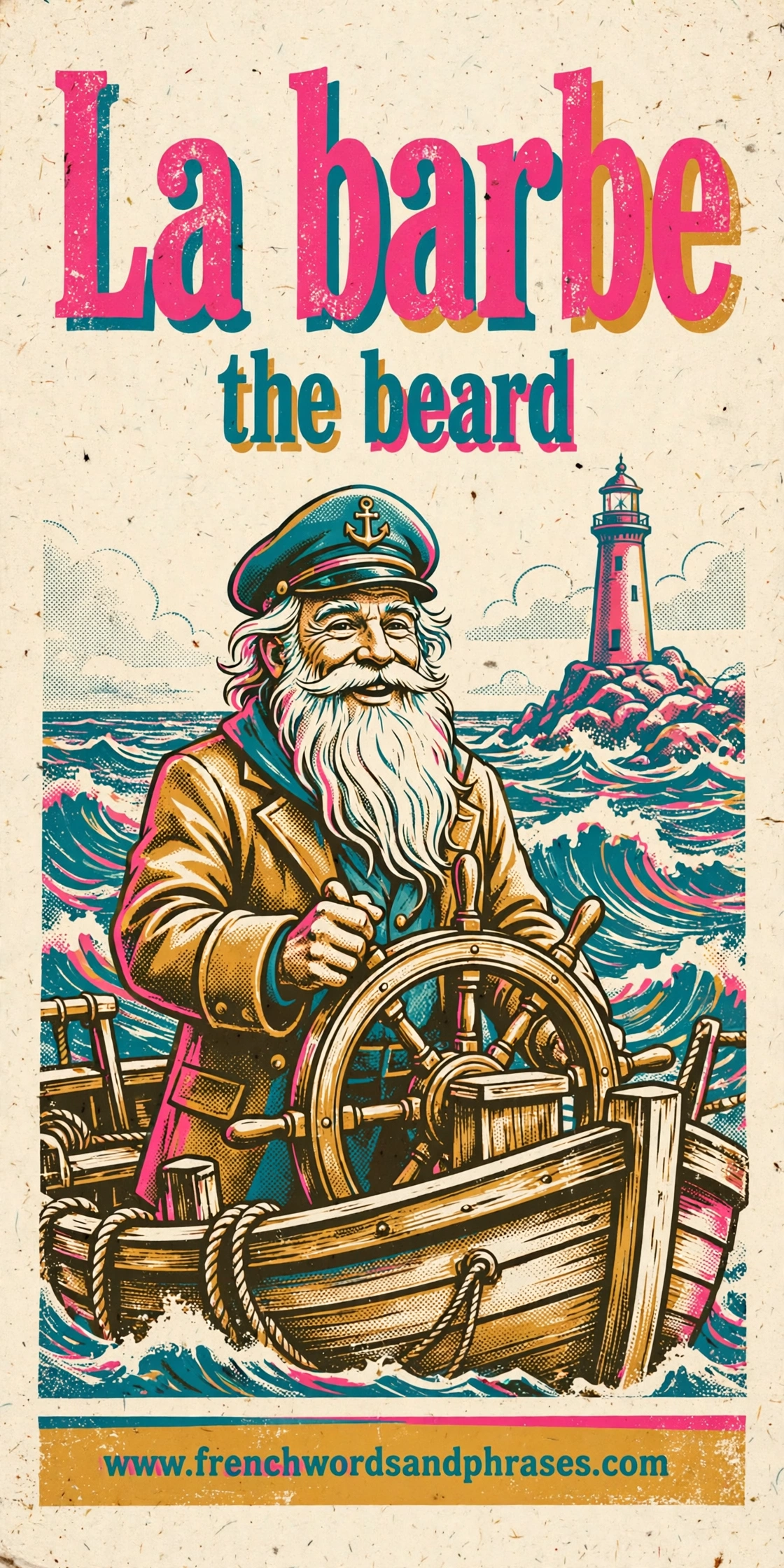
Imagine the lighthouse keeper of the old stories, beard to his chest, white as the foam he watches. Children in the village measure winters by it. Sa barbe est une carte de sa vie — a map of his life, drawn in hair.
You have not just named facial hair. You have named patience and character — la barbe, the beard, grown one day at a time.
How to Use Barbe in French: Complete Guide
Let’s explore how barbe works in French, beginning with its articles — la barbe, une barbe, porter la barbe.
Barbe with the Definite Article (La, Les)
Used for a specific beard — his, the sailor’s, the white one.
| Form | French |
|---|---|
| Feminine singular | la barbe |
| Plural | les barbes |
Example
La barbe du marin est pleine de sel.
The sailor’s beard is full of salt.
Barbe with the Indefinite Article (Une, Des)
Used for a beard in general — one grown, one trimmed, one admired.
| Form | French |
|---|---|
| Feminine singular | une barbe |
| Plural | des barbes |
Example
Il porte une barbe depuis ses vingt ans.
He has worn a beard since he was twenty.
Barbe in Its Styles (Longue, Blanche, De trois jours…)
Beards are described by length, colour and care — the vocabulary of the barber’s mirror.
| Kind | French |
|---|---|
| a long beard | une barbe longue |
| a white beard | une barbe blanche |
| three days’ stubble | une barbe de trois jours |
| a well-trimmed beard | une barbe bien taillée |
| a full beard | une barbe fournie |
Example
La barbe de trois jours lui donne un air décontracté.
His three days’ stubble gives him a relaxed air.
Quick Quiz 1
Complete the sentence:
______ barbe du Père Noël est blanche. (the)
Reveal the answer
La
La barbe du Père Noël est blanche.
Father Christmas’s beard is white — barbe is feminine, so la.
The Plural of Barbe
Barbe takes a regular plural in -s — beards travel in crews of sailors and choirs of grandfathers.
| Number | French |
|---|---|
| Singular | la barbe |
| Plural | les barbes |
Example
Les barbes blanches des anciens entourent la table.
The white beards of the old men surround the table.
Barbe with Possessive Adjectives (Ma, Ta, Sa…)
Possessives agree with the noun: barbe is feminine, so ma, ta, sa in the singular.
| Owner | French |
|---|---|
| my | ma barbe |
| your (tu) | ta barbe |
| his / her | sa barbe |
| our | notre barbe |
| your (vous) | votre barbe |
| their | leur barbe |
Example
Il caresse sa barbe quand il réfléchit.
He strokes his beard when he thinks.
Quick Quiz 2
Complete the sentence:
Le professeur ajuste ses lunettes et caresse ______ barbe. (his)
Reveal the answer
sa
Le professeur ajuste ses lunettes et caresse sa barbe.
The teacher adjusts his glasses and strokes his beard — sa, because barbe is feminine.
Barbe with Demonstrative Adjectives (Cette, Ces)
Used to point: cette barbe, this beard — usually the magnificent one.
| Form | French |
|---|---|
| Feminine singular | cette barbe |
| Plural | ces barbes |
Example
Cette barbe impressionnante descend jusqu’à sa poitrine.
That impressive beard reaches down to his chest.
Barbe with Adjectives
Adjectives agree with barbe — feminine singular: une barbe longue, une barbe blanche.
| Adjective | With Barbe |
|---|---|
| longue (long) | une barbe longue |
| blanche (white) | une barbe blanche |
| épaisse (thick) | une barbe épaisse |
| courte (short) | une barbe courte |
| bien taillée (well trimmed) | une barbe bien taillée |
Example
Le philosophe porte une longue barbe grise.
The philosopher wears a long grey beard.
Quick Quiz 3
Complete the sentence:
Le marin a une barbe très ______. (thick)
Reveal the answer
épaisse
Le marin a une barbe très épaisse.
The sailor has a very thick beard — épaisse, feminine, to agree with barbe.
Everyday Expressions with Barbe
Barbers, fairs and sighs of boredom — the barbe phrases of daily life.
| Expression | In English |
|---|---|
| porter la barbe | to have, to wear a beard |
| se laisser pousser la barbe | to grow a beard |
| la barbe à papa | candyfloss — literally « daddy’s beard » |
| une barbe de trois jours | three days’ stubble |
| la barbe ! | what a bore! (familiar) |
Example
À la fête foraine, les enfants mangent de la barbe à papa rose.
At the fair, the children eat pink candyfloss.
Words from the Same Family as Barbe
Faces and grooming — the words that travel with barbe.
| French | In English |
|---|---|
| la moustache | the mustache — above the lip |
| un barbu | a bearded man |
| se raser | to shave (the verb) |
| le menton | the chin |
| un barbier | a barber (old-fashioned word) |
Example
Un barbu sans moustache, c’est rare dans ce village de marins.
A bearded man without a mustache is rare in this village of sailors.
Quick Quiz 4
What is la barbe à papa?
Reveal the answer
Candyfloss — literally « daddy’s beard », the pink sugar cloud of fairgrounds.
Les enfants adorent la barbe à papa.
Children love candyfloss.
Barbe in Everyday French: Real-Life Examples
Now that you know the word, let’s see how barbe appears in everyday French.
Example 1 — Growing
Il se laisse pousser la barbe pour l’hiver.
He is growing his beard for the winter.
Example 2 — Trimming
Le barbier taille sa barbe en dix minutes.
The barber trims his beard in ten minutes.
Example 3 — Grandfather
La barbe blanche de grand-père sent le savon.
Grandfather’s white beard smells of soap.
Example 4 — Stubble
Une barbe de trois jours, c’est sa signature.
Three days’ stubble is his signature look.
Example 5 — The fair
Une barbe à papa pour la petite, s’il vous plaît.
A candyfloss for the little girl, please.
Example 6 — Boredom
Encore des devoirs ? La barbe !
Homework again? What a bore!
Beyond Translation: The Meaning of Barbe
Barbe is one of Latin’s survivors almost unchanged — barba — and it left a fossil in English: the barbarian was, to Roman eyes, simply the bearded one, the man who did not shave like a citizen. French added the sweetness: at the fairground, spun sugar became la barbe à papa, daddy’s beard, because the cloud of pink strands looked exactly like one — proof that the word lives as much in affection as in anatomy.
To say barbe is to name the beard — and, at the fair, dessert.
It evokes the barber’s strop, the sailor’s chin and the child’s sticky fingers: one word, three worlds.
How to Remember the French Noun Barbe
Remember it this way: Barbe is the beard — feminine: la barbe, worn with porter, and sweet at the fair as la barbe à papa.
- Always feminine — la barbe, une barbe, sa barbe.
- The beard verbs — porter la barbe, se laisser pousser la barbe, tailler sa barbe.
- The sweet trap — la barbe à papa, candyfloss, not a beard at all.
The key idea is la barbe — the beard, feminine; la barbe à papa = candyfloss.
Test Your Knowledge of Barbe
Let’s see how much you’ve learned. Try answering these questions before revealing the answers.
Question 1
Is barbe masculine or feminine?
Reveal the answer
Feminine — la barbe, une barbe.
Question 2
How do you say to grow a beard?
Reveal the answer
Se laisser pousser la barbe.
Question 3
Translate: He strokes his beard when he thinks.
Reveal the answer
Il caresse sa barbe quand il réfléchit.
Question 4
What is la barbe à papa?
Reveal the answer
Candyfloss — literally « daddy’s beard », the fairground sugar cloud.
Question 5
Complete the sentence:
______ barbe du marin est pleine de sel. (the)
Reveal the answer
La
La barbe du marin est pleine de sel.
The sailor’s beard is full of salt.
Your Final Challenge
Can You Use It?
How would you say this in French?
“Grandfather’s white beard smells of soap.”
Reveal the answer
La barbe blanche de grand-père sent le savon.
Grandfather’s white beard smells of soap.
A little French. A little curiosity. A richer everyday life.
LEARN FRENCH ONE WORD AT A TIME