A French Word to Live By
How to Conjugate Bobiner in French
/bɔ.bi.ne/
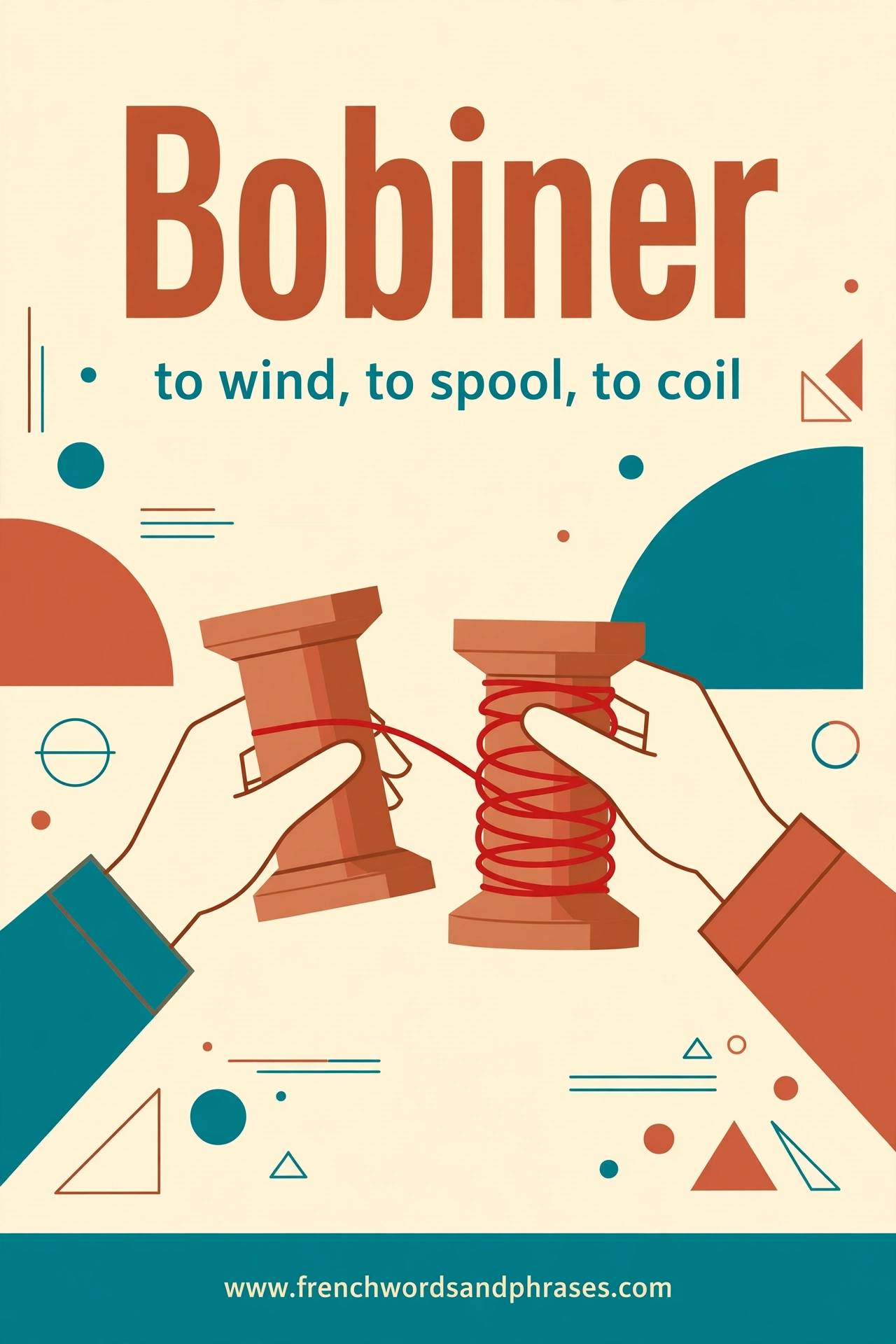
Bobiner means to wind — to roll thread, film, wire or yarn neatly onto a spool, a reel or a coil.
A seamstress winding silk thread onto a tiny bobbin, a projectionist spooling film in the dark, an electrician coiling copper wire for a motor — bobiner is the verb of tidy winding: whatever is long and loose gets rolled, evenly and patiently, around something round.
In this guide, you’ll learn how to conjugate bobiner in all the major French tenses and moods. Explore complete conjugation tables, French examples, English translations, and practice quizzes.
Understanding the French Verb Bobiner
Bobiner is a regular French verb belonging to the first group of verbs, those ending in-er.
It means to wind, to spool, to coil. It is commonly used in sewing rooms for thread and wool, in old cinemas for reels of film, and in workshops and garages for wire, cable and coils — anywhere something flexible is stored by rolling it around a core.
Verb classification: First group (-er)
Auxiliary verb: Avoir
Past participle: bobiné
Present participle: bobinant
English equivalents: To wind, to spool, to coil; bobiner du fil — to wind thread onto a bobbin; bobiner une pellicule — to spool a film; bobiner du fil de cuivre — to wind copper wire (for a coil); une bobine — a bobbin, a spool, a reel, an ignition coil; rebobiner — to rewind.
One important detail: bobiner is perfectly regular, but its family does the talking. The noun une bobine is a bobbin, a spool, a reel of film and even the coil in a car engine — so one bobine thread for sewing, film for the cinema, and wire for electricity. To wind something back the other way is rebobiner, the word every French film fan knows. Note that winding a clock is not bobiner — that is remonter.
Experience the Word
Bobiner is the verb of patient hands — turning a tangled length of something into a neat, obedient roll.
Imagine a tailor’s workshop at closing time. On the table lies a drift of loose red thread from the day’s work. The seamstress picks up the bobbin, traps the end, and turns — lentement, régulièrement — until the whole shining length lies bobiné, tight and even, ready for tomorrow.
Nothing is cut or thrown away. It has simply been wound — bobiné — chaos rolled into order.
How to Conjugate Bobiner: Complete French Conjugation Guide
Let’s explore every major conjugation of bobiner, beginning with the indicative mood.
How to Conjugate Bobiner in the Indicative Mood
The indicative mood is used to express facts, observations, actions, and events.
How to Conjugate Bobiner in the Present Tense (Présent)
Used for actions happening now, habitual actions, and general truths.
| Subject | Conjugation |
|---|---|
| je | bobine |
| tu | bobines |
| il / elle | bobine |
| nous | bobinons |
| vous | bobinez |
| ils / elles | bobinent |
Example
La couturière bobine le fil sur la canette.
The seamstress winds the thread onto the bobbin.
Quick Quiz 1
Complete the sentence:
Nous ______ le fil de cuivre pour le moteur.
Reveal the answer
bobinons
Nous bobinons le fil de cuivre pour le moteur.
We are winding the copper wire for the motor.
How to Conjugate Bobiner in the Passé Composé
Used for completed actions in the past. Bobiner takes the auxiliary verb avoir.
| Subject | Conjugation |
|---|---|
| j’ | ai bobiné |
| tu | as bobiné |
| il / elle | a bobiné |
| nous | avons bobiné |
| vous | avez bobiné |
| ils / elles | ont bobiné |
Example
Il a bobiné tout le fil de pêche avant de partir.
He wound all the fishing line before leaving.
How to Conjugate Bobiner in the Imparfait (Imperfect Tense)
Used for habitual past actions, descriptions, and ongoing situations in the past.
| Subject | Conjugation |
|---|---|
| je | bobinais |
| tu | bobinais |
| il / elle | bobinait |
| nous | bobinions |
| vous | bobiniez |
| ils / elles | bobinaient |
Example
Grand-mère bobinait la laine en écoutant la radio.
Grandmother used to wind the wool while listening to the radio.
Quick Quiz 2
Choose the correct form:
He wound the fishing line.
Il ______ le fil de pêche. (a bobiné / est bobiné)
Reveal the answer
a bobiné
Il a bobiné le fil de pêche.
Bobiner takes avoir.
How to Conjugate Bobiner in the Plus-que-parfait
Used to describe an action that had already been completed before another past event.
| Subject | Conjugation |
|---|---|
| j’ | avais bobiné |
| tu | avais bobiné |
| il / elle | avait bobiné |
| nous | avions bobiné |
| vous | aviez bobiné |
| ils / elles | avaient bobiné |
Example
Elle avait bobiné le fil avant de commencer à coudre.
She had wound the thread before starting to sew.
How to Conjugate Bobiner in the Passé Simple
Primarily used in formal writing, literature, and historical narratives. It is rarely used in everyday conversation.
| Subject | Conjugation |
|---|---|
| je | bobinai |
| tu | bobinas |
| il / elle | bobina |
| nous | bobinâmes |
| vous | bobinâtes |
| ils / elles | bobinèrent |
Example
Le projectionniste bobina la pellicule en quelques minutes.
The projectionist spooled the film in a few minutes.
How to Conjugate Bobiner in the Passé Antérieur
A literary tense used to express an action completed immediately before another past action, generally in the passé simple.
| Subject | Conjugation |
|---|---|
| j’ | eus bobiné |
| tu | eus bobiné |
| il / elle | eut bobiné |
| nous | eûmes bobiné |
| vous | eûtes bobiné |
| ils / elles | eurent bobiné |
Example
Quand il eut bobiné le câble, l’électricien rangea ses outils.
When he had coiled the cable, the electrician put away his tools.
How to Conjugate Bobiner in the Future Tense (Futur Simple)
Used to describe actions that will take place in the future.
| Subject | Conjugation |
|---|---|
| je | bobinerai |
| tu | bobineras |
| il / elle | bobinera |
| nous | bobinerons |
| vous | bobinerez |
| ils / elles | bobineront |
Example
Demain, nous bobinerons le fil de cuivre pour le moteur.
Tomorrow, we will wind the copper wire for the motor.
How to Conjugate Bobiner in the Futur Antérieur (Future Perfect)
Used for an action that will have been completed before a particular point in the future.
| Subject | Conjugation |
|---|---|
| j’ | aurai bobiné |
| tu | auras bobiné |
| il / elle | aura bobiné |
| nous | aurons bobiné |
| vous | aurez bobiné |
| ils / elles | auront bobiné |
Example
À midi, elle aura bobiné toutes les pelotes.
By noon, she will have wound all the balls of yarn.
How to Conjugate Bobiner in the Near Future (Futur Proche)
Used to describe something that is going to happen soon. Formed with aller + infinitive.
| Subject | Conjugation |
|---|---|
| je | vais bobiner |
| tu | vas bobiner |
| il / elle | va bobiner |
| nous | allons bobiner |
| vous | allez bobiner |
| ils / elles | vont bobiner |
Example
Je vais bobiner ce fil avant qu’il s’emmêle.
I am going to wind this thread before it tangles.
How to Conjugate Bobiner in the Conditional Mood
The conditional mood expresses what would happen under certain circumstances. It is also frequently used to make polite requests or express wishes.
How to Conjugate Bobiner in the Present Conditional
| Subject | Conjugation |
|---|---|
| je | bobinerais |
| tu | bobinerais |
| il / elle | bobinerait |
| nous | bobinerions |
| vous | bobineriez |
| ils / elles | bobineraient |
Example
Sans la machine, tu bobinerais le fil à la main.
Without the machine, you would wind the thread by hand.
How to Conjugate Bobiner in the Past Conditional
| Subject | Conjugation |
|---|---|
| j’ | aurais bobiné |
| tu | aurais bobiné |
| il / elle | aurait bobiné |
| nous | aurions bobiné |
| vous | auriez bobiné |
| ils / elles | auraient bobiné |
Example
Elle aurait bobiné la pellicule si le projecteur avait marché.
She would have spooled the film if the projector had worked.
Bobiner in the Literary Past Conditional Form
This less common literary form uses the imperfect subjunctive of avoir.
| Subject | Conjugation |
|---|---|
| j’ | eusse bobiné |
| tu | eusses bobiné |
| il / elle | eût bobiné |
| nous | eussions bobiné |
| vous | eussiez bobiné |
| ils / elles | eussent bobiné |
Example
Il eût bobiné le fil plus vite avec un dévidoir.
He would have wound the thread faster with a winder.
How to Conjugate Bobiner in the Subjunctive Mood
The subjunctive is used to express wishes, emotions, doubts, necessity, and uncertainty. It frequently follows expressions such as il faut que (it is necessary that) or bien que (although).
How to Conjugate Bobiner in the Present Subjunctive
| Subject | Conjugation |
|---|---|
| que je | bobine |
| que tu | bobines |
| qu’il / qu’elle | bobine |
| que nous | bobinions |
| que vous | bobiniez |
| qu’ils / qu’elles | bobinent |
Example
Il faut que tu bobines le fil bien serré.
You must wind the thread nice and tight.
Quick Quiz 3
Complete the sentence using the subjunctive:
Il faut que vous ______ la pellicule ce soir.
Reveal the answer
bobiniez
Il faut que vous bobiniez la pellicule ce soir.
You must spool the film this evening.
How to Conjugate Bobiner in the Imperfect Subjunctive
A literary tense, rarely encountered in modern spoken French.
| Subject | Conjugation |
|---|---|
| que je | bobinasse |
| que tu | bobinasses |
| qu’il / qu’elle | bobinât |
| que nous | bobinassions |
| que vous | bobinassiez |
| qu’ils / qu’elles | bobinassent |
Example
Elle voulait que nous bobinassions le câble sans l’abîmer.
She wanted us to coil the cable without damaging it.
How to Conjugate Bobiner in the Pluperfect Subjunctive
A literary construction used to express an action completed before another past action.
| Subject | Conjugation |
|---|---|
| que j’ | eusse bobiné |
| que tu | eusses bobiné |
| qu’il / qu’elle | eût bobiné |
| que nous | eussions bobiné |
| que vous | eussiez bobiné |
| qu’ils / qu’elles | eussent bobiné |
Example
On doutait qu’il eût bobiné tout le fil en une heure.
People doubted he had wound all the thread in an hour.
How to Conjugate Bobiner in the Past Subjunctive
| Subject | Conjugation |
|---|---|
| que j’ | aie bobiné |
| que tu | aies bobiné |
| qu’il / qu’elle | ait bobiné |
| que nous | ayons bobiné |
| que vous | ayez bobiné |
| qu’ils / qu’elles | aient bobiné |
Example
Je suis content que tu aies bobiné la laine.
I am glad you wound the wool.
How to Conjugate Bobiner in the Imperative
The imperative is used to give commands, instructions, invitations, or suggestions. Subject pronouns are omitted.
How to Conjugate Bobiner in the Present Imperative
| Person | Conjugation |
|---|---|
| (tu) | bobine |
| (nous) | bobinons |
| (vous) | bobinez |
Example
Bobine le fil doucement, sans tirer !
Wind the thread gently, without pulling!
Quick Quiz 4
How would you say Wind the thread gently (tu form)?
Reveal the answer
Bobine le fil doucement !
French Participles of Bobiner
Participles are verb forms that can be used in compound tenses and other grammatical constructions.
Present Participle of Bobiner
bobinant
En bobinant le fil trop vite, elle a fait un nœud.
By winding the thread too fast, she made a knot.
Past Participle of Bobiner
bobiné
Bobiné trop lâche, le fil s’emmêle sans cesse.
Wound too loosely, the thread keeps tangling.
Bobiner in Everyday French: Real-Life Examples
Now that you know the conjugations, let’s see how bobiner appears in everyday French.
Example 1 — Present
La couturière bobine le fil.
The seamstress winds the thread.
Example 2 — Passé composé
Il a bobiné le fil de pêche.
He wound the fishing line.
Example 3 — Imparfait
Grand-mère bobinait la laine.
Grandmother used to wind the wool.
Example 4 — Future
Nous bobinerons le fil de cuivre demain.
We will wind the copper wire tomorrow.
Example 5 — Conditional
Tu bobinerais le fil à la main sans la machine.
You would wind the thread by hand without the machine.
Example 6 — Imperative
Bobine ce fil avant qu’il s’emmêle !
Wind this thread before it tangles!
Beyond Translation: The Meaning of Bobiner
English bobbin is a loan from French bobine — the little spool travelled, and the word with it. French bobiner simply puts that spool to work.
One noun, three worlds.
Une bobine de fil sits in a sewing basket, une bobine de film turns in a projector, and une bobine d’allumage fires a car engine — and in familiar French, quelle bobine ! is even a cheeky way to talk about someone’s face.
How to Remember the French Verb Bobiner
Remember it this way: Bobiner is about the seamstress’s bobbin — chaos rolled into order.
- Une bobine is the spool, the reel or the coil — bobiner is putting it to work: winding something onto it.
- Thread, film and wire are its three classic loads: bobiner du fil, une pellicule, du fil de cuivre.
- Regular -er: je bobine, nous bobinons, past participle bobiné; to wind back is rebobiner.
The key idea is the seamstress’s bobbin — chaos rolled into order.
Test Your Knowledge of Bobiner
Let’s see how much you’ve learned. Try answering these questions before revealing the answers.
Question 1
What is une bobine, and why does it matter for this verb?
Reveal the answer
A bobbin, spool, reel or coil — bobiner means winding something onto one: du fil, une pellicule, du fil de cuivre.
Question 2
How do you say The seamstress winds the thread in French?
Reveal the answer
La couturière bobine le fil.
Question 3
Translate: He wound all the fishing line.
Reveal the answer
Il a bobiné tout le fil de pêche.
Question 4
What is the past participle of bobiner?
Reveal the answer
Bobiné.
Question 5
Complete the sentence:
Il faut que tu ______ le fil bien serré.
Reveal the answer
bobines
Il faut que tu bobines le fil bien serré.
You must wind the thread nice and tight.
Your Final Challenge
Can You Use It?
How would you say this in French?
She winds the red thread slowly, and tomorrow’s dress begins with this little wooden cylinder.
Reveal the answer
Elle bobine le fil rouge lentement, et la robe de demain commence par ce petit cylindre de bois.
She winds the red thread slowly, and tomorrow’s dress begins with this little wooden cylinder.
A little French. A little curiosity. A richer everyday life.
LEARN FRENCH ONE WORD AT A TIME