A French Word to Live By
How to Conjugate Boire in French
/bwaʁ/
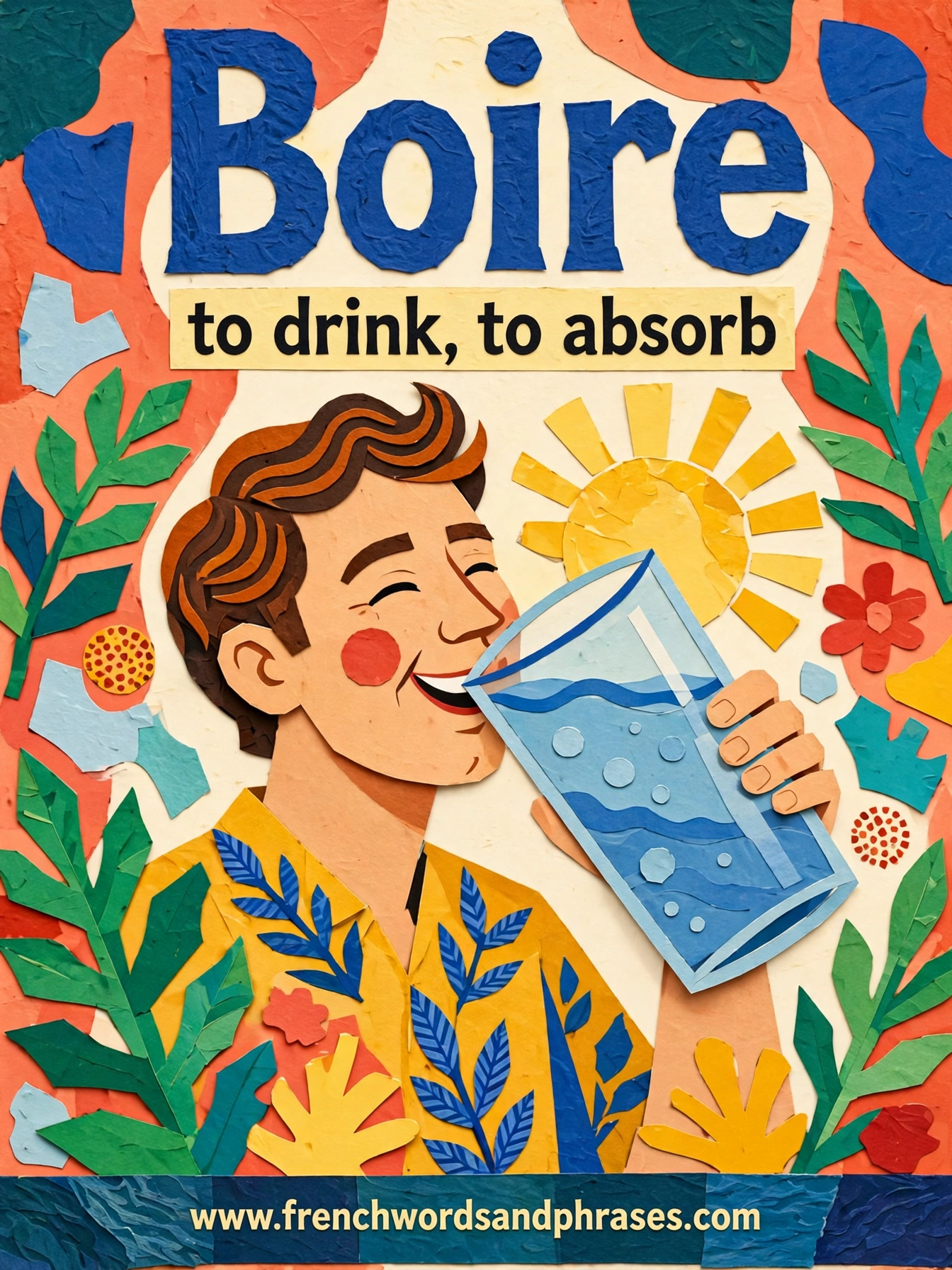
Boire means to drink — to take in liquid, from a glass of water to a bottle of wine, and, like blotting paper, to soak up whatever is poured, spilt or said.
A child gulping water at a fountain on a hot day, friends raising their glasses at a wedding, dry soil drinking in the first rain — boire is one of the oldest and busiest verbs in French: to drink, and by extension to absorb anything liquid, even words.
In this guide, you’ll learn how to conjugate boire in all the major French tenses and moods. Explore complete conjugation tables, French examples, English translations, and practice quizzes.
Understanding the French Verb Boire
Boire is an irregular French verb ending in -oire — one of the essential verbs, with two stems: boi- in the singular and buv- in the plural.
It means to drink, to absorb. It is the ordinary verb for drinking anything, and French also lets thirsty things drink: le sol boit la pluie, le buvard boit l’encre (the ground drinks the rain, blotting paper drinks ink). Said of a person alone, il boit can hint that he drinks too much, and boire les paroles de quelqu’un — to drink in someone’s words — is to listen with total devotion.
Verb classification: Irregular (-oire)
Auxiliary verb: Avoir
Past participle: bu
Present participle: buvant
English equivalents: To drink, to absorb; boire un verre d’eau — to drink a glass of water; boire à la bouteille — to drink from the bottle; boire les paroles de quelqu’un — to drink in someone’s words; la terre boit la pluie — the ground soaks up the rain; boire un coup — to have a drink; boire la tasse — to swallow a mouthful while swimming, to take a financial bath.
One important detail: boire runs on two stems. The singular and the ils-form use boi-: je bois, tu bois, il boit, ils boivent. The nous and vous forms, the imperfect and the present participle use buv-: nous buvons, vous buvez, je buvais, en buvant. The subjunctive splits the same way: que je boive, but que nous buvions. The past participle is short and bare: bu (bue, bus, bues), and the passé simple is je bus, il but, nous bûmes — mind the circumflex on bûmes and bûtes. The future goes back to the infinitive: je boirai.
Experience the Word
Boire is the verb of thirst and of everything that behaves like thirst — glasses, soil, sponges and eager listeners all drink in French.
Imagine a cyclist reaching a village fountain at noon in August. The water is cold and iron-tasting; he drinks, fills his bottle, drinks again — il boit à longs traits, and the whole square seems to slow down around that simple, essential act.
Nothing is more ordinary, and nothing is more necessary. He has drunk — bu — and the afternoon can begin.
How to Conjugate Boire: Complete French Conjugation Guide
Let’s explore every major conjugation of boire, beginning with the indicative mood.
How to Conjugate Boire in the Indicative Mood
The indicative mood is used to express facts, observations, actions, and events.
How to Conjugate Boire in the Present Tense (Présent)
Used for actions happening now, habitual actions, and general truths.
| Subject | Conjugation |
|---|---|
| je | bois |
| tu | bois |
| il / elle | boit |
| nous | buvons |
| vous | buvez |
| ils / elles | boivent |
Example
Je bois un verre d’eau avant de partir.
I drink a glass of water before leaving.
Quick Quiz 1
Complete the sentence:
Nous ______ de l’eau à chaque repas.
Reveal the answer
buvons
Nous buvons de l’eau à chaque repas.
We drink water at every meal.
How to Conjugate Boire in the Passé Composé
Used for completed actions in the past. Boire takes the auxiliary verb avoir.
| Subject | Conjugation |
|---|---|
| j’ | ai bu |
| tu | as bu |
| il / elle | a bu |
| nous | avons bu |
| vous | avez bu |
| ils / elles | ont bu |
Example
Nous avons bu un excellent vin rouge.
We drank an excellent red wine.
How to Conjugate Boire in the Imparfait (Imperfect Tense)
Used for habitual past actions, descriptions, and ongoing situations in the past.
| Subject | Conjugation |
|---|---|
| je | buvais |
| tu | buvais |
| il / elle | buvait |
| nous | buvions |
| vous | buviez |
| ils / elles | buvaient |
Example
Il buvait toujours son café sans sucre.
He always drank his coffee without sugar.
Quick Quiz 2
Choose the correct form:
He is drinking a coffee.
Il ______ un café. (boit / buve)
Reveal the answer
boit
Il boit un café.
The singular stem is boi-: je bois, tu bois, il boit.
How to Conjugate Boire in the Plus-que-parfait
Used to describe an action that had already been completed before another past event.
| Subject | Conjugation |
|---|---|
| j’ | avais bu |
| tu | avais bu |
| il / elle | avait bu |
| nous | avions bu |
| vous | aviez bu |
| ils / elles | avaient bu |
Example
Elle avait déjà bu quand nous sommes arrivés.
She had already drunk when we arrived.
How to Conjugate Boire in the Passé Simple
Primarily used in formal writing, literature, and historical narratives. It is rarely used in everyday conversation.
| Subject | Conjugation |
|---|---|
| je | bus |
| tu | bus |
| il / elle | but |
| nous | bûmes |
| vous | bûtes |
| ils / elles | burent |
Example
Le roi but à la santé de ses invités.
The king drank to his guests’ health.
How to Conjugate Boire in the Passé Antérieur
A literary tense used to express an action completed immediately before another past action, generally in the passé simple.
| Subject | Conjugation |
|---|---|
| j’ | eus bu |
| tu | eus bu |
| il / elle | eut bu |
| nous | eûmes bu |
| vous | eûtes bu |
| ils / elles | eurent bu |
Example
Quand il eut bu, il reposa le verre sur la table.
When he had drunk, he put the glass back on the table.
How to Conjugate Boire in the Future Tense (Futur Simple)
Used to describe actions that will take place in the future.
| Subject | Conjugation |
|---|---|
| je | boirai |
| tu | boiras |
| il / elle | boira |
| nous | boirons |
| vous | boirez |
| ils / elles | boiront |
Example
Vous boirez un thé bien chaud en arrivant.
You will drink a nice hot tea when you arrive.
How to Conjugate Boire in the Futur Antérieur (Future Perfect)
Used for an action that will have been completed before a particular point in the future.
| Subject | Conjugation |
|---|---|
| j’ | aurai bu |
| tu | auras bu |
| il / elle | aura bu |
| nous | aurons bu |
| vous | aurez bu |
| ils / elles | auront bu |
Example
À minuit, ils auront bu tout le champagne.
By midnight, they will have drunk all the champagne.
How to Conjugate Boire in the Near Future (Futur Proche)
Used to describe something that is going to happen soon. Formed with aller + infinitive.
| Subject | Conjugation |
|---|---|
| je | vais boire |
| tu | vas boire |
| il / elle | va boire |
| nous | allons boire |
| vous | allez boire |
| ils / elles | vont boire |
Example
Je vais boire un grand verre d’eau, j’ai soif.
I am going to drink a big glass of water, I am thirsty.
How to Conjugate Boire in the Conditional Mood
The conditional mood expresses what would happen under certain circumstances. It is also frequently used to make polite requests or express wishes.
How to Conjugate Boire in the Present Conditional
| Subject | Conjugation |
|---|---|
| je | boirais |
| tu | boirais |
| il / elle | boirait |
| nous | boirions |
| vous | boiriez |
| ils / elles | boiraient |
Example
Je boirais bien un jus d’orange frais.
I would gladly drink a fresh orange juice.
How to Conjugate Boire in the Past Conditional
| Subject | Conjugation |
|---|---|
| j’ | aurais bu |
| tu | aurais bu |
| il / elle | aurait bu |
| nous | aurions bu |
| vous | auriez bu |
| ils / elles | auraient bu |
Example
Nous aurions bu davantage si l’eau avait été fraîche.
We would have drunk more if the water had been cool.
Boire in the Literary Past Conditional Form
This less common literary form uses the imperfect subjunctive of avoir.
| Subject | Conjugation |
|---|---|
| j’ | eusse bu |
| tu | eusses bu |
| il / elle | eût bu |
| nous | eussions bu |
| vous | eussiez bu |
| ils / elles | eussent bu |
Example
Il eût bu tout le verre d’un trait.
He would have drunk the whole glass in one go.
How to Conjugate Boire in the Subjunctive Mood
The subjunctive is used to express wishes, emotions, doubts, necessity, and uncertainty. It frequently follows expressions such as il faut que (it is necessary that) or bien que (although).
How to Conjugate Boire in the Present Subjunctive
| Subject | Conjugation |
|---|---|
| que je | boive |
| que tu | boives |
| qu’il / qu’elle | boive |
| que nous | buvions |
| que vous | buviez |
| qu’ils / qu’elles | boivent |
Example
Il faut que les enfants boivent plus d’eau en été.
The children must drink more water in summer.
Quick Quiz 3
Complete the sentence using the subjunctive:
Il faut que les enfants ______ plus d’eau.
Reveal the answer
boivent
Il faut que les enfants boivent plus d’eau.
The children must drink more water.
How to Conjugate Boire in the Imperfect Subjunctive
A literary tense, rarely encountered in modern spoken French.
| Subject | Conjugation |
|---|---|
| que je | busse |
| que tu | busses |
| qu’il / qu’elle | bût |
| que nous | bussions |
| que vous | bussiez |
| qu’ils / qu’elles | bussent |
Example
Le médecin voulait qu’il bût moins de café.
The doctor wanted him to drink less coffee.
How to Conjugate Boire in the Pluperfect Subjunctive
A literary construction used to express an action completed before another past action.
| Subject | Conjugation |
|---|---|
| que j’ | eusse bu |
| que tu | eusses bu |
| qu’il / qu’elle | eût bu |
| que nous | eussions bu |
| que vous | eussiez bu |
| qu’ils / qu’elles | eussent bu |
Example
On racontait qu’ils eussent bu toute la cave.
People said they had drunk the whole cellar.
How to Conjugate Boire in the Past Subjunctive
| Subject | Conjugation |
|---|---|
| que j’ | aie bu |
| que tu | aies bu |
| qu’il / qu’elle | ait bu |
| que nous | ayons bu |
| que vous | ayez bu |
| qu’ils / qu’elles | aient bu |
Example
Je suis surpris qu’elle ait bu si vite.
I am surprised she drank so fast.
How to Conjugate Boire in the Imperative
The imperative is used to give commands, instructions, invitations, or suggestions. Subject pronouns are omitted.
How to Conjugate Boire in the Present Imperative
| Person | Conjugation |
|---|---|
| (tu) | bois |
| (nous) | buvons |
| (vous) | buvez |
Example
Buvez lentement, l’eau est glacée !
Drink slowly, the water is ice-cold!
Quick Quiz 4
How would you say Drink slowly (tu form)?
Reveal the answer
Bois lentement !
French Participles of Boire
Participles are verb forms that can be used in compound tenses and other grammatical constructions.
Present Participle of Boire
buvant
En buvant trop vite, il s’est étranglé.
By drinking too fast, he choked.
Past Participle of Boire
bu
Bu à petites gorgées, ce thé fait du bien.
Drunk in small sips, this tea does you good.
Boire in Everyday French: Real-Life Examples
Now that you know the conjugations, let’s see how boire appears in everyday French.
Example 1 — Present
Je bois un verre d’eau.
I drink a glass of water.
Example 2 — Passé composé
Nous avons bu un excellent vin rouge.
We drank an excellent red wine.
Example 3 — Imparfait
Il buvait son café sans sucre.
He drank his coffee without sugar.
Example 4 — Future
Vous boirez un thé bien chaud.
You will drink a nice hot tea.
Example 5 — Conditional
Je boirais bien un jus d’orange frais.
I would gladly drink a fresh orange juice.
Example 6 — Imperative
Buvez lentement, l’eau est glacée !
Drink slowly, the water is ice-cold!
Beyond Translation: The Meaning of Boire
From Latin bibere, boire gives French a whole thirsty family: une boisson is a drink, buvable is drinkable, un buveur is a drinker, and le buvard is blotting paper — the sheet that drinks ink. English borrowed the same root for imbibe and beverage (through Old French).
To listen is also to drink.
Boire les paroles de quelqu’un — to drink in someone’s words — is one of the prettiest compliments French can pay a speaker: the audience is thirsty, and every word is water.
How to Remember the French Verb Boire
Remember it this way: Boire is about two stems at the fountain — boi- to drink now, buv- for the crowd.
- Two stems: boi- for je, tu, il and ils (je bois, ils boivent), buv- for nous, vous and the imperfect (nous buvons, je buvais).
- The past participle is tiny: bu — j’ai bu, nous avons bu; the passé simple is je bus, il but.
- The future returns to the infinitive: je boirai, nous boirons.
The key idea is two stems at the fountain — boi- to drink now, buv- for the crowd.
Test Your Knowledge of Boire
Let’s see how much you’ve learned. Try answering these questions before revealing the answers.
Question 1
Which two stems does boire alternate between, and where?
Reveal the answer
Boi- in the singular and ils boivent; buv- in nous buvons, vous buvez, the imperfect and en buvant.
Question 2
How do you say We drank an excellent red wine in French?
Reveal the answer
Nous avons bu un excellent vin rouge.
Question 3
Translate: The children must drink more water in summer.
Reveal the answer
Il faut que les enfants boivent plus d’eau en été.
Question 4
What is the past participle of boire?
Reveal the answer
Bu — agreeing: bue, bus, bues.
Question 5
Complete the sentence:
Quand il eut ______, il reposa le verre sur la table.
Reveal the answer
bu
Quand il eut bu, il reposa le verre sur la table.
When he had drunk, he put the glass back on the table.
Your Final Challenge
Can You Use It?
How would you say this in French?
The earth drinks the first autumn rain the way a traveller drinks at the fountain.
Reveal the answer
La terre boit la première pluie d’automne comme un voyageur boit à la fontaine.
The earth drinks the first autumn rain the way a traveller drinks at the fountain.
A little French. A little curiosity. A richer everyday life.
LEARN FRENCH ONE WORD AT A TIME