A French Word to Live By
How to Conjugate Bluter in French
/bly.te/
Bluter means to sift, to bolt — to pass flour through a fine sieve so that only the whitest, lightest part goes into the bread.
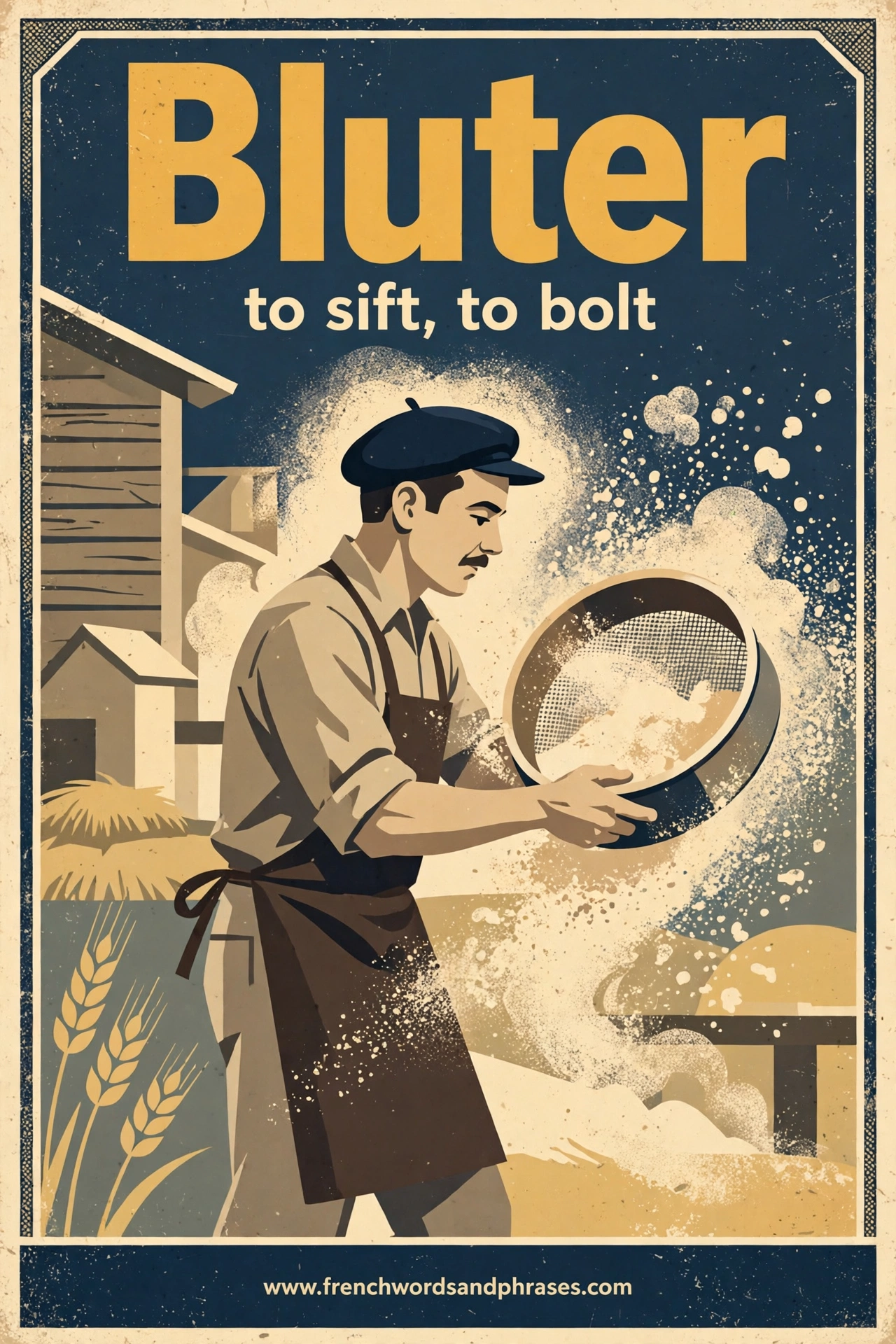
A miller turning the great silk sieve, a cloud of white dust in the bakery light, bran falling away on one side and fine flour on the other — bluter is the old, precise verb of sifting flour: the gesture that decided, for centuries, whether bread would be white or brown.
In this guide, you’ll learn how to conjugate bluter in all the major French tenses and moods. Explore complete conjugation tables, French examples, English translations, and practice quizzes.
Understanding the French Verb Bluter
Bluter is a regular French verb belonging to the first group of verbs, those ending in-er.
It means to sift, to bolt. It means to sift flour (or another powder) through a fine mesh to remove the bran and coarsest parts — the step that produced white flour and, for centuries, marked the difference between the bread of the rich and the bread of the poor. Home bakers today mostly tamiser; bluter belongs to millers, bakers and old recipes.
Verb classification: First group (-er)
Auxiliary verb: Avoir
Past participle: bluté
Present participle: blutant
English equivalents: To sift, to bolt (flour); bluter la farine — to sift the flour; un blutoir — a bolting machine, a flour sifter; la farine blutée — bolted, sifted flour; bluter le son — to separate out the bran.
One important detail: bluter is a regular -er verb — je blute, nous blutons, past participle bluté — and its home is the mill and the bakery. The machine that does the work is un blutoir, a great rotating sieve of silk or fine cloth, and la farine blutée is flour that has been through it. English once had the twin word: to bolt flour meant exactly this, before ‘bolt’ ran away to doors and lightning.
Experience the Word
Bluter is the verb of the great sieve — flour goes in grey and heavy, and comes out white as snow.
Imagine the village mill at dawn. The miller tips the ground wheat into the blutoir, the silk drum begins to turn, and a soft white cloud fills the room: on one side the bran falls away, on the other the fine flour gathers — il blute, and the village’s bread is decided before breakfast.
Nothing was added and nothing baked yet. The flour had simply been sifted — blutée — and already the bread was whiter.
How to Conjugate Bluter: Complete French Conjugation Guide
Let’s explore every major conjugation of bluter, beginning with the indicative mood.
How to Conjugate Bluter in the Indicative Mood
The indicative mood is used to express facts, observations, actions, and events.
How to Conjugate Bluter in the Present Tense (Présent)
Used for actions happening now, habitual actions, and general truths.
| Subject | Conjugation |
|---|---|
| je | blute |
| tu | blutes |
| il / elle | blute |
| nous | blutons |
| vous | blutez |
| ils / elles | blutent |
Example
Le boulanger blute la farine avant de pétrir.
The baker sifts the flour before kneading.
Quick Quiz 1
Complete the sentence:
Nous ______ la farine avant de pétrir.
Reveal the answer
blutons
Nous blutons la farine avant de pétrir.
We sift the flour before kneading.
How to Conjugate Bluter in the Passé Composé
Used for completed actions in the past. Bluter takes the auxiliary verb avoir.
| Subject | Conjugation |
|---|---|
| j’ | ai bluté |
| tu | as bluté |
| il / elle | a bluté |
| nous | avons bluté |
| vous | avez bluté |
| ils / elles | ont bluté |
Example
Elle a bluté deux kilos de farine pour les crêpes.
She sifted two kilos of flour for the crêpes.
How to Conjugate Bluter in the Imparfait (Imperfect Tense)
Used for habitual past actions, descriptions, and ongoing situations in the past.
| Subject | Conjugation |
|---|---|
| je | blutais |
| tu | blutais |
| il / elle | blutait |
| nous | blutions |
| vous | blutiez |
| ils / elles | blutaient |
Example
Autrefois, on blutait le grain au moulin du village.
In the old days, they used to sift the grain at the village mill.
Quick Quiz 2
Choose the correct form:
She sifted two kilos of flour.
Elle ______ deux kilos de farine. (a bluté / est blutée)
Reveal the answer
a bluté
Elle a bluté deux kilos de farine.
Bluter takes avoir.
How to Conjugate Bluter in the Plus-que-parfait
Used to describe an action that had already been completed before another past event.
| Subject | Conjugation |
|---|---|
| j’ | avais bluté |
| tu | avais bluté |
| il / elle | avait bluté |
| nous | avions bluté |
| vous | aviez bluté |
| ils / elles | avaient bluté |
Example
Le meunier avait bluté toute la farine avant midi.
The miller had sifted all the flour before noon.
How to Conjugate Bluter in the Passé Simple
Primarily used in formal writing, literature, and historical narratives. It is rarely used in everyday conversation.
| Subject | Conjugation |
|---|---|
| je | blutai |
| tu | blutas |
| il / elle | bluta |
| nous | blutâmes |
| vous | blutâtes |
| ils / elles | blutèrent |
Example
Le meunier bluta le grain et remplit les sacs.
The miller sifted the grain and filled the sacks.
How to Conjugate Bluter in the Passé Antérieur
A literary tense used to express an action completed immediately before another past action, generally in the passé simple.
| Subject | Conjugation |
|---|---|
| j’ | eus bluté |
| tu | eus bluté |
| il / elle | eut bluté |
| nous | eûmes bluté |
| vous | eûtes bluté |
| ils / elles | eurent bluté |
Example
Quand elle eut bluté la farine, elle prépara le levain.
When she had sifted the flour, she prepared the starter.
How to Conjugate Bluter in the Future Tense (Futur Simple)
Used to describe actions that will take place in the future.
| Subject | Conjugation |
|---|---|
| je | bluterai |
| tu | bluteras |
| il / elle | blutera |
| nous | bluterons |
| vous | bluterez |
| ils / elles | bluteront |
Example
Demain, nous bluterons la farine de sarrasin.
Tomorrow, we will sift the buckwheat flour.
How to Conjugate Bluter in the Futur Antérieur (Future Perfect)
Used for an action that will have been completed before a particular point in the future.
| Subject | Conjugation |
|---|---|
| j’ | aurai bluté |
| tu | auras bluté |
| il / elle | aura bluté |
| nous | aurons bluté |
| vous | aurez bluté |
| ils / elles | auront bluté |
Example
À six heures, le boulanger aura bluté toute sa farine.
By six o’clock, the baker will have sifted all his flour.
How to Conjugate Bluter in the Near Future (Futur Proche)
Used to describe something that is going to happen soon. Formed with aller + infinitive.
| Subject | Conjugation |
|---|---|
| je | vais bluter |
| tu | vas bluter |
| il / elle | va bluter |
| nous | allons bluter |
| vous | allez bluter |
| ils / elles | vont bluter |
Example
Je vais bluter la farine, il reste trop de son.
I am going to sift the flour, there is too much bran left.
How to Conjugate Bluter in the Conditional Mood
The conditional mood expresses what would happen under certain circumstances. It is also frequently used to make polite requests or express wishes.
How to Conjugate Bluter in the Present Conditional
| Subject | Conjugation |
|---|---|
| je | bluterais |
| tu | bluterais |
| il / elle | bluterait |
| nous | bluterions |
| vous | bluteriez |
| ils / elles | bluteraient |
Example
Sans le tamis fin, on bluterait beaucoup moins bien.
Without the fine sieve, we would sift much less well.
How to Conjugate Bluter in the Past Conditional
| Subject | Conjugation |
|---|---|
| j’ | aurais bluté |
| tu | aurais bluté |
| il / elle | aurait bluté |
| nous | aurions bluté |
| vous | auriez bluté |
| ils / elles | auraient bluté |
Example
Tu aurais bluté la farine si tu avais suivi la recette.
You would have sifted the flour if you had followed the recipe.
Bluter in the Literary Past Conditional Form
This less common literary form uses the imperfect subjunctive of avoir.
| Subject | Conjugation |
|---|---|
| j’ | eusse bluté |
| tu | eusses bluté |
| il / elle | eût bluté |
| nous | eussions bluté |
| vous | eussiez bluté |
| ils / elles | eussent bluté |
Example
La servante eût bluté le grain avant l’aube.
The servant girl would have sifted the grain before dawn.
How to Conjugate Bluter in the Subjunctive Mood
The subjunctive is used to express wishes, emotions, doubts, necessity, and uncertainty. It frequently follows expressions such as il faut que (it is necessary that) or bien que (although).
How to Conjugate Bluter in the Present Subjunctive
| Subject | Conjugation |
|---|---|
| que je | blute |
| que tu | blutes |
| qu’il / qu’elle | blute |
| que nous | blutions |
| que vous | blutiez |
| qu’ils / qu’elles | blutent |
Example
Il faut que je blute cette farine avant de l’utiliser.
I must sift this flour before using it.
Quick Quiz 3
Complete the sentence using the subjunctive:
La recette exige que vous ______ la farine deux fois.
Reveal the answer
blutiez
La recette exige que vous blutiez la farine deux fois.
The recipe requires you to sift the flour twice.
How to Conjugate Bluter in the Imperfect Subjunctive
A literary tense, rarely encountered in modern spoken French.
| Subject | Conjugation |
|---|---|
| que je | blutasse |
| que tu | blutasses |
| qu’il / qu’elle | blutât |
| que nous | blutassions |
| que vous | blutassiez |
| qu’ils / qu’elles | blutassent |
Example
La recette exigeait qu’on blutât la farine deux fois.
The recipe required the flour to be sifted twice.
How to Conjugate Bluter in the Pluperfect Subjunctive
A literary construction used to express an action completed before another past action.
| Subject | Conjugation |
|---|---|
| que j’ | eusse bluté |
| que tu | eusses bluté |
| qu’il / qu’elle | eût bluté |
| que nous | eussions bluté |
| que vous | eussiez bluté |
| qu’ils / qu’elles | eussent bluté |
Example
On racontait que le meunier eût bluté tout le grain du village.
People said the miller had sifted all the grain in the village.
How to Conjugate Bluter in the Past Subjunctive
| Subject | Conjugation |
|---|---|
| que j’ | aie bluté |
| que tu | aies bluté |
| qu’il / qu’elle | ait bluté |
| que nous | ayons bluté |
| que vous | ayez bluté |
| qu’ils / qu’elles | aient bluté |
Example
Je suis content qu’elle ait bluté la farine, le pain est plus léger.
I am glad she sifted the flour, the bread is lighter.
How to Conjugate Bluter in the Imperative
The imperative is used to give commands, instructions, invitations, or suggestions. Subject pronouns are omitted.
How to Conjugate Bluter in the Present Imperative
| Person | Conjugation |
|---|---|
| (tu) | blute |
| (nous) | blutons |
| (vous) | blutez |
Example
Blute la farine, sinon le pain sera lourd !
Sift the flour, or the bread will be heavy!
Quick Quiz 4
How would you say Sift the flour (tu form)?
Reveal the answer
Blute la farine !
French Participles of Bluter
Participles are verb forms that can be used in compound tenses and other grammatical constructions.
Present Participle of Bluter
blutant
En blutant la farine, elle en a mis partout.
By sifting the flour, she got it everywhere.
Past Participle of Bluter
bluté
Blutée avec soin, la farine donne un pain léger.
Carefully sifted, the flour gives a light bread.
Bluter in Everyday French: Real-Life Examples
Now that you know the conjugations, let’s see how bluter appears in everyday French.
Example 1 — Present
Le boulanger blute la farine.
The baker sifts the flour.
Example 2 — Passé composé
Elle a bluté la farine pour les crêpes.
She sifted the flour for the crêpes.
Example 3 — Imparfait
On blutait le grain au moulin.
They used to sift the grain at the mill.
Example 4 — Future
Nous bluterons la farine demain.
We will sift the flour tomorrow.
Example 5 — Conditional
Sans tamis, on bluterait mal.
Without a sieve, we would sift badly.
Example 6 — Imperative
Blute bien la farine !
Sift the flour well!
Beyond Translation: The Meaning of Bluter
English once kept the twin of this verb — to bolt flour, through a bolting cloth — before the word bolted off to locks and lightning; French bluter stayed at the mill.
For centuries, this sieve drew a social line.
Flour that had been blutée made white bread for fine tables; flour that had not made the brown loaf of everyone else. A whole history of bread, mills and hunger turns quietly inside this one small verb and its machine, le blutoir.
How to Remember the French Verb Bluter
Remember it this way: Bluter is about the miller’s great silk sieve and the cloud of white flour.
- Regular -er: je blute, nous blutons, past participle bluté.
- Its world is the mill: bluter la farine, and the machine is un blutoir.
- English ‘to bolt flour’ is the lost twin — the same sifting, the same cloth.
The key idea is the miller’s great silk sieve and the cloud of white flour.
Test Your Knowledge of Bluter
Let’s see how much you’ve learned. Try answering these questions before revealing the answers.
Question 1
What does bluter la farine achieve?
Reveal the answer
It sifts out the bran — passing the flour through a fine sieve (un blutoir) to leave the whitest, lightest flour.
Question 2
How do you say The baker sifts the flour in French?
Reveal the answer
Le boulanger blute la farine.
Question 3
Translate: She sifted the flour for the crêpes.
Reveal the answer
Elle a bluté la farine pour les crêpes.
Question 4
What is the past participle of bluter?
Reveal the answer
Bluté.
Question 5
Complete the sentence:
Il faut que je ______ cette farine avant de l’utiliser.
Reveal the answer
blute
Il faut que je blute cette farine avant de l’utiliser.
I must sift this flour before using it.
Your Final Challenge
Can You Use It?
How would you say this in French?
The miller sifts the flour at dawn, and the village will have white bread.
Reveal the answer
Le meunier blute la farine à l’aube, et le village aura du pain blanc.
The miller sifts the flour at dawn, and the village will have white bread.
A little French. A little curiosity. A richer everyday life.
LEARN FRENCH ONE WORD AT A TIME