A French Word to Live By
How to Conjugate Blasonner in French
/bla.zɔ.ne/
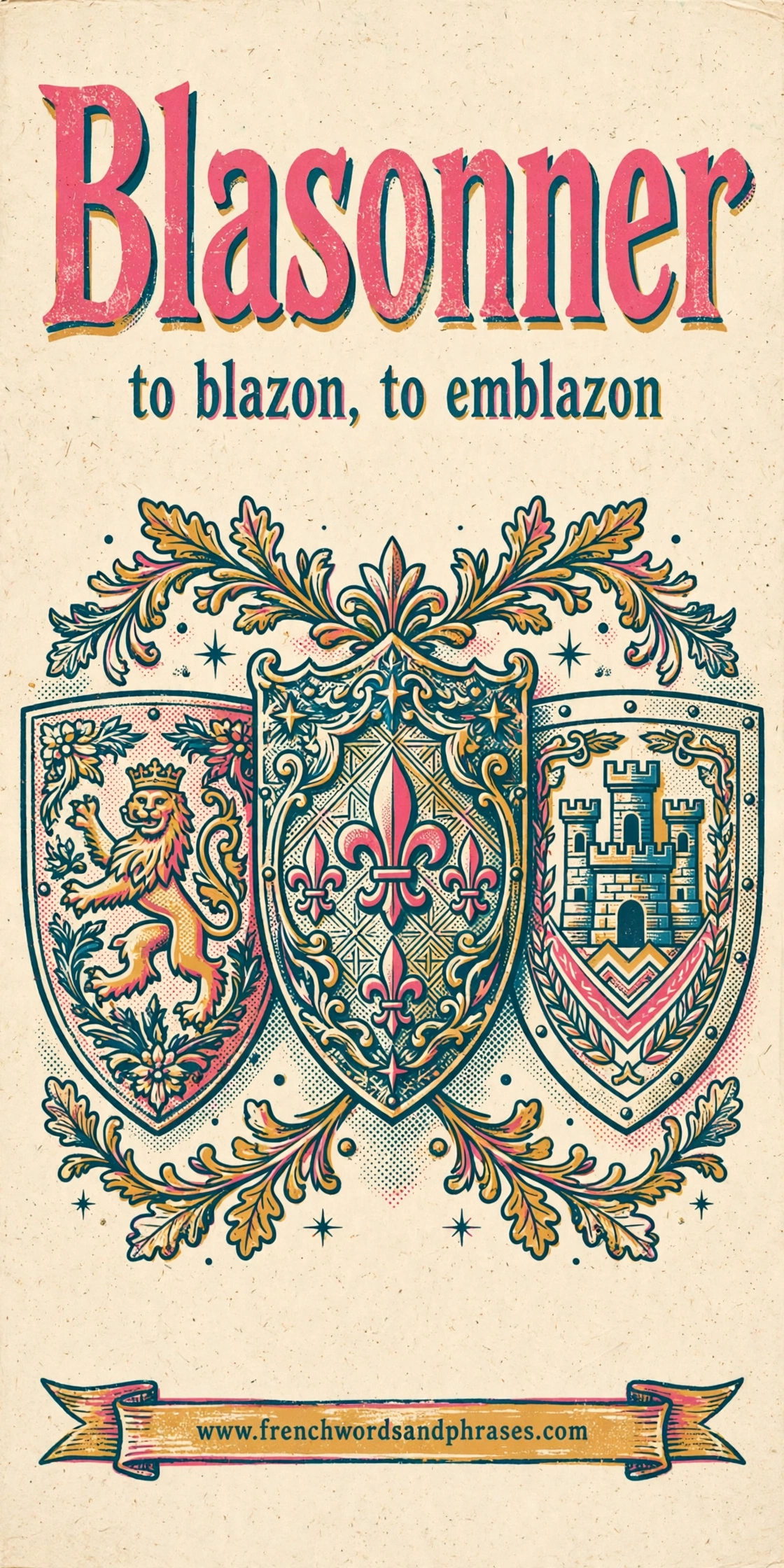
Blasonner means to blazon, to emblazon — to paint a coat of arms, or to describe one in the exact language of heraldry.
A painter on a ladder gilds a shield above a castle gate, a herald reads out lions, stripes and stars in a code eight centuries old — blasonner is the craftsman’s verb of heraldry: arms are not drawn, they are blasonnés, by rule.
In this guide, you’ll learn how to conjugate blasonner in all the major French tenses and moods. Explore complete conjugation tables, French examples, English translations, and practice quizzes.
Understanding the French Verb Blasonner
Blasonner is a regular French verb belonging to the first group of verbs, those ending in -er.
It means to blazon, to emblazon. It survives wherever heraldry survives: town halls, wine labels, regiments, football crests and family genealogies. A town that adopts new arms, a club that redesigns its badge — somewhere, a specialist is still blasonnant, because arms drawn without the rules are, to a heraldist, simply wrong.
Verb classification: First group (-er)
Auxiliary verb: Avoir
Past participle: blasonné
Present participle: blasonnant
English equivalents: To blazon, to emblazon; blasonner un écu — to emblazon a shield; blasonner des armes — to blazon a coat of arms; blasonner une portière — to paint arms on a carriage door; un blason — a coat of arms, a crest.
One important detail: blasonner does two jobs at once — it means to paint arms on a shield, a door or a banner, and to describe arms aloud in the technical language of heraldry, which is also called blasonner: il blasonne : d’azur à trois fleurs de lys d’or. The noun is un blason, the coat of arms itself, and the science is le blason. The conjugation holds no traps: a regular -er, je blasonne, nous blasonnons, ils blasonnent, past participle blasonné — note the double n of the stem, kept everywhere.
Experience the Word
Blasonner is the verb of the shield-maker — half painting, half grammar, entirely governed by rules older than the castle.
Imagine a workshop in a Loire town, commissioned to restore the arms above a mairie door. The painter does not invent: she blasonne — first the field, then the charge, then the colours, gold on blue and never colour on colour — reading the old description aloud as she paints, because in heraldry the words are the drawing.
The shield looks like a picture. It was written — blasonné — before it was painted.
How to Conjugate Blasonner: Complete French Conjugation Guide
Let’s explore every major conjugation of blasonner, beginning with the indicative mood.
How to Conjugate Blasonner in the Indicative Mood
The indicative mood is used to express facts, observations, actions, and events.
How to Conjugate Blasonner in the Present Tense (Présent)
Used for actions happening now, habitual actions, and general truths.
| Subject | Conjugation |
|---|---|
| je | blasonne |
| tu | blasonnes |
| il / elle | blasonne |
| nous | blasonnons |
| vous | blasonnez |
| ils / elles | blasonnent |
Example
L’héraldiste blasonne les armes de la famille.
The heraldist blazons the family’s arms.
Quick Quiz 1
Complete the sentence:
Nous ______ les armes de la famille.
Reveal the answer
blasonnons
Nous blasonnons les armes de la famille.
We blazon the family’s arms.
How to Conjugate Blasonner in the Passé Composé
Used for completed actions in the past. Blasonner takes the auxiliary verb avoir.
| Subject | Conjugation |
|---|---|
| j’ | ai blasonné |
| tu | as blasonné |
| il / elle | a blasonné |
| nous | avons blasonné |
| vous | avez blasonné |
| ils / elles | ont blasonné |
Example
Il a blasonné l’écu du nouveau chevalier.
He emblazoned the new knight’s shield.
How to Conjugate Blasonner in the Imparfait (Imperfect Tense)
Used for habitual past actions, descriptions, and ongoing situations in the past.
| Subject | Conjugation |
|---|---|
| je | blasonnais |
| tu | blasonnais |
| il / elle | blasonnait |
| nous | blasonnions |
| vous | blasonniez |
| ils / elles | blasonnaient |
Example
Autrefois, les peintres blasonnaient les portes des carrosses.
In the old days, painters emblazoned carriage doors.
Quick Quiz 2
Choose the correct form:
He emblazoned the shield.
Il ______ l’écu. (a blasonné / est blasonné)
Reveal the answer
a blasonné
Il a blasonné l’écu.
Blasonner takes avoir.
How to Conjugate Blasonner in the Plus-que-parfait
Used to describe an action that had already been completed before another past event.
| Subject | Conjugation |
|---|---|
| j’ | avais blasonné |
| tu | avais blasonné |
| il / elle | avait blasonné |
| nous | avions blasonné |
| vous | aviez blasonné |
| ils / elles | avaient blasonné |
Example
Elle avait blasonné les armes de trois comtés.
She had blazoned the arms of three counties.
How to Conjugate Blasonner in the Passé Simple
Primarily used in formal writing, literature, and historical narratives. It is rarely used in everyday conversation.
| Subject | Conjugation |
|---|---|
| je | blasonnai |
| tu | blasonnas |
| il / elle | blasonna |
| nous | blasonnâmes |
| vous | blasonnâtes |
| ils / elles | blasonnèrent |
Example
Le graveur blasonna l’écusson au-dessus de la porte.
The engraver emblazoned the escutcheon above the door.
How to Conjugate Blasonner in the Passé Antérieur
A literary tense used to express an action completed immediately before another past action, generally in the passé simple.
| Subject | Conjugation |
|---|---|
| j’ | eus blasonné |
| tu | eus blasonné |
| il / elle | eut blasonné |
| nous | eûmes blasonné |
| vous | eûtes blasonné |
| ils / elles | eurent blasonné |
Example
Quand il eut blasonné toutes les bannières, la fête commença.
When he had emblazoned all the banners, the feast began.
How to Conjugate Blasonner in the Future Tense (Futur Simple)
Used to describe actions that will take place in the future.
| Subject | Conjugation |
|---|---|
| je | blasonnerai |
| tu | blasonneras |
| il / elle | blasonnera |
| nous | blasonnerons |
| vous | blasonnerez |
| ils / elles | blasonneront |
Example
Demain, l’atelier blasonnera les armes du duc.
Tomorrow, the workshop will blazon the duke’s arms.
How to Conjugate Blasonner in the Futur Antérieur (Future Perfect)
Used for an action that will have been completed before a particular point in the future.
| Subject | Conjugation |
|---|---|
| j’ | aurai blasonné |
| tu | auras blasonné |
| il / elle | aura blasonné |
| nous | aurons blasonné |
| vous | aurez blasonné |
| ils / elles | auront blasonné |
Example
À la fin du mois, ils auront blasonné vingt écus.
By the end of the month, they will have blazoned twenty shields.
How to Conjugate Blasonner in the Near Future (Futur Proche)
Used to describe something that is going to happen soon. Formed with aller + infinitive.
| Subject | Conjugation |
|---|---|
| je | vais blasonner |
| tu | vas blasonner |
| il / elle | va blasonner |
| nous | allons blasonner |
| vous | allez blasonner |
| ils / elles | vont blasonner |
Example
Le peintre va blasonner la portière du carrosse.
The painter is going to emblazon the carriage door.
How to Conjugate Blasonner in the Conditional Mood
The conditional mood expresses what would happen under certain circumstances. It is also frequently used to make polite requests or express wishes.
How to Conjugate Blasonner in the Present Conditional
| Subject | Conjugation |
|---|---|
| je | blasonnerais |
| tu | blasonnerais |
| il / elle | blasonnerait |
| nous | blasonnerions |
| vous | blasonneriez |
| ils / elles | blasonneraient |
Example
Un bon héraldiste blasonnerait cet écu en dix minutes.
A good heraldist would blazon this shield in ten minutes.
How to Conjugate Blasonner in the Past Conditional
| Subject | Conjugation |
|---|---|
| j’ | aurais blasonné |
| tu | aurais blasonné |
| il / elle | aurait blasonné |
| nous | aurions blasonné |
| vous | auriez blasonné |
| ils / elles | auraient blasonné |
Example
Sans les archives, on n’aurait pas blasonné correctement ces armes.
Without the archives, we would not have blazoned these arms correctly.
Blasonner in the Literary Past Conditional Form
This less common literary form uses the imperfect subjunctive of avoir.
| Subject | Conjugation |
|---|---|
| j’ | eusse blasonné |
| tu | eusses blasonné |
| il / elle | eût blasonné |
| nous | eussions blasonné |
| vous | eussiez blasonné |
| ils / elles | eussent blasonné |
Example
Le peintre eût blasonné les portes du palais entier.
The painter would have emblazoned the doors of the whole palace.
How to Conjugate Blasonner in the Subjunctive Mood
The subjunctive is used to express wishes, emotions, doubts, necessity, and uncertainty. It frequently follows expressions such as il faut que (it is necessary that) or bien que (although).
How to Conjugate Blasonner in the Present Subjunctive
| Subject | Conjugation |
|---|---|
| que je | blasonne |
| que tu | blasonnes |
| qu’il / qu’elle | blasonne |
| que nous | blasonnions |
| que vous | blasonniez |
| qu’ils / qu’elles | blasonnent |
Example
Il faut que tu blasonnes cet écu selon les règles.
You must blazon this shield according to the rules.
Quick Quiz 3
Complete the sentence using the subjunctive:
Il faut que vous ______ les bannières avant la fête.
Reveal the answer
blasonniez
Il faut que vous blasonniez les bannières avant la fête.
You must emblazon the banners before the feast.
How to Conjugate Blasonner in the Imperfect Subjunctive
A literary tense, rarely encountered in modern spoken French.
| Subject | Conjugation |
|---|---|
| que je | blasonnasse |
| que tu | blasonnasses |
| qu’il / qu’elle | blasonnât |
| que nous | blasonnassions |
| que vous | blasonnassiez |
| qu’ils / qu’elles | blasonnassent |
Example
Le duc exigeait que l’on blasonnât ses armes partout.
The duke demanded that his arms be emblazoned everywhere.
How to Conjugate Blasonner in the Pluperfect Subjunctive
A literary construction used to express an action completed before another past action.
| Subject | Conjugation |
|---|---|
| que j’ | eusse blasonné |
| que tu | eusses blasonné |
| qu’il / qu’elle | eût blasonné |
| que nous | eussions blasonné |
| que vous | eussiez blasonné |
| qu’ils / qu’elles | eussent blasonné |
Example
On doutait que l’atelier eût blasonné l’écu avant la cérémonie.
People doubted the workshop had blazoned the shield before the ceremony.
How to Conjugate Blasonner in the Past Subjunctive
| Subject | Conjugation |
|---|---|
| que j’ | aie blasonné |
| que tu | aies blasonné |
| qu’il / qu’elle | ait blasonné |
| que nous | ayons blasonné |
| que vous | ayez blasonné |
| qu’ils / qu’elles | aient blasonné |
Example
Je suis content qu’il ait blasonné nos armes avec tant de soin.
I am glad he blazoned our arms with such care.
How to Conjugate Blasonner in the Imperative
The imperative is used to give commands, instructions, invitations, or suggestions. Subject pronouns are omitted.
How to Conjugate Blasonner in the Present Imperative
| Person | Conjugation |
|---|---|
| (tu) | blasonne |
| (nous) | blasonnons |
| (vous) | blasonnez |
Example
Blasonne cet écu exactement comme l’original !
Blazon this shield exactly like the original!
Quick Quiz 4
How would you say Blazon this shield (tu form)?
Reveal the answer
Blasonne cet écu !
French Participles of Blasonner
Participles are verb forms that can be used in compound tenses and other grammatical constructions.
Present Participle of Blasonner
blasonnant
En blasonnant, il faut respecter les couleurs et les métaux.
When blazoning, one must respect the colours and metals.
Past Participle of Blasonner
blasonné
Blasonné d’or et d’azur, l’écu brillait au soleil.
Emblazoned in gold and azure, the shield shone in the sun.
Blasonner in Everyday French: Real-Life Examples
Now that you know the conjugations, let’s see how blasonner appears in everyday French.
Example 1 — Present
L’héraldiste blasonne les armes du duc.
The heraldist blazons the duke’s arms.
Example 2 — Passé composé
Il a blasonné l’écu du chevalier.
He emblazoned the knight’s shield.
Example 3 — Imparfait
Les peintres blasonnaient les carrosses.
Painters used to emblazon carriages.
Example 4 — Future
L’atelier blasonnera vingt écus.
The workshop will blazon twenty shields.
Example 5 — Conditional
Un expert blasonnerait cet écu en dix minutes.
An expert would blazon this shield in ten minutes.
Example 6 — Imperative
Blasonnez les bannières avant la fête !
Emblazon the banners before the feast!
Beyond Translation: The Meaning of Blasonner
English blazon is the same word — both languages took it from the herald’s shield, Old French blason, perhaps once a Germanic word for a torch or a brand.
Heraldry is a language disguised as pictures.
That is the secret blasonner keeps: the verb means both to paint the shield and to read it aloud in code — d’or, d’azur, de gueules — because a true coat of arms exists first as a sentence, and only afterwards as an image. To blasonner correctly is to be able to rebuild the picture from words alone, eight hundred years later, without ever having seen it.
How to Remember the French Verb Blasonner
Remember it this way: Blasonner is about the painter on the ladder, reading the shield aloud as she paints it.
- Un blason is the coat of arms; blasonner is both painting it and describing it in heraldic code.
- Its world is shields, banners, carriage doors and town halls — arms are blasonnés, never just drawn.
- Regular -er, double n throughout: je blasonne, nous blasonnons, past participle blasonné.
The key idea is the painter on the ladder, reading the shield aloud as she paints it.
Test Your Knowledge of Blasonner
Let’s see how much you’ve learned. Try answering these questions before revealing the answers.
Question 1
What are the two jobs of blasonner?
Reveal the answer
To paint a coat of arms, and to describe it in the technical language of heraldry.
Question 2
How do you say He emblazoned the knight’s shield in French?
Reveal the answer
Il a blasonné l’écu du chevalier.
Question 3
Translate: Painters used to emblazon carriages.
Reveal the answer
Les peintres blasonnaient les carrosses.
Question 4
What is the past participle of blasonner?
Reveal the answer
Blasonné.
Question 5
Complete the sentence:
Il faut que tu ______ cet écu selon les règles.
Reveal the answer
blasonnes
Il faut que tu blasonnes cet écu selon les règles.
You must blazon this shield according to the rules.
Your Final Challenge
Can You Use It?
How would you say this in French?
She has been blazoning the town’s arms for thirty years, and not one lion, not one star is placed there by chance.
Reveal the answer
Elle blasonne les armes de la ville depuis trente ans, et pas un lion, pas une étoile n’y est placé au hasard.
She has been blazoning the town’s arms for thirty years, and not one lion, not one star is placed there by chance.
A little French. A little curiosity. A richer everyday life.
LEARN FRENCH ONE WORD AT A TIME