A French Word to Live By
How to Conjugate Se blaser in French
/sə bla.ze/
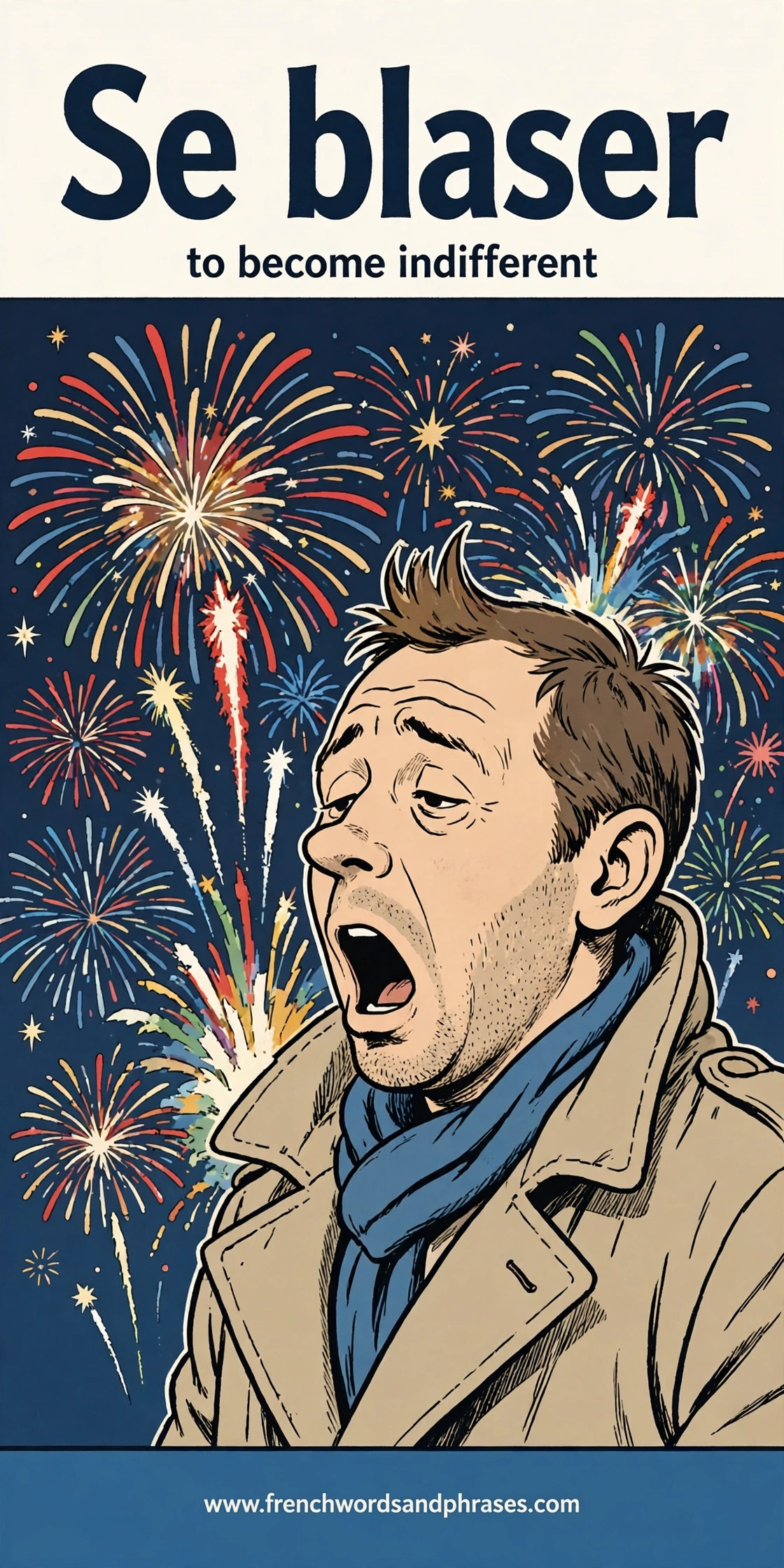
Se blaser means to become indifferent — to have seen so much, tasted so much and won so much that nothing moves you any more.
A food critic who has eaten in every great restaurant and sighs at the menu, a rock star bored by the applause — se blaser is the verb of spoiled senses: pleasure repeated until pleasure itself goes flat.
In this guide, you’ll learn how to conjugate se blaser in all the major French tenses and moods. Explore complete conjugation tables, French examples, English translations, and practice quizzes.
Understanding the French Verb Se blaser
Se blaser is a regular French verb belonging to the first group of verbs, those ending in -er.
It means to become indifferent. It is used of critics, celebrities, rich heirs and whole generations — anyone whose senses have been dulled by abundance. It is sadder than s’ennuyer (to be bored): the bored person wants something to happen; the person who se blase no longer believes anything could be worth wanting.
Verb classification: First group (-er), reflexive
Auxiliary verb: Être
Past participle: blasé
Present participle: blasant
English equivalents: To become blasé, to grow jaded, to become indifferent; se blaser de tout — to grow weary of everything; se blaser des honneurs — to tire of honours; un public blasé — a jaded audience; rien ne le blase — nothing makes him blasé (plain blaser, rare).
One important detail: se blaser is the living form of this verb — the plain blaser (to make someone blasé) exists in dictionaries but French speakers almost always use the reflexive: il se blase, he is becoming blasé. Being reflexive, it takes être in every compound tense and the participle agrees: elle s’est blasée, ils se sont blasés. The adjective is the word English borrowed whole: blasé. Underneath, a perfectly regular -er: je me blase, nous nous blasons, ils se blasent. The tu imperative tucks the pronoun behind the verb: ne te blase pas !
Experience the Word
Se blaser is the verb of the full table and the empty appetite — everything is offered, nothing is desired.
Imagine a restaurant critic in Paris, thirty years into the job. The waiter sets down a perfect soufflé; the room holds its breath; the critic tastes, nods politely, and writes ‘correct’. Il s’est blasé — three thousand great meals have quietly eaten his capacity to be surprised, and the soufflé never stood a chance.
The cooking is as good as ever. He has become indifferent — blasé — and that is the tragedy’s whole plot.
How to Conjugate Se blaser: Complete French Conjugation Guide
Let’s explore every major conjugation of se blaser, beginning with the indicative mood.
How to Conjugate Se blaser in the Indicative Mood
The indicative mood is used to express facts, observations, actions, and events.
How to Conjugate Se blaser in the Present Tense (Présent)
Used for actions happening now, habitual actions, and general truths.
| Subject | Conjugation |
|---|---|
| je | me blase |
| tu | te blases |
| il / elle | se blase |
| nous | nous blasons |
| vous | vous blasez |
| ils / elles | se blasent |
Example
À force de tout voir, les critiques se blasent.
From seeing everything, critics become jaded.
Quick Quiz 1
Complete the sentence:
Nous nous ______ des honneurs.
Reveal the answer
blasons
Nous nous blasons des honneurs.
We are growing weary of honours.
How to Conjugate Se blaser in the Passé Composé
Used for completed actions in the past. Se blaser takes the auxiliary verb être.
| Subject | Conjugation |
|---|---|
| je | me suis blasé / me suis blasée |
| tu | t’es blasé / t’es blasée |
| il / elle | s’est blasé / s’est blasée |
| nous | nous sommes blasés / nous sommes blasées |
| vous | vous êtes blasés / vous êtes blasées / vous êtes blasé / vous êtes blasée |
| ils / elles | se sont blasés / se sont blasées |
Example
Elle s’est blasée des soirées mondaines.
She grew tired of society parties.
How to Conjugate Se blaser in the Imparfait (Imperfect Tense)
Used for habitual past actions, descriptions, and ongoing situations in the past.
| Subject | Conjugation |
|---|---|
| je | me blasais |
| tu | te blasais |
| il / elle | se blasait |
| nous | nous blasions |
| vous | vous blasiez |
| ils / elles | se blasaient |
Example
Peu à peu, il se blasait de la gloire et des prix.
Little by little, he was growing indifferent to fame and prizes.
Quick Quiz 2
Choose the correct form:
She became blasé very quickly.
Elle ______ très vite. (s’est blasée / a blasé)
Reveal the answer
s’est blasée
Elle s’est blasée très vite.
Se blaser is reflexive, takes être, and the participle agrees: blasée.
How to Conjugate Se blaser in the Plus-que-parfait
Used to describe an action that had already been completed before another past event.
| Subject | Conjugation |
|---|---|
| je | m’étais blasé / m’étais blasée |
| tu | t’étais blasé / t’étais blasée |
| il / elle | s’était blasé / s’était blasée |
| nous | nous étions blasés / nous étions blasées |
| vous | vous étiez blasés / vous étiez blasées / vous étiez blasé / vous étiez blasée |
| ils / elles | s’étaient blasés / s’étaient blasées |
Example
Ils s’étaient blasés bien avant leurs trente ans.
They had become jaded well before they turned thirty.
How to Conjugate Se blaser in the Passé Simple
Primarily used in formal writing, literature, and historical narratives. It is rarely used in everyday conversation.
| Subject | Conjugation |
|---|---|
| je | me blasai |
| tu | te blasas |
| il / elle | se blasa |
| nous | nous blasâmes |
| vous | vous blasâtes |
| ils / elles | se blasèrent |
Example
Le vieux comédien se blasa de tout, même des applaudissements.
The old actor grew weary of everything, even the applause.
How to Conjugate Se blaser in the Passé Antérieur
A literary tense used to express an action completed immediately before another past action, generally in the passé simple.
| Subject | Conjugation |
|---|---|
| je | me fus blasé / me fus blasée |
| tu | te fus blasé / te fus blasée |
| il / elle | se fut blasé / se fut blasée |
| nous | nous fûmes blasés / nous fûmes blasées |
| vous | vous fûtes blasés / vous fûtes blasées / vous fûtes blasé / vous fûtes blasée |
| ils / elles | se furent blasés / se furent blasées |
Example
Quand il se fut blasé des voyages, il resta chez lui.
When he had grown tired of travelling, he stayed at home.
How to Conjugate Se blaser in the Future Tense (Futur Simple)
Used to describe actions that will take place in the future.
| Subject | Conjugation |
|---|---|
| je | me blaserai |
| tu | te blaseras |
| il / elle | se blasera |
| nous | nous blaserons |
| vous | vous blaserez |
| ils / elles | se blaseront |
Example
Si tu réussis trop jeune, tu te blaseras vite.
If you succeed too young, you will soon become blasé.
How to Conjugate Se blaser in the Futur Antérieur (Future Perfect)
Used for an action that will have been completed before a particular point in the future.
| Subject | Conjugation |
|---|---|
| je | me serai blasé / me serai blasée |
| tu | te seras blasé / te seras blasée |
| il / elle | se sera blasé / se sera blasée |
| nous | nous serons blasés / nous serons blasées |
| vous | vous serez blasés / vous serez blasées / vous serez blasé / vous serez blasée |
| ils / elles | se seront blasés / se seront blasées |
Example
À force de luxe, ils se seront blasés de tout.
Through too much luxury, they will have grown indifferent to everything.
How to Conjugate Se blaser in the Near Future (Futur Proche)
Used to describe something that is going to happen soon. Formed with aller + infinitive.
| Subject | Conjugation |
|---|---|
| je | vais me blaser |
| tu | vas te blaser |
| il / elle | va se blaser |
| nous | allons nous blaser |
| vous | allez vous blaser |
| ils / elles | vont se blaser |
Example
Attention, ce public va se blaser si le spectacle dure.
Careful, this audience is going to get bored if the show drags on.
How to Conjugate Se blaser in the Conditional Mood
The conditional mood expresses what would happen under certain circumstances. It is also frequently used to make polite requests or express wishes.
How to Conjugate Se blaser in the Present Conditional
| Subject | Conjugation |
|---|---|
| je | me blaserais |
| tu | te blaserais |
| il / elle | se blaserait |
| nous | nous blaserions |
| vous | vous blaseriez |
| ils / elles | se blaseraient |
Example
Sans curiosité, on se blaserait de tout en un an.
Without curiosity, one would grow tired of everything within a year.
How to Conjugate Se blaser in the Past Conditional
| Subject | Conjugation |
|---|---|
| je | me serais blasé / me serais blasée |
| tu | te serais blasé / te serais blasée |
| il / elle | se serait blasé / se serait blasée |
| nous | nous serions blasés / nous serions blasées |
| vous | vous seriez blasés / vous seriez blasées / vous seriez blasé / vous seriez blasée |
| ils / elles | se seraient blasés / se seraient blasées |
Example
Elle ne se serait jamais blasée avec un travail aussi varié.
She would never have grown jaded with such varied work.
Se blaser in the Literary Past Conditional Form
This less common literary form uses the imperfect subjunctive of être.
| Subject | Conjugation |
|---|---|
| je | me fusse blasé / me fusse blasée |
| tu | te fusses blasé / te fusses blasée |
| il / elle | se fût blasé / se fût blasée |
| nous | nous fussions blasés / nous fussions blasées |
| vous | vous fussiez blasés / vous fussiez blasées / vous fussiez blasé / vous fussiez blasée |
| ils / elles | se fussent blasés / se fussent blasées |
Example
Il se fût blasé des honneurs comme des richesses.
He would have grown weary of honours as of riches.
How to Conjugate Se blaser in the Subjunctive Mood
The subjunctive is used to express wishes, emotions, doubts, necessity, and uncertainty. It frequently follows expressions such as il faut que (it is necessary that) or bien que (although).
How to Conjugate Se blaser in the Present Subjunctive
| Subject | Conjugation |
|---|---|
| que je | me blase |
| que tu | te blases |
| qu’il / qu’elle | se blase |
| que nous | nous blasions |
| que vous | vous blasiez |
| qu’ils / qu’elles | se blasent |
Example
Il est triste que les jeunes se blasent si tôt.
It is sad that young people become blasé so early.
Quick Quiz 3
Complete the sentence using the subjunctive:
Il est triste que tu te ______ si tôt.
Reveal the answer
blases
Il est triste que tu te blases si tôt.
It is sad that you are becoming blasé so early.
How to Conjugate Se blaser in the Imperfect Subjunctive
A literary tense, rarely encountered in modern spoken French.
| Subject | Conjugation |
|---|---|
| que je | me blasasse |
| que tu | te blasasses |
| qu’il / qu’elle | se blasât |
| que nous | nous blasassions |
| que vous | vous blasassiez |
| qu’ils / qu’elles | se blasassent |
Example
Je craignais qu’il ne se blasât de son succès.
I feared he might grow tired of his success.
How to Conjugate Se blaser in the Pluperfect Subjunctive
A literary construction used to express an action completed before another past action.
| Subject | Conjugation |
|---|---|
| que je | me fusse blasé / me fusse blasée |
| que tu | te fusses blasé / te fusses blasée |
| qu’il / qu’elle | se fût blasé / se fût blasée |
| que nous | nous fussions blasés / nous fussions blasées |
| que vous | vous fussiez blasés / vous fussiez blasées / vous fussiez blasé / vous fussiez blasée |
| qu’ils / qu’elles | se fussent blasés / se fussent blasées |
Example
On disait qu’ils se fussent blasés de la vie parisienne.
People said they had grown weary of Parisian life.
How to Conjugate Se blaser in the Past Subjunctive
| Subject | Conjugation |
|---|---|
| que je | me sois blasé / me sois blasée |
| que tu | te sois blasé / te sois blasée |
| qu’il / qu’elle | se soit blasé / se soit blasée |
| que nous | nous soyons blasés / nous soyons blasées |
| que vous | vous soyez blasés / vous soyez blasées / vous soyez blasé / vous soyez blasée |
| qu’ils / qu’elles | se soient blasés / se soient blasées |
Example
Je suis étonné qu’elle se soit blasée si vite.
I am surprised she became blasé so quickly.
How to Conjugate Se blaser in the Imperative
The imperative is used to give commands, instructions, invitations, or suggestions. Subject pronouns are omitted.
How to Conjugate Se blaser in the Present Imperative
| Person | Conjugation |
|---|---|
| (tu) | blase-toi |
| (nous) | blasons-nous |
| (vous) | blasez-vous |
Example
Ne te blase pas trop vite, garde ton étonnement !
Do not become blasé too quickly, keep your sense of wonder!
Quick Quiz 4
How would you say Do not become blasé (tu form)?
Reveal the answer
Ne te blase pas !
French Participles of Se blaser
Participles are verb forms that can be used in compound tenses and other grammatical constructions.
Present Participle of Se blaser
blasant
En se blasant de tout, on perd le goût des choses simples.
By growing indifferent to everything, one loses the taste for simple things.
Past Participle of Se blaser
blasé
Blasés de tout, les vieux acteurs quittèrent la scène.
Jaded with everything, the old actors left the stage.
Se blaser in Everyday French: Real-Life Examples
Now that you know the conjugations, let’s see how se blaser appears in everyday French.
Example 1 — Present
Les critiques se blasent vite.
Critics become jaded quickly.
Example 2 — Passé composé
Elle s’est blasée des soirées mondaines.
She grew tired of society parties.
Example 3 — Imparfait
Il se blasait de la gloire.
He was growing indifferent to fame.
Example 4 — Future
Tu te blaseras si tu réussis trop tôt.
You will become blasé if you succeed too early.
Example 5 — Conditional
On se blaserait sans curiosité.
One would grow jaded without curiosity.
Example 6 — Imperative
Ne vous blasez pas, restez curieux !
Do not become blasé, stay curious!
Beyond Translation: The Meaning of Se blaser
English borrowed the finished product — blasé, the adjective — but French kept the factory: se blaser is the slow process by which a person becomes blasé, meal by meal, prize by prize.
It is the disease of abundance.
The verb probably comes from a Dutch word for blowing or being puffed up — too much air, too much of everything. Its opposite is not work or duty but étonnement, astonishment: the French moralists treated se blaser as the one unforgivable ageing, because the body may tire, but the blasé soul has stopped tasting.
How to Remember the French Verb Se blaser
Remember it this way: Se blaser is about the critic sighing at the perfect soufflé — abundance has eaten his appetite.
- Always reflexive in real life: je me blase, elle s’est blasée — être, and the participle agrees.
- The adjective English stole is the result: un critique blasé is a critic who s’est blasé.
- Regular -er underneath: je me blase, nous nous blasons, past participle blasé.
The key idea is the critic sighing at the perfect soufflé — abundance has eaten his appetite.
Test Your Knowledge of Se blaser
Let’s see how much you’ve learned. Try answering these questions before revealing the answers.
Question 1
Which auxiliary does se blaser use, and why?
Reveal the answer
Être — it is a reflexive verb: elle s’est blasée des soirées mondaines.
Question 2
How do you say She grew tired of society parties in French?
Reveal the answer
Elle s’est blasée des soirées mondaines.
Question 3
Translate: Critics become jaded quickly.
Reveal the answer
Les critiques se blasent vite.
Question 4
What is the past participle of se blaser?
Reveal the answer
Blasé — agreeing: blasée, blasés, blasées.
Question 5
Complete the sentence:
Il est triste que les jeunes se ______ si tôt.
Reveal the answer
blasent
Il est triste que les jeunes se blasent si tôt.
It is sad that young people become blasé so early.
Your Final Challenge
Can You Use It?
How would you say this in French?
He grew blasé about grand hotels and prizes, but a simple pain au chocolat from his childhood still makes him happy.
Reveal the answer
Il s’est blasé des palaces et des prix, mais un simple pain au chocolat de son enfance le rend encore heureux.
He grew blasé about grand hotels and prizes, but a simple pain au chocolat from his childhood still makes him happy.
A little French. A little curiosity. A richer everyday life.
LEARN FRENCH ONE WORD AT A TIME