A French Word to Live By
Translate Être au taquet to English
/ɛtʁ o ta.kɛ/
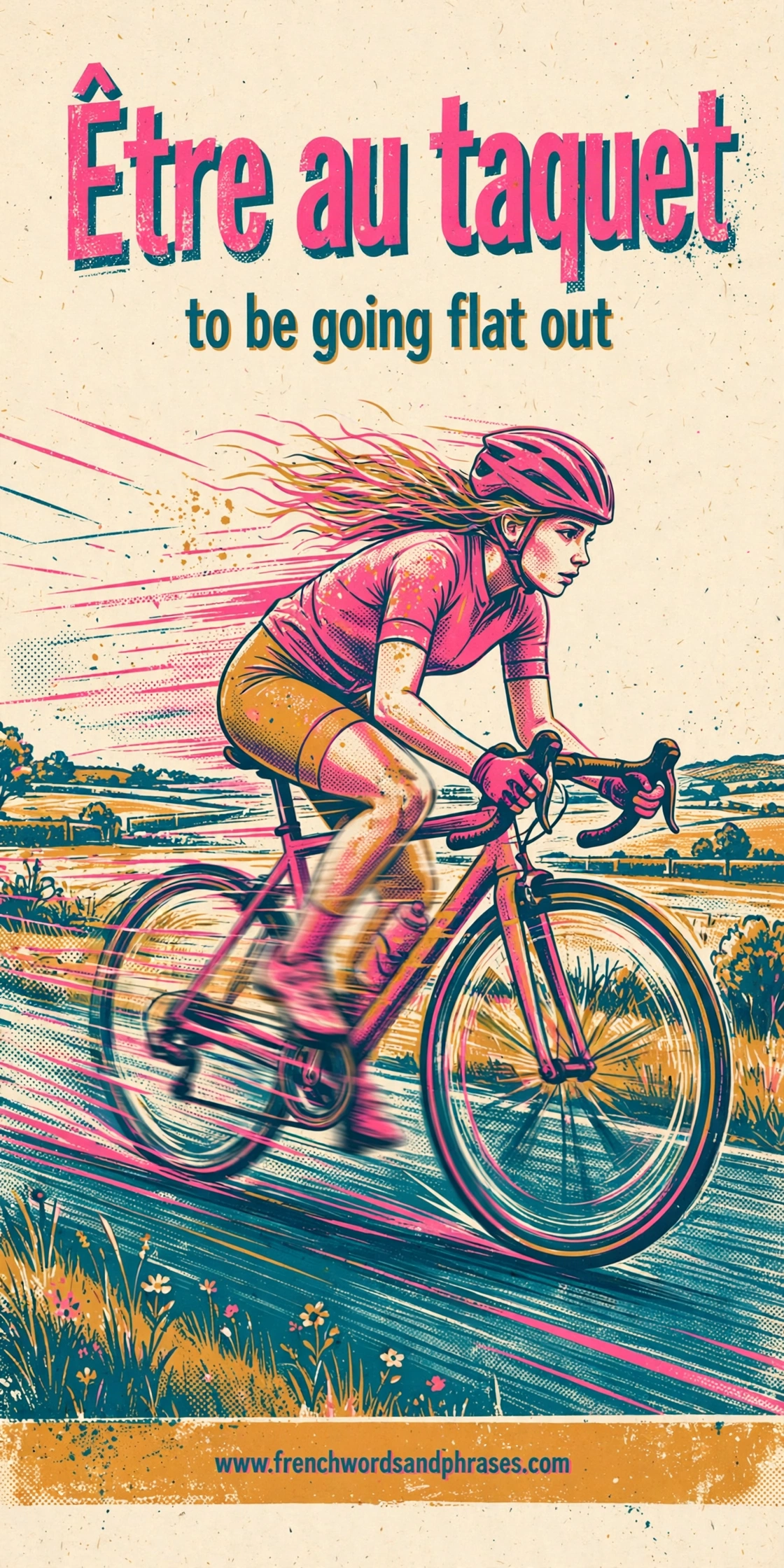
Être au taquet means to be going flat out, giving it everything.
Race morning at the village fête. Your friend is at the start line of the fun run with her number pinned on, bouncing on her toes, eyes bright, already half-launched before the whistle. Ask her if she is ready and she grins: she is not just ready — she is at the stop, at the limit, at maximum. French has a small wooden word for that state.
Let’s explore how être au taquet works in French, beginning with the whole phrase on one card.
Understanding the French Phrase Être au taquet
Être au taquet is a French idiom built from être (to be) and taquet — a stop, a cleat, the little block that stops a sliding part at its limit. To be au taquet is to be up against that top stop: at maximum effort, maximum energy, fully committed and raring to go.
It means to be going flat out — giving something everything you have, at full throttle, with nothing held back. Athletes are au taquet on race day, students the night before an exam, whole offices in the last week before a launch. English says flat out or all in; French says you are up against the stop.
Type: Idiom — être + au taquet (at the stop, at the limit)
Answers the need: Saying someone is fully on it — maximum effort, energy and focus
Register: Informal and upbeat — friends, sport, work banter; not for formal writing
Strength: Maximum — all the way up against the stop, nothing held back
One important usage detail: être au taquet is informal. Cheer a friend on with it freely — tu es au taquet ? — but in a formal report you would write donner le maximum or être pleinement engagé instead. It describes effort and readiness, not just speed.
Experience the Word
Être au taquet is the state every coach wants and every deadline demands — the needle against the stop.
Imagine the little bakery on the morning of the village festival: ovens roaring since four, trays sliding in and out, the baker’s daughter calling orders without looking up. Nobody is strolling in that kitchen. Everybody is au taquet, and the croissants have never been better.
French borrowed the image from the machine shop. When the part can slide no further, it is giving its maximum — and so are you.
How to Use Être au taquet in French: Complete Guide
Let’s explore how être au taquet works in French, beginning with the whole phrase on one card.
Être au taquet at a Glance
The Whole Phrase on One Card
Real meaning, literal building blocks, English twin and register — être au taquet in five lines.
| Point | Être au taquet |
|---|---|
| What it really means | to be going flat out — giving it everything |
| Word for word | to be at the stop (a taquet is a cleat or block that stops a part at its limit) |
| English equivalent | to be flat out / to be all in / to be raring to go |
| Register | informal and upbeat — sport, friends, work banter |
| Use it for | maximum effort and readiness — races, deadlines, big days |
Example
Demain, c’est la finale : je suis au taquet.
Tomorrow is the final: I’m going flat out.
Word by Word: Building the Maximum
Three small pieces — one verb, one contraction, and one piece of hardware.
| Word | Literal meaning | Its job in the phrase |
|---|---|---|
| être | to be | the verb of state — it conjugates for the person: je suis, tu es, ils sont |
| au | at the | à + le squeezed together — the place where you stand |
| taquet | a stop, a cleat | the block that halts a sliding part at its limit — here, the top limit of effort |
Example
Toute l’équipe est au taquet pour la finale.
The whole team is going flat out for the final.
Quick Quiz 1
What is a taquet outside this idiom?
Reveal the answer
A stop or cleat — the small block that stops a sliding part at its limit. Being au taquet means being up against that top stop, at maximum.
Il est au taquet depuis ce matin.
He has been going flat out since this morning.
When You Say It: The Big Efforts
Être au taquet belongs to race days, deadlines and launches — anywhere maximum effort is the mood.
| Situation | Example |
|---|---|
| Before a race | tu es au taquet pour la course de demain ? — are you raring to go for tomorrow’s race? |
| At work, before a launch | toute l’équipe est au taquet cette semaine — the whole team is flat out this week |
| Studying hard | elle est au taquet sur ses révisions — she’s going flat out on her revision |
| Cheering someone on | allez, sois au taquet, c’est le dernier tour ! — come on, give it everything, it’s the last lap! |
Example
Les étudiants sont au taquet avant les examens.
The students are going flat out before the exams.
Make It Yours: Who Is at the Stop?
Only être changes — taquet never moves, for anyone, in any tense.
| Form | French | In English |
|---|---|---|
| For me | je suis au taquet | I’m going flat out |
| For you (tu) | tu es au taquet | you’re going flat out |
| For us | on est au taquet | we’re going flat out |
| For them | ils sont au taquet | they’re going flat out |
| In the past | j’étais au taquet toute la semaine | I was flat out all week |
| As a question | t’es au taquet ? | are you raring to go? |
Example
Vous êtes au taquet pour l’ouverture du magasin ?
Are you going flat out for the shop opening?
Quick Quiz 2
How do you ask a friend if they are raring to go?
Reveal the answer
T’es au taquet ? — informal, with tu, exactly the register this idiom lives in.
T’es au taquet pour le match ?
Are you raring to go for the match?
Everyday Expressions: Building on the Maximum
Être au taquet slots into these everyday frames — each one ready to use as it stands.
| Frame | In English |
|---|---|
| être au taquet pour quelque chose | to be going flat out for something |
| être au taquet au travail | to be flat out at work |
| se mettre au taquet | to get yourself to maximum, to switch on fully |
| au taquet dès le matin | flat out from first thing in the morning |
| pas vraiment au taquet | not really giving it everything |
Example
Elle s’est mise au taquet dès la rentrée.
She went flat out from the start of term.
Close Cousins: The Full-Effort Family
French has several ways to give everything — être au taquet is the cheerful, informal one.
| Expression | The difference |
|---|---|
| être au taquet | the state — at maximum effort and readiness, informal and upbeat |
| à fond | flat out, fully — the closest cousin; à fond la caisse is the joking upgrade |
| donner le maximum | to give your maximum — the neutral version, safe anywhere |
| mettre le paquet | to go all out — the action of pulling out every stop |
| être surmotivé | informal — super motivated; about attitude more than effort |
Example
Pour ce projet, elle a mis le paquet et elle est restée au taquet.
For this project, she went all out and stayed flat out.
Quick Quiz 3
In a formal report about a hardworking team, which fits better: au taquet or donner le maximum?
Reveal the answer
Donner le maximum — être au taquet is informal banter, perfect for friends and sport, too casual for a report.
L’équipe a donné le maximum toute la semaine.
The team gave its maximum all week.
Être au taquet and Its Neighbours
The effort shelf around the phrase — the all-in side and the easing-off side.
| French | In English |
|---|---|
| être prêt | to be ready |
| être motivé | to be motivated |
| être en forme | to be on form, fit |
| y aller à fond | to go at it flat out |
| lever le pied | to ease off — the opposite |
| être à la traîne | to lag behind — the opposite end |
Example
Après le marathon, il a levé le pied pendant un mois.
After the marathon, he eased off for a month.
Watch Out: The Traps Around the Taquet
The traps: a piece of hardware mistaken for a ticket, and banter used in the boardroom.
| Trap | The truth |
|---|---|
| confusing taquet with ticket | a ticket is un billet or un ticket — a taquet is a wooden or metal stop |
| translating word for word | at the cleat means nothing in English — say flat out, all in, raring to go |
| using it in formal writing | the idiom is informal — reports prefer donner le maximum |
| using it for speed alone | être au taquet is effort and commitment — a fast car is not au taquet, its driver can be |
Example
Le jour de l’ouverture, tout le personnel était au taquet.
On opening day, the whole staff was going flat out.
Quick Quiz 4
True or false: être au taquet simply means ‘to be very fast’.
Reveal the answer
False — it means giving maximum effort and commitment, at work, in sport or in study, not just moving quickly.
Elle est au taquet sur son mémoire.
She is going flat out on her dissertation.
Être au taquet in Everyday French: Real-Life Examples
Now that you know the word, let’s see how être au taquet appears in everyday French.
Example 1 — Race morning
Le jour du marathon, les coureurs sont au taquet dès l’aube.
On marathon day, the runners are raring to go from dawn.
Example 2 — The bakery rush
Le samedi matin, les boulangers sont au taquet.
On Saturday mornings, the bakers are going flat out.
Example 3 — Exam week
Ma sœur est au taquet : son concours est dans trois jours.
My sister is going flat out: her exam is in three days.
Example 4 — A quick check
T’es au taquet pour le déménagement de samedi ?
Are you all in for Saturday’s move?
Example 5 — Honest answer
Aujourd’hui, je ne suis pas vraiment au taquet.
Today, I’m not really giving it everything.
Example 6 — The launch
Toute la boutique était au taquet pour les soldes.
The whole shop was going flat out for the sales.
Beyond Translation: The Meaning of Être au taquet
The taquet began life in workshops and on boats: a small block of wood or metal that stops a sliding part dead at the end of its travel. Sailors know its cousin the cleat, around which a rope is made fast. To be au taquet is to be secured at the very end of the line — nothing left to give because everything is already given.
To be au taquet is to have slid all the way to your own limit, on purpose.
That is why the phrase is always a compliment or a battle cry, never a complaint: nobody drifts au taquet by accident.
How to Remember the French Phrase Être au taquet
Remember it this way: Picture a sliding bolt shooting across and stopping dead against its block — clack, the very end of the track. That block is the taquet, and being against it means giving the maximum.
- You picture the sliding part stopped at its top stop — it can give no more because it is already giving everything.
- You keep taquet unchanged for everyone: je suis, tu es, ils sont — only être moves.
- You save it for informal moments: races, deadlines, friendly banter — never the formal report.
The key idea is être au taquet means to be going flat out — up against the stop, at maximum effort, in informal French.
Test Your Knowledge of Être au taquet
Let’s see how much you’ve learned. Try answering these questions before revealing the answers.
Question 1
What does être au taquet mean?
Reveal the answer
To be going flat out — giving maximum effort, energy and focus.
Question 2
What is a taquet?
Reveal the answer
A stop or cleat — the small block that halts a sliding part at its limit.
Question 3
What register is être au taquet?
Reveal the answer
Informal and upbeat — friends, sport and work banter; formal writing prefers donner le maximum.
Question 4
Translate: The whole team is flat out this week.
Reveal the answer
Toute l’équipe est au taquet cette semaine.
Question 5
Complete the sentence:
Nous sommes au ______ pour la finale. (We are going flat out for the final.)
Reveal the answer
taquet
Nous sommes au taquet pour la finale.
We are going flat out for the final.
Your Final Challenge
Can You Use It?
How would you say this in French?
“Tomorrow is the big day, and I am going flat out.”
Reveal the answer
Demain, c’est le grand jour, et je suis au taquet.
Tomorrow is the big day, and I am going flat out.
A little French. A little curiosity. A richer everyday life.
LEARN FRENCH ONE WORD AT A TIME