A French Word to Live By
Translate Avoir la moutarde qui monte au nez to English
/a.vwaʁ la mus.taʁd ki mɔ̃t o ne/
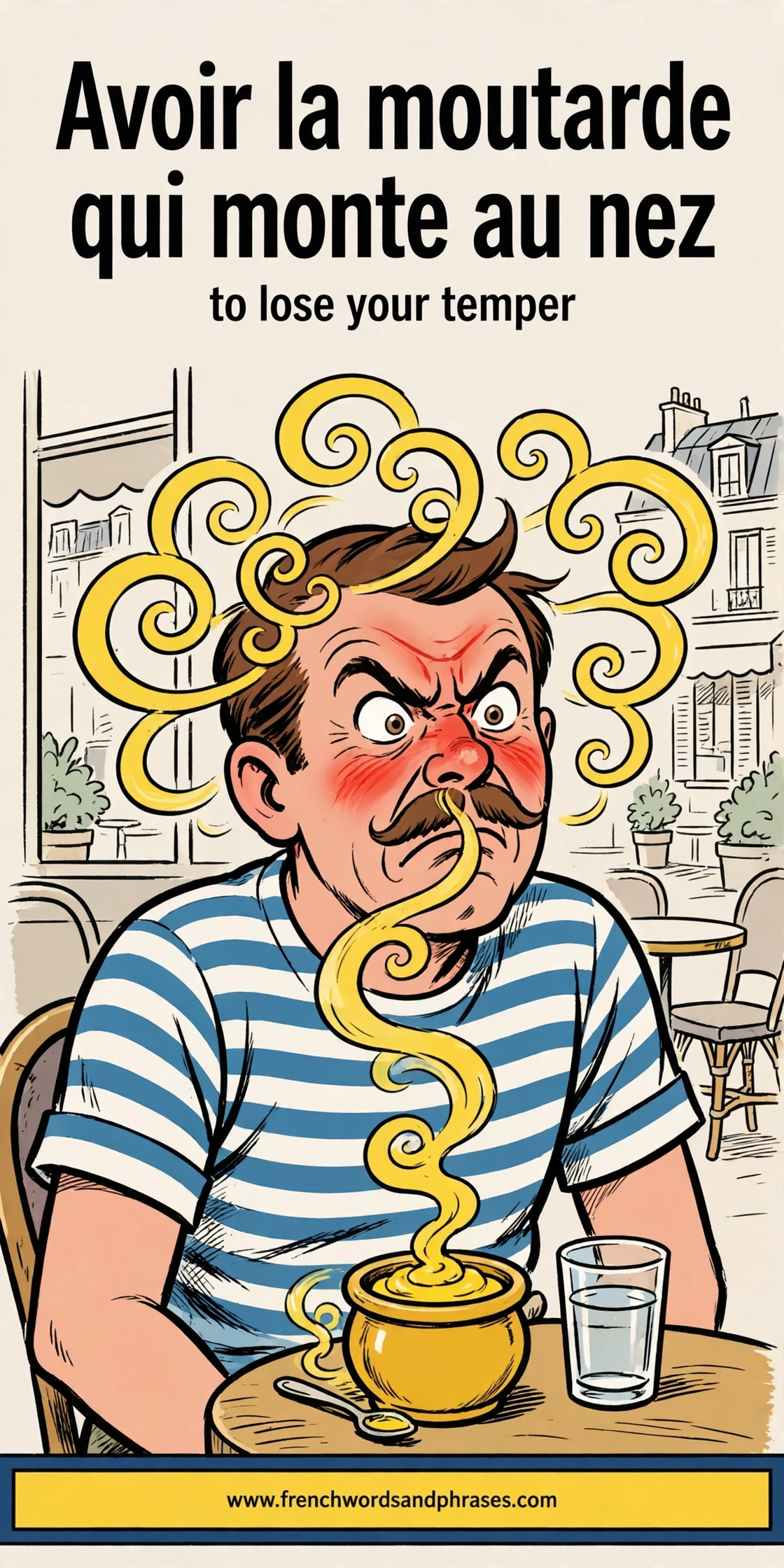
Avoir la moutarde qui monte au nez means to lose your temper, to get angry.
The train is cancelled for the third time this week, the platform loudspeaker crackles out another apology, and the man beside you goes very quiet. His jaw tightens, his face colours, and you can almost see it happen — the famous French mustard rising to his nose. A few more seconds and his temper will go with it.
Let’s explore how avoir la moutarde qui monte au nez works in French, beginning with the whole phrase on one card.
Understanding the French Phrase Avoir la moutarde qui monte au nez
Avoir la moutarde qui monte au nez is a French idiom built as a tiny scene: la moutarde (the mustard) qui monte (that rises) au nez (to the nose). Anyone who has taken a spoonful of strong Dijon mustard knows the sting that shoots straight up the nose — and that rising sting is exactly the feeling of anger climbing towards the surface.
It means to lose your temper, or to feel it slipping — to get angry, visibly, as the irritation rises. The phrase catches the moment just before the explosion: patience gone, face hot, words about to escape. English says to see red or to lose your temper; French feels the mustard reach the nose.
Type: Idiom — a little scene: the mustard rises to the nose
Answers the need: Saying someone is starting to lose their temper
Register: Everyday, colourful and slightly humorous — conversation and storytelling
Strength: The flash point — anger rising, just before it bursts out
One important usage detail: the person getting angry is the indirect object, not the subject — la moutarde ME monte au nez, la moutarde LUI monte au nez. The mustard does the rising; you just feel it arrive. In the past it becomes la moutarde m’est montée au nez.
Experience the Word
La moutarde qui monte au nez is anger you can feel in your face — a sting climbing where everyone can see it coming.
Imagine a cook who has seasoned the soup three times, and three times a helpful guest has added salt behind her back. She tastes it, sets the spoon down very slowly, and smiles the smile that is not a smile. The mustard has reached her nose; the whole kitchen knows what happens next.
French anger often arrives through the kitchen. Here, temper is a condiment — and it burns on the way up.
How to Use Avoir la moutarde qui monte au nez in French: Complete Guide
Let’s explore how avoir la moutarde qui monte au nez works in French, beginning with the whole phrase on one card.
Avoir la moutarde qui monte au nez at a Glance
The Whole Phrase on One Card
Real meaning, literal building blocks, English twin and register — the rising mustard in five lines.
| Point | Avoir la moutarde qui monte au nez |
|---|---|
| What it really means | to lose your temper — to feel anger rising |
| Word for word | to have the mustard that rises to the nose |
| English equivalent | to lose your temper / to see red |
| Register | everyday, colourful, slightly humorous |
| Use it for | the moment patience snaps — queues, delays, provocations |
Example
Quand il a vu la facture, la moutarde lui est montée au nez.
When he saw the bill, he lost his temper.
Word by Word: Building the Sting
Five pieces — and the whole idiom is a spoonful of Dijon, re-enacted on a face.
| Word | Literal meaning | Its job in the phrase |
|---|---|---|
| avoir | to have | the headword form — in real sentences the mustard itself becomes the subject |
| la moutarde | the mustard | strong Dijon mustard — the kind whose sting shoots up the nose |
| qui | that / which | the little hinge joining the mustard to its action |
| monte | rises, climbs | from monter — the anger climbing, present tense, unstoppable |
| au nez | to the nose | where the sting lands — and where everyone sees the temper arrive |
Example
Attention, la moutarde commence à me monter au nez.
Careful, I’m starting to lose my temper.
Quick Quiz 1
Who or what does the rising in this idiom?
Reveal the answer
The mustard — it is the subject of monter. The angry person only receives it: la moutarde lui monte au nez.
La moutarde me monte au nez !
I’m losing my temper!
When You Say It: The Flash Points
The phrase belongs to the seconds when irritation turns into temper — in public, at work, at home.
| Situation | Example |
|---|---|
| A warning about yourself | la moutarde me monte au nez, changeons de sujet — I’m losing my temper, let’s change the subject |
| Watching someone else | regarde-le, la moutarde lui monte au nez — look at him, he’s losing his temper |
| In a queue | après une heure d’attente, la moutarde montait au nez de tout le monde — after an hour’s wait, everyone was losing their temper |
| Telling the story | quand elle a entendu ça, la moutarde lui est montée au nez d’un coup — when she heard that, she suddenly lost her temper |
Example
Ne le provoque pas, la moutarde lui monte déjà au nez.
Don’t provoke him, he’s already losing his temper.
Make It Yours: Whose Nose Is It?
The mustard stays the same — only the little pronoun in front of monte changes with the victim.
| Form | French | In English |
|---|---|---|
| For me | la moutarde me monte au nez | I’m losing my temper |
| For you (tu) | la moutarde te monte au nez | you’re losing your temper |
| For him / her | la moutarde lui monte au nez | he / she is losing his / her temper |
| For us | la moutarde nous monte au nez | we’re losing our temper |
| For them | la moutarde leur monte au nez | they’re losing their temper |
| In the past | la moutarde m’est montée au nez | I lost my temper |
Example
La moutarde leur est montée au nez dès la première remarque.
They lost their temper at the very first remark.
Quick Quiz 2
How do you say ‘He is losing his temper’?
Reveal the answer
La moutarde lui monte au nez — lui carries the person; the mustard does the rising.
La moutarde lui monte au nez, pars avant qu’il explose.
He’s losing his temper, leave before he blows up.
Everyday Expressions: Building on the Mustard
The rising mustard slots into these everyday frames — each one ready to use as it stands.
| Frame | In English |
|---|---|
| la moutarde me monte au nez | I’m losing my temper |
| faire monter la moutarde au nez de quelqu’un | to make someone lose their temper |
| la moutarde est montée au nez | the temper has snapped (past) |
| attention, la moutarde monte | watch out, the temper is rising |
| avant que la moutarde me monte au nez | before I lose my temper |
Example
Arrête de faire monter la moutarde au nez de ton frère.
Stop making your brother lose his temper.
Close Cousins: The Anger Family
French anger has many doors — the mustard is the colourful, visible one.
| Expression | The difference |
|---|---|
| avoir la moutarde qui monte au nez | the rising moment — temper climbing to the surface, colourfully told |
| perdre patience | the plain version — to lose patience, no image attached |
| s’énerver | to get worked up — irritation and nerves as much as anger |
| voir rouge | to see red — a sudden flash of fury |
| sortir de ses gonds | to fly off the handle — the explosion itself, stronger |
| péter un câble | informal — to blow a fuse, to lose it completely |
Example
Il a d’abord perdu patience, puis la moutarde lui est montée au nez.
First he lost patience, then he lost his temper.
Quick Quiz 3
Which is stronger: perdre patience or sortir de ses gonds?
Reveal the answer
Sortir de ses gonds — flying off the handle is the explosion; perdre patience is only the beginning.
À la troisième insulte, il est sorti de ses gonds.
At the third insult, he flew off the handle.
Avoir la moutarde qui monte au nez and Its Neighbours
The anger shelf around the phrase — from calm to eruption.
| French | In English |
|---|---|
| garder son calme | to keep your calm — the opposite |
| être en colère | to be angry |
| être furieux | to be furious |
| s’emporter | to lose your temper, to flare up |
| bouillir de colère | to boil with anger |
| exploser | to explode — the end of the story |
Example
Elle a gardé son calme malgré les provocations.
She kept her calm despite the provocations.
Watch Out: The Traps Around the Mustard
The traps: making yourself the subject, and seasoning a sentence that was only about lunch.
| Trap | The truth |
|---|---|
| making the person the subject | you do not rise — the mustard does: la moutarde me monte au nez, never je monte la moutarde |
| translating word for word | mustard up the nose means nothing in English — say lose your temper or see red |
| confusing it with real mustard | at the table, passe-moi la moutarde is just lunch; the idiom needs monte au nez |
| using it for quiet sadness | the phrase is anger rising — for sadness, French would say avoir le cafard |
Example
Quand le garagiste a annoncé le prix, la moutarde m’est montée au nez.
When the mechanic announced the price, I lost my temper.
Quick Quiz 4
True or false: je monte la moutarde au nez is a correct way to say ‘I’m losing my temper’.
Reveal the answer
False — the mustard is the subject, and you are the little pronoun before monte: la moutarde me monte au nez.
La moutarde me monte au nez, je préfère partir.
I’m losing my temper, I’d rather leave.
Avoir la moutarde qui monte au nez in Everyday French: Real-Life Examples
Now that you know the word, let’s see how avoir la moutarde qui monte au nez appears in everyday French.
Example 1 — The cancelled train
À la troisième annonce de retard, la moutarde est montée au nez des voyageurs.
At the third delay announcement, the passengers lost their temper.
Example 2 — A fair warning
Change de ton, la moutarde commence à me monter au nez.
Change your tone, I’m starting to lose my temper.
Example 3 — The noisy neighbour
Quand la musique a repris à minuit, la moutarde lui est montée au nez.
When the music started again at midnight, he lost his temper.
Example 4 — Watching the boss
Ne dis rien : la moutarde monte au nez du directeur.
Say nothing: the director is losing his temper.
Example 5 — Traffic jam
Après deux heures d’embouteillage, la moutarde nous montait au nez.
After two hours in traffic, we were losing our temper.
Example 6 — The last straw
Ce petit commentaire a suffi pour que la moutarde lui monte au nez.
That little comment was enough to make her lose her temper.
Beyond Translation: The Meaning of Avoir la moutarde qui monte au nez
Every French child knows the experiment: a spoonful of strong Dijon, taken bravely, sends a hot sting straight up the nose and brings tears to the eyes. The idiom simply moves that sting from the dining table to the temper — anger, too, rises where everyone can see it, and cannot be called back down.
To feel the mustard rise is to feel your temper become visible.
That is the phrase’s charm: it makes anger slightly comic, a condiment rather than a catastrophe, even while it warns that the explosion is seconds away.
How to Remember the French Phrase Avoir la moutarde qui monte au nez
Remember it this way: Remember your first spoonful of real Dijon mustard — the hot sting that shot straight up your nose before you could stop it. Anger in this idiom climbs exactly the same path.
- You picture the sting of Dijon mustard shooting up the nose — anger rises the same way.
- You let the mustard be the subject: la moutarde me monte au nez, never je monte la moutarde.
- You change only the little pronoun: me, te, lui, nous, leur monte au nez.
The key idea is avoir la moutarde qui monte au nez means to lose your temper — anger rising like the sting of strong mustard, with the mustard as the subject.
Test Your Knowledge of Avoir la moutarde qui monte au nez
Let’s see how much you’ve learned. Try answering these questions before revealing the answers.
Question 1
What does la moutarde lui monte au nez mean?
Reveal the answer
He (or she) is losing his temper — anger is rising to the surface.
Question 2
Why mustard, of all things?
Reveal the answer
Because strong Dijon mustard stings up the nose — the idiom borrows that rising sting for rising anger.
Question 3
Who is the subject of monte in the idiom?
Reveal the answer
La moutarde — the mustard rises; the person is the pronoun before the verb (me, lui, leur…).
Question 4
Translate: I’m starting to lose my temper.
Reveal the answer
La moutarde commence à me monter au nez.
Question 5
Complete the sentence:
La moutarde ______ monte au nez, il va exploser. (He is losing his temper, he’s going to blow up.)
Reveal the answer
lui
La moutarde lui monte au nez, il va exploser.
He is losing his temper, he’s going to blow up.
Your Final Challenge
Can You Use It?
How would you say this in French?
“When he heard the news, he lost his temper.”
Reveal the answer
Quand il a entendu la nouvelle, la moutarde lui est montée au nez.
When he heard the news, he lost his temper.
A little French. A little curiosity. A richer everyday life.
LEARN FRENCH ONE WORD AT A TIME