A French Word to Live By
Translate Avoir la gueule de bois to English
/a.vwaʁ la ɡœl də bwa/
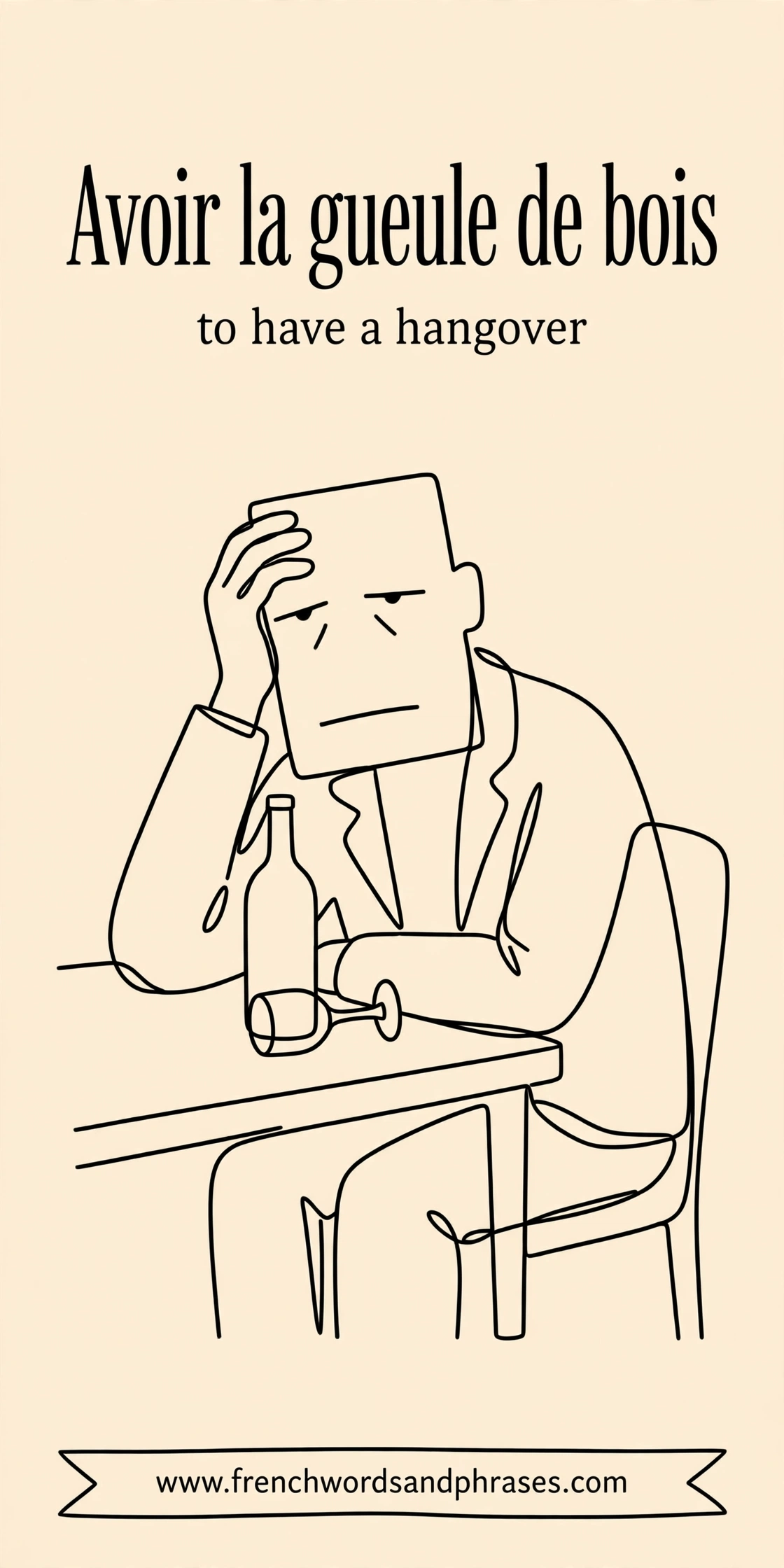
Avoir la gueule de bois means to have a hangover.
Sunday, eleven o’clock. Your friend finally surfaces, hair in revolt, sunglasses on indoors, and makes straight for the water jug without a word. Last night’s party is written all over him — the dry mouth, the heavy head, the regret. French names the whole morning-after package with an image nobody forgets: a mouth made of wood.
Let’s explore how avoir la gueule de bois works in French, beginning with the whole phrase on one card.
Understanding the French Phrase Avoir la gueule de bois
Avoir la gueule de bois is a French idiom built from avoir (to have), gueule — properly an animal’s mouth or muzzle, used in slang for a person’s mouth or face — and de bois (of wood). The picture is the morning-after mouth: dry, stiff and tasteless as a plank. The whole phrase is the standard jokey French word for a hangover.
It means to have a hangover — the headache, the wooden mouth, the slow brain and the sunlight that hurts, all in one phrase. It is the state itself, not the drinking: the drinking was hier soir, the gueule de bois is this morning. English says a hangover; French says your mouth has turned to wood.
Type: Idiom — avoir + noun phrase (la gueule de bois, the wooden mouth)
Answers the need: Saying someone has a hangover — the full morning-after state
Register: Informal and humorous — gueule is slang, so keep it for friends
Strength: The full morning after — headache, dry mouth and regret included
One important usage detail: gueule is slang — it is the word for an animal’s mouth, borrowed jokingly for a person’s face or mouth. Among friends the phrase is pure comedy, but choose your audience: with a doctor or your boss, describe the symptoms instead — je me suis réveillé avec un gros mal de tête.
Experience the Word
Avoir la gueule de bois is the hangover with a carpenter’s precision — the mouth measured, found wooden, and reported.
Imagine the morning after the village wedding: the chairs still in rows on the grass, the band’s cables coiled by the stage, and the best man at the café counter ordering coffee in a whisper, wincing at the cups. He does not need to explain. One phrase, passed around with a grin, covers the whole table: la gueule de bois.
French likes its suffering vivid. A dry mouth is a fact; a wooden mouth is a story.
How to Use Avoir la gueule de bois in French: Complete Guide
Let’s explore how avoir la gueule de bois works in French, beginning with the whole phrase on one card.
Avoir la gueule de bois at a Glance
The Whole Phrase on One Card
Real meaning, literal building blocks, English twin and register — the wooden mouth in five lines.
| Point | Avoir la gueule de bois |
|---|---|
| What it really means | to have a hangover |
| Word for word | to have the wooden mouth (gueule = mouth, slang; de bois = of wood) |
| English equivalent | to have a hangover / to be hung over |
| Register | informal and humorous — friends and family, never formal |
| Use it for | the morning after — headache, dry mouth, regret |
Example
Ce matin, j’ai la gueule de bois, ne me parle pas trop fort.
This morning I’ve got a hangover, don’t talk too loudly.
Word by Word: Building the Morning After
Three pieces — and the middle one is doing all the comic work.
| Word | Literal meaning | Its job in the phrase |
|---|---|---|
| avoir | to have | the engine — French has its states: j’ai faim, j’ai soif, j’ai la gueule de bois |
| la gueule | the mouth, the muzzle | properly an animal’s mouth; slang for a person’s mouth or face — the joke starts here |
| de bois | of wood | dry, stiff, tasteless — exactly how the morning-after mouth feels |
Example
Après la fête, tout le monde avait la gueule de bois.
After the party, everyone had a hangover.
Quick Quiz 1
What is a gueule, properly speaking?
Reveal the answer
An animal’s mouth or muzzle — using it for a person’s mouth is slang, which is what makes the idiom funny.
Quelle gueule de bois ce matin !
What a hangover this morning!
When You Say It: The Morning After
The phrase belongs to the morning after — at the café counter, on the sofa, at the bakery run.
| Situation | Example |
|---|---|
| Confessing it yourself | j’ai une de ces gueules de bois… — I’ve got such a hangover… |
| Teasing a friend | belle gueule de bois, mon ami ! — that’s a fine hangover, my friend! |
| Explaining a slow start | il a la gueule de bois, laisse-le dormir — he’s hung over, let him sleep |
| Promising yourself | plus jamais : la gueule de bois du dimanche, c’est fini — never again: the Sunday hangover is over |
Example
Elle s’est réveillée avec la gueule de bois et un verre d’eau à la main.
She woke up with a hangover and a glass of water in her hand.
Make It Yours: Bending the Hangover
Avoir conjugates, and the phrase takes une as soon as you describe the hangover’s size.
| Form | French | In English |
|---|---|---|
| For me | j’ai la gueule de bois | I’ve got a hangover |
| For him | il a la gueule de bois | he’s got a hangover |
| With an adjective | j’ai une gueule de bois terrible | I’ve got a terrible hangover |
| In the past | hier matin, j’avais la gueule de bois | yesterday morning, I had a hangover |
| As a question | tu as la gueule de bois ? | are you hung over? |
| The vow | je n’aurai plus jamais la gueule de bois | I’ll never have a hangover again |
Example
Vous avez la gueule de bois après le mariage, vous aussi ?
Have you got a hangover after the wedding too?
Quick Quiz 2
How do you say ‘I’ve got a terrible hangover’?
Reveal the answer
J’ai une gueule de bois terrible — with an adjective, la becomes une.
J’ai une gueule de bois terrible, je reste au lit.
I’ve got a terrible hangover, I’m staying in bed.
Everyday Expressions: Building on the Hangover
Avoir la gueule de bois slots into these everyday frames — each one ready to use as it stands.
| Frame | In English |
|---|---|
| se réveiller avec la gueule de bois | to wake up with a hangover |
| une gueule de bois carabinée | a monster hangover (informal) |
| la gueule de bois du lendemain | the next-day hangover |
| avoir la gueule de bois après une soirée | to be hung over after a night out |
| ça se voit, ta gueule de bois | it shows, that hangover of yours |
Example
Il s’est réveillé avec une gueule de bois carabinée.
He woke up with a monster hangover.
Close Cousins: The Morning-After Family
French has several ways to describe the damage — the wooden mouth is the famous one.
| Expression | The difference |
|---|---|
| avoir la gueule de bois | the hangover itself — the standard jokey phrase, informal |
| avoir mal aux cheveux | humorous — my hair hurts; a comic symptom-by-symptom version |
| être dans le brouillard | to be in a fog — the thick head, without naming the cause |
| avoir la bouche pâteuse | to have a pasty, dry mouth — one symptom of the same morning |
| être malade après avoir trop bu | the plain description — to be ill after drinking too much; safe anywhere |
Example
Il n’est pas malade, il a juste la gueule de bois.
He isn’t ill, he’s just hung over.
Quick Quiz 3
Your friend says j’ai mal aux cheveux the morning after a party. Is he ill?
Reveal the answer
No — he is joking. Avoir mal aux cheveux, my hair hurts, is a humorous way of describing a hangover.
J’ai mal aux cheveux, passe-moi l’aspirine.
My hair hurts, pass me the aspirin.
Avoir la gueule de bois and Its Neighbours
The drinking shelf around the phrase — the night before on one side, recovery on the other.
| French | In English |
|---|---|
| être ivre | to be drunk — the night before |
| être pompette | to be tipsy — informal and gentle |
| avoir soif | to be thirsty — the morning’s first feeling |
| dégriser | to sober up |
| être sobre | to be sober — the opposite shore |
| un mal de tête | a headache — the headline symptom |
Example
Il était ivre hier soir ; ce matin, il dégrise lentement.
He was drunk last night; this morning, he’s sobering up slowly.
Watch Out: The Traps Around the Gueule
The traps: a slang word with sharp edges, and a wooden face that means nothing in English.
| Trap | The truth |
|---|---|
| using gueule carelessly | gueule is slang for a face or mouth — and ta gueule ! means shut up, and is vulgar; keep the word inside this friendly idiom |
| translating word for word | a wooden face means nothing in English — say a hangover |
| using it formally | with a doctor or an employer, describe symptoms instead: un mal de tête, des nausées |
| confusing it with the drinking itself | the phrase is the morning after, not the party — the party is la soirée, the price is la gueule de bois |
Example
Après trois verres de trop, la gueule de bois était inévitable.
After three glasses too many, the hangover was inevitable.
Quick Quiz 4
True or false: avoir la gueule de bois describes the party itself.
Reveal the answer
False — it describes the morning after the party: the hangover.
La fête était super, mais la gueule de bois aussi.
The party was great, but so was the hangover.
Avoir la gueule de bois in Everyday French: Real-Life Examples
Now that you know the word, let’s see how avoir la gueule de bois appears in everyday French.
Example 1 — Sunday morning
Le dimanche matin, il a toujours la gueule de bois après le poker.
On Sunday mornings, he always has a hangover after poker night.
Example 2 — The whispered order
Un café serré, s’il vous plaît — j’ai la gueule de bois.
A strong coffee, please — I’ve got a hangover.
Example 3 — Sympathy
Elle a la gueule de bois, parlez doucement.
She’s got a hangover, speak softly.
Example 4 — The wedding bill
Après le mariage, la moitié des invités avait la gueule de bois.
After the wedding, half the guests had a hangover.
Example 5 — The promise
C’est la dernière fois que j’ai la gueule de bois, promis.
It’s the last time I have a hangover, I promise.
Example 6 — At the office
Il est arrivé au bureau avec une gueule de bois visible.
He arrived at the office with a visible hangover.
Beyond Translation: The Meaning of Avoir la gueule de bois
The image is pure carpentry: a mouth planed from wood — dry as a plank, stiff as a board, incapable of tasting anything. French could have blamed the head, and sometimes does, but the mouth is where last night’s wine leaves its signature, so the mouth takes the blame in timber.
To have la gueule de bois is to wake up with last night still in your mouth.
And because gueule is slang, the phrase always carries a grin: it is a hangover reported by a friend, not a patient.
How to Remember the French Phrase Avoir la gueule de bois
Remember it this way: Feel the morning-after mouth: dry, stiff, tasteless — as if it were carved from wood. That wooden mouth is the whole idiom.
- You picture the mouth made of wood — dry, stiff, unable to taste: de bois does the describing.
- You remember gueule is slang for a mouth or face — funny among friends, kept out of formal talk.
- You switch to une when you size it up: une gueule de bois terrible.
The key idea is avoir la gueule de bois means to have a hangover — the wooden mouth of the morning after, in informal French.
Test Your Knowledge of Avoir la gueule de bois
Let’s see how much you’ve learned. Try answering these questions before revealing the answers.
Question 1
What does avoir la gueule de bois mean?
Reveal the answer
To have a hangover — the full morning-after state after drinking too much.
Question 2
Why wood?
Reveal the answer
Because the morning-after mouth feels dry, stiff and tasteless — like a mouth carved from wood.
Question 3
What register is the phrase?
Reveal the answer
Informal and humorous — gueule is slang for a mouth or face, so the phrase belongs among friends.
Question 4
Translate: She woke up with a hangover.
Reveal the answer
Elle s’est réveillée avec la gueule de bois.
Question 5
Complete the sentence:
J’ai une gueule de ______ terrible. (I’ve got a terrible hangover.)
Reveal the answer
bois
J’ai une gueule de bois terrible.
I’ve got a terrible hangover.
Your Final Challenge
Can You Use It?
How would you say this in French?
“This morning, I have a terrible hangover.”
Reveal the answer
Ce matin, j’ai une gueule de bois terrible.
This morning, I have a terrible hangover.
A little French. A little curiosity. A richer everyday life.
LEARN FRENCH ONE WORD AT A TIME