A French Word to Live By
Translate Élève to English
/e.lɛv/
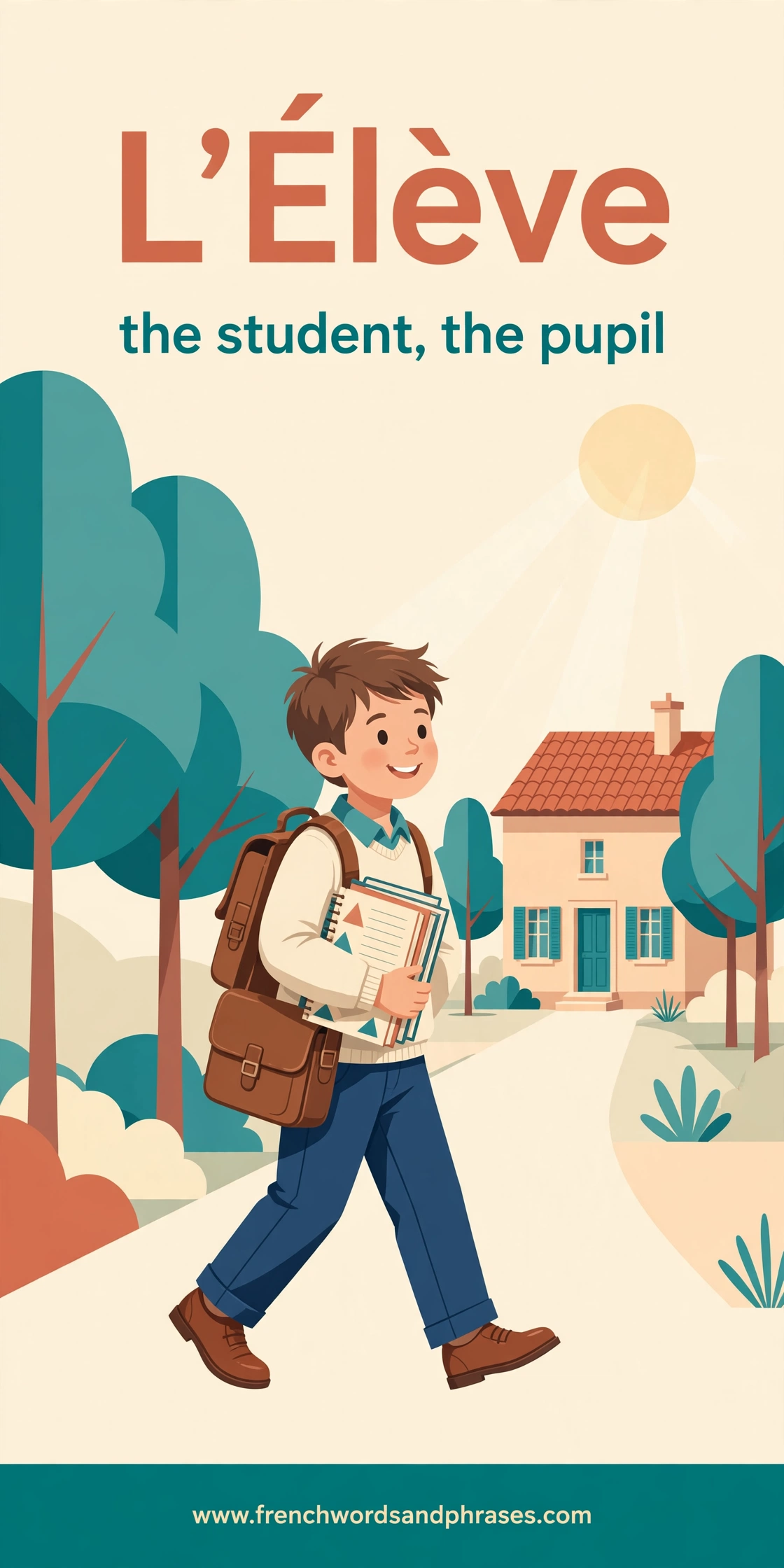
L’Élève means the student, the pupil.
A satchel bigger than its owner, a hand shooting up before the question is even finished, a copybook ruled in perfect squares: l’élève, the pupil — the schoolchild, the one being raised towards knowledge, which is exactly what the word says.
In this guide, you’ll learn what élève means in English, how to use it with its articles, how to form its plural, and how it appears in everyday French. Explore French examples, English translations, and practice quizzes.
Understanding the French Noun Élève
Élève is an epicene French noun — one form for both genders, learned with its articles: un élève for a boy, une élève for a girl, and l’élève when the article melts before the opening vowel. It comes from the verb élever, to raise: an élève is literally a child being raised, lifted up by teaching. In school French it is the standard word for a pupil at primary or secondary school.
It means a pupil, a school student — the child or teenager in the classroom: un élève de primaire, a primary-school pupil, une élève de sixième, a pupil in the first year of collège, un bon élève, a good pupil. Keep the border clear: a university student is un étudiant, while the élève belongs to l’école, le collège and le lycée. The word travels beyond school too — un élève de piano can be a piano teacher’s pupil, of any age.
Gender: Epicene — un élève (boy), une élève (girl)
Definite article: l’ — l’élève (the pupil), melted before the vowel
Indefinite article: un / une — un élève, une élève
Plural: les élèves — regular, with a simple -s
Spelling note: from élever, to raise — the pupil is the one being raised
The border: school pupil = élève; university student = étudiant
English equivalents: The student, the pupil.
Teachers live with the plural: les élèves is the class as a body — les élèves écoutent, the pupils are listening. The word carries effort and report cards: un élève sérieux, a conscientious pupil, un élève en difficulté, a pupil who is struggling. And because the noun never changes shape, only the article and the adjectives around it tell you whether l’élève is a boy or a girl: l’élève est arrivée, the (girl) pupil has arrived.
Experience the Word
Élève is childhood at a desk: the raised hand, the ink-stained finger, the exercise book filled one careful line at a time.
Imagine the classroom door on the first day of term — thirty élèves finding their places, each satchel a small declaration of who they intend to be this year.
You have not just named a schoolchild. You have named the person teaching exists for — l’élève, the pupil, the one being raised.
How to Use Élève in French: Complete Guide
Let’s explore how élève works in French, beginning with its articles — l’élève, un élève, une élève.
Élève with the Definite Article (L’, Les)
Used for a specific pupil — the one at the front, the new one. The vowel opening makes le and la melt into l’.
| Form | French |
|---|---|
| Singular (boy or girl) | l’élève |
| Plural | les élèves |
Example
L’élève lève la main pour poser une question.
The pupil raises their hand to ask a question.
Élève with the Indefinite Article (Un, Une, Des)
The article does the gender work: un élève is a boy, une élève is a girl — the noun itself never changes.
| Form | French |
|---|---|
| A boy pupil | un élève |
| A girl pupil | une élève |
| Plural | des élèves |
Example
Une nouvelle élève arrive dans notre classe.
A new pupil (girl) is joining our class.
Élève with School Levels (De primaire, De sixième…)
An élève is always an élève of somewhere — the level phrases of French schooling.
| Level | French |
|---|---|
| a primary-school pupil | un élève de primaire |
| a pupil in sixième (first year of collège) | un élève de sixième |
| a sixth-form pupil | un élève de terminale |
| a good pupil | un bon élève |
| a new pupil | un nouvel élève |
Example
C’est un élève de terminale, il passe le bac cette année.
He’s a final-year pupil, he’s taking the bac this year.
Quick Quiz 1
Complete the sentence:
______ élève a oublié son cartable dans le couloir. (the)
Reveal the answer
L’
L’élève a oublié son cartable dans le couloir.
The pupil forgot their schoolbag in the corridor — le and la melt into l’ before the vowel.
The Plural of Élève
Élève takes a regular plural in -s — and les élèves is the teacher’s word for the whole class.
| Number | French |
|---|---|
| Singular | l’élève |
| Plural | les élèves |
Example
Les élèves entrent dans la classe en silence.
The pupils come into the classroom in silence.
Élève with Possessive Adjectives (Mon, Ton, Son…)
Before a vowel-initial noun, possessives take the smooth forms mon, ton, son — for boy and girl pupils alike.
| Owner | French |
|---|---|
| my | mon élève |
| your (tu) | ton élève |
| his / her | son élève |
| our | notre élève |
| your (vous) | votre élève |
| their | leur élève |
Example
Le professeur connaît bien son élève.
The teacher knows their pupil well.
Quick Quiz 2
Complete the sentence:
C’est ______ élève le plus travailleur de l’école. (the/my — choose the definite article form)
Reveal the answer
l’
C’est l’élève le plus travailleur de l’école.
He is the hardest-working pupil in the school — l’, the melted article before the vowel.
Élève with Demonstrative Adjectives (Cet, Ces)
Used to point: cet élève, this pupil — cet, the special form before a vowel.
| Form | French |
|---|---|
| Singular (boy or girl) | cet élève |
| Plural | ces élèves |
Example
Cet élève a toujours de bonnes notes.
This pupil always gets good marks.
Élève with Adjectives
Adjectives agree with the pupil’s gender, not the noun’s shape: un élève sérieux, une élève sérieuse.
| Adjective | With Élève |
|---|---|
| sérieux / sérieuse (conscientious) | un élève sérieux, une élève sérieuse |
| nouveau / nouvelle (new) | un nouvel élève, une nouvelle élève |
| jeune (young) | un jeune élève |
| brillant / brillante (brilliant) | une élève brillante |
| en difficulté (struggling) | un élève en difficulté |
Example
C’est une élève brillante et très sérieuse.
She is a brilliant and very conscientious pupil.
Quick Quiz 3
Complete the sentence:
Marie est une élève très ______. (hard-working, feminine)
Reveal the answer
travailleuse
Marie est une élève très travailleuse.
Marie is a very hard-working pupil — travailleuse, feminine, because Marie is a girl.
Everyday Expressions with Élève
Classrooms and report cards — the élève phrases of daily life.
| Expression | In English |
|---|---|
| un bon élève | a good pupil |
| un élève en difficulté | a struggling pupil |
| les élèves de la classe | the pupils in the class |
| un ancien élève | a former pupil, an alumnus |
| le carnet de notes | the report card the élève brings home |
Example
Un ancien élève de l’école est devenu professeur ici.
A former pupil of the school has become a teacher here.
Words from the Same Family as Élève
Raising and learning — the words that travel with élève.
| French | In English |
|---|---|
| élever | to raise, to bring up (the verb at the root) |
| un étudiant | a university student — one step up |
| un professeur | a teacher |
| la classe | the class |
| apprendre | to learn (the verb) |
Example
L’élève apprend vite avec un bon professeur.
The pupil learns quickly with a good teacher.
Quick Quiz 4
What is the difference between un élève and un étudiant?
Reveal the answer
Level — the élève is at school (primary, collège, lycée); the étudiant is at university.
À dix ans, on est élève ; à vingt ans, étudiant.
At ten you’re a pupil; at twenty, a student.
Élève in Everyday French: Real-Life Examples
Now that you know the word, let’s see how élève appears in everyday French.
Example 1 — In class
Les élèves écoutent le professeur.
The pupils are listening to the teacher.
Example 2 — A new arrival
Un nouvel élève arrive lundi prochain.
A new pupil is arriving next Monday.
Example 3 — Praise
C’est un bon élève, il travaille beaucoup.
He’s a good pupil, he works hard.
Example 4 — Homework
Chaque élève fait ses devoirs le soir.
Every pupil does their homework in the evening.
Example 5 — The register
Le professeur appelle les élèves un par un.
The teacher calls the pupils one by one.
Example 6 — Beyond school
Elle est l’élève d’un grand pianiste.
She is the pupil of a great pianist.
Beyond Translation: The Meaning of Élève
Élève is a hopeful word: built on élever, to raise, it defines the child by the direction of travel — upwards. French schooling keeps the word from the first morning of maternelle to the last exam of terminale, and its epicene shape quietly teaches its own lesson: un élève, une élève, the same word, the same desk, the same chance. Only later does the language split the road, sending the étudiant to the université while the élève remains the emblem of school itself.
To say élève is to name someone in the act of being raised by knowledge.
It evokes the raised hand, the ruled copybook and the satchel by the door — childhood, learning as it goes.
How to Remember the French Noun Élève
Remember it this way: Élève is the school pupil — epicene: un élève, une élève, l’élève. For university, switch to étudiant.
- One form, two articles — un élève (boy), une élève (girl), l’élève for both.
- The root — élever, to raise: the pupil is the one being raised.
- The border — élève at school, étudiant at university.
The key idea is l’élève — the pupil, epicene; from élever, to raise.
Test Your Knowledge of Élève
Let’s see how much you’ve learned. Try answering these questions before revealing the answers.
Question 1
How do you say a girl pupil?
Reveal the answer
Une élève — the noun never changes; only the article marks the gender.
Question 2
Is élève used for a university student?
Reveal the answer
No — at university the word is étudiant; élève belongs to school.
Question 3
Translate: The pupils are listening to the teacher.
Reveal the answer
Les élèves écoutent le professeur.
Question 4
What verb is élève built on, and what does it mean?
Reveal the answer
Élever — to raise; the pupil is the one being raised.
Question 5
Complete the sentence:
______ élèves de cette classe sont très sages. (the)
Reveal the answer
Les
Les élèves de cette classe sont très sages.
The pupils in this class are very well-behaved.
Your Final Challenge
Can You Use It?
How would you say this in French?
“The pupils come into the classroom in silence.”
Reveal the answer
Les élèves entrent dans la classe en silence.
The pupils come into the classroom in silence.
A little French. A little curiosity. A richer everyday life.
LEARN FRENCH ONE WORD AT A TIME