A French Word to Live By
Translate En avoir marre to English
/ɑ̃n avwaʁ maʁ/
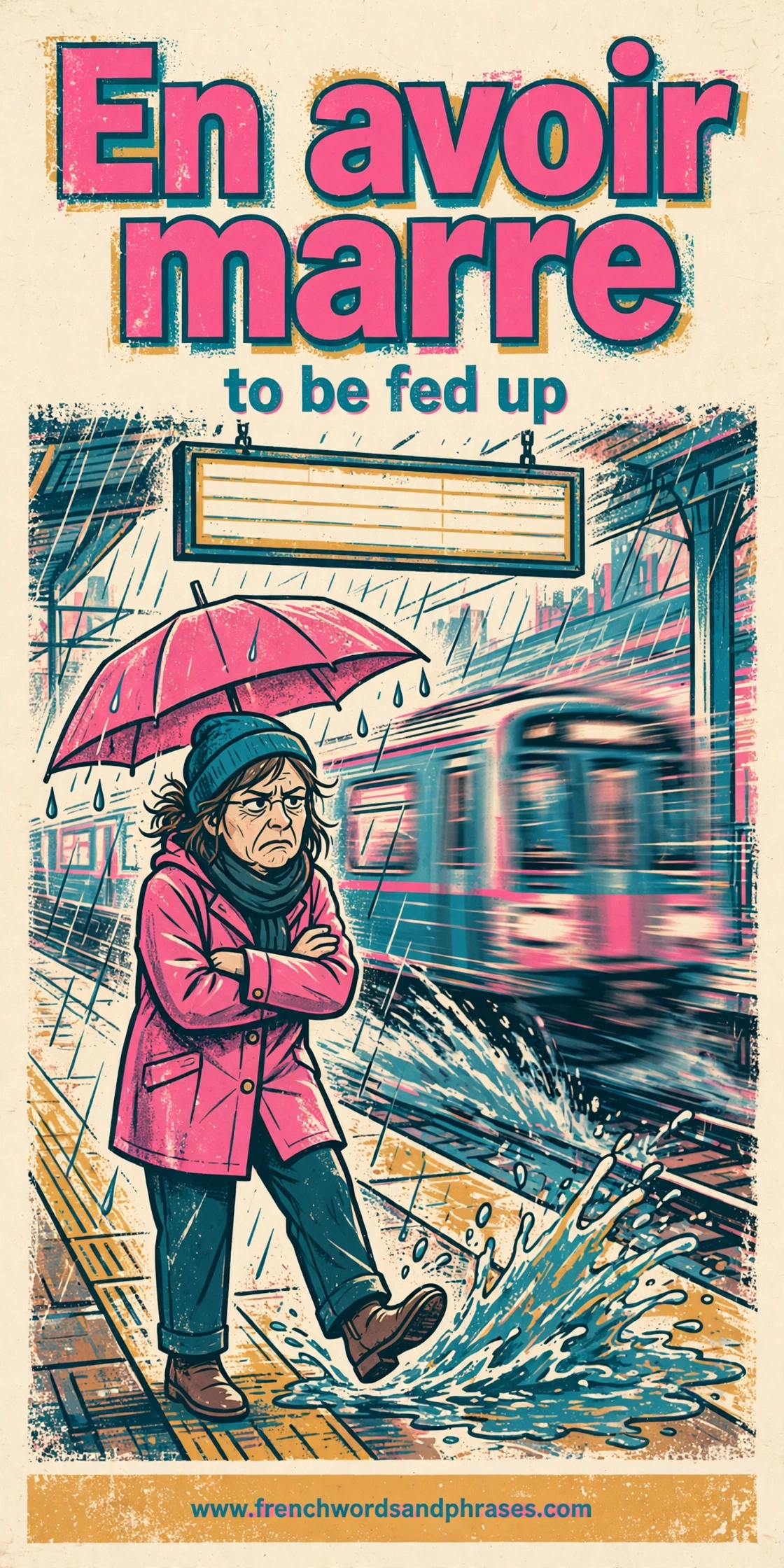
En avoir marre means to be fed up.
The train to Paris is cancelled for the third time this week. On the platform, a woman looks at the departure board, sighs, shakes her head and says the words half of France says every single day: « J’en ai marre ! »
Let’s explore how en avoir marre works in French, beginning with the whole phrase on one card.
Understanding the French Phrase En avoir marre
En avoir marre is a French idiom — a fixed verb phrase built on avoir (to have), the little word en (of it) and marre, an old slang word for ‘enough’. It is the classic French way to say you have had enough of something and your patience is gone.
It means to be fed up — fed up with a situation, a noise, a person, the weather, anything that has gone on too long. English says ‘I’ve had it up to here’ or ‘I’m sick of this’; French reaches for j’en ai marre, and everyone around you understands instantly.
Type: Idiom — verb phrase (en + avoir + marre)
Answers the need: Saying you have had enough of something or someone
Register: Informal, everyday spoken French — fine with friends, family and close colleagues; keep it out of formal writing
Strength: Strong — real exasperation, not mild annoyance
One important grammar detail: the little word en is not optional decoration. It means ‘of it’ and points back at the thing you are fed up with, so the full idiom is j’en ai marre — drop the en and the phrase falls apart. To name the cause, add de: j’en ai marre de ce bruit, j’en ai marre d’attendre.
Experience the Word
En avoir marre is the sound of patience running out — at the station, in the traffic jam, in front of the broken washing machine.
Imagine a father mending the same leaking tap for the fourth time in a month. The wrench slips, the water sprays, and he laughs the laugh of a man with nothing left: « J’en ai marre de ce robinet ! » The tap has won. He knows it. The whole kitchen knows it.
French keeps a whole shelf of fed-up phrases, but this is the one on everyone’s lips. Three small words — en, avoir, marre — and a whole day of frustration fits inside them.
How to Use En avoir marre in French: Complete Guide
Let’s explore how en avoir marre works in French, beginning with the whole phrase on one card.
En avoir marre at a Glance
The Whole Phrase on One Card
Real meaning, literal building blocks, English twin and register — en avoir marre in five lines.
| Point | En avoir marre |
|---|---|
| What it really means | to be fed up — to have had more than enough of something |
| Word for word | to have enough of it (en = of it, marre = fed up, enough) |
| English equivalent | to be fed up / I’ve had it up to here / I’m sick of it |
| Register | informal — everyday speech, not formal writing |
| Use it for | the moment patience runs out — delays, noise, weather, people |
Example
J’en ai marre de ce retard !
I’m fed up with this delay!
Word by Word: Building the Sigh
Three pieces — take them one by one and the frustration builds itself.
| Word | Literal meaning | Its job in the phrase |
|---|---|---|
| en | of it, about it | the small pronoun that points at the thing you are fed up with — it is essential, never drop it |
| avoir | to have | the engine of the phrase — conjugated for the person: j’en ai, tu en as, on en a |
| marre | fed up, enough | the slang heart of the idiom — it never changes form, whatever the subject |
Example
On en a marre, nous aussi.
We’re fed up too.
Quick Quiz 1
Which word in j’en ai marre means ‘of it’ — and can you drop it?
Reveal the answer
En means ‘of it’, and no — you cannot drop it. The idiom is j’en ai marre, never just j’ai marre.
J’en ai marre de la pluie.
I’m fed up with the rain.
When You Say It: Patience Running Out
En avoir marre belongs to the moment something has gone on too long — the situation chooses the words.
| Situation | Example |
|---|---|
| Endless delays | j’en ai marre d’attendre ce bus — I’m fed up with waiting for this bus |
| Noise that won’t stop | j’en ai marre du bruit des voisins — I’m fed up with the neighbours’ noise |
| Bad weather again | j’en ai marre de cet hiver — I’m fed up with this winter |
| Work overload | j’en ai marre de ces réunions — I’m fed up with these meetings |
| Speaking for everyone | on en a tous marre — we’re all fed up |
Example
J’en ai marre, ce train a encore une heure de retard.
I’m fed up, this train is an hour late again.
Make It Yours: Fed Up in Every Form
The idiom bends to fit the person, the cause and the tense — en stays, avoir moves, marre never changes.
| Form | French | In English |
|---|---|---|
| Naming the cause | j’en ai marre de ce bruit | I’m fed up with this noise |
| With an infinitive | j’en ai marre de répéter | I’m fed up with repeating myself |
| Asking someone | tu en as marre, toi aussi ? | are you fed up too? |
| In the past | j’en ai eu marre et je suis parti | I got fed up and I left |
| Everyone together | on en a marre ! | we’ve had enough! |
| Softening it | j’en ai un peu marre | I’m a bit fed up |
Example
Elle en a eu marre et elle a changé de travail.
She got fed up and changed jobs.
Quick Quiz 2
How do you say ‘I’m fed up with waiting’?
Reveal the answer
J’en ai marre d’attendre — name the cause with de plus an infinitive.
J’en ai marre d’attendre sous la pluie.
I’m fed up with waiting in the rain.
Everyday Expressions: Building on the Sigh
En avoir marre slots into these everyday frames — each one ready to use as it stands.
| Frame | In English |
|---|---|
| j’en ai marre de + nom | I’m fed up with + noun |
| j’en ai marre de + infinitif | I’m fed up with doing… |
| j’en ai marre, ça suffit ! | I’ve had enough, that’s enough! |
| on en a marre de tout | we’re fed up with everything |
| j’en ai vraiment marre | I’m really fed up |
Example
J’en ai marre de tout, je pars en vacances.
I’m fed up with everything, I’m going on holiday.
Close Cousins: The Fed-Up Family
French has a whole shelf of fed-up phrases — en avoir marre is the classic; its cousins turn the volume up or down.
| Expression | The difference |
|---|---|
| en avoir marre | the classic — strong, informal, the one everyone uses |
| en avoir ras le bol | even stronger — the bowl is full to the brim; same family, more exasperation |
| en avoir assez | neutral — ‘I’ve had enough’, safe in careful speech and writing |
| en avoir plein le dos | very informal — literally ‘to have your back full of it’, utterly sick of something |
| ça suffit | that’s enough — a stop sign, often said to children or noise |
Example
J’en ai assez de tes excuses.
I’ve had enough of your excuses.
Quick Quiz 3
You are writing a polite email to your landlord. J’en ai marre or j’en ai assez?
Reveal the answer
J’en ai assez — it is the neutral cousin. En avoir marre is for speech among people you know.
J’en ai assez de ce problème de chauffage.
I’ve had enough of this heating problem.
En avoir marre and Its Neighbours
The patience shelf around en avoir marre — putting up with things, and the moment you stop.
| French | In English |
|---|---|
| supporter | to put up with, to bear |
| en avoir assez | to have had enough (neutral) |
| craquer | to crack, to snap — the moment patience breaks |
| ras-le-bol | the fed-up feeling itself (a noun: le ras-le-bol des usagers) |
| patience | patience — the opposite pole |
| tenir bon | to hold on, to hang in there |
Example
Je ne supporte plus ce bruit, j’en ai marre.
I can’t stand this noise any more, I’m fed up.
Watch Out: The Traps Around En avoir marre
The traps: the little word en, the word that never changes, and a pond hiding in the spelling.
| Trap | The truth |
|---|---|
| dropping the en | j’en ai marre is the idiom — j’ai marre on its own is broken French |
| changing marre | marre is invariable — never marres, whatever the subject or number |
| confusing marre and mare | une mare is a pond; marre with two r’s is the fed-up word — spelling changes everything |
| using it in formal writing | it is spoken and informal — in a formal letter, choose en avoir assez |
Example
Les enfants en ont marre de la mare ? Non — ils en ont marre de l’école !
Are the children fed up with the pond? No — they’re fed up with school!
Quick Quiz 4
True or false: in nous en avons marre, the word marre takes an s because the subject is plural.
Reveal the answer
False — marre never changes. Only avoir conjugates.
Nous en avons marre de ce chantier.
We’re fed up with this building site.
En avoir marre in Everyday French: Real-Life Examples
Now that you know the word, let’s see how en avoir marre appears in everyday French.
Example 1 — The cancelled train
J’en ai marre, le train est encore annulé.
I’m fed up, the train is cancelled again.
Example 2 — Noisy neighbours
J’en ai marre de la musique des voisins.
I’m fed up with the neighbours’ music.
Example 3 — Endless rain
J’en ai marre de la pluie, je veux du soleil.
I’m fed up with the rain, I want some sun.
Example 4 — Paperwork
J’en ai marre de tous ces formulaires.
I’m fed up with all these forms.
Example 5 — The broken car
J’en ai marre de cette voiture, elle tombe toujours en panne.
I’m fed up with this car, it keeps breaking down.
Example 6 — Speaking for the team
On en a marre de ces horaires impossibles.
We’re fed up with these impossible hours.
Beyond Translation: The Meaning of En avoir marre
Every language needs a safety valve, and j’en ai marre is one of France’s favourites. It is said with a sigh, a shrug, sometimes a laugh — it lets the frustration out before it boils over, and it invites the people around you to sigh along. Half the platform says it with you.
To say j’en ai marre is to open the valve — and to find you are not the only one who needed to.
That is why the phrase lives at stations, in traffic jams and in kitchens: wherever patience is a shared, daily exercise.
How to Remember the French Phrase En avoir marre
Remember it this way: En avoir marre is the full sigh in three words — en points at the problem, avoir carries it, marre says ‘enough’.
- You keep the en — it means ‘of it’, and the idiom collapses without it.
- You never change marre — one form for everyone, always.
- You add de to name the cause — marre de la pluie, marre d’attendre.
The key idea is en avoir marre means to be fed up — en is essential and marre never changes.
Test Your Knowledge of En avoir marre
Let’s see how much you’ve learned. Try answering these questions before revealing the answers.
Question 1
What does j’en ai marre mean?
Reveal the answer
I’m fed up — I have had more than enough of something.
Question 2
Which small word must never be dropped from the idiom, and what does it mean?
Reveal the answer
En — it means ‘of it’ and points at the thing you are fed up with.
Question 3
How do you name the cause of your frustration?
Reveal the answer
With de — j’en ai marre de ce bruit, j’en ai marre d’attendre.
Question 4
Translate: We’re all fed up with these delays.
Reveal the answer
On en a tous marre de ces retards.
Question 5
Complete the sentence:
Elle en a ______ marre et elle est partie. (She got fed up and left.)
Reveal the answer
eu
Elle en a eu marre et elle est partie.
She got fed up and left.
Your Final Challenge
Can You Use It?
How would you say this in French?
“I’m fed up with this noise!”
Reveal the answer
J’en ai marre de ce bruit !
I’m fed up with this noise!
A little French. A little curiosity. A richer everyday life.
LEARN FRENCH ONE WORD AT A TIME