A French Word to Live By
Translate Prendre la tête to English
/pʁɑ̃dʁ la tɛt/
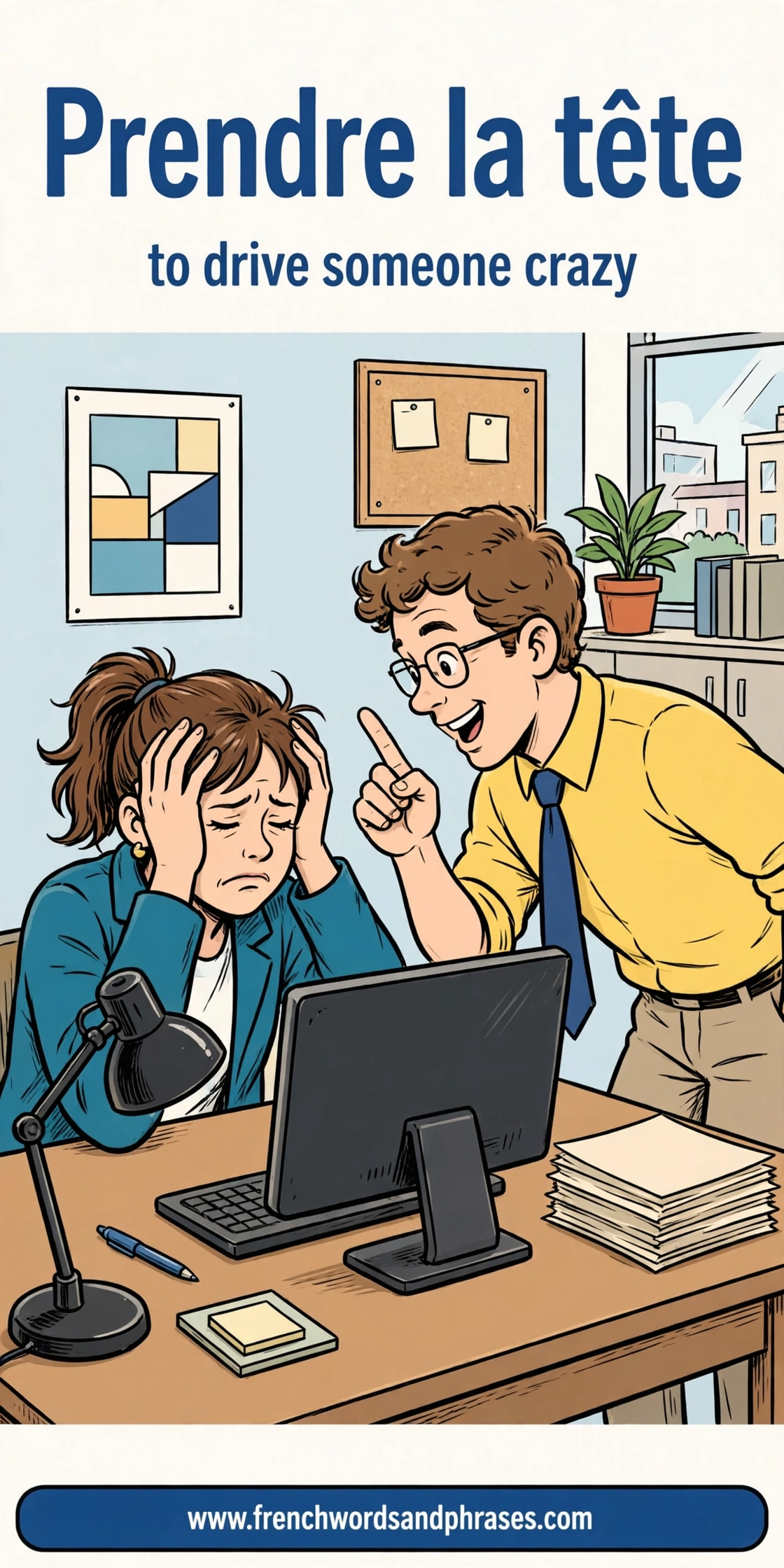
Prendre la tête means to bother someone — to give someone a headache, to drive someone crazy.
The printer has jammed for the third time, the form needs a code nobody knows, and your colleague has been on hold with the helpline for twenty minutes. She hangs up, rubs her forehead, and sums up the whole morning in four words: « Ça me prend la tête. »
Let’s explore how prendre la tête works in French, beginning with the whole phrase on one card.
Understanding the French Phrase Prendre la tête
Prendre la tête is a French idiomatic expression built from prendre (to take) and la tête (the head). Used of a person or a thing, it means something gets into your head and stays there — bothering you, winding you up, doing your head in. Turned reflexive, se prendre la tête, it means to overthink and tie yourself in knots.
It means to bother someone, to give them a headache, to drive them crazy — not with pain, but with sheer mental noise. A form, a neighbour, a problem that will not leave you alone: it takes your head and will not give it back. And when you do it to yourself — je me prends la tête — you are the one who will not let go.
Type: Idiomatic expression — annoyance (verb + body part)
Answers the need: Saying something is doing your head in — or that you are overthinking it
Register: Informal — everyday speech; too slangy for formal writing
Strength: Strong — real irritation, or real mental knots
One important usage detail: the little word se changes everything. Ça me prend la tête — it is doing my head in; the thing is the problem. Je me prends la tête — I am overthinking it; I am the problem. And the friendly rescue is the negative command: ne te prends pas la tête, don’t tie yourself in knots, don’t worry about it.
Experience the Word
Prendre la tête is the sound of a mind with no off switch — the form, the neighbour, the worry, all still talking at midnight.
Imagine the student the night before the results, refreshing the page, re-reading the questions, inventing disasters. Her brother looks up from his book and gives her the whole of French wisdom in six words: ne te prends pas la tête. She breathes. The head, slowly, is handed back.
French locates irritation precisely. Not the heart, not the nerves — the head, where the noise is.
How to Use Prendre la tête in French: Complete Guide
Let’s explore how prendre la tête works in French, beginning with the whole phrase on one card.
Prendre la tête at a Glance
The Whole Phrase on One Card
Real meaning, literal picture, English twin and register — prendre la tête in five lines.
| Point | Prendre la tête |
|---|---|
| What it really means | to do your head in — to bother, to wind up, to drive crazy |
| Word for word | to take the head |
| English equivalent | to do someone’s head in / to drive someone up the wall |
| Register | informal — everyday speech, a shade slangy |
| Use it for | paperwork, noise, nagging problems — and your own overthinking |
Example
Ce bruit me prend la tête depuis ce matin.
This noise has been doing my head in since this morning.
Word by Word: Building the Noise
Three small pieces — take them one by one and the grip on the head appears.
| Word | Literal meaning | Its job in the phrase |
|---|---|---|
| prendre | to take | the grip of the phrase — something seizes your head and holds on |
| la | the | your head, the one and only |
| tête | the head | where the noise happens — the seat of the irritation |
Example
Ce formulaire me prend la tête.
This form is doing my head in.
Quick Quiz 1
What changes between ça me prend la tête and je me prends la tête?
Reveal the answer
The culprit — without se, the thing is doing your head in; with se, you are overthinking it yourself.
Je me prends la tête pour un rien.
I tie myself in knots over nothing.
When You Say It: The Head-Taking Moments
Prendre la tête fires at moments like these — the noise will not stop, or you will not stop it.
| Situation | Example |
|---|---|
| Paperwork | ce formulaire me prend la tête — this form is doing my head in |
| A noisy neighbour | le voisin et sa perceuse me prennent la tête — the neighbour and his drill are driving me crazy |
| A non-stop talker | il me prend la tête avec ses histoires — he does my head in with his stories |
| Overthinking a decision | je me prends la tête pour choisir — I’m tying myself in knots choosing |
| A couple’s row | ils se sont pris la tête pour la voiture — they had a row over the car |
Example
Ils se sont pris la tête pour une histoire d’argent.
They had a row over a money matter.
Make It Yours: With and Without the Se
Two phrases in one coat — the se decides whether the world is annoying you or you are annoying yourself.
| Form | French | In English |
|---|---|---|
| It does my head in | ça me prend la tête | it’s doing my head in |
| He winds me up | il me prend la tête | he’s driving me crazy |
| I’m overthinking | je me prends la tête | I’m tying myself in knots |
| Don’t stress | ne te prends pas la tête | don’t get worked up about it |
| A row with someone | se prendre la tête avec quelqu’un | to have an argument with someone |
| Past | ce dossier m’a pris la tête | that file did my head in |
Example
Ne te prends pas la tête, on va trouver une solution.
Don’t get worked up, we’ll find a solution.
Quick Quiz 2
A friend is panicking over a small decision. Which do you say — ça te prend la tête or ne te prends pas la tête?
Reveal the answer
Ne te prends pas la tête — the kind command: don’t tie yourself in knots over it.
Ne te prends pas la tête, ce n’est pas grave.
Don’t get worked up, it’s not serious.
Everyday Expressions: Building on the Head
Prendre la tête slots into these everyday frames — each one ready to use as it stands.
| Frame | In English |
|---|---|
| ça me prend la tête | it’s doing my head in |
| se prendre la tête pour un rien | to tie yourself in knots over nothing |
| ne te prends pas la tête | don’t stress, don’t overthink it |
| prendre la tête à quelqu’un | to do someone’s head in |
| se prendre la tête avec quelqu’un | to have a row with someone |
Example
Elle se prend la tête pour un rien, c’est dommage.
She ties herself in knots over nothing, it’s a shame.
Close Cousins: The Other Irritations
French has a whole shelf of annoyance phrases — prendre la tête is the head one; its cousins work the feet, the nerves, or the plain verb.
| Expression | The difference |
|---|---|
| prendre la tête | to do your head in — the noise inside the skull |
| casser les pieds à quelqu’un | to annoy someone, to get on their nerves — the feet to our head, equally informal |
| taper sur les nerfs | to get on someone’s nerves — the nerves version, vivid and everyday |
| énerver | to annoy, to irritate — the plain verb, at home in every register |
| se compliquer la vie | to complicate your own life — the overthinking cousin, self-inflicted |
Example
Son frère lui casse les pieds et lui tape sur les nerfs.
Her brother annoys her and gets on her nerves.
Quick Quiz 3
Which cousin is the neutral verb you could use in any company — casser les pieds or énerver?
Reveal the answer
Énerver — the plain verb for annoying; casser les pieds is an idiom of conversation.
Ce retard m’énerve profondément.
This delay annoys me deeply.
Prendre la tête and Its Neighbours
The head shelf around the phrase — headaches real and figurative, and the calm opposite.
| French | In English |
|---|---|
| un casse-tête | a headache of a problem, a brain-teaser — literally a head-breaker |
| mal à la tête | a real headache — the body’s version |
| perdre la tête | to lose your head — panic, or love; a different disaster |
| prendre la tête | to do your head in |
| garder la tête froide | to keep a cool head — the calm opposite |
| réfléchir | to think — what stops being useful when it prend la tête |
Example
Ce casse-tête m’a pris la tête toute la soirée.
That brain-teaser did my head in all evening.
Watch Out: The Traps Around Prendre la tête
The traps: a sports page surprise, a se that flips the blame, and a headache that is not this phrase.
| Trap | The truth |
|---|---|
| the sports trap | on a sports page, prendre la tête means to take the lead — le cycliste a pris la tête de la course; no headache involved |
| the se that flips it | ça me prend la tête blames the thing; je me prends la tête blames my own overthinking — dropping the se changes the culprit |
| not a medical phrase | for a real headache, French says j’ai mal à la tête — prendre la tête is mental noise, not pain |
| losing is different | perdre la tête is to lose your mind or your self-control — one step beyond having it taken |
Example
Le coureur français a pris la tête de la course au dernier tour.
The French rider took the lead of the race on the last lap.
Quick Quiz 4
A headline reads: elle prend la tête du classement. Is her head hurting?
Reveal the answer
No — in sport, prendre la tête means to take the lead: she has gone top of the rankings.
Après cette victoire, elle prend la tête du classement.
After this victory, she goes top of the rankings.
Prendre la tête in Everyday French: Real-Life Examples
Now that you know the word, let’s see how prendre la tête appears in everyday French.
Example 1 — The form
Ce formulaire me prend la tête depuis une heure.
This form has been doing my head in for an hour.
Example 2 — The drill
Le voisin me prend la tête avec sa perceuse.
The neighbour is driving me crazy with his drill.
Example 3 — Overthinking
Je me prends la tête pour choisir un cadeau.
I’m tying myself in knots choosing a present.
Example 4 — The kind command
Ne te prends pas la tête, ce n’est pas grave.
Don’t get worked up, it’s not serious.
Example 5 — The row
Ils se sont pris la tête pour une place de parking.
They had a row over a parking space.
Example 6 — The talker
Il me prend la tête avec ses histoires de bureau.
He does my head in with his office stories.
Beyond Translation: The Meaning of Prendre la tête
English does your head in too — the two languages, for once, share the address of irritation exactly. But French adds the reflexive twist English cannot copy in one breath: se prendre la tête, the head taken by its own owner, worrying as a solo sport.
To prendre la tête is to lose your head to noise; to se prendre la tête is to make the noise yourself.
And the rescue is built into the phrase — ne te prends pas la tête may be the most useful sentence in spoken French.
How to Remember the French Phrase Prendre la tête
Remember it this way: Prendre la tête is the head seized by noise — and the little se decides whether the world did it, or you did.
- You picture the grip — prendre is to take, and irritation takes the whole head and holds on.
- You check for the se — ça me prend la tête blames the thing; je me prends la tête blames the overthinking.
- You keep the rescue ready — ne te prends pas la tête: don’t tie yourself in knots.
The key idea is prendre la tête means to do your head in — and se prendre la tête is to overthink it yourself.
Test Your Knowledge of Prendre la tête
Let’s see how much you’ve learned. Try answering these questions before revealing the answers.
Question 1
What does prendre la tête mean?
Reveal the answer
To do someone’s head in — to bother them, wind them up, drive them crazy with mental noise.
Question 2
What does se prendre la tête add?
Reveal the answer
The reflexive turns it inward — je me prends la tête means I am overthinking, tying myself in knots.
Question 3
How do you tell a friend ‘don’t stress about it’?
Reveal the answer
Ne te prends pas la tête — literally, don’t take your head over it.
Question 4
On a sports page, what does prendre la tête mean?
Reveal the answer
To take the lead — prendre la tête de la course is to go in front, with no headache anywhere.
Question 5
Complete the sentence:
Ce bruit me ______ la tête. (This noise is doing my head in.)
Reveal the answer
prend
Ce bruit me prend la tête.
This noise is doing my head in.
Your Final Challenge
Can You Use It?
How would you say this in French?
“This form is doing my head in.”
Reveal the answer
Ce formulaire me prend la tête.
This form is doing my head in.
A little French. A little curiosity. A richer everyday life.
LEARN FRENCH ONE WORD AT A TIME