A French Word to Live By
Translate Avoir du pain sur la planche to English
/a.vwaʁ dy pɛ̃ syʁ la plɑ̃ʃ/
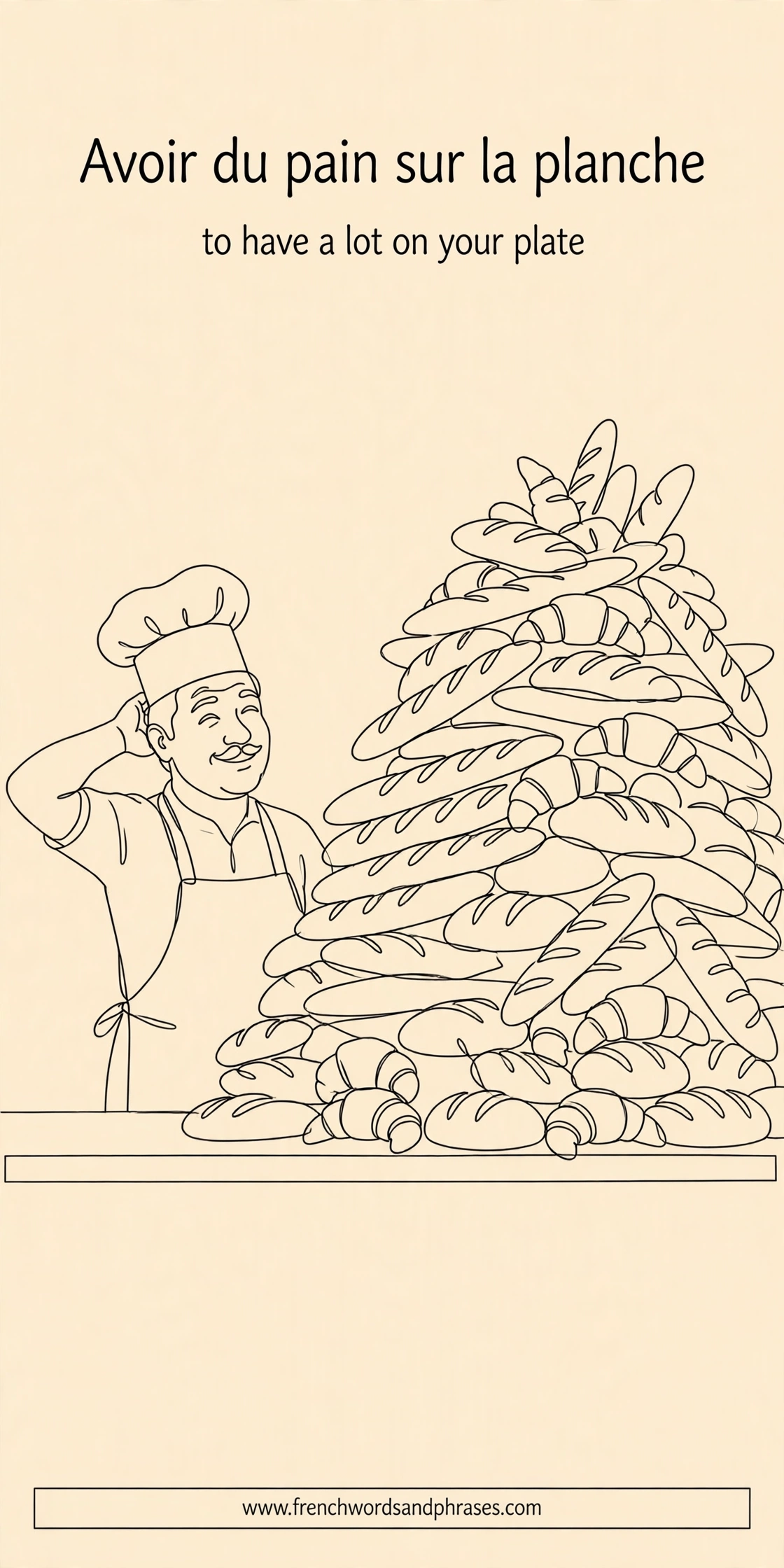
Avoir du pain sur la planche means to have a lot on your plate, a lot to do.
It is Monday morning in a small bakery office in Bordeaux. The owner opens her notebook: three weddings to cater, a broken oven, two staff on holiday and a mountain of invoices. She laughs, rolls up her sleeves and says: « On a du pain sur la planche ! »
Let’s explore how avoir du pain sur la planche works in French, beginning with the whole phrase on one card.
Understanding the French Phrase Avoir du pain sur la planche
Avoir du pain sur la planche is a French idiom — literally ‘to have bread on the board’, from the baker’s workbench where loaves waited to be shaped and baked. Every loaf on the board is a job waiting to be done, and the phrase has meant a full workload ever since.
It means to have a lot on your plate — a lot of work waiting, more than enough to keep you busy. English piles the work onto a plate; French lays it out as bread on the baker’s board. The tone is cheerful rather than complaining: the board is full, so let’s get started.
Type: Idiom — verb phrase (avoir + du pain + sur la planche)
Answers the need: Saying you have a lot of work or many tasks ahead
Register: Neutral to informal — at home in the office, the workshop and the kitchen alike
Strength: Everyday — busy and well loaded, not a cry of despair
One important usage detail: the article is fixed. It is du pain sur la planche — some bread on the board — with la planche, the board. You cannot swap in une planche or change pain for another food; the picture is set, and French speakers keep it exactly as it is.
Experience the Word
Avoir du pain sur la planche turns a to-do list into a bakery at dawn — everything laid out, everything waiting for your hands.
Imagine a teacher in September: thirty new names to learn, a classroom to decorate, parents to meet, lessons to plan. She looks at the pile, smiles, and gets to work. The board is full — but bakers are not afraid of bread.
French loves to hide work inside food. A full board means a full day, and a full day, in this phrase, is something to roll up your sleeves for.
How to Use Avoir du pain sur la planche in French: Complete Guide
Let’s explore how avoir du pain sur la planche works in French, beginning with the whole phrase on one card.
Avoir du pain sur la planche at a Glance
The Whole Phrase on One Card
Real meaning, literal building blocks, English twin and register — avoir du pain sur la planche in five lines.
| Point | Avoir du pain sur la planche |
|---|---|
| What it really means | to have a lot on your plate — plenty of work waiting to be done |
| Word for word | to have bread on the board (the baker’s workbench) |
| English equivalent | to have a lot on your plate / to have your work cut out for you |
| Register | neutral to informal — safe almost everywhere |
| Use it for | busy weeks, big projects, long lists — with a smile, not a groan |
Example
On a du pain sur la planche cette semaine.
We’ve got a lot on our plate this week.
Word by Word: Building the Bakery
Five pieces — take them one by one and the busy morning builds itself.
| Word | Literal meaning | Its job in the phrase |
|---|---|---|
| avoir | to have | the engine — conjugated for the person: j’ai, tu as, on a |
| du pain | some bread | the work itself, pictured as loaves waiting on the board |
| sur | on | the little word that lays the bread out in front of you |
| la planche | the board | the baker’s workbench — where every waiting job sits in a row |
Example
J’ai du pain sur la planche aujourd’hui.
I’ve got a lot on my plate today.
Quick Quiz 1
In the literal picture, where is the bread — and what does each loaf stand for?
Reveal the answer
On the baker’s board (la planche) — and each loaf is a job waiting to be done.
Regarde ma liste : j’ai du pain sur la planche.
Look at my list: I’ve got a lot on my plate.
When You Say It: The Full Board
Avoir du pain sur la planche belongs to busy starts — the moment you look at everything waiting and begin.
| Situation | Example |
|---|---|
| A busy week ahead | on a du pain sur la planche cette semaine — we’ve got a lot on our plate this week |
| A big project starts | le chantier commence demain, on a du pain sur la planche — the work starts tomorrow, we’ve got plenty to do |
| Before an exam period | les étudiants ont du pain sur la planche — the students have a lot on their plates |
| Moving house | entre les cartons et les meubles, on a du pain sur la planche — between the boxes and the furniture, we’ve got our work cut out |
| Encouraging the team | allez, on a du pain sur la planche, au travail ! — come on, we’ve got a lot to do, let’s get to work! |
Example
Après les vacances, j’ai toujours du pain sur la planche.
After the holidays, I’ve always got a lot on my plate.
Make It Yours: Loading Every Board
The phrase bends to fit the person and the tense — the bread and the board never change.
| Form | French | In English |
|---|---|---|
| Talking about yourself | j’ai du pain sur la planche | I’ve got a lot on my plate |
| Asking someone | tu as du pain sur la planche ? | have you got a lot on? |
| In the past | on avait du pain sur la planche | we had a lot on our plate |
| In the future | demain, on aura du pain sur la planche | tomorrow we’ll have a lot on our plate |
| Still more of it | j’ai encore du pain sur la planche | I’ve still got a lot to do |
| Good news at the end | on n’a plus de pain sur la planche | we’ve got nothing left on our plate |
Example
Courage, on aura du pain sur la planche demain.
Stay strong, we’ll have a lot on our plate tomorrow.
Quick Quiz 2
How do you say ‘We had a lot on our plate’?
Reveal the answer
On avait du pain sur la planche — only avoir changes tense; the bread stays put.
La semaine dernière, on avait du pain sur la planche.
Last week, we had a lot on our plate.
Everyday Expressions: Building on the Board
Avoir du pain sur la planche slots into these everyday frames — each one ready to use as it stands.
| Frame | In English |
|---|---|
| avoir du pain sur la planche | to have a lot on your plate |
| avoir encore du pain sur la planche | to still have a lot to do |
| donner du pain sur la planche à quelqu’un | to give someone plenty to do |
| il y a du pain sur la planche | there’s a lot to do |
| au boulot, il y a du pain sur la planche ! | to work — there’s plenty to do! |
Example
Ce projet va nous donner du pain sur la planche.
This project is going to give us plenty to do.
Close Cousins: The Busy Family
French has stronger and weaker ways to be busy — avoir du pain sur la planche is the cheerful middle.
| Expression | The difference |
|---|---|
| avoir du pain sur la planche | a lot to do — busy, but coping, and said with a smile |
| être débordé | overwhelmed — the work is spilling over the edges |
| avoir du travail par-dessus la tête | work up to over your head — much stronger, close to drowning in it |
| ne pas savoir où donner de la tête | not knowing where to start — too many demands at once |
| avoir mille choses à faire | to have a thousand things to do — plain and literal |
Example
Je ne suis pas débordé, j’ai juste du pain sur la planche.
I’m not overwhelmed, I’ve just got a lot on my plate.
Quick Quiz 3
Your colleague is drowning in work and close to tears. Is avoir du pain sur la planche strong enough?
Reveal the answer
Not quite — that phrase is cheerful. For drowning, French says être débordé.
Elle est complètement débordée en ce moment.
She’s completely overwhelmed at the moment.
Avoir du pain sur la planche and Its Neighbours
The bread shelf around the phrase — French hides half its work words in the bakery.
| French | In English |
|---|---|
| mettre la main à la pâte | to pitch in, to lend a hand (literally: to put your hand in the dough) |
| gagner son pain | to earn your bread — to make a living |
| long comme un jour sans pain | endless (literally: as long as a day without bread) |
| le pain quotidien | daily bread — the everyday routine |
| être au four et au moulin | to be in two places at once (oven and mill — the baker again) |
| se reposer | to rest — the empty board at last |
Example
Allez, tout le monde met la main à la pâte !
Come on, everyone pitch in!
Watch Out: The Traps Around Avoir du pain sur la planche
The traps: the fixed articles, and a board that is not a shelf.
| Trap | The truth |
|---|---|
| changing the articles | it is du pain and la planche, always — the picture is fixed |
| translating planche as ‘shelf’ or ‘plate’ | la planche is the baker’s board or workbench — and English’s ‘plate’ version is a different picture altogether |
| hearing despair in it | the tone is willing, not overwhelmed — for real overload, French switches to être débordé |
| using it for one tiny task | the board holds a load of work — one small job is not pain sur la planche |
Example
Un seul email à écrire ? Ce n’est pas du pain sur la planche !
One email to write? That’s hardly a lot on your plate!
Quick Quiz 4
True or false: avoir du pain sur la planche means you are overwhelmed and can’t cope.
Reveal the answer
False — it means busy with plenty to do, said cheerfully. Overwhelmed is être débordé.
On a du pain sur la planche, mais on va y arriver.
We’ve got a lot on our plate, but we’ll get there.
Avoir du pain sur la planche in Everyday French: Real-Life Examples
Now that you know the word, let’s see how avoir du pain sur la planche appears in everyday French.
Example 1 — Monday morning
Bon, on a du pain sur la planche aujourd’hui.
Right, we’ve got a lot on our plate today.
Example 2 — The new house
Entre la peinture et le jardin, on a du pain sur la planche.
Between the painting and the garden, we’ve got plenty to do.
Example 3 — Exam season
Les professeurs ont du pain sur la planche avec toutes ces copies.
The teachers have a lot on their plates with all those papers to mark.
Example 4 — At the garage
Le mécanicien a du pain sur la planche, la voiture ne sera pas prête avant vendredi.
The mechanic has a lot on, the car won’t be ready before Friday.
Example 5 — The wedding list
La robe, le gâteau, les fleurs — on a du pain sur la planche !
The dress, the cake, the flowers — we’ve got a lot on our plate!
Example 6 — End of the tunnel
Encore un peu de pain sur la planche, et c’est fini.
A little more work to go, and it’s done.
Beyond Translation: The Meaning of Avoir du pain sur la planche
The phrase carries the smell of a bakery at five in the morning: flour in the air, the board covered with loaves, the day’s work visible at a glance. French took its busiest idiom from the trade that starts earliest and feeds everyone — work, in this picture, is not a burden dropped on you but bread laid out for your hands.
To have bread on the board is to have work that matters — work that will feed someone by the end of the day.
That is why the phrase is said with energy rather than complaint: the board is full, the oven is hot, let’s begin.
How to Remember the French Phrase Avoir du pain sur la planche
Remember it this way: Avoir du pain sur la planche is the baker’s morning in one picture — every loaf on the board is a job waiting for your hands.
- You picture the board — la planche, the baker’s workbench, covered with loaves.
- You keep the articles fixed — du pain, la planche, never anything else.
- You say it with a smile — it means busy, not beaten; beaten is être débordé.
The key idea is avoir du pain sur la planche means to have a lot on your plate — a full board of work, faced cheerfully.
Test Your Knowledge of Avoir du pain sur la planche
Let’s see how much you’ve learned. Try answering these questions before revealing the answers.
Question 1
What does avoir du pain sur la planche mean?
Reveal the answer
To have a lot on your plate — to have plenty of work waiting to be done.
Question 2
What is la planche in the literal picture?
Reveal the answer
The baker’s board — the workbench where loaves wait to be shaped and baked.
Question 3
Which is stronger: avoir du pain sur la planche or être débordé?
Reveal the answer
Être débordé — that means overwhelmed. Pain sur la planche is busy but coping.
Question 4
Translate: We’ve got a lot on our plate this week.
Reveal the answer
On a du pain sur la planche cette semaine.
Question 5
Complete the sentence:
Demain, on ______ du pain sur la planche. (Tomorrow we’ll have a lot on our plate.)
Reveal the answer
aura
Demain, on aura du pain sur la planche.
Tomorrow we’ll have a lot on our plate.
Your Final Challenge
Can You Use It?
How would you say this in French?
“We’ve got a lot on our plate this week.”
Reveal the answer
On a du pain sur la planche cette semaine.
We’ve got a lot on our plate this week.
A little French. A little curiosity. A richer everyday life.
LEARN FRENCH ONE WORD AT A TIME