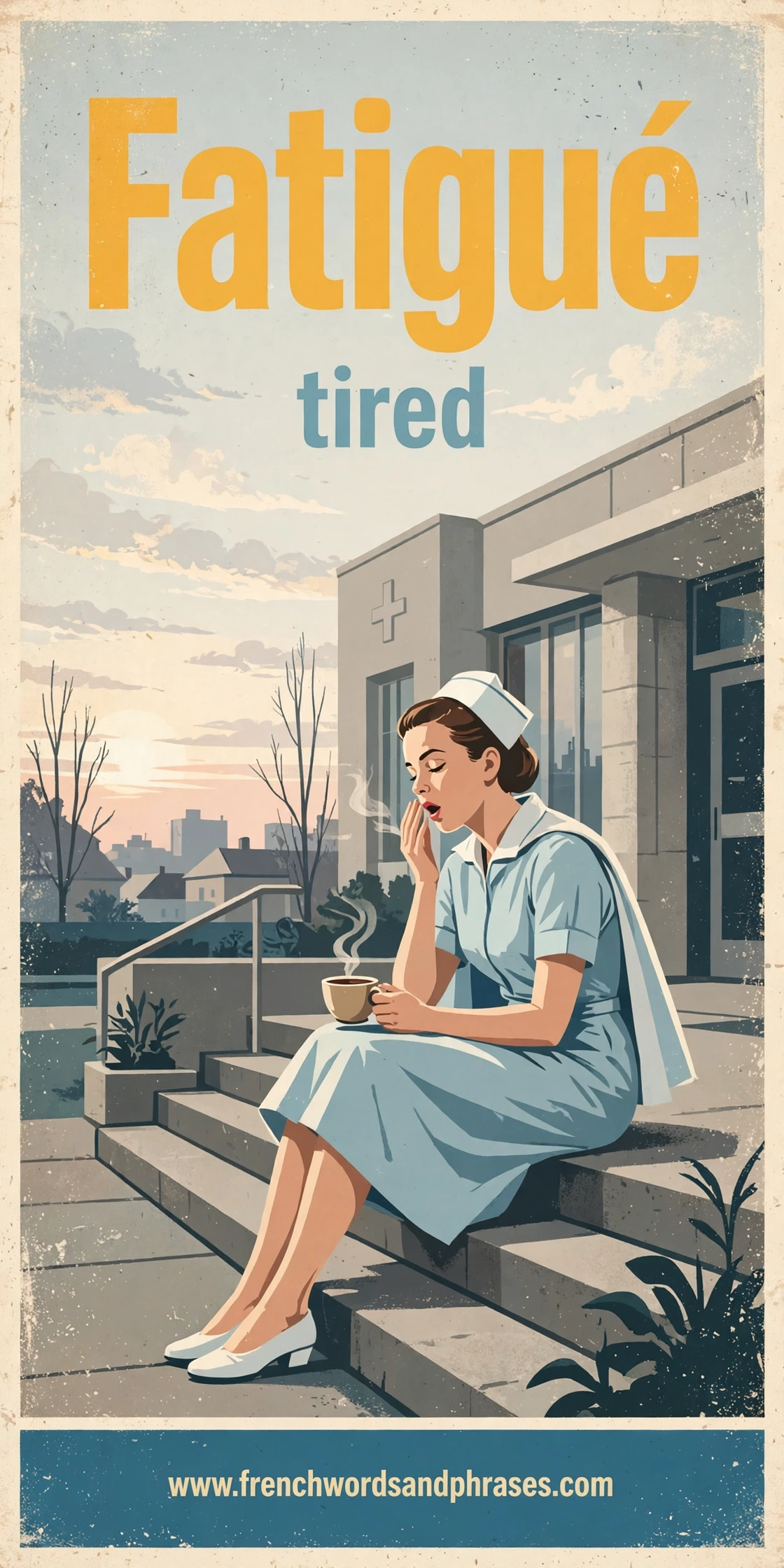
A French Word to Live By
Translate Fatigué to English
/fa.ti.ɡe/
Fatigué means tired.
The night train rolls into Marseille at dawn: doors sigh open, suitcases thump down, and a carriage of travellers blinks in the early light, ties loosened, children asleep on shoulders. Nobody needs to ask how they feel. They are fatigués.
In this guide, you’ll learn what fatigué means in English, why it is really a verb form in disguise, the crucial difference between fatigué and fatigant, and how fatigué de quietly means you’ve had enough. Explore French examples, English translations, and practice quizzes.
Understanding the French Adjective Fatigué
Fatigué is a French adjective of quality — and secretly a verb form: it is the past participle of fatiguer, to tire, working as an adjective. That is why it agrees the participle way, in four neat forms: fatigué, fatiguée, fatigués, fatiguées.
It means tired — the ordinary, end-of-the-day tired of travellers, bakers and parents: je suis fatigué, I’m tired. Followed by de and a verb it changes key: fatigué de marcher, tired of walking — no longer sleepy, just finished with the thing itself.
Type: Adjective of quality — tiredness (the past participle of fatiguer)
Answers the question: What is he like? — tired
Changes form: Yes — fatigué, fatiguée, fatigués, fatiguées, like a past participle
English equivalents: Tired; weary.
One important usage detail: fatigué describes the person who feels it — je suis fatigué. The thing that causes the feeling is fatigant: le voyage est fatigant, the journey is tiring. French keeps the feeler and the cause in two different words, and so must you.
Experience the Word
Fatigué is the adjective of the long day’s end — the honest word French reaches for when the body files its report.
Imagine the baker of this run’s earlier lesson at noon, ovens cooling, the last baguette sold. He unties his apron, sits on the step with a coffee, and says the sentence his whole morning has been walking towards: « je suis fatigué ». It is not a complaint. It is a receipt for work well done.
You have not just described a state. You have closed the day with its proper signature.
How to Use Fatigué in French: Complete Guide
Let’s explore how fatigué works in French, beginning with the whole word on one card.
Fatigué at a Glance
Before the details, here is the whole word on one card.
The Whole Word on One Card
Meaning, type, position and forms — fatigué in four lines.
| Point | Fatigué |
|---|---|
| Meaning | tired |
| Type | adjective of quality — the past participle of fatiguer |
| Usual position | after the noun — un voyageur fatigué |
| Form | fatigué / fatiguée / fatigués / fatiguées |
Example
Les voyageurs fatigués dorment dans le train.
The tired travellers are sleeping on the train.
The Four Forms of Fatigué
Fatigué agrees like the past participle it is: -é for a man, -ée for a woman, and an -s more whenever there are several.
| Form | Fatigué | Example |
|---|---|---|
| Masculine singular | fatigué | un homme fatigué — a tired man |
| Feminine singular | fatiguée | une femme fatiguée — a tired woman |
| Masculine plural | fatigués | des hommes fatigués — tired men |
| Feminine plural | fatiguées | des femmes fatiguées — tired women |
Example
Les voyageuses sont fatiguées après la nuit dans le train.
The travellers are tired after the night on the train.
Quick Quiz 1
Which form of fatigué goes with voyageuses (feminine plural) — fatigués or fatiguées?
Reveal the answer
fatiguées
Les voyageuses sont fatiguées.
The travellers are tired.
Where Fatigué Goes: After the Noun, and After Être
Fatigué follows the noun like most French adjectives, and its natural home is after être, often softened by un peu or très.
| Pattern | Example |
|---|---|
| noun + fatigué | un voyageur fatigué — a tired traveller |
| After être | je suis fatigué — I am tired |
| Softened or strengthened | un peu fatigué, très fatigué — a little tired, very tired |
| Before the noun | un fatigué voyageur — never; fatigué goes after |
Example
Après douze heures de route, nous sommes très fatigués.
After twelve hours on the road, we are very tired.
More Tired: Comparing with Fatigué
Fatigué compares the regular way, with plus, moins and aussi — and the superlative keeps the agreement: le plus fatigué, la plus fatiguée.
| Degree | Example |
|---|---|
| As tired as | aussi fatigué que — as tired as |
| More tired | plus fatigué — plus fatigué qu’hier |
| Less tired | moins fatigué — less tired |
| The most tired (masc.) | le plus fatigué — le plus fatigué de l’équipe |
| The most tired (fem.) | la plus fatiguée — la plus fatiguée des voyageuses |
Example
C’est elle la plus fatiguée, elle a conduit toute la nuit.
She’s the most tired, she drove all night.
Quick Quiz 2
Which is correct — le voyage est fatigué or le voyage est fatigant?
Reveal the answer
le voyage est fatigant — the journey is tiring; the traveller is fatigué. Things tire, people get tired.
Le voyage est fatigant, les voyageurs sont fatigués.
The journey is tiring, the travellers are tired.
Everyday Expressions with Fatigué
Fatigué turns up at every day’s end — in tired eyes, tired voices, and in the little phrase that means you’ve had enough.
| Expression | In English |
|---|---|
| être fatigué | to be tired |
| fatigué de + infinitive | tired of doing… — fatigué d’attendre |
| les yeux fatigués | tired eyes |
| une mine fatiguée | a tired look, a weary face |
| avoir l’air fatigué | to look tired |
| la fatigue | tiredness — the noun of the family |
Example
Tu as l’air fatigué, va te reposer.
You look tired, go and rest.
Fatigué and Its Neighbours
French owns a whole scale of tiredness. Fatigué is the everyday middle; its neighbours climb towards exhaustion or step back into rest.
| French | In English |
|---|---|
| épuisé | exhausted — stronger than fatigué |
| crevé | dead tired, shattered — informal |
| exténué | worn out — formal and dramatic |
| fatigant | tiring — the thing, not the person |
| reposée / reposé | rested — the opposite, after sleep |
| en forme | in good shape, full of energy — the fresh opposite |
Example
Après la course, il n’est pas seulement fatigué, il est épuisé.
After the race, he isn’t just tired, he’s exhausted.
Quick Quiz 3
What does fatigué d’attendre mean?
Reveal the answer
Tired of waiting — with de, fatigué stops meaning sleepy and starts meaning fed up.
Je suis fatigué d’attendre, on y va.
I’m tired of waiting, let’s go.
Fatigué at the End of the Day
Fatigué clocks off in every trade and every household. A tour of the places it hangs up its coat.
| Place | Example |
|---|---|
| After work | un boulanger fatigué à midi — a tired baker at noon |
| After a journey | des enfants fatigués à l’arrivée — tired children on arrival |
| After a party | des invités fatigués mais heureux — tired but happy guests |
| After sport | des joueurs fatigués après le match — tired players after the match |
Example
Les joueurs fatigués rentrent aux vestiaires en silence.
The tired players go back to the changing rooms in silence.
Watch Out: The Traps Around Fatigué
Three traps wait around this word — the cause mistaken for the feeling, the missing accent, and the de that changes the meaning.
| Trap | The truth |
|---|---|
| fatigant for a person | a person is fatigué; fatigant describes the thing — un enfant fatigant is a tiring child, not a tired one |
| je suis fatigue | without the accent you have written the noun — the adjective is fatigué, with é |
| fatigué de | before a verb it means tired OF doing it, not tired from it — fatigué de marcher, fed up with walking |
| fatigue as adjective | la fatigue is tiredness itself, a noun — never say ‘je suis fatigue’ |
Example
Ce travail est fatigant, et ce soir je suis vraiment fatigué.
This work is tiring, and tonight I am really tired.
Quick Quiz 4
How do you say ‘the tired travellers’ (all women) — les voyageuses fatigués or les voyageuses fatiguées?
Reveal the answer
les voyageuses fatiguées
Fatigué agrees like a past participle: -ées for a feminine plural.
Les voyageuses fatiguées — the tired travellers.
Fatigué in Everyday French: Real-Life Examples
Now that you know the word, let’s see how fatigué appears in everyday French.
Example 1 — In the morning
Je suis fatigué, j’ai mal dormi cette nuit.
I’m tired, I slept badly last night.
Example 2 — After work
Elle rentre fatiguée mais contente de sa journée.
She comes home tired but happy with her day.
Example 3 — On the train
Les voyageurs fatigués dorment sur les sièges.
The tired travellers are sleeping in their seats.
Example 4 — Tired of it
Je suis fatigué d’attendre, on y va.
I’m tired of waiting, let’s go.
Example 5 — Tired eyes
Tu as les yeux fatigués, va te reposer.
Your eyes look tired, go and rest.
Example 6 — A weary look
Il a une mine fatiguée après sa nuit blanche.
He looks tired after his sleepless night.
Beyond Translation: The Meaning of Fatigué
English says tired for the meaning of fatigué — but French draws one line English smudges. The person is fatigué; the thing is fatigant. Cause and feeling never share a word, and a whole philosophy of politeness hides in the gap.
Je suis un peu fatigué is also the gentlest exit in French social life — the sentence that ends an evening without ending a friendship.
And the family is tidy: fatiguer the verb, la fatigue the noun, fatigant for the cause, fatigué for you. Learn one corner of it and the other three come free.
How to Remember the French Adjective Fatigué
Remember it this way: Fatigué is a verb form on holiday — the past participle of fatiguer, agreeing like one too.
- You see the participle family — fatigué, fatiguée, fatigués, fatiguées — one é, then the agreements stack on.
- You split cause from feeling — le voyage est fatigant, je suis fatigué.
- You watch the de — fatigué de marcher means tired of walking, not tired from it.
The key idea is fatigué means tired, agrees — fatiguée, fatigués, fatiguées — and the thing that tires you is fatigant.
Test Your Knowledge of Fatigué
Let’s see how much you’ve learned. Try answering these questions before revealing the answers.
Question 1
What does fatigué mean?
Reveal the answer
Tired — weary, at the end of the day.
Question 2
What are the forms of fatigué?
Reveal the answer
fatigué, fatiguée, fatigués, fatiguées — it agrees like the past participle it is.
Question 3
Translate: The travellers (women) are tired.
Reveal the answer
Les voyageuses sont fatiguées.
Question 4
What is the French noun for tiredness?
Reveal the answer
La fatigue — and the thing that causes it is fatigant.
Question 5
Complete the sentence:
Après la longue marche, nous sommes très ______.
Reveal the answer
fatigués
Après la longue marche, nous sommes très fatigués.
After the long walk, we are very tired.
Your Final Challenge
Can You Use It?
How would you say this in French?
“After the long walk, the children are tired and happy.”
Reveal the answer
Après la longue marche, les enfants sont fatigués et contents.
After the long walk, the children are tired and happy.
A little French. A little curiosity. A richer everyday life.
LEARN FRENCH ONE WORD AT A TIME