A French Word to Live By
Translate Malheureux to English
/ma.lø.ʁø/
Malheureux means unhappy.
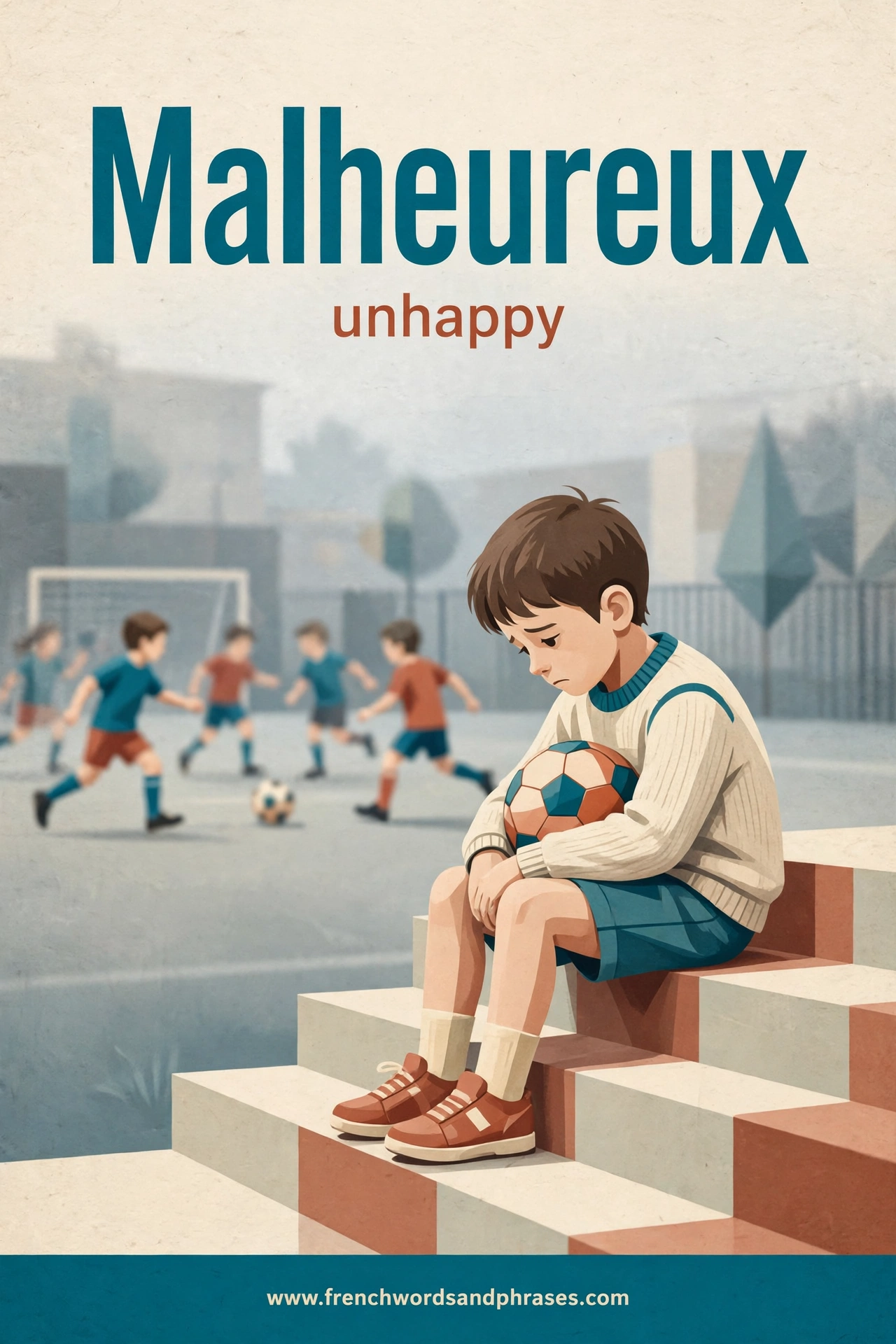
A kite, a tree, and a small boy standing underneath with the string still in his hand. The wind has stopped, the branches are too high, and the whole afternoon has folded itself into one small face. In French, that face is malheureux.
In this guide, you’ll learn what malheureux means in English, how it is built from heureux with one dark prefix, its second life meaning unfortunate, and why its masculine plural refuses to change. Explore French examples, English translations, and practice quizzes.
Understanding the French Adjective Malheureux
Malheureux is a French adjective of quality — heureux, happy, wearing the prefix mal-, the little syllable of bad luck. It agrees the regular way for the feminine — malheureuse — but its masculine plural is identical to the singular, because the word already ends in -x.
It means unhappy — sad, downhearted, sorry for yourself: un enfant malheureux, an unhappy child. But it carries a second sense English splits off: unfortunate, wretched — un malheureux accident, an unfortunate accident; un malheureux hasard, an unlucky coincidence. And before a sum of money it shrinks things with a sigh: quelques malheureux euros, a few measly euros.
Type: Adjective of quality — sadness (mal- + heureux)
Answers the question: What is he like? — unhappy; (of events) unfortunate
Changes form: Yes — malheureux, malheureuse, malheureux, malheureuses; the masculine plural never changes
English equivalents: Unhappy; unfortunate; wretched; measly (of amounts).
One important usage detail: the two senses of malheureux sit in different places. For feelings it follows the noun or être — un enfant malheureux, elle est malheureuse. For the ‘unfortunate’ sense it often stands BEFORE the noun — un malheureux accident, un malheureux hasard.
Experience the Word
Malheureux is the adjective of the small, complete sorrow — not tragedy, just the day when everything ordinary goes quietly wrong.
Imagine the boy under the tree an hour later: the kite still up there, his ice cream finished, his friends gone home for dinner. Nothing terrible has happened. That is exactly the size of malheureux — the sadness of small things, taken seriously.
You have not just described a feeling. You have given the small sorrows their full French dignity.
How to Use Malheureux in French: Complete Guide
Let’s explore how malheureux works in French, beginning with the whole word on one card.
Malheureux at a Glance
Before the details, here is the whole word on one card.
The Whole Word on One Card
Meaning, type, position and forms — malheureux in four lines.
| Point | Malheureux |
|---|---|
| Meaning | unhappy |
| Type | adjective of quality — mal- + heureux (happy) |
| Usual position | after the noun for feelings — un enfant malheureux; before it for ‘unfortunate’ — un malheureux accident |
| Form | malheureux / malheureuse / malheureux / malheureuses |
Example
Le petit garçon est malheureux, son cerf-volant est dans l’arbre.
The little boy is unhappy, his kite is in the tree.
The Four Forms of Malheureux
The feminine swaps -eux for -euse, like heureux itself. The masculine plural adds nothing at all — the -x is already there, so malheureux covers one man or ten.
| Form | Malheureux | Example |
|---|---|---|
| Masculine singular | malheureux | un homme malheureux — an unhappy man |
| Feminine singular | malheureuse | une femme malheureuse — an unhappy woman |
| Masculine plural | malheureux | des hommes malheureux — unhappy men |
| Feminine plural | malheureuses | des femmes malheureuses — unhappy women |
Example
Les enfants sont malheureux quand la fête est annulée.
The children are unhappy when the party is cancelled.
Quick Quiz 1
What is the feminine of malheureux — malheureuxe or malheureuse?
Reveal the answer
malheureuse
Une femme malheureuse.
An unhappy woman.
Where Malheureux Goes: Two Senses, Two Places
Malheureux changes its seat with its meaning: after the noun for a feeling, before the noun for an unfortunate twist of fate.
| Pattern | Example |
|---|---|
| noun + malheureux (feeling) | un enfant malheureux — an unhappy child |
| After être | elle est malheureuse — she is unhappy |
| malheureux + noun (unfortunate) | un malheureux accident — an unfortunate accident |
| With an adverb | très malheureux — very unhappy |
Example
Par un malheureux hasard, le train était annulé.
By an unfortunate coincidence, the train was cancelled.
More Unhappy: Comparing with Malheureux
Malheureux compares the regular way, with plus, moins and aussi — and the superlative keeps the agreement: le plus malheureux, la plus malheureuse.
| Degree | Example |
|---|---|
| As unhappy as | aussi malheureux que — as unhappy as |
| More unhappy | plus malheureux — plus malheureux qu’hier |
| Less unhappy | moins malheureux — less unhappy |
| The most unhappy (masc.) | le plus malheureux — le plus malheureux de la famille |
| The most unhappy (fem.) | la plus malheureuse — la plus malheureuse du village |
Example
Depuis le départ de son ami, il est le plus malheureux des enfants.
Since his friend left, he is the unhappiest of the children.
Quick Quiz 2
What does the idiom malheureux comme les pierres mean?
Reveal the answer
Utterly miserable — as unhappy as the stones.
Elle est malheureuse comme les pierres depuis son déménagement.
She has been utterly miserable since her move.
Everyday Expressions with Malheureux
Malheureux turns up wherever luck runs out — in love, in coincidences, and in one magnificent idiom about stones.
| Expression | In English |
|---|---|
| être malheureux | to be unhappy |
| rendre malheureux | to make unhappy |
| malheureux comme les pierres | utterly miserable — as unhappy as the stones |
| un malheureux hasard | an unfortunate coincidence |
| malheureux en amour | unlucky in love |
| quelques malheureux euros | a few measly euros |
Example
Il a tout perdu pour quelques malheureux euros.
He lost everything for a few measly euros.
Malheureux and Its Neighbours
French owns a whole shelf of sorrow words. Malheureux is the everyday one; its neighbours are about tears, luck, or blame — and heureux waits at the other end, sharing the same root.
| French | In English |
|---|---|
| triste | sad — the simple, direct word |
| affligé | distressed, grief-stricken — stronger and more formal |
| malchanceux | unlucky — about luck, not feelings |
| misérable | miserable, wretched — deeper than malheureux |
| désolé | sorry — also how you say ‘I’m sorry’ |
| heureux | happy — the opposite, same family |
Example
Il n’est pas malchanceux, juste malheureux en ce moment.
He isn’t unlucky, just unhappy at the moment.
Quick Quiz 3
In un malheureux accident, does malheureux mean ‘unhappy’ or ‘unfortunate’?
Reveal the answer
Unfortunate — the accident has no feelings; this is the second sense.
Un malheureux accident a fermé la route.
An unfortunate accident closed the road.
Malheureux Moments: The Small Sorrows
Malheureux lives in the minor key: lost toys, rained-off picnics and missed trains. A tour of its home ground.
| Moment | Example |
|---|---|
| A lost toy | un enfant malheureux sans son ours — an unhappy child without his bear |
| A rainy holiday | des vacanciers malheureux sous la pluie — unhappy holidaymakers in the rain |
| A missed train | un voyageur malheureux sur le quai — an unhappy traveller on the platform |
| A broken vase | une grand-mère malheureuse devant les morceaux — an unhappy grandmother before the pieces |
Example
Le voyageur malheureux regarde le train partir sans lui.
The unhappy traveller watches the train leave without him.
Watch Out: The Traps Around Malheureux
Three traps wait around this word — the English cousin it is not, the plural that looks like a mistake, and the euros that are not sad.
| Trap | The truth |
|---|---|
| malicious | malheureux never means malicious — spite is malveillance, and a spiteful person is malveillant or méchant |
| des malheureuxs | never — the masculine plural is malheureux, identical to the singular |
| quelques malheureux euros | the euros are not unhappy — malheureux here means measly, paltry |
| un malheureux (noun) | as a noun it means a poor wretch, a pitiable person — handle with kindness |
Example
Les pauvres malheureux attendaient sous la pluie.
The poor wretches were waiting in the rain.
Quick Quiz 4
What is the masculine plural of malheureux?
Reveal the answer
malheureux — it never changes; the -x is already there.
Des hommes malheureux.
Unhappy men.
Malheureux in Everyday French: Real-Life Examples
Now that you know the word, let’s see how malheureux appears in everyday French.
Example 1 — At home
Le petit est malheureux, son ballon est perdu.
The little one is unhappy, his balloon is lost.
Example 2 — About love
Il est malheureux en amour depuis des années.
He has been unlucky in love for years.
Example 3 — A coincidence
Par un malheureux hasard, le train était annulé.
By an unfortunate coincidence, the train was cancelled.
Example 4 — The idiom
Elle est malheureuse comme les pierres depuis son déménagement.
She has been utterly miserable since her move.
Example 5 — A few euros
Il a tout perdu pour quelques malheureux euros.
He lost everything for a few measly euros.
Example 6 — Sad news
Cette nouvelle l’a rendu très malheureux.
This news made him very unhappy.
Beyond Translation: The Meaning of Malheureux
English says unhappy for the meaning of malheureux — but the French word is two words wearing one coat. For people it is a feeling; for accidents, coincidences and small sums of money it is a judgement on luck itself.
Its build tells the story: heureux, happy, with mal- locked on the front — the same dark prefix that turns honnête into malhonnête two lessons from here.
And its idiom is pure poetry: malheureux comme les pierres, unhappy as the stones — as if even the road under your feet could share your mood.
How to Remember the French Adjective Malheureux
Remember it this way: Malheureux is heureux with a mal- locked on the front — happiness with the sign reversed.
- You see the parent inside the word — mal- + heureux — and the feminine in -euse: malheureuse.
- You leave the masculine plural alone — des hommes malheureux, never with an added letter.
- You split the senses by place: a feeling after the noun, bad luck before it — un malheureux accident.
The key idea is malheureux means unhappy (and unfortunate), feminine malheureuse, and its masculine plural never changes.
Test Your Knowledge of Malheureux
Let’s see how much you’ve learned. Try answering these questions before revealing the answers.
Question 1
What does malheureux mean?
Reveal the answer
Unhappy — and, of events and things, unfortunate.
Question 2
What are the forms of malheureux?
Reveal the answer
malheureux, malheureuse, malheureux, malheureuses — the masculine plural is identical to the singular.
Question 3
Translate: The children are unhappy.
Reveal the answer
Les enfants sont malheureux.
Question 4
What is the opposite of malheureux?
Reveal the answer
Heureux — happy. Malheureux is heureux with the prefix mal-.
Question 5
Complete the sentence:
Elle est ______ depuis le départ de son ami.
Reveal the answer
malheureuse
Elle est malheureuse depuis le départ de son ami.
She has been unhappy since her friend left.
Your Final Challenge
Can You Use It?
How would you say this in French?
“Since his friend left, the little boy is unhappy.”
Reveal the answer
Depuis le départ de son ami, le petit garçon est malheureux.
Since his friend left, the little boy is unhappy.
A little French. A little curiosity. A richer everyday life.
LEARN FRENCH ONE WORD AT A TIME