A French Word to Live By
How to Conjugate Sauter in French
/so.te/
Sauter means to jump, to hop, or to leap.
Children at the rope, frogs at the pond, a dancer leaving the floor — French has one springy verb for all of it. You jump over the puddle, you hop on one foot, the heart jumps at a sudden noise: sauter covers every lift-off.
In this guide, you’ll learn how to conjugate sauter in all the major French tenses and moods. Explore complete conjugation tables, French examples, English translations, and practice quizzes.
Understanding the French Verb Sauter
Sauter is a regular French verb belonging to the first group of verbs, those ending in -er.
It means to jump, to hop, or to leap. It is commonly used for jumping and hopping in play and dance, for skipping a page or a meal, and in the kitchen for tossing food in a hot pan.
Verb classification: First group (-er)
Auxiliary verb: Avoir
Past participle: sauté
Present participle: sautant
English equivalents: To jump, to hop, to skip (a page, a meal), to blow up.
One important detail: sauter is a perfectly regular -er verb — but it leads a double life in the kitchen. Faire sauter les légumes is to toss them in the pan, and des pommes sautées are sautéed potatoes: the vegetables jump in the fat. The same verb also skips things — sauter une ligne, to skip a line — and blows things up: faire sauter un pont.
Experience the Word
Sauter is the verb of the playground and the dance floor — the moment both feet agree to leave the ground together.
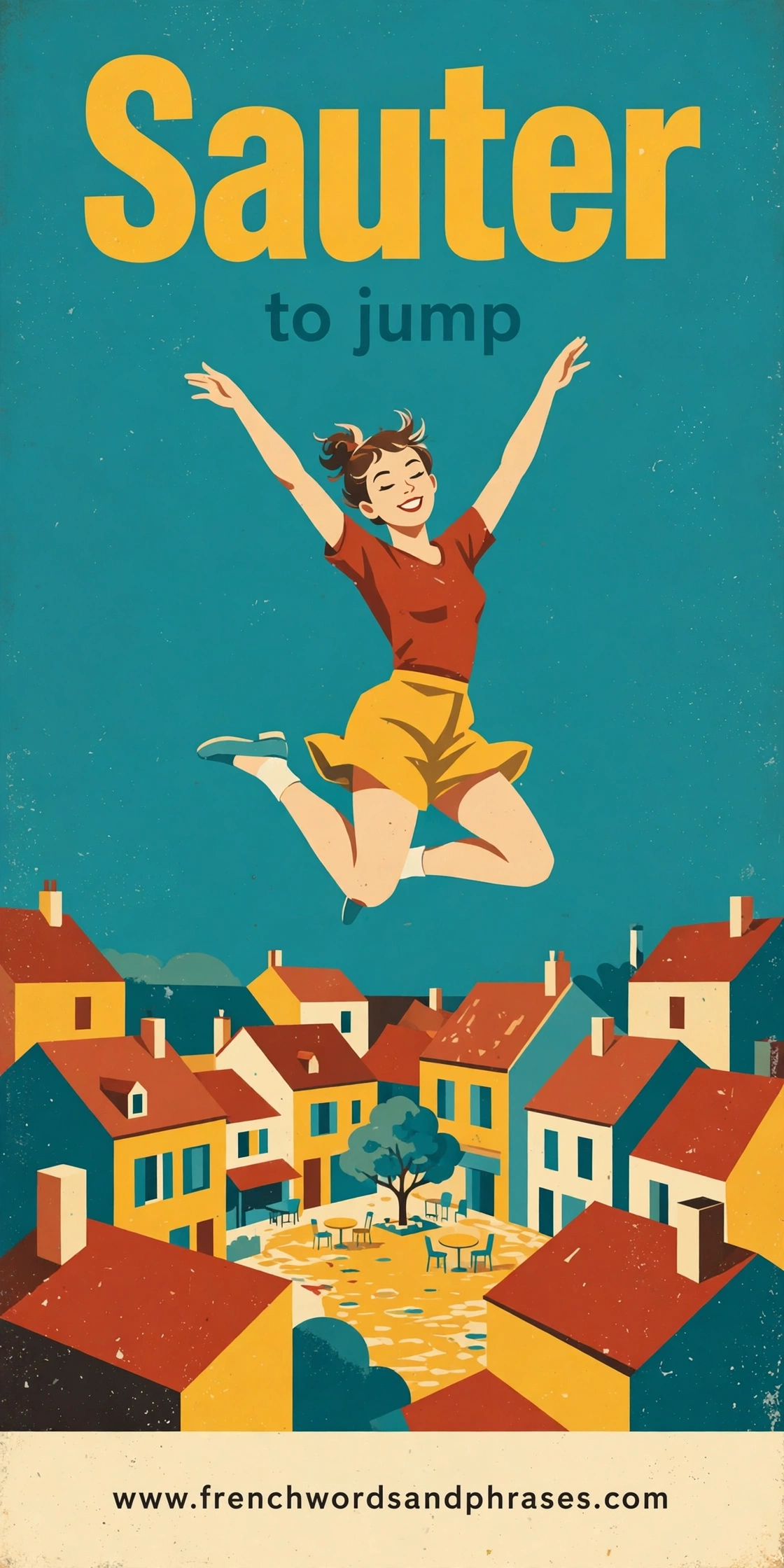
Imagine the village fête: the rope turning, the children counting, and one small dancer hopping in on the beat, knees up, grinning, while the whole square claps the rhythm.
You have not just left the ground. You have trusted the air — and landed dancing.
How to Conjugate Sauter: Complete French Conjugation Guide
Let’s explore every major conjugation of sauter, beginning with the indicative mood.
How to Conjugate Sauter in the Indicative Mood
The indicative mood is used to express facts, observations, actions, and events.
How to Conjugate Sauter in the Present Tense (Présent)
Used for actions happening now, habitual actions, and general truths.
| Subject | Conjugation |
|---|---|
| je | saute |
| tu | sautes |
| il / elle | saute |
| nous | sautons |
| vous | sautez |
| ils / elles | sautent |
Example
Les enfants sautent à la corde dans la cour.
The children are skipping rope in the yard.
Quick Quiz 1
Complete the sentence:
Nous ______ par-dessus la barrière.
Reveal the answer
sautons
Nous sautons par-dessus la barrière.
We are jumping over the fence.
How to Conjugate Sauter in the Passé Composé
Used for completed actions in the past. Sauter takes the auxiliary verb avoir.
| Subject | Conjugation |
|---|---|
| j’ | ai sauté |
| tu | as sauté |
| il / elle | a sauté |
| nous | avons sauté |
| vous | avez sauté |
| ils / elles | ont sauté |
Example
Elle a sauté par-dessus la flaque.
She jumped over the puddle.
How to Conjugate Sauter in the Imparfait (Imperfect Tense)
Used for habitual past actions, descriptions, and ongoing situations in the past.
| Subject | Conjugation |
|---|---|
| je | sautais |
| tu | sautais |
| il / elle | sautait |
| nous | sautions |
| vous | sautiez |
| ils / elles | sautaient |
Example
Quand nous étions petits, nous sautions dans les flaques.
When we were little, we used to jump in the puddles.
Quick Quiz 2
Choose the correct form:
She jumped over the puddle.
Elle ______ par-dessus la flaque. (a sauté / est sautée)
Reveal the answer
a sauté
Elle a sauté par-dessus la flaque.
Sauter takes avoir in the passé composé.
How to Conjugate Sauter in the Plus-que-parfait
Used to describe an action that had already been completed before another past event.
| Subject | Conjugation |
|---|---|
| j’ | avais sauté |
| tu | avais sauté |
| il / elle | avait sauté |
| nous | avions sauté |
| vous | aviez sauté |
| ils / elles | avaient sauté |
Example
Le chat avait déjà sauté sur le mur quand le chien est arrivé.
The cat had already jumped onto the wall when the dog arrived.
How to Conjugate Sauter in the Passé Simple
Primarily used in formal writing, literature, and historical narratives. It is rarely used in everyday conversation.
| Subject | Conjugation |
|---|---|
| je | sautai |
| tu | sautas |
| il / elle | sauta |
| nous | sautâmes |
| vous | sautâtes |
| ils / elles | sautèrent |
Example
Le danseur sauta au milieu du cercle sous les applaudissements.
The dancer leapt into the middle of the circle to applause.
How to Conjugate Sauter in the Passé Antérieur
A literary tense used to express an action completed immediately before another past action, generally in the passé simple.
| Subject | Conjugation |
|---|---|
| j’ | eus sauté |
| tu | eus sauté |
| il / elle | eut sauté |
| nous | eûmes sauté |
| vous | eûtes sauté |
| ils / elles | eurent sauté |
Example
Dès qu’il eut sauté, la corde continua de tourner.
As soon as he had jumped, the rope kept turning.
How to Conjugate Sauter in the Future Tense (Futur Simple)
Used to describe actions that will take place in the future.
| Subject | Conjugation |
|---|---|
| je | sauterai |
| tu | sauteras |
| il / elle | sautera |
| nous | sauterons |
| vous | sauterez |
| ils / elles | sauteront |
Example
Demain, tu sauteras plus haut, tu verras.
Tomorrow, you will jump higher, you’ll see.
How to Conjugate Sauter in the Futur Antérieur (Future Perfect)
Used for an action that will have been completed before a particular point in the future.
| Subject | Conjugation |
|---|---|
| j’ | aurai sauté |
| tu | auras sauté |
| il / elle | aura sauté |
| nous | aurons sauté |
| vous | aurez sauté |
| ils / elles | auront sauté |
Example
À la fin du spectacle, elle aura sauté vingt fois.
By the end of the show, she will have jumped twenty times.
How to Conjugate Sauter in the Near Future (Futur Proche)
Used to describe something that is going to happen soon. Formed with aller + infinitive.
| Subject | Conjugation |
|---|---|
| je | vais sauter |
| tu | vas sauter |
| il / elle | va sauter |
| nous | allons sauter |
| vous | allez sauter |
| ils / elles | vont sauter |
Example
Attention, le chien va sauter !
Watch out, the dog is going to jump!
How to Conjugate Sauter in the Conditional Mood
The conditional mood expresses what would happen under certain circumstances. It is also frequently used to make polite requests or express wishes.
How to Conjugate Sauter in the Present Conditional
| Subject | Conjugation |
|---|---|
| je | sauterais |
| tu | sauterais |
| il / elle | sauterait |
| nous | sauterions |
| vous | sauteriez |
| ils / elles | sauteraient |
Example
Je sauterais de joie si je réussissais.
I would jump for joy if I passed.
How to Conjugate Sauter in the Past Conditional
| Subject | Conjugation |
|---|---|
| j’ | aurais sauté |
| tu | aurais sauté |
| il / elle | aurait sauté |
| nous | aurions sauté |
| vous | auriez sauté |
| ils / elles | auraient sauté |
Example
Il aurait sauté plus loin avec un meilleur élan.
He would have jumped further with a better run-up.
Sauter in the Literary Past Conditional Form
This less common literary form uses the imperfect subjunctive of avoir.
| Subject | Conjugation |
|---|---|
| j’ | eusse sauté |
| tu | eusses sauté |
| il / elle | eût sauté |
| nous | eussions sauté |
| vous | eussiez sauté |
| ils / elles | eussent sauté |
Example
Il eût sauté de joie à cette nouvelle.
He would have jumped for joy at the news.
How to Conjugate Sauter in the Subjunctive Mood
The subjunctive is used to express wishes, emotions, doubts, necessity, and uncertainty. It frequently follows expressions such as il faut que (it is necessary that) or bien que (although).
How to Conjugate Sauter in the Present Subjunctive
| Subject | Conjugation |
|---|---|
| que je | saute |
| que tu | sautes |
| qu’il / qu’elle | saute |
| que nous | sautions |
| que vous | sautiez |
| qu’ils / qu’elles | sautent |
Example
Il faut que tu sautes au bon moment.
You need to jump at the right moment.
Quick Quiz 3
Complete the sentence using the subjunctive:
Il faut que vous ______ au bon moment.
Reveal the answer
sautiez
Il faut que vous sautiez au bon moment.
You need to jump at the right moment.
How to Conjugate Sauter in the Imperfect Subjunctive
A literary tense, rarely encountered in modern spoken French.
| Subject | Conjugation |
|---|---|
| que je | sautasse |
| que tu | sautasses |
| qu’il / qu’elle | sautât |
| que nous | sautassions |
| que vous | sautassiez |
| qu’ils / qu’elles | sautassent |
Example
Il voulait qu’elle sautât par-dessus la barrière.
He wanted her to jump over the fence.
How to Conjugate Sauter in the Pluperfect Subjunctive
A literary construction used to express an action completed before another past action.
| Subject | Conjugation |
|---|---|
| que j’ | eusse sauté |
| que tu | eusses sauté |
| qu’il / qu’elle | eût sauté |
| que nous | eussions sauté |
| que vous | eussiez sauté |
| qu’ils / qu’elles | eussent sauté |
Example
Je regrettais qu’ils eussent sauté le repas.
I regretted that they had skipped the meal.
How to Conjugate Sauter in the Past Subjunctive
| Subject | Conjugation |
|---|---|
| que j’ | aie sauté |
| que tu | aies sauté |
| qu’il / qu’elle | ait sauté |
| que nous | ayons sauté |
| que vous | ayez sauté |
| qu’ils / qu’elles | aient sauté |
Example
Je suis content que tu aies sauté le pas.
I am glad you took the plunge.
How to Conjugate Sauter in the Imperative
The imperative is used to give commands, instructions, invitations, or suggestions. Subject pronouns are omitted.
How to Conjugate Sauter in the Present Imperative
| Person | Conjugation |
|---|---|
| (tu) | saute |
| (nous) | sautons |
| (vous) | sautez |
Example
Saute par-dessus la flaque, elle est petite !
Jump over the puddle, it’s small!
Quick Quiz 4
How would you say Jump!, using the tu form?
Reveal the answer
Saute !
French Participles of Sauter
Participles are verb forms that can be used in compound tenses and other grammatical constructions.
Present Participle of Sauter
sautant
En sautant, elle a perdu une chaussure.
While jumping, she lost a shoe.
Past Participle of Sauter
sauté
Les pommes sautées sont prêtes.
The sautéed potatoes are ready.
Sauter in Everyday French: Real-Life Examples
Now that you know the conjugations, let’s see how sauter appears in everyday French.
Example 1 — Present
Les enfants sautent sur le lit.
The children are jumping on the bed.
Example 2 — Passé composé
Il a sauté de joie à la nouvelle.
He jumped for joy at the news.
Example 3 — Imparfait
Nous sautions à cloche-pied dans la cour.
We used to hop on one foot in the yard.
Example 4 — Future
Le chat sautera sur le mur.
The cat will jump onto the wall.
Example 5 — Kitchen
Fais sauter les légumes dans l’huile chaude.
Toss the vegetables in the hot oil.
Example 6 — Figurative
Elle a sauté une page du livre.
She skipped a page of the book.
See sauter in a story: Dance Vocabulary: French Vocabulary (Le Vocabulaire de la Danse) — a village fête under the lights.
Beyond Translation: The Meaning of Sauter
English splits jump, hop and skip where French keeps one springy verb — sauter — for the child at the rope, the frog at the pond and the dancer at the fête. Then it lends the jump to the kitchen (faire sauter, to sauté), to reading (sauter une ligne) and to courage itself: sauter le pas, to take the plunge.
To sauter is to leave the ground — or the safe option — behind.
It evokes the turning rope and the counted jumps, the puddle cleared in one bound, and the small brave moment of sauter le pas.
How to Remember the French Verb Sauter
Remember it this way: Sauter is about sauter — the jump, the sauté, and the plunge.
- You leave the ground — elle a sauté par-dessus la flaque: auxiliary avoir, participle sauté.
- You toss the pan — faire sauter les légumes: the kitchen jump, to sauté.
- You take courage — sauter le pas, to take the plunge.
The key idea is sauter — the jump, the sauté, and the plunge.
Test Your Knowledge of Sauter
Let’s see how much you’ve learned. Try answering these questions before revealing the answers.
Question 1
What is the past participle of sauter?
Reveal the answer
Sauté.
Question 2
How do you say I will jump in French?
Reveal the answer
Je sauterai.
Question 3
Translate: The children are skipping rope.
Reveal the answer
Les enfants sautent à la corde.
Question 4
What does faire sauter les légumes mean?
Reveal the answer
To toss the vegetables in the pan — to sauté them; the vegetables jump in the hot fat.
Question 5
Complete the sentence:
Il faut que tu ______ au bon moment.
Reveal the answer
sautes
Il faut que tu sautes au bon moment.
You need to jump at the right moment.
Your Final Challenge
Can You Use It?
How would you say this in French?
The children are skipping rope and laughing out loud.
Reveal the answer
Les enfants sautent à la corde et rient aux éclats.
The children are skipping rope and laughing out loud.
A little French. A little curiosity. A richer everyday life.
LEARN FRENCH ONE WORD AT A TIME