A French Word to Live By
Translate Mangue to English
/mɑ̃ɡ/
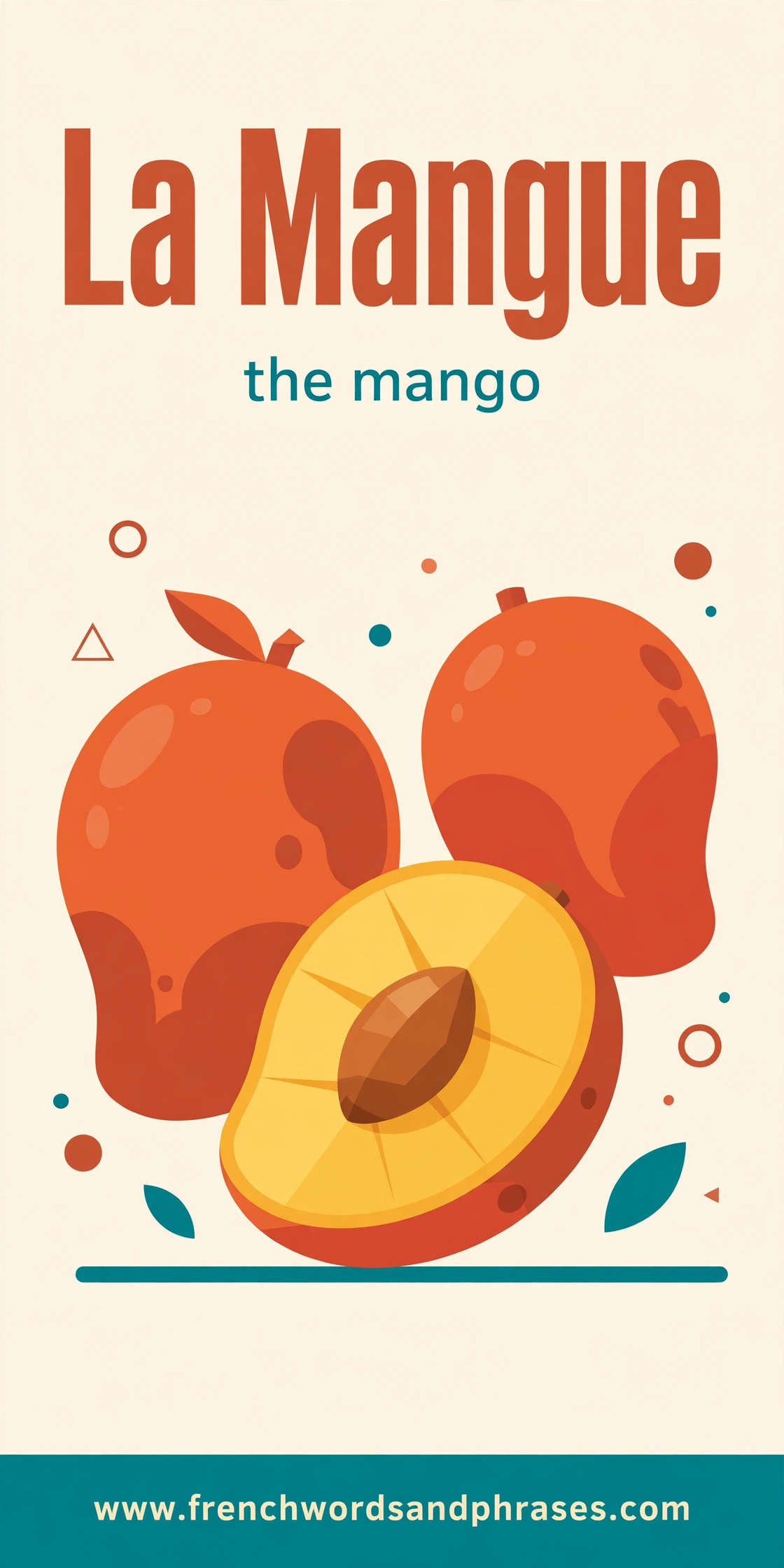
La mangue means the mango.
At the market stall, a pyramid of mangoes glows orange and gold in the morning sun. The stallholder picks one up, presses it gently, and nods: this one is ready — la mangue.
In this guide, you’ll learn what mangue means in English, how to use it with its articles, how to form its plural, and how it appears in everyday French. Explore French examples, English translations, and practice quizzes.
Understanding the French Noun Mangue
Mangue is a feminine French noun. It is learned together with its article: la mangue, une mangue. It names the great tropical fruit with golden flesh and one large stone — le noyau — hidden in the middle.
It means the mango — a tropical fruit with smooth skin that turns from green to gold and red as it ripens, and soft, sweet, orange flesh around a single big flat stone. In France you meet it at the market, in fruit salads and smoothies, and on dessert menus: une mangue mûre is a ripe mango, and a ripe one perfumes the whole kitchen.
Gender: Feminine
Definite article: la — la mangue (the mango)
Indefinite article: une — une mangue (a mango)
Plural: les mangues
English equivalents: The mango.
One important usage detail: a mango is judged by touch and by smell, not by colour alone. Ask for une mangue mûre — a ripe mango — and check that it gives a little under your fingers. The tree it grows on has its own name: le manguier, the mango tree.
Experience the Word
Mangue is more than a fruit. It is a small piece of the tropics on a French market stall — sunshine you can hold in one hand.
Imagine cutting it open at home: the knife slides around the great stone, the two halves come away golden and shining, and the smell fills the room before the first spoonful.
You have not just eaten a fruit. You have tasted the sun, the French way — with la mangue.
How to Use Mangue in French: Complete Guide
Let’s explore how mangue works in French, beginning with its articles.
Mangue with the Definite Article (La, Les)
Used for the mango everyone in the conversation knows — the one on the stall, the one in the fruit bowl.
| Number | French |
|---|---|
| Singular | la mangue |
| Plural | les mangues |
Example
La mangue sur l’étal est bien mûre.
The mango on the stall is good and ripe.
Mangue with the Indefinite Article (Une, Des)
Used for a mango in general — the one you are choosing, the one on your shopping list.
| Number | French |
|---|---|
| Singular | une mangue |
| Plural | des mangues |
Example
Je voudrais une mangue bien parfumée, s’il vous plaît.
I would like a nice fragrant mango, please.
Choosing a Mangue at the Market
Ripe, fragrant and ready to cut — the words for judging a mango like a stallholder.
| French | In English |
|---|---|
| une mangue mûre | a ripe mango |
| une mangue parfumée | a fragrant mango |
| le noyau | the stone |
| la chair | the flesh |
| éplucher une mangue | to peel a mango |
| couper une mangue en tranches | to cut a mango into slices |
Example
Attention au noyau quand tu coupes la mangue.
Mind the stone when you cut the mango.
Quick Quiz 1
What is le noyau?
Reveal the answer
The stone — the one large flat stone hidden in the middle of the mango.
On coupe la mangue autour du noyau.
You cut the mango around the stone.
The Plural of Mangue
Mangue adds an -s in the plural — les mangues, the mangoes of the whole market.
| Number | French |
|---|---|
| Singular | la mangue |
| Plural | les mangues |
Example
Les mangues de ce marchand sont toujours excellentes.
This stallholder’s mangoes are always excellent.
Mangue with Possessive Adjectives (Ma, Ta, Sa…)
Possessives agree with the noun, not with the owner — and mangue is feminine, so it takes ma, ta, sa.
| Owner | French |
|---|---|
| my | ma mangue |
| your (tu) | ta mangue |
| his / her | sa mangue |
| our | notre mangue |
| your (vous) | votre mangue |
| their | leur mangue |
Example
Ma mangue est encore un peu ferme, j’attends demain.
My mango is still a bit firm, I’ll wait until tomorrow.
Quick Quiz 2
Complete the sentence:
______ mangue est mûre, on peut la manger ce soir. (My)
Reveal the answer
Ma
Ma mangue est mûre, on peut la manger ce soir.
My mango is ripe, we can eat it this evening.
Mangue with Demonstrative Adjectives (Cette, Ces)
Used to point: this mango here, those mangoes there.
| Number | French |
|---|---|
| Singular | cette mangue |
| Plural | ces mangues |
Example
Cette mangue sent très bon, je la prends.
This mango smells lovely, I’ll take it.
Mangue with Adjectives
Adjectives agree with mangue, feminine — mûre, juteuse, sucrée.
| Adjective | With Mangue |
|---|---|
| mûre (ripe) | une mangue mûre |
| juteuse (juicy) | une mangue juteuse |
| sucrée (sweet) | une mangue sucrée |
| parfumée (fragrant) | une mangue parfumée |
| ferme (firm) | une mangue ferme |
Example
Une mangue mûre et juteuse, c’est le meilleur des desserts.
A ripe, juicy mango is the best of desserts.
Quick Quiz 3
Complete the sentence:
Je cherche une mangue bien ______. (ripe)
Reveal the answer
mûre
Je cherche une mangue bien mûre.
I’m looking for a good ripe mango.
Everyday Expressions with Mangue
At the market and in the kitchen, these are the mangue phrases of daily life.
| Expression | In English |
|---|---|
| manger une mangue | to eat a mango |
| un jus de mangue | a mango juice |
| une salade de mangues | a mango salad |
| la saison des mangues | mango season |
| une mangue bien mûre | a good ripe mango |
| couper la mangue en deux | to cut the mango in two |
Example
Le matin, elle boit un jus de mangue frais.
In the morning, she drinks a fresh mango juice.
Words from the Same Family as Mangue
Trees, stones and flesh — the words that travel with mangue.
| French | In English |
|---|---|
| le manguier | the mango tree |
| le noyau | the stone |
| la chair | the flesh |
| le fruit | the fruit |
| la salade de fruits | the fruit salad |
| un fruit exotique | an exotic fruit |
Example
Le manguier donne des mangues en été.
The mango tree gives mangoes in summer.
Quick Quiz 4
What is le manguier?
Reveal the answer
The mango tree — mangue is the fruit, manguier is the tree it grows on.
Les mangues poussent sur le manguier.
Mangoes grow on the mango tree.
Mangue in Everyday French: Real-Life Examples
Now that you know the word, let’s see how mangue appears in everyday French.
Example 1 — At the market
Cette mangue est-elle mûre, s’il vous plaît ?
Is this mango ripe, please?
Example 2 — At breakfast
Je mets des morceaux de mangue dans mon yaourt.
I put pieces of mango in my yogurt.
Example 3 — Making a smoothie
Elle mixe une mangue avec une banane.
She blends a mango with a banana.
Example 4 — For dessert
Nous servons une salade de mangues après le dîner.
We are serving a mango salad after dinner.
Example 5 — Checking ripeness
La mangue est encore ferme, attendons deux jours.
The mango is still firm, let’s wait two days.
Example 6 — A gift of fruit
Il apporte des mangues mûres pour le dessert.
He is bringing ripe mangoes for dessert.
See la mangue in a story: Fruits and Vegetables: French Vocabulary (Fruits et Légumes) — a Saturday trip to a French market.
Beyond Translation: The Meaning of Mangue
The mangue travelled far before it reached the French market stall: born in India, carried by Portuguese ships to Africa and the Americas, and welcomed at last into the orchards of France’s overseas departments, where it ripens under the same flag. On the mainland it stays a luxury — chosen one by one, by hand and by nose.
To say mangue is to choose your fruit the slow way — by touch and by perfume.
It evokes the stallholder’s nod, the golden halves on the board, the juice on your fingers — a tropical fruit that France has adopted without ever quite taming.
How to Remember the French Noun Mangue
Remember it this way: Mangue is the mango — feminine, with la and une, golden flesh around one big stone, judged ripe by touch and smell.
- You choose it at the market — une mangue mûre, s’il vous plaît.
- You cut around the middle — attention au noyau, the stone.
- You name the tree — les mangues poussent sur le manguier.
The key idea is la mangue is ripe when it smells sweet.
Test Your Knowledge of Mangue
Let’s see how much you’ve learned. Try answering these questions before revealing the answers.
Question 1
Is mangue masculine or feminine?
Reveal the answer
Feminine — la mangue, une mangue.
Question 2
How do you say a ripe mango in French?
Reveal the answer
Une mangue mûre — mûre is the feminine of mûr, ripe.
Question 3
Translate: I am buying two mangoes at the market.
Reveal the answer
J’achète deux mangues au marché.
Question 4
What is le noyau of a mango?
Reveal the answer
Its stone — the one large flat stone in the middle of the fruit.
Question 5
Complete the sentence:
Elle coupe ______ mangue en tranches.
Reveal the answer
la
Elle coupe la mangue en tranches.
She cuts the mango into slices.
Your Final Challenge
Can You Use It?
How would you say this in French?
“I am buying two ripe mangoes at the market.”
Reveal the answer
J’achète deux mangues mûres au marché.
I am buying two ripe mangoes at the market.
A little French. A little curiosity. A richer everyday life.
LEARN FRENCH ONE WORD AT A TIME