A French Word to Live By
Translate Mademoiselle to English
/mad.mwa.zɛl/
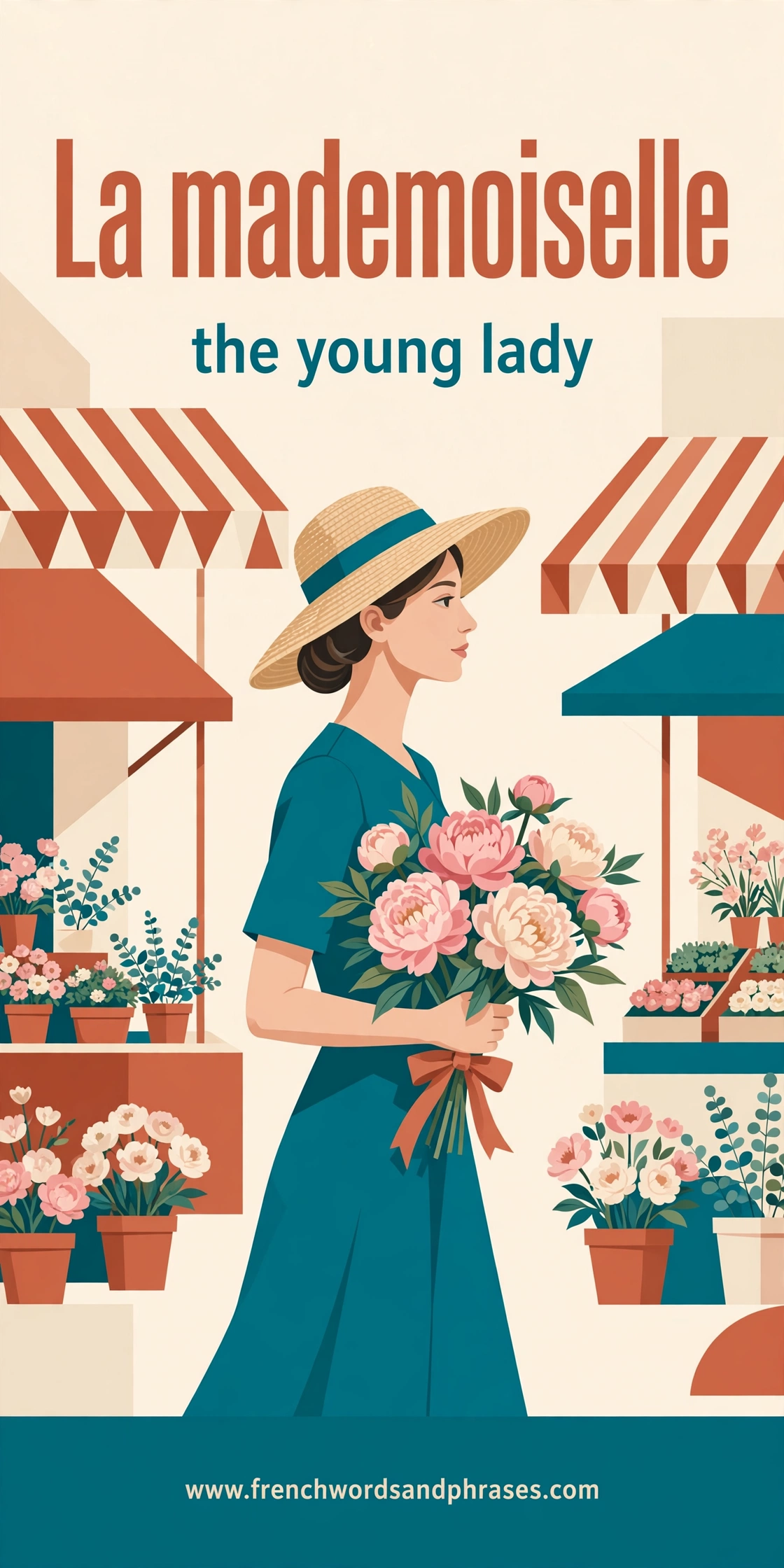
Mademoiselle means the young lady.
Called across a café terrace by a waiter with a tray, printed for two centuries on forms beside Madame and Monsieur: mademoiselle, the young lady — a word of politeness with a long history and a modern twist.
In this guide, you’ll learn what mademoiselle means in English, how to use it with its articles, how to form its plural, and how it appears in everyday French. Explore French examples, English translations, and practice quizzes.
Understanding the French Noun Mademoiselle
Mademoiselle is a feminine French noun, learned with its article: la mademoiselle, une mademoiselle. It is built from ma, my, and demoiselle, a young lady of rank — literally “my young lady”. Traditionally it was the title for an unmarried woman or girl, the counterpart of madame for a married woman; its plural is the elegant irregular mesdemoiselles.
It means a young lady, a miss — used to address or describe a girl or a young, unmarried woman: une mademoiselle à l’accueil, a young lady at reception, Mademoiselle, votre ticket !, Miss, your ticket! Waiters and shopkeepers still call it across rooms to catch a young woman’s attention. But the word has an official sunset: since 2012, French government forms no longer offer mademoiselle — every woman is madame on paper, whatever her age or marital status, exactly as every man is monsieur.
Gender: Feminine — la mademoiselle
Definite article: la — la mademoiselle (the young lady)
Indefinite article: une — une mademoiselle (a young lady)
Plural: les demoiselles / mesdemoiselles — mesdemoiselles when addressing them
Spelling note: ma + demoiselle: “my young lady”; demoiselle alone also means a damselfly
Modern rule: since 2012, official forms use madame for all women; mademoiselle lives on in speech
English equivalents: The young lady, Miss.
Addressing someone, no article is used: Mademoiselle ! to a young woman, Mesdemoiselles, Mesdames, Messieurs to a room. In daily life you will still hear it warmly used for girls and young women — a compliment as much as a title. On paper, though, choose madame: forms, letters and administration have retired mademoiselle, and some women prefer madame at any age.
Experience the Word
Mademoiselle is politeness with a curtsy in it — the word a whole room used to stand up a little straighter to say.
Imagine the grand café in 1960: the waiter threading between tables, tray high, calling Mademoiselle ! toward the young woman by the window who has forgotten her gloves on the chair.
You have not just named a title. You have named a piece of French courtesy — mademoiselle, the young lady, half compliment, half tradition.
How to Use Mademoiselle in French: Complete Guide
Let’s explore how mademoiselle works in French, beginning with its articles — la mademoiselle, une mademoiselle, mesdemoiselles.
Mademoiselle with the Definite Article (La, Les)
Used for a specific young lady — the one at the desk, the one by the door.
| Form | French |
|---|---|
| Feminine singular | la mademoiselle |
| Plural | les demoiselles |
Example
La mademoiselle à l’accueil vous aidera.
The young lady at reception will help you.
Mademoiselle with the Indefinite Article (Une, Des)
Used for a young lady in general — a girl, a young woman not yet introduced.
| Form | French |
|---|---|
| Feminine singular | une mademoiselle |
| Plural | des demoiselles |
Example
Une mademoiselle demande le directeur.
A young lady is asking for the director.
The Titles of Politeness (Mademoiselle, Madame, Monsieur…)
French addresses the world with three titles — here is the whole polite family.
| Title | French |
|---|---|
| a young lady, Miss | mademoiselle |
| a lady, Mrs/Ms | madame |
| a gentleman, Mr | monsieur |
| young ladies (addressed) | mesdemoiselles |
| ladies and gentlemen | mesdames et messieurs |
Example
Mesdemoiselles, mesdames, messieurs, bonsoir !
Young ladies, ladies and gentlemen, good evening!
Quick Quiz 1
Complete the sentence:
______ mademoiselle au comptoir parle anglais. (the)
Reveal the answer
La
La mademoiselle au comptoir parle anglais.
The young lady at the counter speaks English — mademoiselle is feminine, so la.
The Plural of Mademoiselle
The plural dresses up: mademoiselle becomes demoiselles, and in address, mesdemoiselles — “my young ladies”.
| Number | French |
|---|---|
| Singular | la mademoiselle |
| Plural | les demoiselles |
| Plural (address) | mesdemoiselles |
Example
Les demoiselles portent des robes fleuries.
The young ladies are wearing flowery dresses.
Mademoiselle with Possessive Adjectives (Ma, Ta, Sa…)
Possessives agree with the noun: mademoiselle is feminine, so ma, ta, sa in the singular — rare, but the forms exist.
| Owner | French |
|---|---|
| my | ma demoiselle (old-fashioned) |
| your (tu) | ta demoiselle |
| his / her | sa demoiselle |
| our | notre demoiselle |
| your (vous) | votre demoiselle |
| their | leur demoiselle |
Example
Il a présenté sa demoiselle à ses parents.
He introduced his young lady to his parents.
Quick Quiz 2
Complete the sentence:
Une ______ demande le directeur au comptoir. (young lady)
Reveal the answer
mademoiselle
Une mademoiselle demande le directeur au comptoir.
A young lady is asking for the director at the counter.
Mademoiselle with Demonstrative Adjectives (Cette, Ces)
Used to point: cette mademoiselle, this young lady — this girl, this young woman.
| Form | French |
|---|---|
| Feminine singular | cette mademoiselle |
| Plural | ces demoiselles |
Example
Cette mademoiselle est la sœur du marié.
This young lady is the groom’s sister.
Mademoiselle with Adjectives
Adjectives agree with mademoiselle — feminine singular: une jeune mademoiselle, une charmante mademoiselle.
| Adjective | With Mademoiselle |
|---|---|
| jeune (young) | une jeune mademoiselle |
| charmante (charming) | une charmante mademoiselle |
| petite (little) | une petite mademoiselle |
| grande (tall, grown) | une grande demoiselle |
| élégante (elegant) | une élégante mademoiselle |
Example
La petite mademoiselle a déjà huit ans.
The little young lady is already eight.
Quick Quiz 3
Complete the sentence:
______ demoiselles, bienvenue au bal ! (young ladies, in address)
Reveal the answer
Mesdemoiselles
Mesdemoiselles, bienvenue au bal !
Young ladies, welcome to the ball! — in address, the plural is mesdemoiselles.
Everyday Expressions with Mademoiselle
Cafés, counters and compliments — the mademoiselle phrases of daily life.
| Expression | In English |
|---|---|
| Mademoiselle ! | Miss! (calling a young woman) |
| une jeune mademoiselle | a young lady |
| mesdemoiselles, mesdames, messieurs | ladies and gentlemen (full address) |
| Mademoiselle a oublié… | You’ve forgotten…, Miss (polite) |
| une demoiselle d’honneur | a bridesmaid |
Example
Mademoiselle, vous avez oublié votre écharpe !
Miss, you’ve forgotten your scarf!
Words from the Same Family as Mademoiselle
Titles and courtesy — the words that travel with mademoiselle.
| French | In English |
|---|---|
| madame | madam, Mrs, Ms — the title for all women on official paper |
| monsieur | sir, Mr — the title for men |
| une demoiselle | a young lady; also a damselfly |
| une demoiselle d’honneur | a bridesmaid |
| la politesse | politeness |
Example
Une demoiselle d’honneur porte un bouquet assorti.
A bridesmaid carries a matching bouquet.
Quick Quiz 4
What is une demoiselle d’honneur?
Reveal the answer
A bridesmaid — the young lady who attends the bride.
Sa sœur sera sa demoiselle d’honneur.
Her sister will be her bridesmaid.
Mademoiselle in Everyday French: Real-Life Examples
Now that you know the word, let’s see how mademoiselle appears in everyday French.
Example 1 — At the café
Mademoiselle, l’addition, s’il vous plaît !
Miss, the bill, please!
Example 2 — At reception
La mademoiselle à l’accueil est très aimable.
The young lady at reception is very kind.
Example 3 — A forgotten scarf
Mademoiselle, votre écharpe !
Miss, your scarf!
Example 4 — A wedding
Les demoiselles d’honneur portent du rose.
The bridesmaids are wearing pink.
Example 5 — On a form
Sur les formulaires officiels, on écrit Madame.
On official forms, you write Madame.
Example 6 — A compliment
Quelle charmante mademoiselle !
What a charming young lady!
Beyond Translation: The Meaning of Mademoiselle
Mademoiselle carries a whole social history in eight syllables. For centuries it sorted women by marital status at a glance — mademoiselle until the wedding, madame after — while men sailed through life as monsieur from cradle to grave. Feminists pointed out the asymmetry for decades, and in 2012 the French state agreed: official forms dropped mademoiselle (and the nom de jeune fille with it), and madame now serves for every woman. The spoken word survives, softened into a compliment: to be called mademoiselle at forty is a small gift of the language.
To say mademoiselle is to bow slightly as you speak.
It evokes the café terrace, the forgotten scarf and the bridesmaid’s bouquet — courtesy, tradition and a title in gentle retirement.
How to Remember the French Noun Mademoiselle
Remember it this way: Mademoiselle is the young lady — feminine: la mademoiselle, plural mesdemoiselles in address; on official paper, madame has replaced it.
- Always feminine — la mademoiselle, une mademoiselle, cette mademoiselle.
- The address plural — mesdemoiselles, not “les mademoiselles”, when you speak to them.
- The modern rule — since 2012, forms use madame for all women; mademoiselle lives in speech.
The key idea is la mademoiselle — the young lady, feminine; address plural mesdemoiselles.
Test Your Knowledge of Mademoiselle
Let’s see how much you’ve learned. Try answering these questions before revealing the answers.
Question 1
Is mademoiselle masculine or feminine?
Reveal the answer
Feminine — la mademoiselle, une mademoiselle.
Question 2
How do you address several young ladies?
Reveal the answer
Mesdemoiselles — the plural of address: mesdemoiselles, mesdames, messieurs.
Question 3
Translate: Miss, you’ve forgotten your scarf!
Reveal the answer
Mademoiselle, vous avez oublié votre écharpe !
Question 4
What title do official French forms use for women today?
Reveal the answer
Madame — since 2012, mademoiselle no longer appears on government forms.
Question 5
Complete the sentence:
______ mademoiselle à l’accueil parle trois langues. (the)
Reveal the answer
La
La mademoiselle à l’accueil parle trois langues.
The young lady at reception speaks three languages.
Your Final Challenge
Can You Use It?
How would you say this in French?
“Miss, you’ve forgotten your scarf!”
Reveal the answer
Mademoiselle, vous avez oublié votre écharpe !
Miss, you’ve forgotten your scarf!
A little French. A little curiosity. A richer everyday life.
LEARN FRENCH ONE WORD AT A TIME