A French Word to Live By
Translate Notre to English
/nɔtʁ/
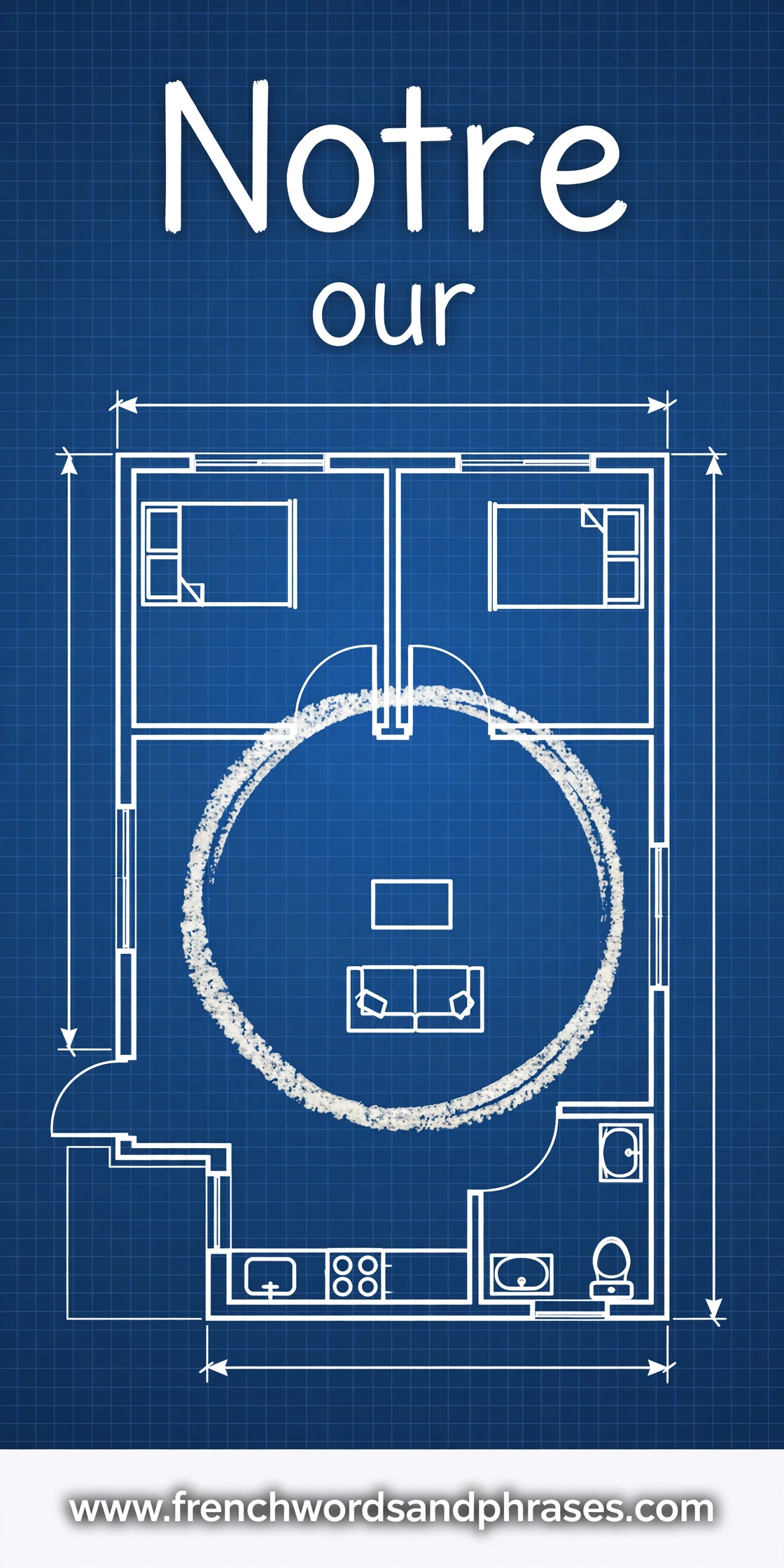
Notre means our.
A whole family stands in front of a small house with blue shutters, arms full of boxes. « C’est notre maison, enfin ! » — it is our house, at last! Notre is the French word for ‘our’: the determiner of the team, the family, the couple — everything that belongs not to me alone, but to us.
Let’s explore how notre works in French, beginning with the whole word on one card.
Understanding the French Determiner Notre
Notre is a French possessive determiner — ‘our’, for something belonging to a group that includes the speaker. It stands in front of a noun and, in the singular, makes no distinction between masculine and feminine: notre maison (our house), notre jardin (our garden), nos enfants (our children).
It means our. The picture it paints is a circle of people around one thing: our table, our street, our story. English ‘our’ is a single form; French notre is nearly as simple — one form for every singular noun, and nos for the plural — the calmest corner of the possessive family.
Type: Possessive determiner — our (owners: we, a group including the speaker)
Answers the question: À qui ? / De qui ? — Whose? (Answer: ours, belonging to us)
What follows it: A noun: notre maison, notre école, nos parents
Watch the pair: notre (determiner, our — before a noun, no accent) vs le nôtre (pronoun, ours — standing alone, with a circumflex): notre maison = our house, la nôtre = ours
One important usage detail: notre is the same word for masculine and feminine singular nouns — notre père, notre mère. There is no separate feminine form to learn; only the plural changes, to nos.
Experience the Word
Notre is the determiner of the team photo — it never speaks of one person, always of a circle.
Imagine a village bakery at dawn, the whole family already at work: notre four chauffe, notre farine arrive, nos clients attendent — our oven is heating, our flour is arriving, our customers are waiting.
You have not just marked a possession. You have spoken for the whole group: this is ours, all of ours, together.
How to Use Notre in French: Complete Guide
Let’s explore how notre works in French, beginning with the whole word on one card.
Notre at a Glance
The Whole Word on One Card
Meaning, job, grid and pair — notre in four lines.
| Point | Notre |
|---|---|
| Meaning | our — belonging to us |
| Job | possessive determiner — marks the owners (we) before the noun |
| The grid | notre (masc. sg.), notre (fem. sg.), nos (plural) — one singular form for both genders |
| What it signals | this belongs to us — a family, a team, a couple, a village |
Example
Notre village est célèbre pour son marché.
Our village is famous for its market.
The Pattern in Action: The World of ‘Us’
Notre connects nouns to a group that includes the speaker — everything the group shares.
| Pattern | Example |
|---|---|
| before a masculine noun | notre jardin est plein de fleurs — our garden is full of flowers |
| before a feminine noun | notre maison est au bord de la rivière — our house is by the river |
| before a plural noun | nos enfants jouent dans la cour — our children are playing in the yard |
| the group’s whole world | notre école, notre quartier, nos voisins — our school, our neighbourhood, our neighbours |
Example
Notre train arrive dans cinq minutes.
Our train arrives in five minutes.
Quick Quiz 1
“Our mother” — is the form different from “our father”?
Reveal the answer
No — notre covers both genders in the singular: notre père, notre mère.
Notre mère et notre père arrivent ce soir.
Our mother and our father arrive this evening.
The Tricky Bit: One Form for Both Genders
Notre breaks the usual possessive pattern: where mon splits into mon/ma and son into son/sa, notre refuses to split at all.
| Situation | What happens |
|---|---|
| masculine singular: notre | notre livre, notre chien, notre appartement |
| feminine singular: notre again | notre maison, notre voiture, notre école — no change |
| before a vowel: notre, smoothly | notre ami, notre école — notre ends in a vowel sound, so nothing needs to change |
| any plural: nos | nos livres, nos maisons, nos amis — one plural form for everything |
Example
Notre école organise une fête pour nos parents.
Our school is organising a party for our parents.
Where It Goes: Directly Before the Noun
Notre leads the noun phrase like every possessive — determiner first, then adjective, then noun.
| Position / pattern | Example |
|---|---|
| directly before the noun | notre projet, notre patience, nos efforts — the determiner leads |
| before noun + adjective | notre petit village, notre grande maison — notre still stands first |
| repeated before each noun | notre père et notre mère — our father and our mother (one determiner per noun) |
| number does the only changing | notre for one thing, nos for several: nos clés, nos affaires |
Example
Notre vieille maison a un grand jardin.
Our old house has a big garden.
Quick Quiz 2
“Our friends” — notre amis or nos amis?
Reveal the answer
nos amis — amis is plural, and the plural form is nos for every noun.
Nos amis arrivent par le train de midi.
Our friends arrive on the midday train.
Everyday Expressions with Notre
Notre fills the phrases of families, teams and whole communities speaking as one.
| Expression | In English |
|---|---|
| notre maison | our house / our home |
| à notre avis | in our opinion |
| notre époque | our time, our era |
| de notre côté | on our side, for our part |
| notre pain quotidien | our daily bread |
Example
À notre avis, ce quartier est le plus calme.
In our opinion, this neighbourhood is the quietest.
Close Cousins: Notre, Le nôtre, Votre
Three near neighbours — the difference is the noun’s presence, an accent, and who is listening.
| Word | The difference |
|---|---|
| notre / nos | the determiner — it needs a noun after it: notre maison (our house) |
| le nôtre | the pronoun ‘ours’ — it stands alone, and wears a circumflex: la nôtre est là-bas |
| votre / vos | your — the same calm pattern, aimed at the listener: votre maison |
| leur / leurs | their — several owners outside the conversation: leur maison |
Example
Votre maison est petite, mais la nôtre a un jardin.
Your house is small, but ours has a garden.
Quick Quiz 3
Which cousin stands alone to mean “ours” — notre or le nôtre?
Reveal the answer
le nôtre — notre must hold a noun’s hand; le nôtre, with its circumflex, walks on its own.
Votre jardin est beau, mais le nôtre est plus grand.
Your garden is beautiful, but ours is bigger.
Notre and Its Neighbours
The possessive shelf: the whole determiner family, owner by owner.
| French | In English |
|---|---|
| mon / ma / mes | my |
| ton / ta / tes | your (for tu) |
| son / sa / ses | his / her |
| notre / nos | our |
| votre / vos | your (for vous) |
| leur / leurs | their |
Example
Notre école accueille vos enfants et leurs amis.
Our school welcomes your children and their friends.
Watch Out: The Traps Around Notre
The traps: an accent that wanders in, a plural that stays singular, and a feminine form that does not exist.
| Trap | The truth |
|---|---|
| writing ‘nôtre’ before a noun | the determiner has no accent: notre maison; the circumflex belongs to the pronoun le nôtre |
| inventing a feminine form | there is none — notre mère, notre sœur, exactly like notre père |
| using notre for several things | plurals take nos: nos enfants, nos clés — never ‘notre enfants’ |
| confusing notre with votre | notre = our (the speakers), votre = your (the listeners): notre maison, votre maison |
Example
Notre quartier est calme et nos voisins sont gentils.
Our neighbourhood is quiet and our neighbours are kind.
Quick Quiz 4
Complete: ______ école organise une grande fête. (Our school is organising a big party)
Reveal the answer
Notre — école is singular, and notre is the same for masculine and feminine.
Notre école organise une grande fête.
Our school is organising a big party.
Notre in Everyday French: Real-Life Examples
Now that you know the word, let’s see how notre appears in everyday French.
Example Example 1 — Home
Notre maison a trois chambres et un petit jardin.
Our house has three bedrooms and a small garden.
Example Example 2 — Family
Notre grand-mère prépare le repas de dimanche.
Our grandmother is preparing Sunday lunch.
Example Example 3 — Travel
Notre vol part à six heures du matin.
Our flight leaves at six in the morning.
Example Example 4 — Work
Notre équipe a gagné le match samedi.
Our team won the match on Saturday.
Example Example 5 — School
Nos professeurs sont exigeants mais justes.
Our teachers are demanding but fair.
Example Example 6 — Opinion
À notre avis, ce livre est le meilleur de l’année.
In our opinion, this book is the best of the year.
Beyond Translation: The Meaning of Notre
Every other possessive in French makes you work — genders to match, vowels to dodge, forms to split. Notre simply declines: one word for our house and our garden, our father and our mother, and nos when there are several.
To say notre is to speak with several voices at once — the family, the team, the village, all inside one word.
Its only flourish is saved for its twin: when notre stands alone as a pronoun, it puts on a circumflex like a hat — le nôtre, ours — the same word, dressed for going out alone.
How to Remember the French Determiner Notre
Remember it this way: Remember it this way: Notre is the peacemaker of the possessives — one singular form for every noun, and nos for the plural.
- You never split it — notre père, notre mère: the singular never changes for gender.
- You count for the plural — one thing notre, several things nos: nos enfants, nos clés.
- You watch the hat — no accent before a noun (notre maison), circumflex when it stands alone (le nôtre).
The key idea is notre / nos means our — notre is identical for masculine and feminine singular, and le nôtre with a circumflex means ours.
Test Your Knowledge of Notre
Let’s see how much you’ve learned. Try answering these questions before revealing the answers.
Question 1
What does notre mean?
Reveal the answer
Our — the possessive determiner for a group including the speaker.
Question 2
What are the forms of ‘our’ in French?
Reveal the answer
Notre and nos — notre for every singular noun, nos for plurals.
Question 3
Translate: Our children play in our garden.
Reveal the answer
Nos enfants jouent dans notre jardin.
Question 4
What is the difference between notre maison and la nôtre?
Reveal the answer
Notre maison is ‘our house’ (determiner + noun); la nôtre is ‘ours’ (pronoun standing alone, with a circumflex).
Question 5
Complete the sentence:
______ voisins organisent une fête ce week-end. (Our neighbours are organising a party this weekend.)
Reveal the answer
Nos
Nos voisins organisent une fête ce week-end.
Our neighbours are organising a party this weekend.
Your Final Challenge
Can You Use It?
How would you say this in French?
“How would you say this in French?”
Reveal the answer
Notre maison est près de notre école.
Our house is near our school.
A little French. A little curiosity. A richer everyday life.
LEARN FRENCH ONE WORD AT A TIME