A French Word to Live By
Translate Il to English
/il/
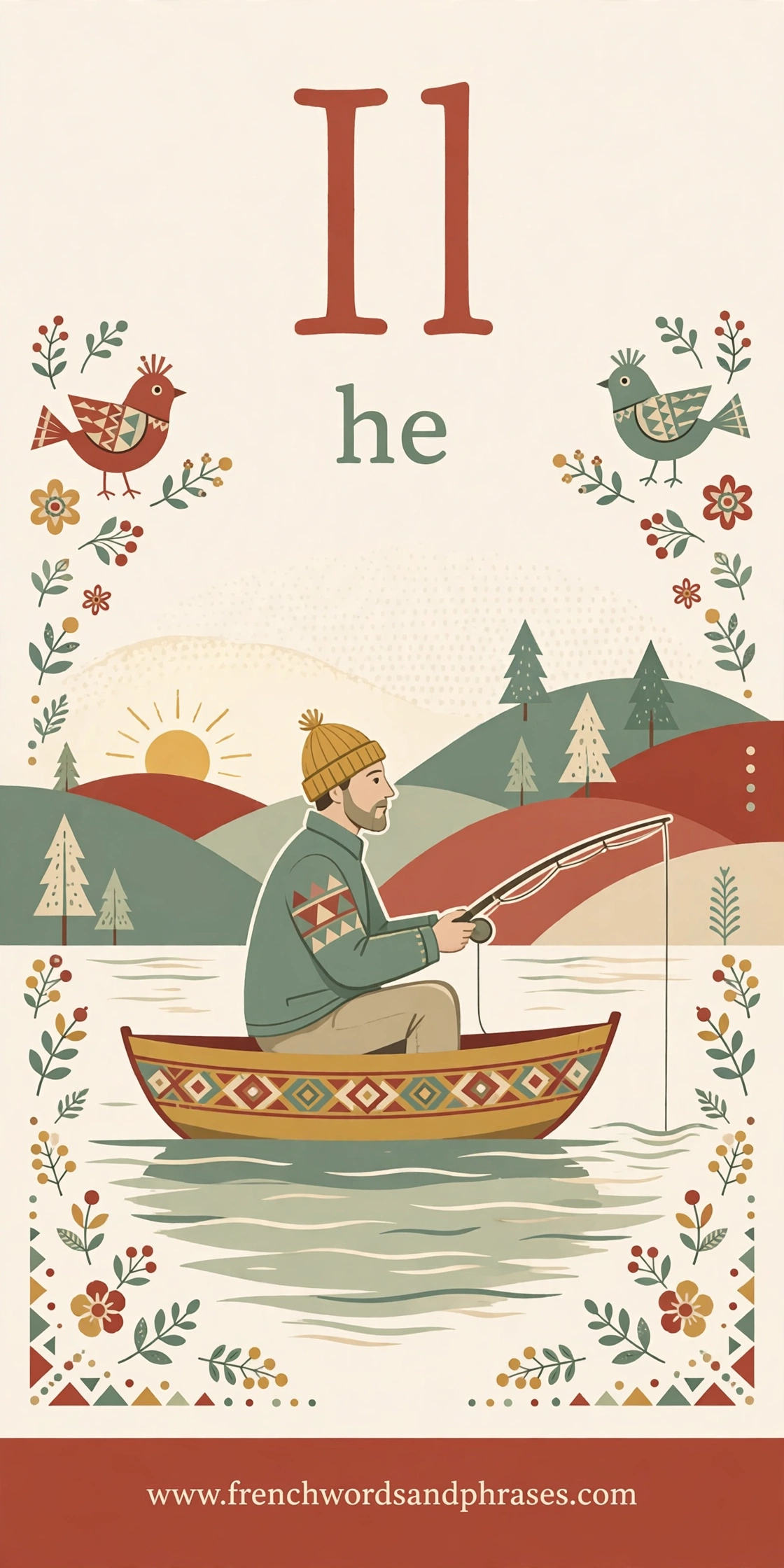
Il means he / it.
Dark clouds gather over the harbour and the fishermen glance at the sky. « Il pleut encore ! » — it is raining again! Il is the hardest-working pronoun in French: it means ‘he’ for a man, ‘it’ for a masculine thing, and even nobody at all — the little word that speaks for the weather itself.
Let’s explore how il works in French, beginning with the whole word on one card.
Understanding the French Pronoun Il
Il is a French subject pronoun — the third person masculine singular. It stands for a man (il parle, he speaks), for a masculine noun (le train → il arrive), and, with no person behind it at all, for the weather and general truths: il pleut, il faut, il y a.
It means he or it. The picture it paints is a stand-in actor: whenever a masculine person or thing has been named, il steps onto the stage in its place and carries the sentence on. And in its strangest job, il plays an empty role — the ‘it’ of il pleut names no one; French simply refuses to let a verb stand without a subject.
Type: Subject pronoun — third person masculine singular (also the impersonal ‘it’)
Answers the question: Qui ? — Who? (Answer: he) — or nobody at all, for the weather
What follows it: A verb: il parle, il arrive, il pleut, il faut
Watch the pair: il (he, or a masculine noun) vs ce (it, pointing at a statement or a thing presented): il est grand = he is tall, c’est grand = it is big
One important usage detail: il never changes before a vowel — il arrive, il écoute, il habite. Unlike je, il keeps both letters in every company; only its plural twin ils loses the s in speech, never in writing.
Experience the Word
Il is the pronoun of a thousand roles — a king, a train, a thunderstorm, all wearing the same two letters.
Imagine a grandfather telling the day’s story: il se lève tôt, il prend son café, il regarde le ciel — il va pleuvoir, dit-il. He gets up early, he has his coffee, he looks at the sky — it is going to rain, he says. One small word carries the man and the weather in a single breath.
You have not just replaced a noun. You have kept the story moving — he, it, the rain itself, all flowing through il.
How to Use Il in French: Complete Guide
Let’s explore how il works in French, beginning with the whole word on one card.
Il at a Glance
The Whole Word on One Card
Meaning, jobs, family and pair — il in four lines.
| Point | Il |
|---|---|
| Meaning | he / it |
| Jobs | a man, a masculine noun, and the impersonal ‘it’ of weather and il y a |
| What it stands for | a male person or any masculine noun already named: Paul → il, le livre → il |
| Its family | il (he/it), elle (she/it), ils (they, masc.), elles (they, fem.) |
Example
Il arrive à la gare à midi.
He (or it) arrives at the station at midday.
The Pattern in Action: Man, Thing and Weather
Il connects three kinds of subject to the verb — a person, a masculine thing, and the empty ‘it’ of the sky.
| Pattern | Example |
|---|---|
| il for a man | il travaille à l’hôpital — he works at the hospital |
| il for a masculine noun | le train est en retard, il arrive à midi — the train is late, it arrives at midday |
| il for the weather | il pleut, il neige, il fait froid — it is raining, it is snowing, it is cold |
| il in fixed phrases | il y a un chat, il faut partir — there is a cat, we must leave |
Example
Il fait beau, alors il joue dehors avec son chien.
The weather is fine, so he is playing outside with his dog.
Quick Quiz 1
In il pleut, who or what is il?
Reveal the answer
Nobody — the weather il is an empty subject; French verbs simply refuse to stand alone.
Il pleut depuis ce matin.
It has been raining since this morning.
The Tricky Bit: Il or Ce for ‘It Is’?
English ‘it is’ splits in two in French: ce presents and points, il continues a story already begun.
| Situation | What happens |
|---|---|
| presenting a thing or an idea: ce | c’est un livre, c’est magnifique — it is a book, it is wonderful (pointing at it) |
| continuing about a known masculine noun: il | le livre ? il est sur la table — the book? it is on the table |
| il est + adjective for a man | il est grand, il est fatigué — he is tall, he is tired |
| il est + time or a general truth | il est midi, il est temps de partir — it is midday, it is time to leave |
Example
Regarde ce chien : il est énorme ! C’est un géant.
Look at this dog: it is enormous! It is a giant.
Where It Goes: Before the Verb, Always
Il holds the subject’s seat in every weather report and every story — it cannot be dropped, moved or stressed.
| Position / pattern | Example |
|---|---|
| at the head of the sentence | il comprend la question — he understands the question |
| in the negative, il … ne + verb | il ne vient pas ce soir — he is not coming this evening |
| in questions, inverted | vient-il demain ? — is he coming tomorrow? (formal written style) |
| il y a, the great exception | il y a trois chats dans le jardin — there are three cats in the garden |
Example
Il ne pleut plus, le soleil revient.
It is not raining any more, the sun is coming back.
Quick Quiz 2
“It is a cat” — pointing at an animal in the garden: il est un chat or c’est un chat?
Reveal the answer
c’est un chat — before un + noun, French presents with ce, not il.
C’est un chat, il dort sous l’arbre.
It is a cat, it is sleeping under the tree.
Everyday Expressions with Il
Il runs the weather forecast and half the fixed phrases of daily life.
| Expression | In English |
|---|---|
| il y a | there is / there are |
| il pleut / il neige | it is raining / it is snowing |
| il fait beau | the weather is fine |
| il faut | it is necessary, one must |
| il est temps de… | it is time to… |
Example
Il y a du vent aujourd’hui, il faut un manteau.
It is windy today, a coat is necessary.
Close Cousins: Il, Elle, Ce
Three ways to say he, she and it — the difference is the noun’s gender and the pointing finger.
| Word | The difference |
|---|---|
| il | he, or it for a masculine noun: le soleil → il brille |
| elle | she, or it for a feminine noun: la lune → elle brille |
| ce | it for presenting ideas and things: c’est vrai, c’est mon frère |
| ils | they for men or masculine things: les trains → ils arrivent |
Example
Le soleil brille, la lune aussi — il fait jour, elle veille la nuit.
The sun shines, the moon too — it lights the day, she watches over the night.
Quick Quiz 3
La table is feminine. “It is big” — il est grande or elle est grande?
Reveal the answer
elle est grande — a feminine noun is replaced by elle, and the adjective agrees: grande.
La table ? Elle est grande et lourde.
The table? It is big and heavy.
Il and Its Neighbours
The subject shelf: the whole family of people who can drive a verb.
| French | In English |
|---|---|
| je | I |
| tu | you (one friend) |
| il / elle | he / she — it |
| nous | we |
| vous | you (formal or plural) |
| ils / elles | they |
Example
Il chante, elle danse, et ils rient ensemble.
He sings, she dances, and they laugh together.
Watch Out: The Traps Around Il
The traps: il for a woman, a missing weather subject, and il est where c’est belongs.
| Trap | The truth |
|---|---|
| using il for a woman or a feminine noun | she and feminine things take elle: Marie → elle, la voiture → elle |
| dropping il in weather sentences | ‘pleut’ alone is impossible — il pleut, il neige, il fait beau |
| saying ‘il est un professeur’ for a presentation | presenting a person or thing takes ce: c’est un professeur (il est professeur, with no un, is the other pattern) |
| translating every ‘it’ as il | ideas and statements take ce: c’est vrai, c’est fini — not ‘il est vrai’ in everyday speech |
Example
Il est tard, il faut rentrer.
It is late, we must go home.
Quick Quiz 4
Complete: ______ neige en montagne en hiver. (It snows in the mountains in winter)
Reveal the answer
Il — weather verbs always carry their empty subject il.
Il neige en montagne en hiver.
It snows in the mountains in winter.
Il in Everyday French: Real-Life Examples
Now that you know the word, let’s see how il appears in everyday French.
Example Example 1 — Weather
Il fait froid ce matin, mets un manteau.
It is cold this morning, put on a coat.
Example Example 2 — A brother
Il joue au football tous les samedis.
He plays football every Saturday.
Example Example 3 — The train
Le train est en retard : il arrive à midi.
The train is late: it arrives at midday.
Example Example 4 — Existence
Il y a un marché sur la place le dimanche.
There is a market on the square on Sundays.
Example Example 5 — Obligation
Il faut acheter du pain avant midi.
We must buy bread before midday.
Example Example 6 — A description
Il est grand, gentil et très drôle.
He is tall, kind and very funny.
Beyond Translation: The Meaning of Il
No pronoun in French works harder than il. It is a brother, a train, a thunderstorm; it announces what exists (il y a), what must be done (il faut) and what the sky is doing (il pleut) — three universes in two letters.
To say il is to give the sentence a subject, even when the subject is the weather itself.
Grammarians call this il ‘impersonal’, but there is nothing cold about it: il pleut is the first sentence of a thousand French mornings, spoken over coffee while the rain writes on the windows.
How to Remember the French Pronoun Il
Remember it this way: Remember it this way: Il is the great stand-in — a man, a masculine thing, or the empty chair the weather sits in.
- You match the noun — masculine things take il, feminine things take elle: le livre → il, la table → elle.
- You never drop the weather’s il — il pleut, il neige, il fait beau, always with il in front.
- You present with ce — c’est un livre, c’est vrai; il continues the story, ce starts it.
The key idea is il means he or it for the masculine — and as an empty subject it runs the weather, il y a and il faut, while ce presents new things.
Test Your Knowledge of Il
Let’s see how much you’ve learned. Try answering these questions before revealing the answers.
Question 1
What does il mean?
Reveal the answer
He / it — the subject pronoun of the third person masculine singular.
Question 2
How do you say ‘it is raining’ and ‘it is snowing’?
Reveal the answer
Il pleut, il neige — weather verbs always take the impersonal il.
Question 3
Translate: There is a cat in the garden.
Reveal the answer
Il y a un chat dans le jardin.
Question 4
A feminine noun — la voiture — is ‘it’. Which pronoun replaces it?
Reveal the answer
Elle — feminine nouns take elle: la voiture → elle est rouge.
Question 5
Complete the sentence:
______ faut partir maintenant. (We must leave now.)
Reveal the answer
Il
Il faut partir maintenant.
We must leave now.
Your Final Challenge
Can You Use It?
How would you say this in French?
“How would you say this in French?”
Reveal the answer
Il pleut, alors il reste à la maison.
It is raining, so he is staying at home.
A little French. A little curiosity. A richer everyday life.
LEARN FRENCH ONE WORD AT A TIME