A French Word to Live By
Translate Le mien to English
/lə mjɛ̃/
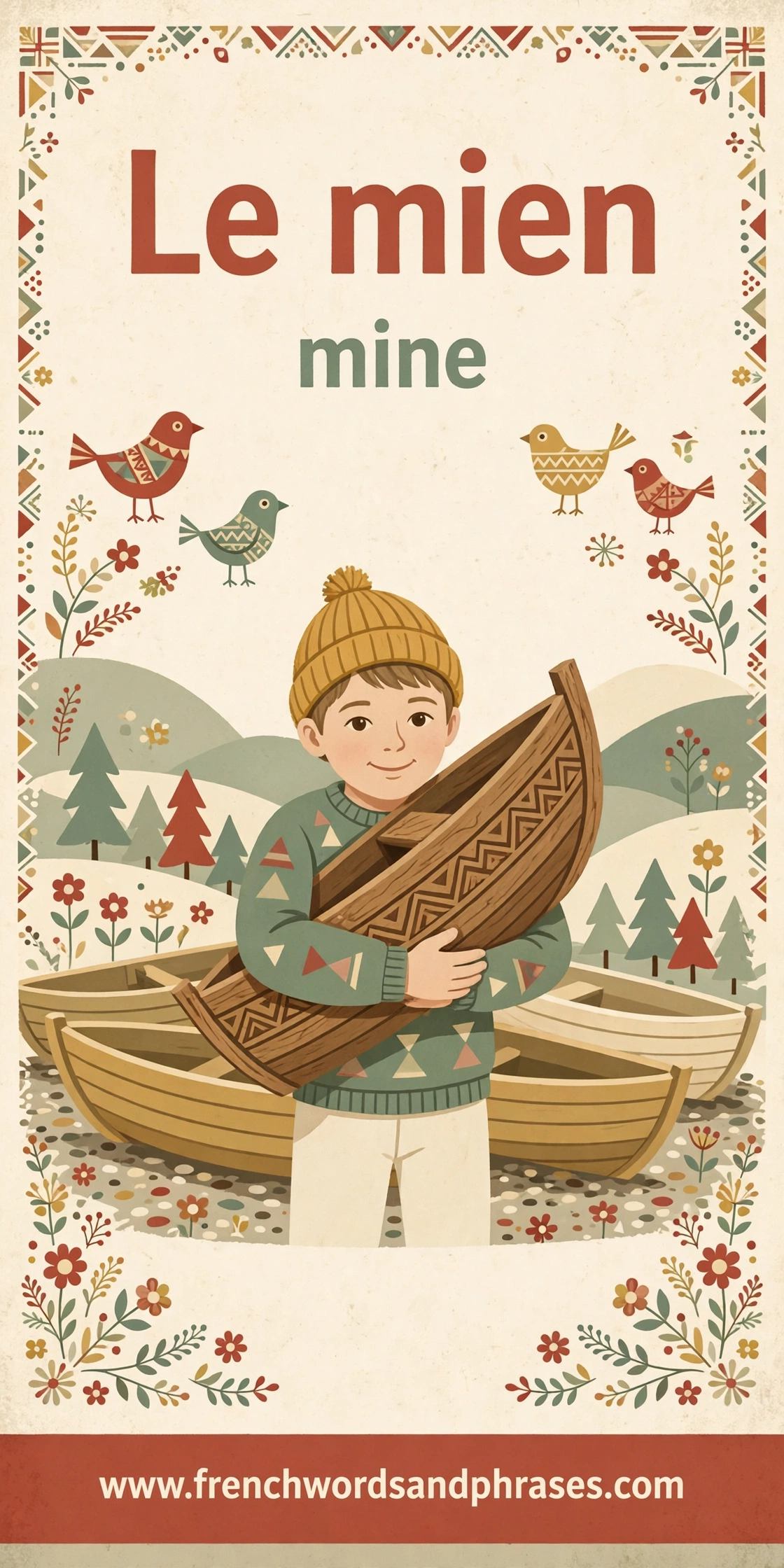
Le mien means mine.
Two black umbrellas drip side by side in a café doorway, identical twins after the rain. A woman reaches for one and smiles: « Non, celui-là, c’est le tien — le mien est celui-ci. » — No, that one is yours — mine is this one. Le mien is the French word for claiming what belongs to you without naming it again: my one, mine.
Let’s explore how le mien works in French, beginning with the whole word on one card.
Understanding the French Pronoun Le mien
Le mien is a French possessive pronoun — it means mine. It replaces mon / ma / mes plus a noun in a single phrase: mon parapluie (my umbrella) becomes le mien (mine). It is the first-person member of the set le mien / le tien / le sien / le nôtre / le vôtre / le leur.
It means mine — my one, the one that belongs to me. The picture it paints is a hand closing gently around a possession: of the two umbrellas, two bicycles, two seats, le mien picks out yours and says: this one is spoken for.
Type: Possessive pronoun — mine (first person singular)
Answers the question: À qui ? — Whose? (Answer: mine, my one)
What follows it: Nothing needs to follow — it stands alone as a subject or after être: le mien est rouge, c’est le mien
Watch the pair: le mien (mine, a pronoun — no noun after it) vs mon (my, a determiner — a noun always follows: mon livre)
One important usage detail: le mien agrees with the THING owned, never with the owner. A woman holding her book says le mien (mon livre is masculine), and holding her car she says la mienne (ma voiture is feminine) — the owner’s own gender never appears in the word at all.
Experience the Word
Le mien is the pronoun of quiet ownership — it exists for the moment when two similar things sit side by side and you lay your claim to one of them.
Imagine a row of bicycles outside a school, a dozen nearly identical. One boy points without hesitating: le mien, c’est celui avec la selle rouge — mine is the one with the red saddle.
You have not just named a possession. You have claimed it: of all of these, this one belongs to me.
How to Use Le mien in French: Complete Guide
Let’s explore how le mien works in French, beginning with the whole word on one card.
Le mien at a Glance
The Whole Word on One Card
Meaning, job, grid and signal — le mien in four lines.
| Point | Le mien |
|---|---|
| Meaning | mine — my one, the one belonging to me |
| Job | possessive pronoun — replaces mon / ma / mes + noun |
| The full grid | le mien (m. sg.), la mienne (f. sg.), les miens (m. pl.), les miennes (f. pl.) |
| What shapes it | the thing owned — its gender and number, never the owner’s |
Example
Ce vélo ? C’est le mien.
This bike? It is mine.
The Pattern in Action: Claiming Without Repeating
Le mien connects a sentence to a possession already mentioned — and takes the place of mon, ma or mes plus the whole noun.
| Pattern | Example |
|---|---|
| as a subject | le mien est plus grand — mine is bigger |
| after c’est | c’est le mien, pas le tien — it is mine, not yours |
| in comparisons | ton jardin est beau, mais le mien est plus sauvage — your garden is beautiful, but mine is wilder |
| after a preposition | je tiens au mien — I am attached to mine (à + le mien = au mien) |
Example
Ton café est chaud ; le mien est déjà froid.
Your coffee is hot; mine is already cold.
Quick Quiz 1
In le mien est rouge, what does the le part match — the owner or the thing owned?
Reveal the answer
The thing owned — le mien is masculine because the possession (un stylo, un livre) is masculine, whoever owns it.
Le mien est rouge.
Mine is red.
The Tricky Bit: It Agrees With the Thing, Not the Owner
This is the trap that catches every learner: the shape of le mien describes the possession, and the owner disappears completely.
| Situation | How it works |
|---|---|
| a woman, one masculine thing | elle dit: le mien — her book (mon livre) gives le mien, exactly as a man would say |
| a man, one feminine thing | il dit: la mienne — his car (ma voiture) gives la mienne, exactly as a woman would say |
| several things owned | les miens (masculine or mixed), les miennes (feminine) — mes livres → les miens, mes clés → les miennes |
| the article is part of the word | never drop it: c’est le mien — ‘c’est mien’ is not French |
Example
Ma sœur a un vélo bleu ; le mien est rouge.
My sister has a blue bike; mine is red.
Where It Goes: Wherever the Noun Would Have Gone
Le mien takes the whole noun phrase’s seat — subject, after être, after prepositions, everywhere mon + noun could stand.
| Position / pattern | Example |
|---|---|
| subject, before the verb | le mien arrive demain — mine arrives tomorrow |
| after être | ce sac est le mien — this bag is mine |
| after a preposition | je compte sur le mien — I am counting on mine |
| in comparisons | le tien est neuf, le mien est ancien — yours is new, mine is old |
Example
Prends le tien ; je garde le mien.
Take yours; I am keeping mine.
Quick Quiz 2
A woman shows you her car (sa voiture) and says “mine is red”. Does she say le mien or la mienne?
Reveal the answer
la mienne — voiture is feminine, so the pronoun is feminine, whoever owns the car.
La mienne est rouge.
Mine is red.
Everyday Expressions with Le mien
Le mien turns up in coat-checks, classrooms and family lunches — anywhere two similar things wait to be claimed.
| Expression | In English |
|---|---|
| c’est le mien | it is mine |
| le mien aussi | mine too |
| pas le mien | not mine |
| les miens | my people, my family — les miens me manquent, I miss my loved ones |
| le mien est prêt | mine is ready |
Example
Les miens arrivent dimanche pour le déjeuner.
My family are arriving on Sunday for lunch.
Close Cousins: Le mien, Mon, À moi
Three ways to claim something — the difference is whether a noun follows, and how loudly you claim it.
| Word | The difference |
|---|---|
| mon / ma / mes | the determiners ‘my’ — a noun must follow: mon livre, ma voiture, mes clés |
| le mien | the pronoun ‘mine’ — no noun follows; it replaces the whole phrase: le mien |
| à moi | the stressed claim after c’est: c’est à moi — it is mine (that one is MINE) |
| le tien / le sien | the same pronoun for other owners: le tien (yours), le sien (his / hers) |
Example
C’est mon livre, alors c’est le mien, pas le tien.
It is my book, so it is mine, not yours.
Quick Quiz 3
Which cousin must be followed by a noun — le mien or mon?
Reveal the answer
mon — mon is a determiner and needs its noun; le mien stands alone.
Mon vélo est rouge.
My bike is red.
Le mien and Its Neighbours
The ownership shelf: the whole possessive pronoun family, owner by owner.
| French | In English |
|---|---|
| le mien / la mienne | mine |
| le tien / la tienne | yours (for tu) |
| le sien / la sienne | his / hers |
| le nôtre / la nôtre | ours |
| le vôtre / la vôtre / le leur / la leur | yours (for vous) / theirs |
Example
Le mien est petit, le tien est grand, et le leur est immense.
Mine is small, yours is big, and theirs is huge.
Watch Out: The Traps Around Le mien
The traps: agreeing with the owner, dropping the article, and standing le mien in front of a noun.
| Trap | The truth |
|---|---|
| agreeing with the owner | a woman says le mien for her book and a man says la mienne for his car — the thing owned decides, never the owner |
| dropping the article | the article belongs to the pronoun: c’est le mien — never ‘c’est mien’ |
| putting a noun after it | le mien already contains the noun: never ‘le mien livre’ — say mon livre or just le mien |
| forgetting the contractions | à + le mien = au mien, de + les miens = des miens: je parle des miens — I am talking about my family |
Example
Elle a pris le sien par erreur ; le mien est encore là.
She took hers by mistake; mine is still here.
Quick Quiz 4
Complete: Ce parapluie, c’est ______. (This umbrella is mine.)
Reveal the answer
le mien — parapluie is masculine, and the article is part of the pronoun.
Ce parapluie, c’est le mien.
This umbrella is mine.
Le mien in Everyday French: Real-Life Examples
Now that you know the word, let’s see how le mien appears in everyday French.
Example Example 1 — Umbrellas
Attention, ce parapluie est le mien !
Careful, this umbrella is mine!
Example Example 2 — Books
Ton livre est neuf ; le mien est tout usé.
Your book is new; mine is all worn out.
Example Example 3 — A phone rings
Écoute, c’est le mien qui sonne.
Listen, it is mine that is ringing.
Example Example 4 — A seat
Cette place, c’est la mienne.
This seat is mine.
Example Example 5 — Family
Les miens me manquent quand je voyage.
I miss my loved ones when I travel.
Example Example 6 — Coffee
Le mien est sans sucre, merci.
Mine is without sugar, thank you.
Beyond Translation: The Meaning of Le mien
English “mine” is a plain claim, but French le mien keeps a portrait of the possession inside itself: le, la, les announce the shape of the thing owned before you even hear the word mien. The owner stays modestly invisible — grammar cares about what is owned, not who owns it.
To say le mien is to claim without naming: my one, this one, spoken for.
And the word stretches kindly beyond objects: les miens means my people, my family — the ones who are ‘mine’ by love rather than by law.
How to Remember the French Pronoun Le mien
Remember it this way: Remember it this way: Le mien is mon without its noun — the article takes the noun’s shape, and the owner vanishes.
- You dress it like the thing owned — un livre → le mien, une voiture → la mienne, des clés → les miennes.
- You never drop the article — c’est le mien, with le, la or les always in front.
- You keep mon for nouns — mon livre when the noun is spoken, le mien when it is not.
The key idea is le mien means mine — it agrees with the thing owned (le mien, la mienne, les miens, les miennes), never with the owner.
Test Your Knowledge of Le mien
Let’s see how much you’ve learned. Try answering these questions before revealing the answers.
Question 1
What does le mien mean?
Reveal the answer
Mine — my one, the one belonging to me; the possessive pronoun for mon / ma / mes + noun.
Question 2
What are the four forms of ‘mine’ in French?
Reveal the answer
Le mien, la mienne, les miens, les miennes — chosen by the gender and number of the thing owned.
Question 3
Translate: Your bike is new, mine is old.
Reveal the answer
Ton vélo est neuf, le mien est vieux.
Question 4
A man is talking about his car (ma voiture). Which form does he use for ‘mine’?
Reveal the answer
La mienne — voiture is feminine, so the pronoun is feminine, whoever owns the car.
Question 5
Complete the sentence:
Ce sac, c’est ______. (This bag is mine.)
Reveal the answer
le mien
Ce sac, c’est le mien.
This bag is mine.
Your Final Challenge
Can You Use It?
How would you say this in French?
“How would you say this in French?”
Reveal the answer
Ton sac est là-bas, le mien est ici.
Your bag is over there, mine is here.
A little French. A little curiosity. A richer everyday life.
LEARN FRENCH ONE WORD AT A TIME