A French Word to Live By
Translate Et to English
/e/
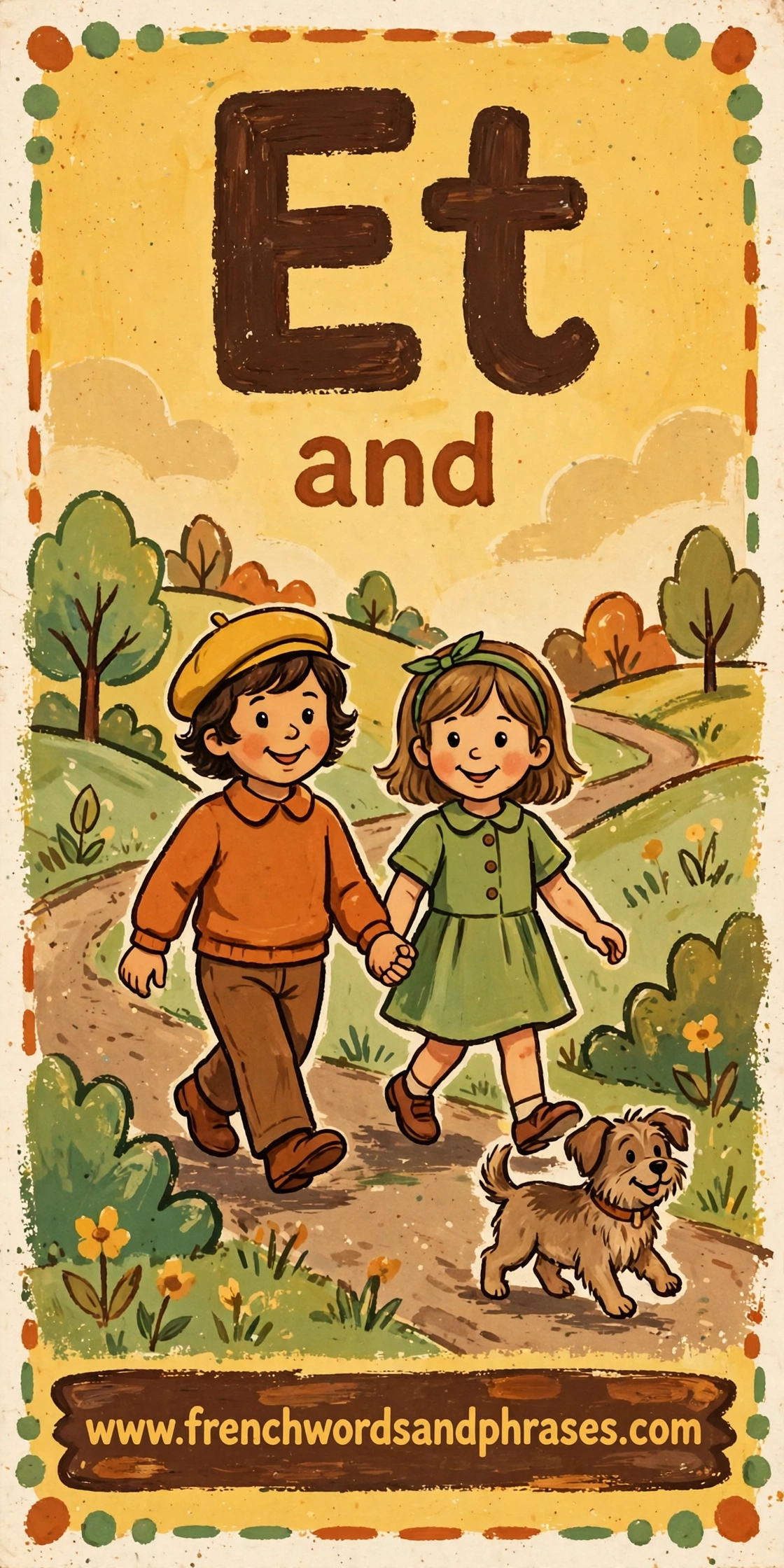
Et means and.
« Et après… et après… » — a child telling you about his day never stops: and then… and then… French runs on et. It is the smallest bridge in the language, crossed a hundred times a day without anyone noticing the crossing.
In this guide, you’ll learn what et means in English, how it joins words and whole sentences, why French puts no comma before it in a list, and how it differs from aussi. Explore French examples, English translations, and practice quizzes.
Understanding the French Conjunction Et
Et is a French coordinating conjunction — the simplest linker in the language. It does not bend one clause under another; it places two equals side by side: a word and a word, a phrase and a phrase, a sentence and a sentence.
It means and. After et can come almost anything, as long as it matches what came before: du pain et du beurre — bread and butter; elle chante et elle danse — she sings and she dances.
Type: Coordinating conjunction — addition
Joins: Words, phrases and whole clauses of equal rank
What follows it: The same kind of element as the one before it
Mood after it: None of its own — verbs stay in the indicative
One detail to fix early: French does not put a comma before et at the end of a list the way English sometimes does before ‘and’. Des pommes, des poires et des bananes — apples, pears and bananas, with no comma before et.
Experience the Word
Et is the conjunction of the open hand — it never chooses, never ranks, never refuses; it simply adds.
Imagine a market stall in Provence on a Saturday morning: the seller calls out his tomatoes, his melons, his olives, and between every treasure, the same small word — et — like a basket that always has room for one more.
You have not just added a word. You have refused to stop the list.
How to Use Et in French: Complete Guide
Let’s explore how et works in French, beginning with the whole word on one card.
Et at a Glance
Before the details, here is the whole word on one card.
The Whole Word on One Card
Meaning, job, pattern and mood — et in four lines.
| Point | Et |
|---|---|
| Meaning | and |
| Job | adds equals together — words, phrases, clauses |
| What follows | an element matching the one before it |
| Mood | none of its own; verbs stay indicative |
Example
Du thé et du café, s’il vous plaît.
Tea and coffee, please.
How Et Links: Equals, Side by Side
Et is a level bridge: what stands on one side must match what stands on the other — noun with noun, verb with verb, clause with clause.
| Pattern | Example |
|---|---|
| two nouns | le chat et le chien — the cat and the dog |
| two adjectives | petit et mignon — small and cute |
| two verbs, one subject | il lit et écrit — he reads and writes |
| two full clauses | le soleil brille et les oiseaux chantent — the sun is shining and the birds are singing |
Example
Nous avons acheté des fleurs et du chocolat.
We bought flowers and chocolate.
Quick Quiz 1
What kind of elements does et join — equals, or a main clause and a lesser clause?
Reveal the answer
Equals — et is a coordinating conjunction: noun with noun, clause with clause.
Du pain et du vin.
Bread and wine.
The Mood Question: Et Changes Nothing
Because et only coordinates, it never triggers the subjunctive and never changes a tense. Each verb keeps the mood it would have on its own — almost always the indicative.
| Combination | Example |
|---|---|
| present stays present | je mange et je bois — I eat and I drink |
| past stays past | elle est venue et elle a tout raconté — she came and she told everything |
| future stays future | tu partiras et tu reviendras — you will leave and you will come back |
| commands stay commands | assieds-toi et écoute — sit down and listen |
Example
Il a ouvert la porte et il est entré.
He opened the door and went in.
Where Et Goes: Between the Two Equals
Et always stands exactly at the joint. Two small rules guard it: no comma before it in a list, and no elision — et never shortens, even before a vowel.
| Position | Example |
|---|---|
| between two words | noir et blanc — black and white |
| no comma before et in lists | des pommes, des oranges et des citrons — apples, oranges and lemons |
| no elision before a vowel | et elle, et Anne — et keeps its full shape; the two words stay separate |
| at the start of a sentence (speech, for effect) | Et voilà ! — And there you are! |
Example
Marc et Anne arrivent demain.
Marc and Anne are arriving tomorrow.
Quick Quiz 2
True or false: in a French list, you put a comma before et, like the English Oxford comma.
Reveal the answer
False — French lists close without a comma before the final et.
Des stylos, des cahiers et des livres.
Pens, notebooks and books.
Everyday Expressions with Et
Et hides inside some of the most useful phrases in spoken French — learn these and whole conversations open up.
| Expression | In English |
|---|---|
| et alors ? | so what? / and then? |
| et voilà | and there you go / that’s it |
| et tout | and everything / and all that |
| et puis | and then / and besides |
| et cetera (etc.) | and so on |
Example
On a mangé, on a ri, et voilà, la soirée était finie.
We ate, we laughed, and that was it, the evening was over.
Close Cousins: Et, Aussi, Ainsi que, De plus
French has several ways to add things, and each has its own seat. Et is the plain, all-purpose one — here is the family portrait.
| Word | The difference |
|---|---|
| et | the plain ‘and’ — joins anything to anything |
| aussi | ‘also/too’ — adds a fact, but sits by the verb or at the end: moi aussi |
| ainsi que | ‘as well as’ — slightly formal, joins nouns elegantly |
| de plus | ‘moreover’ — adds a new argument, starts its own sentence |
Example
Elle parle français et elle parle aussi italien.
She speaks French and she also speaks Italian.
Quick Quiz 3
‘Me too’ in French — et moi or moi aussi?
Reveal the answer
moi aussi — et never means ‘too’ on its own.
— Tu aimes le jazz ? — Moi aussi.
— Do you like jazz? — Me too.
Et and Its Neighbours
Addition has a whole neighbourhood: here are the words that keep et company, and the two that push the other way.
| French | In English |
|---|---|
| aussi | also, too |
| également | also (a little more formal) |
| en plus | on top of that |
| mais | but — the neighbour that pushes the other way |
| ou | or — the neighbour that makes you choose |
Example
Tu veux du thé ou du café ? Moi, je prends les deux : du thé et du café.
Do you want tea or coffee? Me, I’ll have both: tea and coffee.
Watch Out: The Traps Around Et
Three traps catch learners: a twin with the same sound, an English comma habit, and a liaison that must never happen.
| Trap | The truth |
|---|---|
| et vs est | same sound, different worlds: et = and, est = is. Mon frère est grand et gentil. |
| et before a vowel | never elide et and never make the liaison: say et Anne, et elle — the t stays silent |
| the English comma habit | drop the comma before et at the end of a list |
| repeating the subject | after et you may drop a repeated subject: il chante et danse — he sings and dances |
Example
Paul est petit et mince.
Paul is small and slim.
Quick Quiz 4
Which word means ‘and’ — est or et?
Reveal the answer
et. Est means ‘is’.
Elle est fatiguée et elle dort.
She is tired and she is sleeping.
Et in Everyday French: Real-Life Examples
Now that you know the word, let’s see how et appears in everyday French.
Example 1 — At the market
Je voudrais des tomates et des courgettes, s’il vous plaît.
I’d like some tomatoes and some zucchini, please.
Example 2 — Family
Mon frère et ma sœur habitent à Lyon.
My brother and my sister live in Lyon.
Example 3 — Weather
Aujourd’hui, il y a du soleil et du vent.
Today there is sun and wind.
Example 4 — Plans
On se retrouve à huit heures et on va au cinéma.
We’ll meet at eight and go to the movies.
Example 5 — A description
C’est une maison simple et jolie.
It’s a simple, pretty house.
Example 6 — The storyteller
Et après, le chat est entré, et tout le monde a ri.
And then the cat came in, and everyone laughed.
Beyond Translation: The Meaning of Et
English says and for the meaning of et — but no English word is quite so tireless. Et is the breath between two thoughts, the hinge that lets a French sentence keep walking instead of stopping.
Where English pauses, French links — et is the link.
Children learn it before almost any other connector, because childhood itself is a list: this happened, et this, et this. To master et is to learn that in French, a story never has to end just because a sentence did.
How to Remember the French Conjunction Et
Remember it this way: Et is the basket word — there is always room for one more thing inside it.
- You match like with like — du pain et du vin, noun with noun.
- You skip the comma before it — French lists close without one.
- You never shorten it — et elle stays two full words.
The key idea is et adds equals, takes no comma, and never changes shape.
Test Your Knowledge of Et
Let’s see how much you’ve learned. Try answering these questions before revealing the answers.
Question 1
What does et mean?
Reveal the answer
And — it joins words, phrases and clauses of equal rank.
Question 2
Translate: Bread and butter.
Reveal the answer
Du pain et du beurre.
Question 3
True or false: French puts a comma before et at the end of a list.
Reveal the answer
False — des pommes, des poires et des bananes, with no comma before et.
Question 4
Which word means ‘is’ — et or est?
Reveal the answer
est. Et means ‘and’: il est grand et fort — he is tall and strong.
Question 5
Complete the sentence:
Nous avons un chat ______ un chien.
Reveal the answer
et
Nous avons un chat et un chien.
We have a cat and a dog.
Your Final Challenge
Can You Use It?
How would you say this in French?
“I bought apples and oranges.”
Reveal the answer
J’ai acheté des pommes et des oranges.
I bought apples and oranges.
A little French. A little curiosity. A richer everyday life.
LEARN FRENCH ONE WORD AT A TIME