A French Word to Live By
Translate Ou to English
/u/
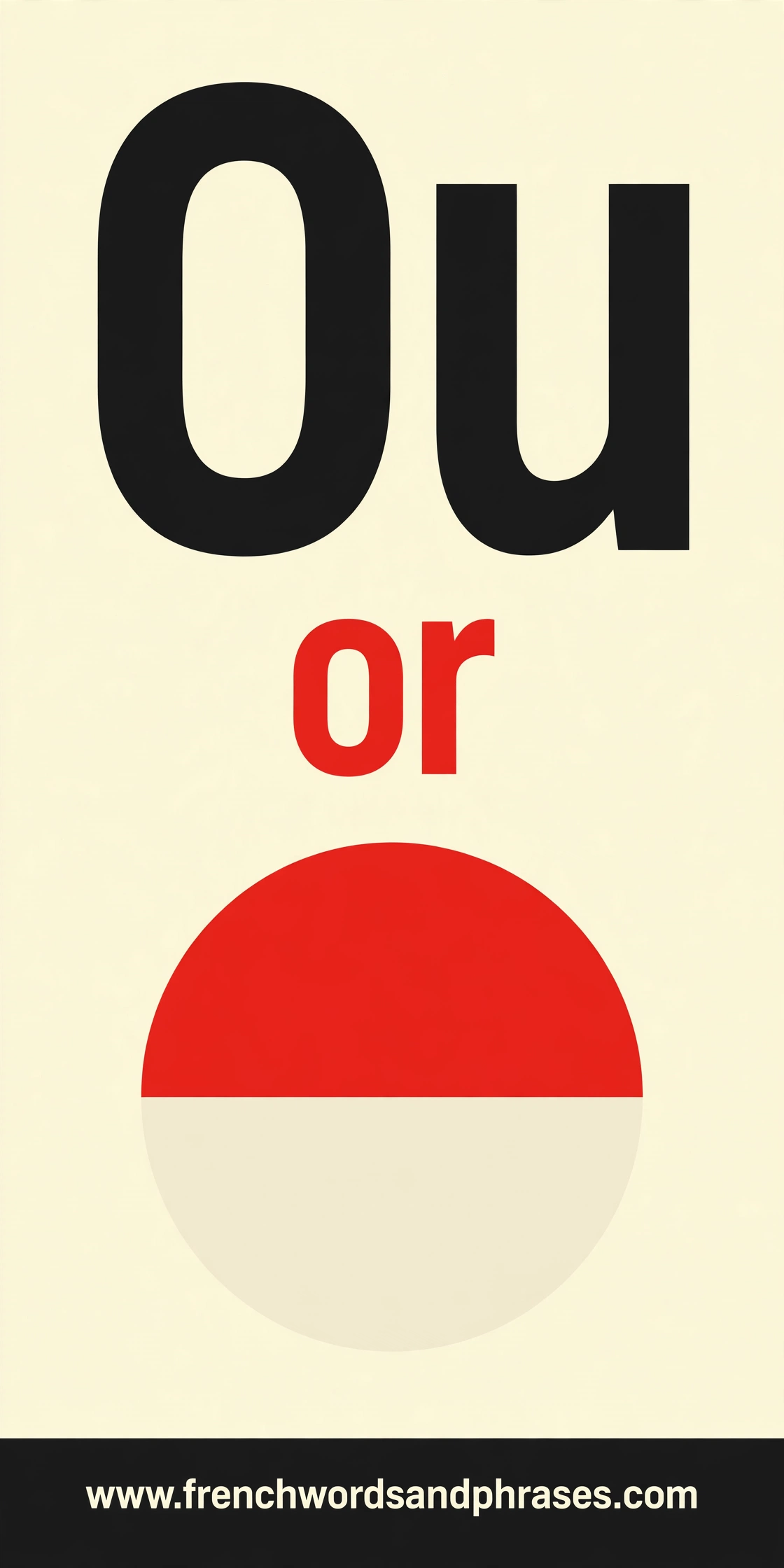
Ou means or.
« Thé ou café ? » — tea or coffee? the waiter asks, and the whole morning hangs on a two-letter word. Ou is the crossroads of French: every choice you make, you make with it.
In this guide, you’ll learn what ou means in English, how it offers a choice, how ou… ou builds ‘either… or’, and why one small accent separates ou from où, ‘where’. Explore French examples, English translations, and practice quizzes.
Understanding the French Conjunction Ou
Ou is a French coordinating conjunction of choice. It links alternatives of equal rank and asks the listener — or the sentence itself — to pick one.
It means or. Ou can join nouns, adjectives, verbs or whole clauses: du thé ou du café — tea or coffee; tu viens ou tu restes ? — are you coming or staying?
Type: Coordinating conjunction — choice
Joins: Words, phrases and clauses of equal rank
What follows it: The alternative element
Mood after it: None of its own — verbs stay in the indicative
Watch the accent: ou with no accent means ‘or’; où with a grave accent means ‘where’. One tiny mark, two different universes: le jour où… — the day when…
Experience the Word
Ou is the conjunction of the open door — nothing is decided until you walk through one side of it.
Imagine a child in a bakery, nose at the glass, one coin in his fist: un croissant ou un pain au chocolat. The whole of philosophy — desire, limit, choice — is inside that ou.
You have not just offered an alternative. You have made the world branch.
How to Use Ou in French: Complete Guide
Let’s explore how ou works in French, beginning with the whole word on one card.
Ou at a Glance
Before the details, here is the whole word on one card.
The Whole Word on One Card
Meaning, job, pattern and mood — ou in four lines.
| Point | Ou |
|---|---|
| Meaning | or |
| Job | offers a choice between equals |
| What follows | an element matching the one before it |
| Mood | none of its own; verbs stay indicative |
Example
Tu veux du thé ou du café ?
Do you want tea or coffee?
How Ou Links: One Side or the Other
Ou is a fork in the road: both paths are open, but the sentence travels down one of them.
| Pattern | Example |
|---|---|
| two nouns | du sucre ou du miel — sugar or honey |
| two adjectives | chaud ou froid — hot or cold |
| two clauses | tu téléphones ou tu écris — you phone or you write |
| the doubled ou… ou | ou tu pars, ou tu restes — either you leave, or you stay |
Example
On part samedi ou dimanche ?
Are we leaving on Saturday or Sunday?
Quick Quiz 1
What does ou… ou mean?
Reveal the answer
Either… or — the choice stated twice, once before each option.
Ou tu m’aides, ou je le fais seul.
Either you help me, or I’ll do it alone.
The Mood Question: Ou Leaves Verbs Alone
Like et, ou only coordinates equals, so it never asks for the subjunctive. The verb on each side of the fork keeps its natural mood and tense.
| Combination | Example |
|---|---|
| present on both sides | il rit ou il pleure — he laughs or he cries |
| past on both sides | elle a téléphoné ou elle est passée — she phoned or she came by |
| a question of choice | vous restez ou vous partez ? — are you staying or leaving? |
| after an order | choisis : le rouge ou le bleu — choose: the red one or the blue one |
Example
Tu as gagné ou tu as perdu ?
Did you win or did you lose?
Where Ou Goes: At the Crossroads
Ou stands between the two options, exactly at the fork. Its firmer partner ou bien warns that the second option is the real alternative.
| Position | Example |
|---|---|
| between the two options | ici ou là — here or there |
| ou bien for a firmer alternative | viens, ou bien reste chez toi — come, or else stay home |
| in questions, the choice is real | c’est vrai ou c’est faux ? — is it true or is it false? |
| no accent — unless it means ‘where’ | ou = or; où = where: la ville où j’habite |
Example
C’est pour aujourd’hui ou pour demain ?
Is it for today or for tomorrow?
Quick Quiz 2
Which word means ‘where’ — ou or où?
Reveal the answer
où, with the grave accent. Ou means ‘or’.
Le village où je suis né.
The village where I was born.
Everyday Expressions with Ou
Ou is tucked inside phrases you will hear every week in France — several of them pair it with its own opposites.
| Expression | In English |
|---|---|
| ou bien | or else / or alternatively |
| tôt ou tard | sooner or later |
| plus ou moins | more or less |
| ou sinon | or otherwise |
| quelque chose ou autre | something or other |
Example
Tôt ou tard, il faut choisir.
Sooner or later, you have to choose.
Close Cousins: Ou, Soit… soit, Sinon, Ni… ni
Choice has a family in French, from the polite offer to the outright warning. Ou is the neutral member — here are its relatives.
| Word | The difference |
|---|---|
| ou | the plain ‘or’ — a simple choice |
| soit… soit | ‘either… or’ — more formal, frames both options up front |
| sinon | ‘otherwise, or else’ — warns of the consequence: dépêche-toi, sinon tu seras en retard |
| ni… ni (with ne) | ‘neither… nor’ — the negative twin: ni thé ni café |
Example
Dépêche-toi, sinon tu vas rater le train.
Hurry up, or else you’ll miss the train.
Quick Quiz 3
How do you say ‘neither tea nor coffee’?
Reveal the answer
ni thé ni café — in a full sentence, ne comes before the verb.
Je ne bois ni thé ni café.
I drink neither tea nor coffee.
Ou and Its Neighbours
Here are the words that keep ou company — including the neighbour that refuses to choose at all.
| French | In English |
|---|---|
| soit… soit | either… or |
| sinon | otherwise, or else |
| ou bien | or else |
| et | and — the neighbour that refuses to choose |
| ni | nor (in negative pairs) |
Example
Avec et, tout s’ajoute ; avec ou, il faut choisir.
With et, everything adds up; with ou, you have to choose.
Watch Out: The Traps Around Ou
One accent, one negative and one generous French habit catch learners around ou.
| Trap | The truth |
|---|---|
| ou vs où | one accent changes everything: ou = or, où = where |
| ‘yes or no’ questions | French asks the choice directly: tu viens ou non ? — are you coming or not? |
| inclusive or | French ou can include both, like English: un café ou un thé — ou les deux ! |
| ou after a negative | use ni instead: je n’ai ni frère ni sœur — I have neither brother nor sister |
Example
Le jour où tu partiras, écris-moi.
The day (when) you leave, write to me.
Quick Quiz 4
Translate: sooner or later.
Reveal the answer
tôt ou tard — ou links the two opposites.
Tôt ou tard, on se reverra.
Sooner or later, we’ll meet again.
Ou in Everyday French: Real-Life Examples
Now that you know the word, let’s see how ou appears in everyday French.
Example 1 — At the café
Un café ou un thé, s’il vous plaît.
A coffee or a tea, please.
Example 2 — Making plans
On se voit vendredi ou samedi ?
Shall we meet on Friday or Saturday?
Example 3 — Shopping
Vous préférez la robe rouge ou la bleue ?
Do you prefer the red dress or the blue one?
Example 4 — Either… or
Ou on cuisine, ou on commande une pizza.
Either we cook, or we order a pizza.
Example 5 — More or less
C’est plus ou moins fini.
It’s more or less finished.
Example 6 — A real choice
Tu restes ou tu pars ? Décide-toi.
Are you staying or leaving? Make up your mind.
Beyond Translation: The Meaning of Ou
English says or for the meaning of ou — but the French word carries a whole philosophy in two letters. Every ou is a small fork in the road of a sentence: life, offered in the alternative.
To speak French is to choose gracefully, one ou at a time.
And guard its accent with your life: ou opens a choice, où opens a map. The difference between deciding and locating is one small mark — French rewards those who notice.
How to Remember the French Conjunction Ou
Remember it this way: Ou is the crossroads word — stand in the middle of it and both roads stay open.
- You offer equals — thé ou café, never a main road and a side path.
- You double it for drama — ou… ou…, either… or.
- You keep it bare — no accent, unless you mean ‘where’: où.
The key idea is ou offers a choice between equals — and the accent belongs to où.
Test Your Knowledge of Ou
Let’s see how much you’ve learned. Try answering these questions before revealing the answers.
Question 1
What does ou mean?
Reveal the answer
Or — it links alternatives and offers a choice.
Question 2
Translate: Tea or coffee?
Reveal the answer
Du thé ou du café ?
Question 3
How do you write ‘where’ — ou or où?
Reveal the answer
où, with a grave accent. Ou means ‘or’.
Question 4
What does ou… ou mean?
Reveal the answer
Either… or: ou tu viens, ou tu restes.
Question 5
Complete the sentence:
Tu veux du pain ______ du riz ?
Reveal the answer
ou
Tu veux du pain ou du riz ?
Do you want bread or rice?
Your Final Challenge
Can You Use It?
How would you say this in French?
“Do you want the red one or the blue one?”
Reveal the answer
Tu veux le rouge ou le bleu ?
Do you want the red one or the blue one?
A little French. A little curiosity. A richer everyday life.
LEARN FRENCH ONE WORD AT A TIME