A French Word to Live By
Translate Vieux to English
/vjø/
Vieux means old.
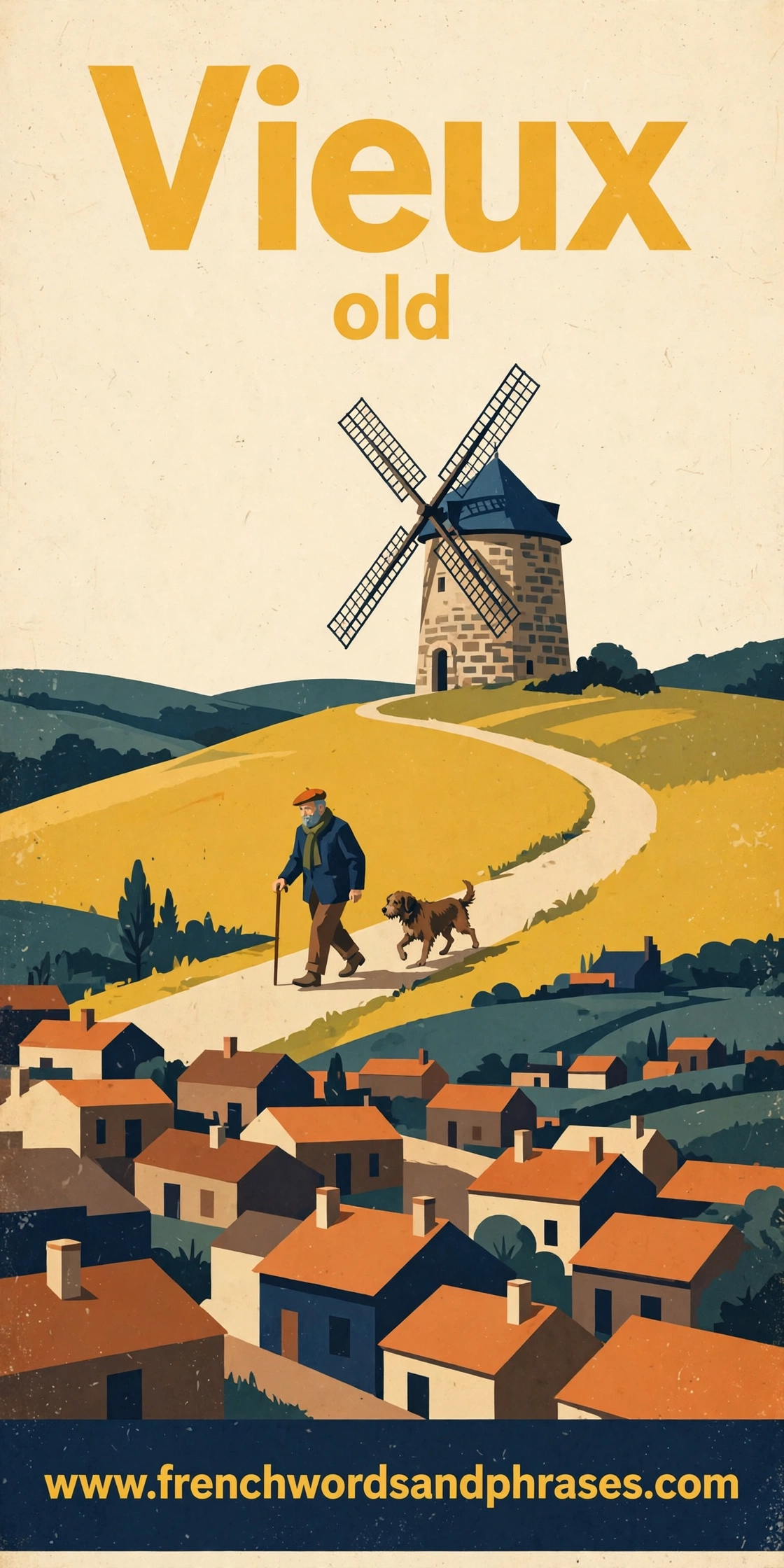
At the top of the village stands a house with blue shutters and a roof that has seen a hundred winters. The same family has grown up inside it for five generations; the apple tree in the garden was old when the grandmother was young. Some things are not worn out. They are vieux, and it is a title of honour.
In this guide, you’ll learn what vieux means in English, its four forms — and its secret fifth, vieil — why a vieil ami may be only thirty, and where vieux stands in front of the noun. Explore French examples, English translations, and practice quizzes.
Understanding the French Adjective Vieux
Vieux is a French adjective of quality — the adjective of age and long acquaintance. Like beau, it stands before the noun, and like beau it keeps a secret fifth form: vieil, which steps in before a masculine noun beginning with a vowel sound.
It means old — of houses, wine, friendships and people. But vieux carries two kinds of age: the age of years, and the age of loyalty. Un vieil ami is a friend of long standing, who may be perfectly young; un homme vieux is a man advanced in years.
Type: Adjective of quality — age
Answers the question: What is it like? — old, long-standing
Changes form: Yes — vieux, vieille, vieux, vieilles, plus vieil before a vowel sound
English equivalents: Old; long-standing (of friends); aged.
One important usage detail: vieux stands BEFORE the noun — une vieille maison. And before a masculine noun starting with a vowel sound, vieux becomes vieil: un vieil ami, un vieil arbre. The feminine vieille never changes.
Experience the Word
Vieux is the adjective of patina — of the table polished by a thousand elbows, the book whose spine is cracked from love.
Imagine a cellar master drawing a bottle from the darkest row, dusting it with the side of his hand: « un vieux vin, un très vieux vin ». He says it the way other men say ‘a great wine’.
You have not just counted the years. You have honoured what the years have made.
How to Use Vieux in French: Complete Guide
Let’s explore how vieux works in French, beginning with the whole word on one card.
Vieux at a Glance
Before the details, here is the whole word on one card.
The Whole Word on One Card
Meaning, type, position and forms — vieux in four lines.
| Point | Vieux |
|---|---|
| Meaning | old |
| Type | adjective of quality — age |
| Usual position | before the noun — une vieille maison |
| Form | vieux / vieille / vieux / vieilles — plus vieil before a vowel |
Example
C’est une vieille maison pleine d’histoires.
It’s an old house full of stories.
The Four Forms of Vieux
Vieux agrees in gender and number — but the masculine, singular and plural, wears the same x-ended shape for both. The feminine vieille is a form of its own.
| Form | Vieux | Example |
|---|---|---|
| Masculine singular | vieux | un vieux château — an old castle |
| Feminine singular | vieille | une vieille église — an old church |
| Masculine plural | vieux | de vieux châteaux — old castles |
| Feminine plural | vieilles | de vieilles églises — old churches |
Example
De vieux villages et de vieilles églises dominent la vallée.
Old villages and old churches overlook the valley.
Quick Quiz 1
Which form of vieux goes with église (feminine)?
Reveal the answer
vieille
Une vieille église.
An old church.
Vieil: The Secret Fifth Form
In front of a masculine noun that begins with a vowel sound, vieux steps aside for vieil — exactly as beau becomes bel. The feminine vieille never changes.
| Situation | Example |
|---|---|
| Before a vowel | un vieil ami — a long-standing friend |
| Before a mute h | un vieil homme — an old man |
| Before a consonant | un vieux château — vieux stays |
| Feminine before a vowel | une vieille école — vieille never changes |
Example
Un vieil arbre ombrage la cour de la vieille école.
An old tree shades the yard of the old school.
Where Vieux Goes: In Front of the Noun
Like beau, vieux leads: it stands before the noun. Moved behind être, it speaks of real age in years — the position quietly chooses the meaning.
| Pattern | Example |
|---|---|
| Before the noun | une vieille maison — an old house |
| vieil before a vowel | un vieil ami — a long-standing friend |
| After être (real age) | il est vieux — he is old (in years) |
| Two adjectives | un beau vieux château — a beautiful old castle |
Example
Mon vieil ami habite une vieille maison au bord du fleuve.
My old friend lives in an old house by the river.
Quick Quiz 2
Where does vieux stand — before or after the noun?
Reveal the answer
Before
Une vieille maison, un vieux village.
An old house, an old village.
Older: Comparing with Vieux
Vieux compares with plus and le plus; for people, French often softens vieux into âgé — older, without the wrinkles.
| Degree | Example |
|---|---|
| As old as | aussi vieux que — as old as |
| Older | plus vieux — older |
| Less old | moins vieux — less old, younger |
| The oldest (masc.) | le plus vieux — le plus vieux village |
| The oldest (fem.) | la plus vieille — la plus vieille maison |
Example
C’est la plus vieille église de la région.
It’s the oldest church in the region.
Everyday Expressions with Vieux
Vieux is soaked in nostalgia: good old days, old bachelors, and a greeting between friends that has nothing to do with age.
| Expression | In English |
|---|---|
| un vieil ami | a long-standing friend (not necessarily old!) |
| au bon vieux temps | in the good old days |
| vieux comme le monde | as old as the hills (literally: as old as the world) |
| se faire vieux | to be getting old |
| un vieux garçon | an old bachelor |
| mon vieux ! | old chap! (a warm, familiar greeting) |
Example
Au bon vieux temps, le train s’arrêtait dans chaque village.
In the good old days, the train stopped in every village.
Quick Quiz 3
Un vieil ami — is the friend necessarily old in years?
Reveal the answer
Not necessarily — a vieil ami is a friend of long standing; he may be thirty.
C’est un vieil ami du lycée.
He’s an old friend from school.
Vieux and Its Neighbours
Age has registers in French — former, elderly, antique — and two bright opposites for everything that is new.
| French | In English |
|---|---|
| ancien | old, former: un ancien professeur, a former teacher |
| âgé | elderly, aged (the polite word for people) |
| antique | antique, ancient |
| démodé | old-fashioned, out of date |
| jeune | young — the opposite |
| neuf / nouveau | brand new / new — the opposites |
Example
Âgé mais plein d’énergie, le vieux professeur raconte ses voyages.
Elderly but full of energy, the old teacher tells of his travels.
Watch Out: The Traps Around Vieux
Vieux’s traps are about which kind of old you mean — years, loyalty, or the wrong word for a person.
| Trap | The truth |
|---|---|
| vieil | only masculine, only before a vowel sound: un vieil ami, but un vieux copain |
| un vieil ami | long-standing, not old: the friendship is old, the friend may not be |
| un vieillard | as a noun, an old man — it can sound unkind; un homme âgé is politer |
| vieux after être | speaks of years: il est vieux is blunter than il est âgé |
Example
Mon vieil ami n’est pas vieux du tout.
My old friend isn’t old at all.
Quick Quiz 4
How do you say ‘an old friend’ (masculine) — un vieux ami or un vieil ami?
Reveal the answer
un vieil ami
Ami begins with a vowel sound, so vieux becomes vieil.
Un vieil ami — an old (long-standing) friend.
Vieux in Everyday French: Real-Life Examples
Now that you know the word, let’s see how vieux appears in everyday French.
Example 1 — In the village
La vieille église domine la place depuis six siècles.
The old church has overlooked the square for six centuries.
Example 2 — Friendship
C’est un vieil ami, on se connaît depuis l’école.
He’s an old friend, we’ve known each other since school.
Example 3 — Wine
Il a ouvert un vieux vin pour l’anniversaire de son père.
He opened an old wine for his father’s birthday.
Example 4 — Nostalgia
Au bon vieux temps, les étés semblaient plus longs.
In the good old days, summers seemed longer.
Example 5 — Family
Mon vieux grand-père raconte toujours la même histoire.
My old grandfather always tells the same story.
Example 6 — Getting old
Notre chien se fait vieux, il dort beaucoup.
Our dog is getting old, he sleeps a lot.
Beyond Translation: The Meaning of Vieux
English says old for the meaning of vieux — but old in English often sounds like a verdict, where vieux can sound like a medal. Vieux vin, vieil ami, vieille maison: the word gathers honour the way its nouns gather dust.
To call something vieux is to say time has tested it, and it is still here.
French even keeps the proof in a greeting between friends — « salut, mon vieux ! » — where old age has nothing to do with it, and loyalty has everything.
How to Remember the French Adjective Vieux
Remember it this way: Vieux is beau’s old companion — it stands in the same place, keeps the same secret fifth form, and honours everything time has tested.
- You see the family together — vieux, vieille, vieux, vieilles — the masculine refuses to change for the plural.
- You hear vieil step in before a vowel — un vieil ami, un vieil arbre.
- You put it in front, always — une vieille maison, un vieux village.
The key idea is vieux stands before the noun, becomes vieil before a vowel, and a vieil ami is old in friendship, not in years.
Test Your Knowledge of Vieux
Let’s see how much you’ve learned. Try answering these questions before revealing the answers.
Question 1
What does vieux mean?
Reveal the answer
Old — in years, or long-standing.
Question 2
What are the forms of vieux?
Reveal the answer
vieux, vieille, vieux, vieilles — plus vieil, the special masculine form before a vowel sound.
Question 3
Translate: an old church.
Reveal the answer
Une vieille église.
Question 4
Which form goes in un ______ ami, before a vowel?
Reveal the answer
vieil
Un vieil ami.
An old friend.
Question 5
Complete the sentence:
Au bon ______ temps, tout semblait plus simple.
Reveal the answer
vieux
Au bon vieux temps, tout semblait plus simple.
In the good old days, everything seemed simpler.
Your Final Challenge
Can You Use It?
How would you say this in French?
“My old friend lives in an old house by the river.”
Reveal the answer
Mon vieil ami habite dans une vieille maison au bord du fleuve.
My old friend lives in an old house by the river.
A little French. A little curiosity. A richer everyday life.
LEARN FRENCH ONE WORD AT A TIME