A French Word to Live By
Translate Mauvais to English
/mo.vɛ/
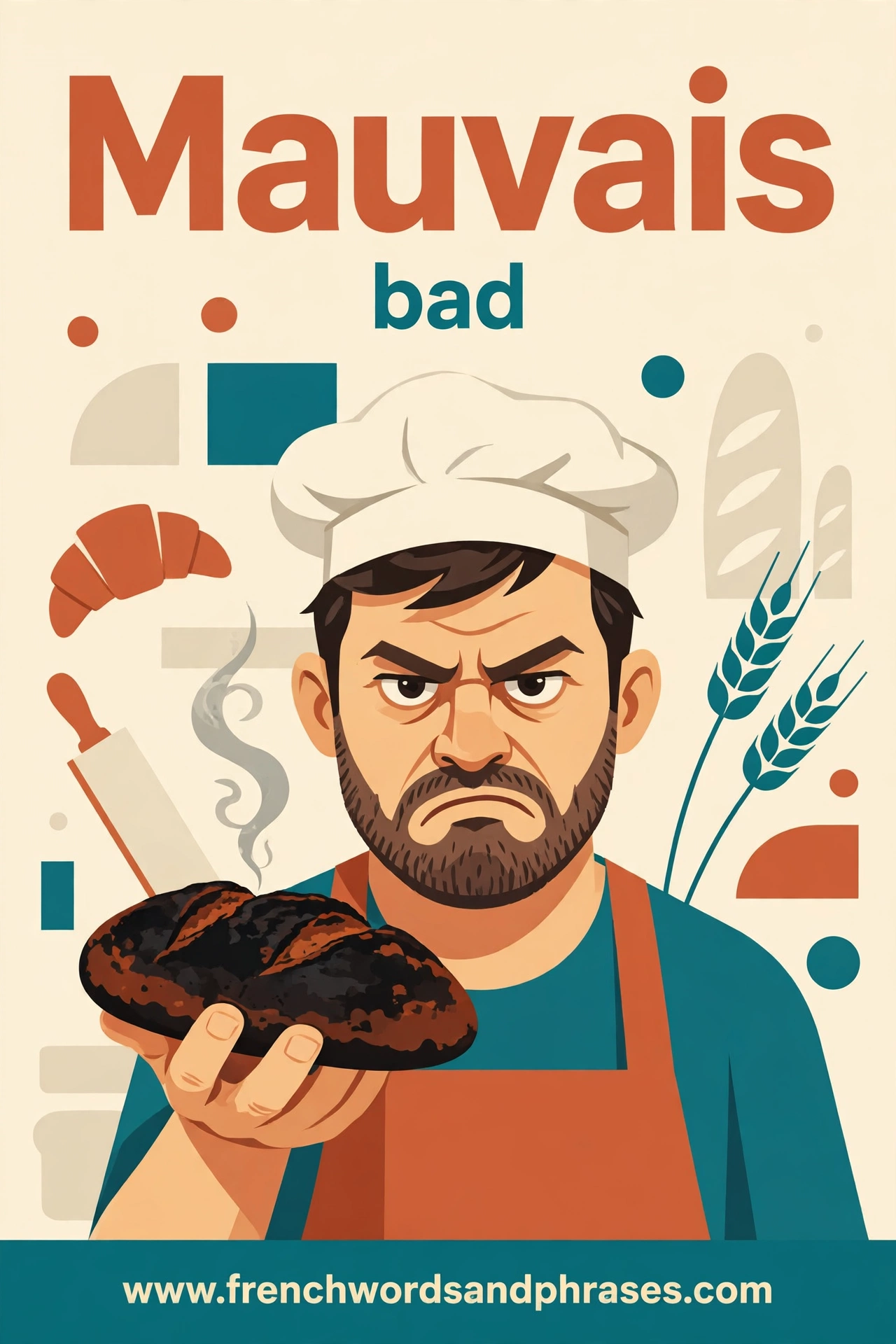
Mauvais means bad.
The market stall at closing time: the cheese has sweated in the sun, the bread is yesterday’s, and the fishmonger is quietly moving the oldest fish to the front. Some days, everything on the table tells the same small story. That story is mauvais.
In this guide, you’ll learn what mauvais means in English, its four forms, why it stands in front of the noun, and why its comparative refuses to play by the rules — plus mauvais, or the famous pire? Explore French examples, English translations, and practice quizzes.
Understanding the French Adjective Mauvais
Mauvais is a French adjective of quality — the adjective of judgement, the opposite of praise. Like every French adjective, it agrees with the noun it describes: masculine or feminine, singular or plural. Its feminine, mauvaise, is one of the most recognisable sounds in French.
It means bad — in almost every way English uses the word: un mauvais film, a bad film; un mauvais repas, a bad meal; mauvais temps, bad weather; une mauvaise nouvelle, bad news. Where bon says yes, this is good, mauvais shakes its head: no, this will not do.
Type: Adjective of quality — judgement (the opposite of bon)
Answers the question: What is it like? — bad
Changes form: Yes — mauvais, mauvaise, mauvais, mauvaises
English equivalents: Bad; poor (quality); wrong.
One important usage detail: mauvais stands BEFORE the noun, like its twin bon — un mauvais jour, a bad day. And its comparative is a law unto itself: ‘worse’ is usually pire, not plus mauvais — c’est pire, it’s worse.
Experience the Word
Mauvais is the adjective of the disappointed sigh — the film everyone said was brilliant, the restaurant with the famous name and the cold soup.
Imagine the cinema lights coming up after two long hours. Nobody says a word in the queue for the coats. Then someone shrugs, the most French shrug in the world: « mauvais. Vraiment mauvais. »
You have not just criticised a film. You have delivered the verdict of the whole evening in one word.
How to Use Mauvais in French: Complete Guide
Let’s explore how mauvais works in French, beginning with the whole word on one card.
Mauvais at a Glance
Before the details, here is the whole word on one card.
The Whole Word on One Card
Meaning, type, position and forms — mauvais in four lines.
| Point | Mauvais |
|---|---|
| Meaning | bad |
| Type | adjective of quality — judgement |
| Usual position | before the noun — un mauvais film |
| Form | mauvais / mauvaise / mauvais / mauvaises |
Example
C’était un mauvais film.
It was a bad film.
The Four Forms of Mauvais
Mauvais agrees with the noun it describes. Notice the masculine plural is spelled exactly like the singular — only the feminine grows a new ending.
| Form | Mauvais | Example |
|---|---|---|
| Masculine singular | mauvais | un mauvais repas — a bad meal |
| Feminine singular | mauvaise | une mauvaise nouvelle — a piece of bad news |
| Masculine plural | mauvais | de mauvais repas — bad meals |
| Feminine plural | mauvaises | de mauvaises nouvelles — pieces of bad news |
Example
Quelle mauvaise journée ! Tout va mal aujourd’hui.
What a bad day! Everything is going wrong today.
Quick Quiz 1
Which form of mauvais goes with nouvelle (feminine)?
Reveal the answer
mauvaise
Une mauvaise nouvelle.
A piece of bad news.
Forming the Feminine: mauvais → mauvaise
The feminine adds -e, and something lovely happens to the sound: the final s of mauvais, completely silent, wakes up and buzzes like a z in mauvaise.
| Step | Example |
|---|---|
| Masculine | mauvais — un mauvais acteur |
| Add -e | mauvaise — une mauvaise actrice |
| The s wakes up | mauvaise ends with a buzzing z sound |
| Plurals | mauvais / mauvaises — de mauvais films, de mauvaises critiques |
Example
C’est une mauvaise habitude.
It’s a bad habit.
Where Mauvais Goes: In Front of the Noun
Mauvais belongs to the small family of adjectives that lead the noun — with bon, beau, petit and grand. After être, it delivers its verdict standing behind the verb instead.
| Pattern | Example |
|---|---|
| mauvais + noun | un mauvais jour — a bad day |
| With an adverb | un très mauvais repas — a very bad meal |
| After être | le film est mauvais — the film is bad |
| After the noun | un repas mauvais — unusual; mauvais leads |
Example
Nous avons eu du mauvais temps pendant les vacances.
We had bad weather during the holidays.
Quick Quiz 2
Where does mauvais stand — before or after the noun?
Reveal the answer
Before
Un mauvais film, une mauvaise journée.
A bad film, a bad day.
Worse and Worst: Comparing with Mauvais
Mauvais owns two comparatives. Plus mauvais is the regular one, but everyday French reaches for the irregular star: pire, worse — and le pire, the worst.
| Degree | Example |
|---|---|
| As bad as | aussi mauvais que — as bad as |
| Worse (everyday) | pire — c’est pire, it’s worse |
| Worse (regular) | plus mauvais — un film plus mauvais que l’autre |
| The worst (masc.) | le pire — le pire film de l’année |
| The worst (fem.) | la pire — la pire journée de ma vie |
Example
Le deuxième film était pire que le premier.
The second film was worse than the first.
Everyday Expressions with Mauvais
Mauvais judges the weather, the news and the mood — and it hides inside one of the most useful phrases for surviving a difficult moment.
| Expression | In English |
|---|---|
| mauvais temps | bad weather |
| une mauvaise nouvelle | bad news — a piece of bad news |
| être de mauvaise humeur | to be in a bad mood |
| un mauvais élève | a bad student — one who misbehaves or struggles |
| mauvaise foi | bad faith — arguing dishonestly |
| un mauvais quart d’heure | a bad quarter of an hour — an unpleasant moment to get through |
Example
Il est de mauvaise humeur ce matin.
He is in a bad mood this morning.
Quick Quiz 3
What does être de mauvaise humeur mean?
Reveal the answer
To be in a bad mood
Ne le dérange pas, il est de mauvaise humeur.
Don’t disturb him, he’s in a bad mood.
Mauvais and Its Neighbours
French grades its disappointments finely. Mauvais is the everyday verdict; its neighbours shade the judgement from mediocre to dreadful — and bon waits at the other end.
| French | In English |
|---|---|
| bon | good — the opposite |
| médiocre | mediocre, second-rate |
| décevant | disappointing |
| nul | rubbish, useless (informal) — un film nul |
| affreux | dreadful, awful |
| terrible | terrible — but in everyday French it often means great! Watch the tone |
Example
Le repas était médiocre, presque mauvais.
The meal was mediocre, almost bad.
Watch Out: The Traps Around Mauvais
Four traps wait around this word — the comparative that changes its name, the adverb that looks like a twin, and the judgement that lands harder than you meant it to.
| Trap | The truth |
|---|---|
| pire vs plus mauvais | pire is the everyday word for ‘worse’ — reach for it first |
| mal is not mauvais | mal is an adverb (badly) or a noun (pain, evil) — il chante mal, he sings badly |
| mauvaise with people | une mauvaise personne is a strong judgement — everyday unkindness is usually méchant or pas gentil |
| mauvais goût | means bad taste in both senses — in food and in style |
Example
Il travaille mal, mais ce n’est pas un mauvais garçon.
He works badly, but he is not a bad boy.
Quick Quiz 4
How do you say ‘it’s worse’ — c’est plus mauvais or c’est pire?
Reveal the answer
c’est pire
Plus mauvais exists, but pire is the word French reaches for.
C’est pire que je pensais. — It’s worse than I thought.
Mauvais in Everyday French: Real-Life Examples
Now that you know the word, let’s see how mauvais appears in everyday French.
Example 1 — At the cinema
Quel mauvais film ! Deux heures de ma vie perdues.
What a bad film! Two hours of my life wasted.
Example 2 — The weather
Mauvais temps pour la fête du village, la pluie ne s’arrête pas.
Bad weather for the village festival, the rain won’t stop.
Example 3 — At the table
Ce fromage a un mauvais goût, ne le mange pas.
This cheese tastes bad, don’t eat it.
Example 4 — Bad news
J’ai une mauvaise nouvelle : le train de ce soir est annulé.
I have bad news: this evening’s train is cancelled.
Example 5 — At school
Il a eu une mauvaise note en histoire, il est déçu.
He got a bad mark in history, he’s disappointed.
Example 6 — A mood
Ne lui parle pas ce matin, il est de très mauvaise humeur.
Don’t talk to him this morning, he’s in a very bad mood.
Beyond Translation: The Meaning of Mauvais
English says bad for the meaning of mauvais — but mauvais carries the weather, the mood and the news on its back: mauvais temps, mauvaise humeur, mauvaise nouvelle.
To call something mauvais is to pass sentence on it — kindly or not, French judges out loud.
And at the very bottom of the scale, mauvais keeps its own dark jewel: le pire, the worst — the word French reaches for when even mauvais is not bad enough.
How to Remember the French Adjective Mauvais
Remember it this way: Mauvais is bon turned upside down — the same place in front of the noun, the same family of forms, and a comparative that answers to a different name: pire.
- You hear the feminine wake up — mauvaise, where the quiet s of mauvais starts to buzz.
- You put it in front, like bon — un mauvais jour, une mauvaise nuit.
- You refuse the regular comparative — worse is pire, the worst is le pire.
The key idea is mauvais stands before the noun, its feminine is mauvaise, and ‘worse’ is pire.
Test Your Knowledge of Mauvais
Let’s see how much you’ve learned. Try answering these questions before revealing the answers.
Question 1
What does mauvais mean?
Reveal the answer
Bad — the opposite of bon, good.
Question 2
What are the forms of mauvais?
Reveal the answer
mauvais, mauvaise, mauvais, mauvaises — the masculine plural is spelled like the singular.
Question 3
Translate: bad weather.
Reveal the answer
Mauvais temps.
Question 4
How do you say ‘it’s worse’?
Reveal the answer
C’est pire.
Question 5
Complete the sentence:
Elle est de ______ humeur ce matin.
Reveal the answer
mauvaise
Elle est de mauvaise humeur ce matin.
She is in a bad mood this morning.
Your Final Challenge
Can You Use It?
How would you say this in French?
“What bad weather! And the film was even worse than yesterday’s.”
Reveal the answer
Quel mauvais temps ! Et le film était encore pire que celui d’hier.
What bad weather! And the film was even worse than yesterday’s.
A little French. A little curiosity. A richer everyday life.
LEARN FRENCH ONE WORD AT A TIME