
A French Word to Live By
Translate Malade to English
/ma.lad/
Malade means sick.
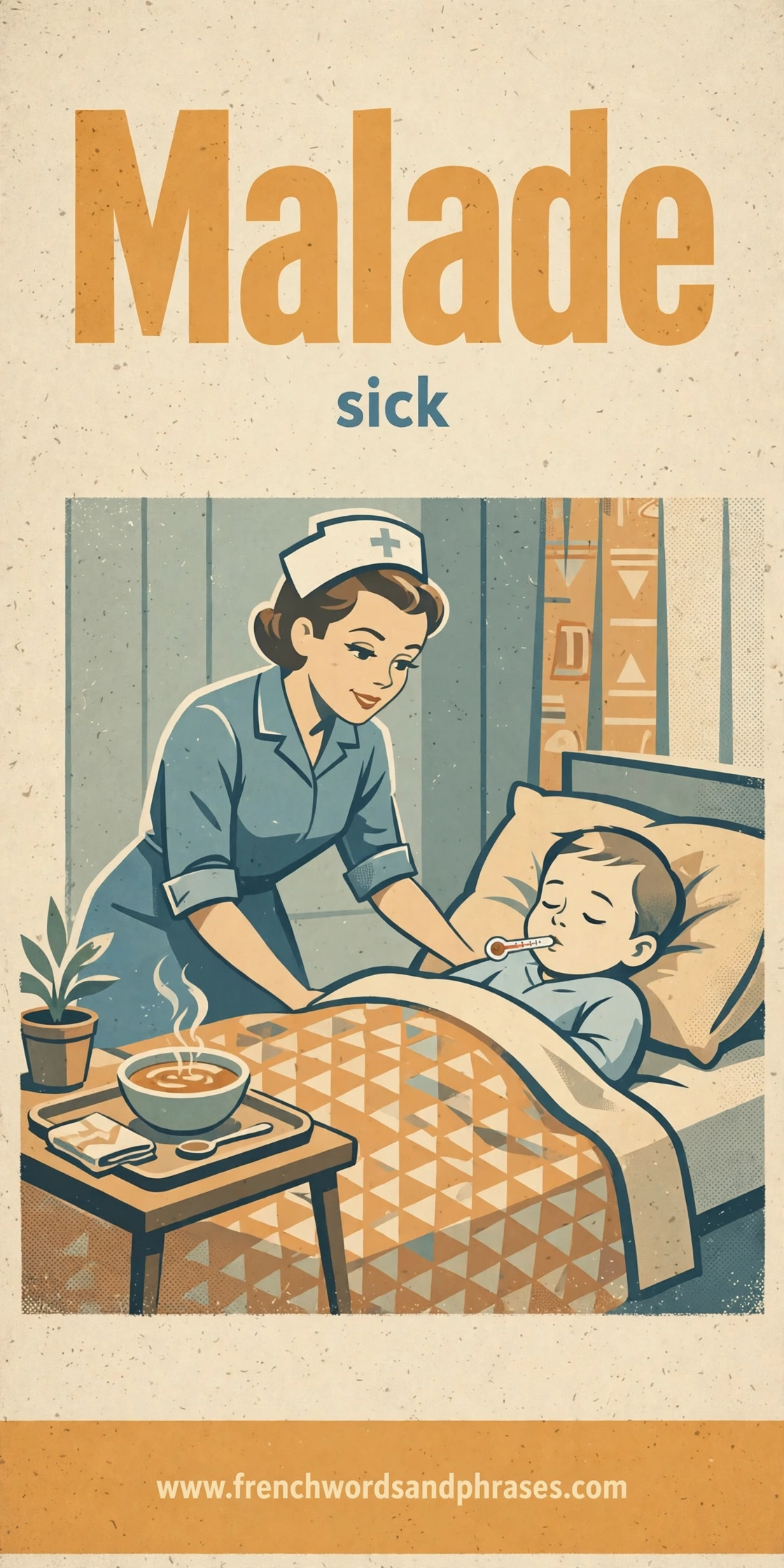
The curtains are half closed, there is soup on a tray and a thermometer on the bedside table. School can wait; the football match can wait. Aujourd’hui, on est malade — today, the whole world shrinks to one quiet room and the people who knock gently at its door.
In this guide, you’ll learn what malade means in English, why it never changes for the feminine, why it lives after être, and the essential phrase tomber malade — plus its second life as a noun, the patient. Explore French examples, English translations, and practice quizzes.
Understanding the French Adjective Malade
Malade is a French adjective of state — the adjective of health, or rather of its absence. It keeps one form for masculine and feminine alike: il est malade, elle est malade.
It means sick, ill, unwell. It describes people and animals above all: un enfant malade, un chien malade. French uses it most often after être — je suis malade — and in the key phrase tomber malade, to fall ill, which describes the moment sickness arrives.
Type: Adjective of state — health
Answers the question: How is he/she? — sick, ill
Changes form: Only for number — malade / malades; the same for masculine and feminine
English equivalents: Sick; ill; unwell.
One important usage detail: malade lives after être and after the noun — il est malade, un enfant malade — and its form never changes for the feminine. To say someone becomes ill, French uses a small drama: tomber malade, literally to fall ill — elle est tombée malade.
Experience the Word
Malade is the adjective of the paused life — of cancelled plans, quiet rooms, soup on trays and the particular kindness of people speaking softly in corridors.
Imagine a village school on a grey Monday: three desks empty, one coat still on its hook. La maîtresse regarde les places vides et dit simplement : « Ils sont malades. » Tout le monde comprend — l’hiver est arrivé dans la classe.
You have not just reported a temperature. You have explained an absence.
How to Use Malade in French: Complete Guide
Let’s explore how malade works in French, beginning with the whole word on one card.
Malade at a Glance
Before the details, here is the whole word on one card.
The Whole Word on One Card
Meaning, type, position and forms — malade in four lines.
| Point | Malade |
|---|---|
| Meaning | sick |
| Type | adjective of state — health |
| Usual position | after être, or after the noun — un enfant malade |
| Form | malade / malades — identical for masculine and feminine |
Example
Mon fils est malade, il reste au lit.
My son is sick, he’s staying in bed.
The Four Forms of Malade
Malade keeps the simplest agreement in French: one form for the singular, one for the plural, and no difference at all between masculine and feminine.
| Form | Malade | Example |
|---|---|---|
| Masculine singular | malade | un garçon malade — a sick boy |
| Feminine singular | malade | une fille malade — a sick girl |
| Masculine plural | malades | des enfants malades — sick children |
| Feminine plural | malades | des filles malades — sick girls |
Example
Les deux enfants sont malades cette semaine.
Both children are sick this week.
Quick Quiz 1
Does malade change its form for the feminine?
Reveal the answer
No
Il est malade, elle est malade.
Malade already ends in -e, so the feminine adds nothing.
The Feminine: Malade Stays Malade
Like jeune and libre, malade arrives already wearing its -e. Nothing changes between masculine and feminine — only the plural adds an -s.
| Point | Malade |
|---|---|
| Masculine | il est malade — he is sick |
| Feminine | elle est malade — she is sick, no change |
| Why | malade already ends in -e; there is nothing to add |
| Plural | malades for everyone — ils sont malades, elles sont malades |
Example
Ma sœur est malade, et son mari est malade aussi.
My sister is sick, and her husband is sick too.
Where Malade Goes: After Être, After the Noun
Malade’s home is after être — je suis malade. When it describes a noun directly, it follows that too, and with tomber it tells the story of falling ill.
| Pattern | Example |
|---|---|
| After être (its home) | Elle est malade — she is sick |
| noun + malade | un chien malade — a sick dog |
| tomber malade | il est tombé malade — he fell ill |
| Before the noun | everyday French keeps malade after |
Example
Leur vieux chien est malade depuis lundi.
Their old dog has been sick since Monday.
Quick Quiz 2
How do you say ‘to fall ill’ in French?
Reveal the answer
tomber malade
Elle est tombée malade hier.
Literally ‘to fall sick’ — French sickness arrives like a fall.
Sicker: Comparing with Malade
Malade compares the regular way, with plus, moins and aussi — comparisons no one enjoys winning.
| Degree | Example |
|---|---|
| As sick as | aussi malade que — as sick as |
| Sicker | plus malade — sicker, more ill |
| Less sick | moins malade — less ill |
| The sickest (masc.) | le plus malade — le plus malade des deux |
| The sickest (fem.) | la plus malade — la plus malade de la famille |
Example
Il est plus malade qu’hier, appelle le médecin.
He is sicker than yesterday, call the doctor.
Everyday Expressions with Malade
Malade has a dramatic streak: the French fall ill, are sick as dogs, worry themselves sick — and then, quietly, the word becomes a noun for the patient.
| Expression | In English |
|---|---|
| tomber malade | to fall ill |
| être malade comme un chien | to be as sick as a dog — very ill indeed |
| malade de + noun | sick with — malade de la grippe, ill with flu |
| malade d’inquiétude | sick with worry |
| se rendre malade | to make oneself ill (with worry) |
| un malade / une malade | a patient, a sick person — the noun |
Example
Elle s’est rendue malade d’inquiétude pour son examen.
She made herself sick with worry over her exam.
Quick Quiz 3
What does tomber malade mean?
Reveal the answer
To fall ill
Il est tombé malade pendant les vacances.
He fell ill during the holidays.
Malade and Its Neighbours
Around malade, French keeps the gentle words of the sickroom — and, at the far end, the words everyone is waiting to hear: guéri, en forme.
| French | In English |
|---|---|
| souffrant | unwell, suffering — gentle |
| indisposé | indisposed, slightly unwell — polite |
| fiévreux | feverish |
| guéri | cured, recovered — the happy opposite |
| en forme | fit, in good shape — the opposite |
| en bonne santé | in good health — the opposite |
Example
Hier il était fiévreux, aujourd’hui il est guéri.
Yesterday he was feverish, today he has recovered.
Watch Out: The Traps Around Malade
Malade’s traps: English ‘sick’ is narrower than it looks, the feminine that isn’t, and the word’s secret second career as a noun.
| Trap | The truth |
|---|---|
| English ‘sick’ | malade means ill in general; for a sick stomach, French says avoir mal au cœur |
| Agreement | no feminine change — elle est malade, exactly like il est malade |
| Malade the noun | un malade is a patient — le médecin examine le malade |
| Position | after être and after the noun — un enfant malade |
Example
Le médecin examine la malade dans la chambre deux.
The doctor is examining the patient in room two.
Quick Quiz 4
What is ‘a patient’ in French?
Reveal the answer
un malade / une malade
Le malade attend le médecin.
The same word, working as a noun: the sick person.
Malade in Everyday French: Real-Life Examples
Now that you know the word, let’s see how malade appears in everyday French.
Example 1 — At home
Je reste à la maison, ma fille est malade.
I’m staying home, my daughter is sick.
Example 2 — At school
Trois élèves sont malades, la classe est presque vide.
Three pupils are sick, the classroom is almost empty.
Example 3 — The cat
Le chat est malade, nous allons chez le vétérinaire.
The cat is sick, we’re going to the vet.
Example 4 — Calling work
Il a téléphoné au bureau : il est malade aujourd’hui.
He phoned the office: he’s sick today.
Example 5 — Getting better
Elle était malade lundi, mais elle va mieux.
She was sick on Monday, but she’s getting better.
Example 6 — Worry
Ne te rends pas malade pour cette histoire.
Don’t make yourself sick over this business.
Beyond Translation: The Meaning of Malade
English says sick for the meaning of malade — and the French word carries an old honesty inside it: from Latin male habitus, ‘in a bad state’, the same root that gives la maladie, illness itself.
To say malade is to pause the machinery of ordinary life with one word.
French treats the state with a small theatre of kindness: one falls ill (tomber malade), one is visited, one is fed soup — and the word itself doubles as the name of the person, le malade, as if the language refused to separate the illness from the human being.
How to Remember the French Adjective Malade
Remember it this way: Malade is the quiet-room word — it lives after être, never changes for the feminine, and arrives by falling: tomber malade.
- You park it after être — il est malade, elle est malade.
- You change nothing for the feminine — malade is already wearing its -e.
- You learn the little drama — tomber malade, to fall ill.
The key idea is malade lives after être, never changes for the feminine, and tomber malade means to fall ill.
Test Your Knowledge of Malade
Let’s see how much you’ve learned. Try answering these questions before revealing the answers.
Question 1
What does malade mean?
Reveal the answer
Sick — ill, unwell.
Question 2
What is the feminine form of malade?
Reveal the answer
malade — exactly the same; it already ends in -e.
Question 3
Translate: She is sick.
Reveal the answer
Elle est malade.
Question 4
What does tomber malade mean?
Reveal the answer
To fall ill — to become sick.
Question 5
Complete the sentence:
Les enfants sont ______ cette semaine. (sick)
Reveal the answer
malades
Les enfants sont malades cette semaine.
The children are sick this week.
Your Final Challenge
Can You Use It?
How would you say this in French?
“My son was sick, but today he is better.”
Reveal the answer
Mon fils était malade, mais aujourd’hui il va mieux.
My son was sick, but today he is better.
A little French. A little curiosity. A richer everyday life.
LEARN FRENCH ONE WORD AT A TIME




