A French Word to Live By
Translate Libre to English
/libʁ/
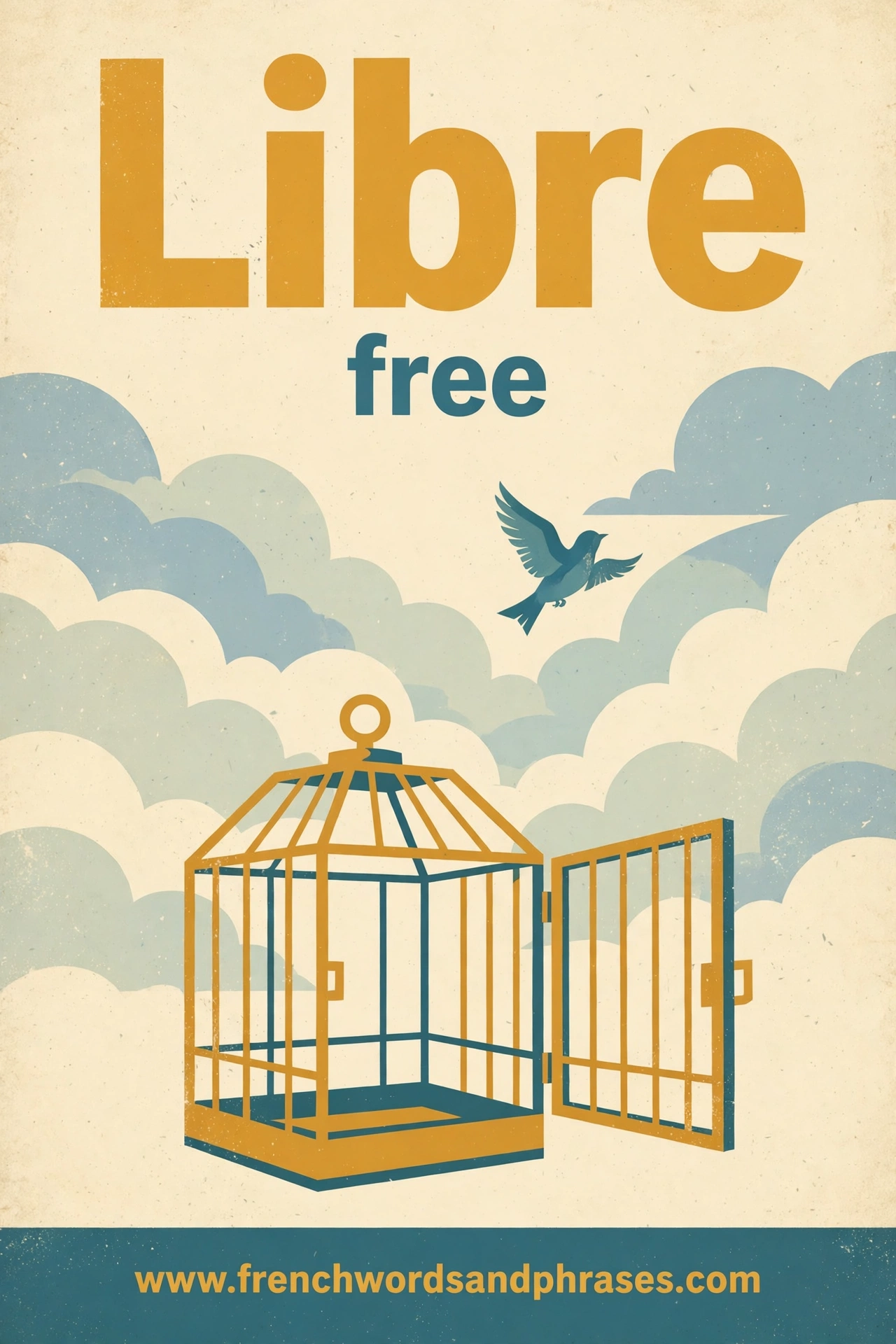
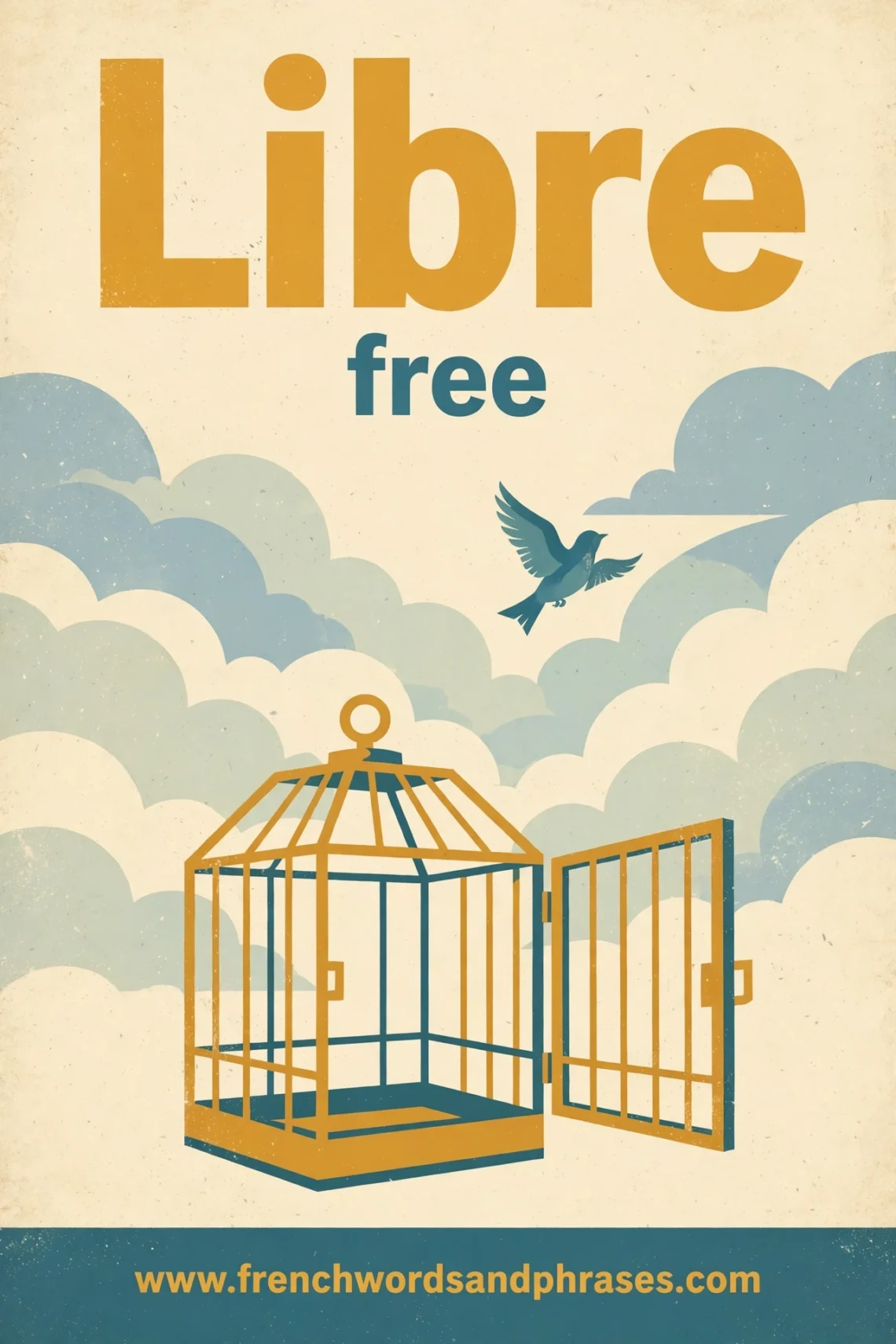
Libre means free.
The café terrace is full except for one small table in the sun, and the waiter nods towards it with a smile: « cette table est libre ». A free table, a free afternoon, a free mind — libre is the word of open doors and unclaimed hours.
In this guide, you’ll learn what libre means in English, why it never changes for the feminine, why it stands after the noun, and the essential difference between libre and gratuit — two words English squeezes into one. Explore French examples, English translations, and practice quizzes.
Understanding the French Adjective Libre
Libre is a French adjective of quality — the adjective of freedom and availability. It keeps one form for masculine and feminine alike: un après-midi libre, une soirée libre.
It means free — in two of the word’s English senses: not occupied, available (une table libre, une place libre, un week-end libre), and at liberty, not controlled or imprisoned (un homme libre, un pays libre). What it never means is free of charge: for that, French has a different word — gratuit.
Type: Adjective of quality — freedom, availability
Answers the question: What is it like? — free, available
Changes form: Only for number — libre / libres; the same for masculine and feminine
English equivalents: Free; available; unoccupied.
One important usage detail: libre stands AFTER the noun — une place libre, un moment libre. And learn the golden pair at once: libre means available or at liberty, while gratuit means costing nothing — un billet gratuit is a free ticket, une place libre is a free seat.
Experience the Word
Libre is the adjective of the empty chair, the open road and the afternoon with nothing in it — the word that says: this space, this hour, this life is unclaimed.
Imagine a Friday evening in early summer: the diary page is blank, the window is open, and the whole weekend is standing in the doorway like a friend with no plans. On est libre. Tout est possible.
You have not just described a schedule. You have described a possibility.
How to Use Libre in French: Complete Guide
Let’s explore how libre works in French, beginning with the whole word on one card.
Libre at a Glance
Before the details, here is the whole word on one card.
The Whole Word on One Card
Meaning, type, position and forms — libre in four lines.
| Point | Libre |
|---|---|
| Meaning | free / available |
| Type | adjective of quality — freedom |
| Usual position | after the noun — une table libre |
| Form | libre / libres — identical for masculine and feminine |
Example
Cette place est libre ?
Is this seat free?
The Four Forms of Libre
The easiest agreement table since jeune: libre has two shapes, singular and plural, and they serve masculine and feminine alike.
| Form | Libre | Example |
|---|---|---|
| Masculine singular | libre | un après-midi libre — a free afternoon |
| Feminine singular | libre | une soirée libre — a free evening |
| Masculine plural | libres | des moments libres — free moments |
| Feminine plural | libres | des tables libres — free tables |
Example
Il reste deux tables libres sur la terrasse.
There are two free tables left on the terrace.
Quick Quiz 1
Does libre change its form for the feminine?
Reveal the answer
No
Un homme libre, une femme libre.
Libre already ends in -e, so the feminine adds nothing.
The Feminine: Libre Stays Libre
Like jeune and malade, libre arrives already wearing its -e. Masculine and feminine are spelled and pronounced exactly the same — only the plural adds an -s.
| Point | Libre |
|---|---|
| Masculine | un homme libre — a free man |
| Feminine | une femme libre — a free woman, no change |
| Why | libre already ends in -e; there is nothing to add |
| Plural | libres for everyone — des places libres, des pays libres |
Example
Une femme libre et un homme libre se rencontrent à Paris.
A free woman and a free man meet in Paris.
Where Libre Goes: After the Noun
Libre follows the noun it describes — and after être it becomes the most useful question and answer of French daily life: je suis libre, I am free.
| Pattern | Example |
|---|---|
| noun + libre | une chambre libre — a free room |
| After être | Je suis libre demain — I’m free tomorrow |
| libre de + infinitive | libre de partir — free to leave |
| Before the noun | everyday French keeps libre after the noun |
Example
Vous êtes libre de partir quand vous voulez.
You are free to leave whenever you like.
Quick Quiz 2
Where does libre stand — before or after the noun?
Reveal the answer
After
Une place libre, un moment libre.
A free seat, a free moment.
Freer: Comparing with Libre
Libre compares the regular way, with plus, moins and aussi — freedom, in grammar as in life, comes in degrees.
| Degree | Example |
|---|---|
| As free as | aussi libre que — as free as |
| Freer | plus libre — freer, more free |
| Less free | moins libre — less free |
| The freest (masc.) | le plus libre — le plus libre des deux |
| The freest (fem.) | la plus libre — la plus libre de toutes |
Example
Les enfants sont plus libres pendant les vacances.
Children are freer during the holidays.
Everyday Expressions with Libre
Libre runs from the café terrace to the national motto — free time, free verse, freewheeling bicycles, and the loveliest simile in French.
| Expression | In English |
|---|---|
| le temps libre | free time, spare time |
| l’entrée libre | free entry — come in as you please |
| un vers libre | free verse (poetry) |
| en roue libre | freewheeling, coasting |
| libre comme l’air | free as a bird — literally, free as the air |
| laisser le champ libre | to leave the field free, to give someone a free hand |
Example
Pendant mon temps libre, je joue de la guitare.
In my free time, I play the guitar.
Quick Quiz 3
What does le temps libre mean?
Reveal the answer
Free time
Pendant mon temps libre, je lis.
In my free time, I read.
Libre and Its Neighbours
Around libre stand the words of doors open and doors shut — disponible for diaries, gratuit for prices, and occupé waiting opposite.
| French | In English |
|---|---|
| disponible | available — for people and appointments |
| gratuit | free of charge — the money sense |
| ouvert | open |
| indépendant | independent |
| occupé | busy, occupied — the opposite |
| pris | taken, busy — the opposite for seats and people |
Example
La place n’est pas libre, elle est déjà prise.
The seat isn’t free, it’s already taken.
Watch Out: Libre or Gratuit?
Here is the trap of the page — English ‘free’ does two jobs, and French gives each job its own word. Mixing them up is the classic learner’s error.
| Idea | The right word |
|---|---|
| A free seat or table | libre — une table libre |
| A free ticket or sample | gratuit — un billet gratuit, un échantillon gratuit |
| A free person or country | libre — un pays libre |
| The classic mistake | ‘un café libre’ for a coffee that costs nothing — say un café gratuit |
Example
Le musée est gratuit le dimanche, mais il reste peu de places libres.
The museum is free on Sundays, but few seats are left free.
Quick Quiz 4
‘A free ticket’ — one that costs nothing. Libre or gratuit?
Reveal the answer
gratuit
Un billet gratuit.
Gratuit is free of charge; libre is free and available.
Libre in Everyday French: Real-Life Examples
Now that you know the word, let’s see how libre appears in everyday French.
Example 1 — At the café
Excusez-moi, cette chaise est libre ?
Excuse me, is this chair free?
Example 2 — Making plans
Je suis libre jeudi après-midi, on peut se voir.
I’m free on Thursday afternoon, we can meet.
Example 3 — At the hotel
Il nous reste une chambre libre avec vue sur la mer.
We have one free room left with a sea view.
Example 4 — On the train
Les places libres sont près de la fenêtre.
The free seats are near the window.
Example 5 — At work
Après la réunion, vous êtes libres de partir.
After the meeting, you are free to leave.
Example 6 — Big ideas
C’est un pays libre, chacun peut donner son avis.
It’s a free country, everyone can give their opinion.
Beyond Translation: The Meaning of Libre
English says free for the meaning of libre — but the French word carries a flag inside it: liberté is the first word of the Republic’s motto, Liberté, Égalité, Fraternité, written over every town hall in France.
To say libre is to touch the most serious word in French — even when all you mean is a chair on a terrace.
Perhaps that is why the language guards the boundary with gratuit so carefully: freedom is one thing, and a free sample is quite another.
How to Remember the French Adjective Libre
Remember it this way: Libre is the open-door word — it stands after the noun, never changes for the feminine, and leaves the money sense to gratuit.
- You put it after the noun — une place libre, un moment libre.
- You change nothing for the feminine — libre is already wearing its -e.
- You split English ‘free’ in two — libre for available, gratuit for no charge.
The key idea is libre stands after the noun, never changes for the feminine, and means available or at liberty — for free of charge, say gratuit.
Test Your Knowledge of Libre
Let’s see how much you’ve learned. Try answering these questions before revealing the answers.
Question 1
What are the two meanings of libre?
Reveal the answer
Free and available (une place libre) — and at liberty (un homme libre). Never ‘free of charge’.
Question 2
What is the feminine form of libre?
Reveal the answer
libre — exactly the same; it already ends in -e.
Question 3
Translate: a free table.
Reveal the answer
Une table libre.
Question 4
A ticket that costs nothing — libre or gratuit?
Reveal the answer
gratuit
Un billet gratuit. Libre means the seat is available, not that it is unpaid for.
Question 5
Complete the sentence:
Je suis ______ demain, on peut se voir. (free)
Reveal the answer
libre
Je suis libre demain, on peut se voir.
I’m free tomorrow, we can meet.
Your Final Challenge
Can You Use It?
How would you say this in French?
“Is this seat free? The museum is free today.”
Reveal the answer
Cette place est libre ? Le musée est gratuit aujourd’hui.
Is this seat free? The museum is free today.
A little French. A little curiosity. A richer everyday life.
LEARN FRENCH ONE WORD AT A TIME