A French Word to Live By
Translate Long to English
/lɔ̃/
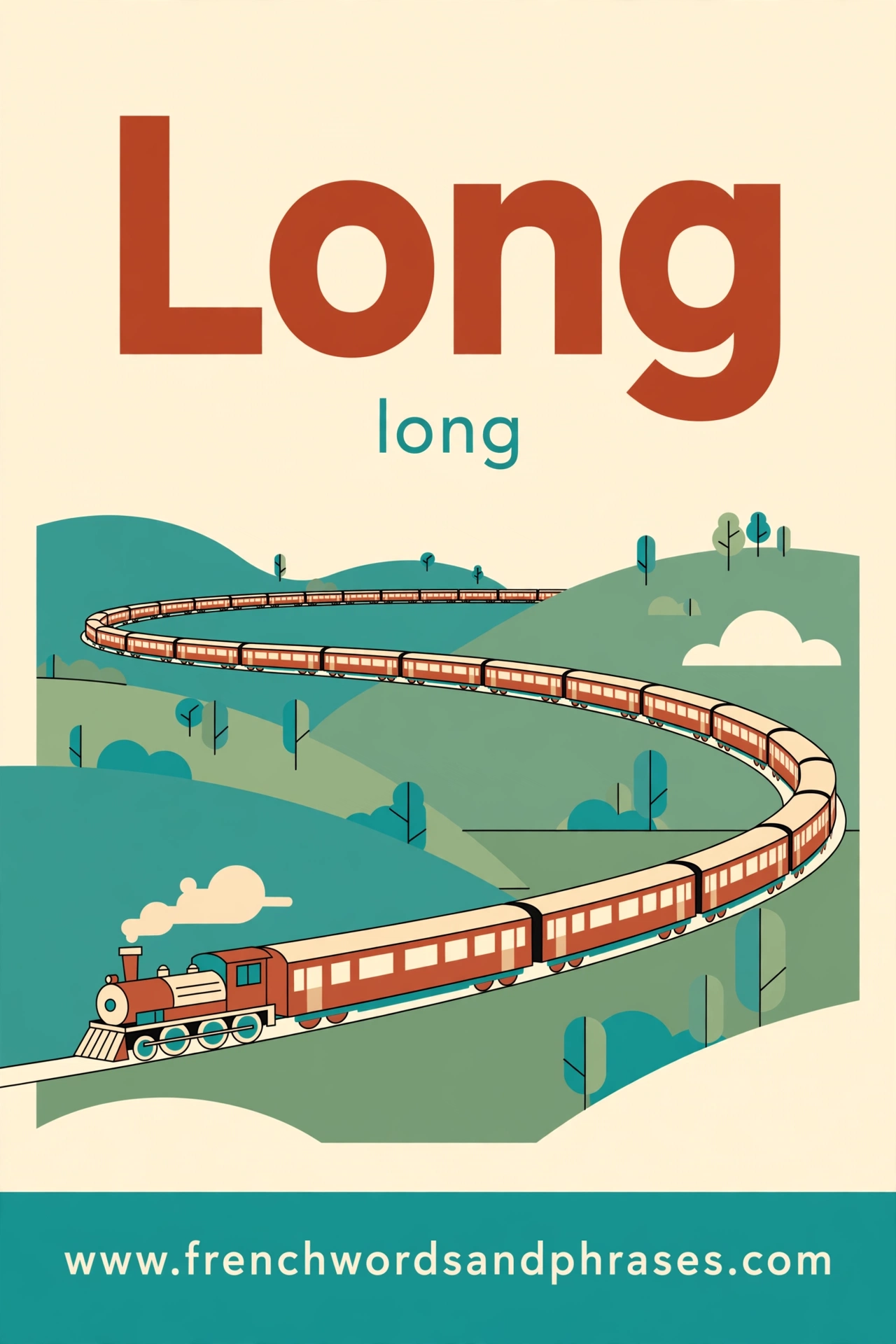
Long means long.
The road leaves the village and does not turn for miles: wheat on both sides, a single line of poplars, and the whole afternoon ahead of it. Some things refuse to be short — a river, a letter, a summer day. En français, elles sont longues.
In this guide, you’ll learn what long means in English, how its feminine longue transforms the word completely, why it stands before the noun, and how it differs from its adverb cousin longtemps. Explore French examples, English translations, and practice quizzes.
Understanding the French Adjective Long
Long is a French adjective of quality — the adjective of length, in space and in time. It agrees with the noun it describes: un long voyage, une longue journée — and its two main forms barely resemble each other.
It means long — stretching far in space or lasting far in time: un long fleuve, une longue lettre, un long silence. Unusually, long stands BEFORE the noun, and its feminine, longue, looks and sounds like a different word altogether: the g wakes up and speaks.
Type: Adjective of quality — length, duration
Answers the question: What is it like? — long
Changes form: Yes — long, longue, longs, longues
English equivalents: Long.
One important usage detail: long stands BEFORE the noun — un long voyage, une longue histoire. And watch the feminine closely: long becomes longue, written with -ue and pronounced with a hard g — the sleeping g of the masculine wakes up.
Experience the Word
Long is the adjective of the horizon — of roads that outlast the afternoon, rivers that cross a whole country, and letters that take four pages to say one thing properly.
Imagine a train window in late summer: fields, then a river keeping pace beside the line, then fields again, gold to the edge of the sky. Le voyage est long, et personne ne regarde sa montre. C’est exactement pour ça qu’on est monté dans ce train.
You have not just measured a distance. You have given a thing room to unfold.
How to Use Long in French: Complete Guide
Let’s explore how long works in French, beginning with the whole word on one card.
Long at a Glance
Before the details, here is the whole word on one card.
The Whole Word on One Card
Meaning, type, position and forms — long in four lines.
| Point | Long |
|---|---|
| Meaning | long |
| Type | adjective of quality — length and time |
| Usual position | before the noun — un long voyage |
| Form | long / longue / longs / longues |
Example
C’est un long voyage, prends un livre.
It’s a long journey, take a book.
The Four Forms of Long
Long agrees with the noun it describes: masculine or feminine, singular or plural. The feminine is the dramatic one — longue, with the g fully awake.
| Form | Long | Example |
|---|---|---|
| Masculine singular | long | un long chemin — a long road |
| Feminine singular | longue | une longue route — a long road, a long way |
| Masculine plural | longs | de longs voyages — long journeys |
| Feminine plural | longues | de longues journées — long days |
Example
Après de longues journées de marche, ils arrivent au village.
After long days of walking, they reach the village.
Quick Quiz 1
What is the feminine form of long?
Reveal the answer
longue
Une longue journée.
A long day — with the g pronounced.
Forming the Feminine: Longue
Long is one of the great shape-shifters: to make the feminine, French adds -ue, and the silent g of the masculine steps forward and speaks. Long → longue is a pair to learn by heart.
| Point | Long |
|---|---|
| The change | long → longue — add -ue, not just -e |
| The sound | the g is silent in long, pronounced hard in longue |
| Masculine plural | longs — add -s |
| Feminine plural | longues — add -s |
Example
Elle a écrit une longue lettre à son amie.
She wrote a long letter to her friend.
Where Long Goes: Before the Noun
Long belongs to the small group of everyday adjectives that lead the noun — un long silence, une longue attente. After être, of course, it simply describes: le voyage est long.
| Pattern | Example |
|---|---|
| long + noun | un long fleuve — a long river |
| With très | une très longue journée — a very long day |
| After être | Le voyage est long — the journey is long |
| After the noun | everyday French puts long in front when it describes the noun directly |
Example
Nous avons fait un long voyage en train.
We made a long train journey.
Quick Quiz 2
Where does long stand — before or after the noun?
Reveal the answer
Before
Un long voyage, une longue histoire.
A long journey, a long story.
Longer: Comparing with Long
Long compares the regular way, with plus, moins and aussi — and its superlative settles a famous French geography question.
| Degree | Example |
|---|---|
| As long as | aussi long que — as long as |
| Longer | plus long — longer |
| Less long | moins long — shorter, less long |
| The longest (masc.) | le plus long — le plus long fleuve de France |
| The longest (fem.) | la plus longue — la plus longue journée de l’année |
Example
La Loire est le plus long fleuve de France.
The Loire is the longest river in France.
Everyday Expressions with Long
Long stretches through French daily life — along rivers, across long weekends, and into friendships of long standing.
| Expression | In English |
|---|---|
| le long de | along — le long de la rivière, along the river |
| un ami de longue date | a long-standing friend |
| à long terme | in the long term |
| à la longue | in the long run |
| un long week-end | a long weekend |
| en long et en large | in detail, at length |
Example
Ils se promènent le long de la rivière.
They walk along the river.
Quick Quiz 3
What does le long de la mer mean?
Reveal the answer
Along the sea
Une promenade le long de la mer.
A walk along the sea.
Long and Its Neighbours
Around long, French keeps the words of stretching and shrinking — from interminable at one end to bref, the shortest of words, at the other.
| French | In English |
|---|---|
| interminable | endless, interminable — stronger |
| étendu | extensive, spread out |
| prolongé | extended, prolonged |
| éternel | eternal — the extreme |
| court | short — the everyday opposite |
| bref | brief — the opposite, and proud of it |
Example
Le discours est bref, mais la journée sera longue.
The speech is brief, but the day will be long.
Watch Out: The Traps Around Long
Long’s traps live in its feminine and in its adverb twin: longue must be spelled whole, and ‘for a long time’ is a different word entirely.
| Trap | The truth |
|---|---|
| The feminine | longue, with -ue — never shorten it to ‘longe’ |
| The g | silent in long, fully pronounced in longue — listen for it |
| Position | before the noun — un long silence |
| Long or longtemps | long is the adjective; longtemps is the adverb ‘for a long time’ — il a attendu longtemps |
Example
Elle a attendu longtemps avant le long voyage.
She waited a long time before the long journey.
Quick Quiz 4
‘For a long time’ — do you say long or longtemps?
Reveal the answer
longtemps
Il a attendu longtemps.
Longtemps is the adverb; long is the adjective.
Long in Everyday French: Real-Life Examples
Now that you know the word, let’s see how long appears in everyday French.
Example 1 — Travel
Un long voyage commence demain à l’aube.
A long journey begins tomorrow at dawn.
Example 2 — Reading
J’ai lu une longue lettre de mon grand-père.
I read a long letter from my grandfather.
Example 3 — A film
Le film est long, mais magnifique.
The film is long, but magnificent.
Example 4 — At work
Après une longue réunion, tout le monde est fatigué.
After a long meeting, everyone is tired.
Example 5 — Nature
Une longue plage de sable borde le village.
A long sandy beach runs alongside the village.
Example 6 — A queue
Il y a une longue file devant la boulangerie.
There’s a long queue in front of the bakery.
Beyond Translation: The Meaning of Long
English says long for the meaning of long — the two words are cousins from the same old root, and French keeps the family wide: la longueur for length itself, longtemps for the adverb, and the gentle geography of le long de, along.
To call something long in French is to refuse to hurry it.
A long letter is written properly. A long journey is taken slowly. Un ami de longue date — a friend of long standing — is the greatest compliment the word can pay: time, survived together.
How to Remember the French Adjective Long
Remember it this way: Long is the shape-shifter — it stands before the noun, and its feminine longue is a whole new word with the g wide awake.
- You put it first — un long voyage, une longue journée.
- You learn the pair by heart — long → longue, with the g awake.
- You keep the twin separate — longtemps means for a long time.
The key idea is long stands before the noun, its feminine longue wakes up the g, and longtemps is the adverb cousin.
Test Your Knowledge of Long
Let’s see how much you’ve learned. Try answering these questions before revealing the answers.
Question 1
What does long mean?
Reveal the answer
Long — stretching far in space or in time.
Question 2
What is the feminine form of long?
Reveal the answer
longue — add -ue, and the g is pronounced.
Question 3
Translate: a long journey.
Reveal the answer
Un long voyage.
Question 4
How do you say ‘for a long time’ in French?
Reveal the answer
longtemps — the adverb. Long is the adjective.
Question 5
Complete the sentence:
Une ______ journée de marche nous attend. (long)
Reveal the answer
longue
Une longue journée de marche nous attend.
A long day of walking awaits us.
Your Final Challenge
Can You Use It?
How would you say this in French?
“It is a long journey along the river.”
Reveal the answer
C’est un long voyage le long de la rivière.
It is a long journey along the river.
A little French. A little curiosity. A richer everyday life.
LEARN FRENCH ONE WORD AT A TIME