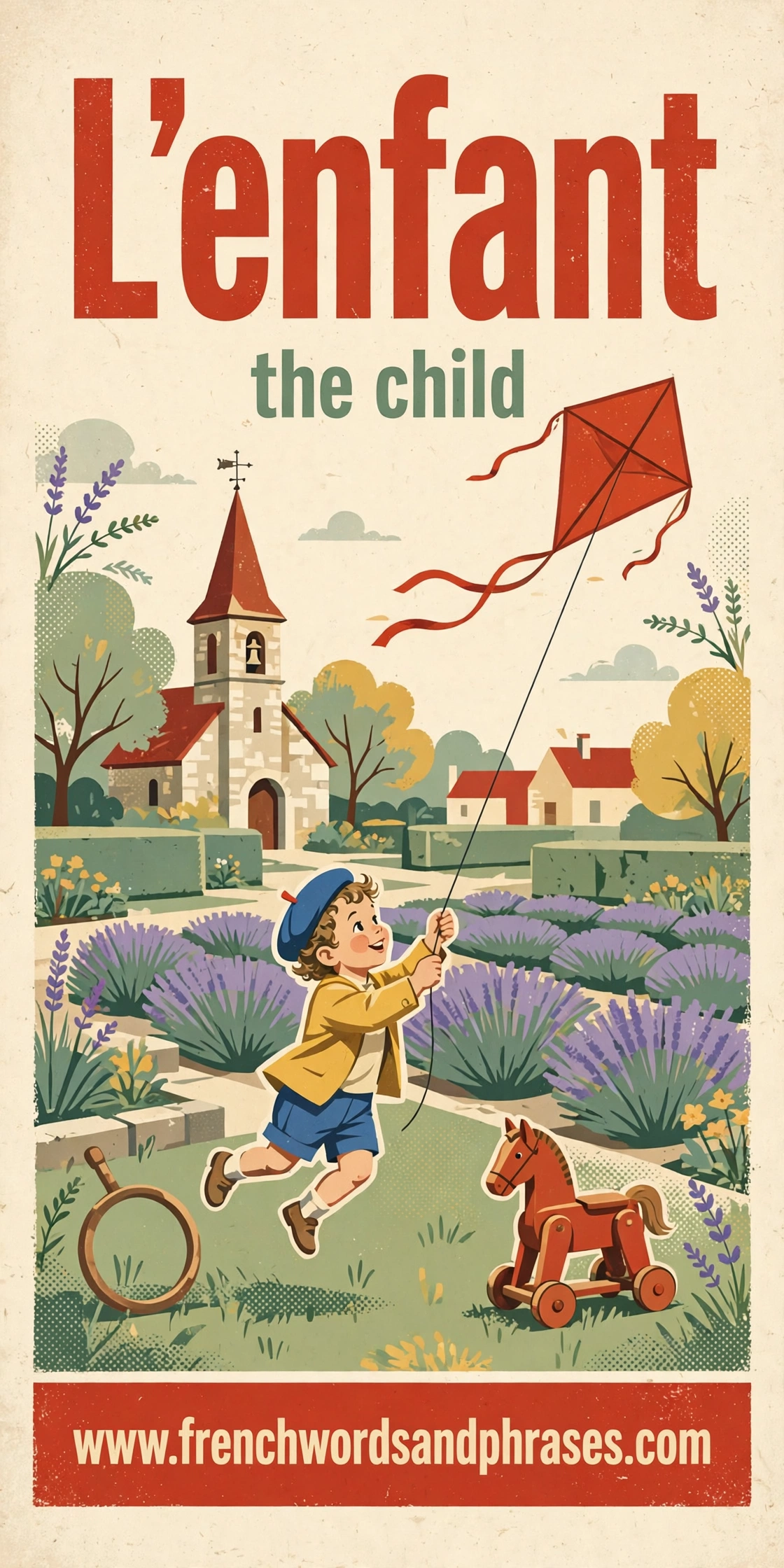
A French Word to Live By
Translate Enfant to English
/ɑ̃.fɑ̃/
Un enfant means a child.
The school gate opens at half past four and they pour out in a bright, noisy river — satchels bouncing, stories tumbling over each other, every one of them someone’s enfant.
In this guide, you’ll learn what enfant means in English, how to use it with its articles, how to form its plural, and how it appears in everyday French. Explore French examples, English translations, and practice quizzes.
Understanding the French Noun Enfant
Enfant is a French noun that can be masculine or feminine. It is learned with its article: l’enfant — an article that hides the gender, because enfant begins with a vowel.
It means a child. It covers everything from a small child to a young teenager, and it is also the word sons and daughters keep for life: a mother of sixty still calls her forty-year-old son mon enfant. With un it is a boy, with une a girl — the article, not the word, tells you which.
Gender: Masculine — un enfant (a boy); also feminine — une enfant (a girl)
Definite article: l’ — l’enfant (the child); les enfants (the children)
Indefinite article: un / une — un enfant, une enfant (a child)
Plural: les enfants (the children)
English equivalents: A child; a kid.
One important detail: because enfant begins with a vowel, the definite article is always l’ in the singular — l’enfant — whether the child is a boy or a girl. Only un or une reveals the gender: un enfant is a boy, une enfant is a girl.
Experience the Word
Enfant is more than a small person. It is the centre of the French family: Sunday lunches that stretch all afternoon, grandparents at the end of the table, and a child’s chair pulled close long after the child has grown.
Imagine the playground at break time: a hundred voices, a football, three arguments and a hundred friendships, all beginning again every twenty minutes.
You have not just described someone young. You have named the person somebody waits for at the gate.
How to Use Enfant in French: Complete Guide
Let’s explore how enfant works in French, beginning with its articles.
Enfant and Its Articles
French nouns are almost never used alone. The small word in front of the noun — the article — does a great deal of work.
Enfant with the Definite Article (L’, Les)
Used for a particular child both speakers know about, or for children in general.
| Number | French |
|---|---|
| Singular | l’enfant |
| Plural | les enfants |
Example
L’enfant joue dans le jardin.
The child is playing in the garden.
Enfant with the Indefinite Article (Un, Une — Des)
Used when the child is mentioned for the first time — and it is here that you learn whether it is a boy or a girl.
| Number | French |
|---|---|
| Singular (a boy) | un enfant |
| Singular (a girl) | une enfant |
| Plural | des enfants |
Example
Un enfant pose une question.
A child asks a question.
Enfant after Quantities (Beaucoup d’, Pas d’)
After words of quantity — beaucoup, peu, trop, combien — and after a negative, French uses de, which becomes d’ before enfant.
| Meaning | French |
|---|---|
| lots of children | beaucoup d’enfants |
| few children | peu d’enfants |
| too many children | trop d’enfants |
| no children / not a child | pas d’enfant |
| how many children | combien d’enfants |
Example
Ils ont beaucoup d’enfants.
They have lots of children.
Quick Quiz 1
Complete the sentence:
______ enfant pose une question. (a boy)
Reveal the answer
Un
Un enfant pose une question.
A boy asks a question.
The Plural of Enfant
Enfant adds a simple -s in the plural — a letter you see but do not hear, so les enfants sounds almost the same as l’enfant.
| Number | French |
|---|---|
| Singular | l’enfant |
| Plural | les enfants |
Example
Les enfants jouent dans le jardin.
The children are playing in the garden.
Enfant with Possessive Adjectives (Mon, Ton, Son…)
Possessives agree with the noun. Before a vowel, French uses mon, ton, son for everyone — mon enfant can mean my son or my daughter.
| Owner | French |
|---|---|
| my | mon enfant |
| your (tu) | ton enfant |
| his / her | son enfant |
| our | notre enfant |
| your (vous) | votre enfant |
| their | leur enfant |
Example
Mon enfant va à l’école à pied.
My child walks to school.
Quick Quiz 2
Complete the sentence:
Les ______ jouent dans la cour. (children)
Reveal the answer
enfants
Les enfants jouent dans la cour.
The children are playing in the yard.
Enfant with Demonstrative Adjectives (Cet, Ces)
Used to point: this child here. Before a vowel, ce becomes cet.
| Number | French |
|---|---|
| Singular | cet enfant |
| Plural | ces enfants |
Example
Cet enfant lit très bien.
This child reads very well.
Enfant with Adjectives
A few favourite adjectives come before enfant — petit, jeune — and most others follow it, agreeing with the child they describe.
| Adjective | With Enfant |
|---|---|
| petit (small) | un petit enfant |
| jeune (young) | un jeune enfant |
| sage (well-behaved) | un enfant sage |
| curieux (curious) | un enfant curieux |
| heureux (happy) | un enfant heureux |
| intelligent (intelligent) | un enfant intelligent |
Example
C’est un enfant sage et curieux.
He is a well-behaved, curious child.
Quick Quiz 3
Where does the adjective petit go?
a ______ enfant (a small child)
Reveal the answer
un petit enfant
Petit comes before the noun: un petit enfant.
A small child.
Everyday Expressions with Enfant
Enfant appears in expressions about family, expectation and things that are delightfully easy.
| Expression | In English |
|---|---|
| un enfant unique | an only child |
| attendre un enfant | to be expecting a baby |
| un enfant gâté | a spoiled child |
| un enfant de cinq ans | a five-year-old child |
| un jeu d’enfant | child’s play (something very easy) |
| faire l’enfant | to behave like a child |
Example
Attendre un enfant change une vie.
Expecting a baby changes a life.
Words from the Same Family as Enfant
Learn these together and the whole world of childhood falls into place.
| French | In English |
|---|---|
| l’enfance (f) | childhood |
| enfantin | childish / childlike |
| un bébé | a baby |
| un adolescent / une adolescente | a teenager |
| un garçon | a boy |
| une fille | a girl |
Example
Son enfance à la campagne était heureuse.
His childhood in the countryside was happy.
Quick Quiz 4
What does un jeu d’enfant mean?
Reveal the answer
Child’s play — something very easy
Pour lui, ce travail est un jeu d’enfant.
For him, this job is child’s play.
Enfant in Everyday French: Real-Life Examples
Now that you know the word, let’s see how enfant appears in everyday French.
Example 1 — Talking about the children
Mes enfants ont six et huit ans.
My children are six and eight years old.
Example 2 — At the school gate
Les enfants sortent de l’école à quatre heures.
The children come out of school at four o’clock.
Example 3 — At the park
Un enfant joue au ballon avec son chien.
A child is playing ball with his dog.
Example 4 — Talking about a baby
Ils attendent un enfant pour le mois de mai.
They are expecting a baby in May.
Example 5 — A question of age
C’est un enfant de cinq ans.
He is a five-year-old child.
Example 6 — An expression in real life
Pour elle, conduire est un jeu d’enfant.
For her, driving is child’s play.
Beyond Translation: The Meaning of Enfant
English says child for the meaning of enfant — but the French word stretches further. It never quite lets go: parents keep it for their grown children all their lives, and a whole village can call its sons and daughters les enfants du pays, the children of the place.
To say enfant is to name a bond, not just an age.
It evokes the school gate at four o’clock, the extra chair at Sunday lunch, and the photograph kept in a wallet for forty years.
How to Remember the French Noun Enfant
Remember it this way: Enfant is the child, l’enfant, with les enfants in the plural and un or une to tell you boy or girl.
- You wait at the school gate — tu attends ton enfant.
- You count heads at bedtime — un, deux, tous mes enfants sont là.
- You hear a baby is coming — ils attendent un enfant.
The key idea is l’enfant for the child, les enfants for the children.
Test Your Knowledge of Enfant
Let’s see how much you’ve learned. Try answering these questions before revealing the answers.
Question 1
Is enfant always masculine?
Reveal the answer
No — un enfant is a boy, une enfant is a girl.
Question 2
How do you say the children in French?
Reveal the answer
Les enfants.
Question 3
Translate: The children are playing in the yard.
Reveal the answer
Les enfants jouent dans la cour.
Question 4
What does attendre un enfant mean?
Reveal the answer
To be expecting a baby.
Question 5
Complete the sentence:
______ enfant lit très bien. (this child, a boy)
Reveal the answer
Cet
Cet enfant lit très bien.
This child reads very well.
Your Final Challenge
Can You Use It?
How would you say this in French?
“The children are playing in the garden.”
Reveal the answer
Les enfants jouent dans le jardin.
The children are playing in the garden.
A little French. A little curiosity. A richer everyday life.
LEARN FRENCH ONE WORD AT A TIME